
AI agents for business work best when you decide the autonomy level before the use case: read-only first, drafting second, acting only behind an approval gate. The deciding factor is whether a wrong action is reversible, detectable, contained and provable.
That ordering is the opposite of how most guides on this topic are written, and it is our position here. The standard advice is to pick a repetitive, high-volume workflow and argue about controls afterwards. We think controls come first, because two workflows of identical difficulty can deserve opposite amounts of autonomy, and because the failures that kill agent programmes are almost never capability failures. In February 2026 a Hacker News user posting as marvin_nora asked the question plainly: "What breaks when you run AI agents unsupervised?" The first reply to name specifics, from lyaocean, ran to seven words: "Permissions, rollback, and cost caps break first." Nobody in that thread said the model wasn't smart enough.
The short answer: Score a candidate workflow on four questions (can you undo the action, would you notice if it went wrong, what can the agent reach while it works, and can you reconstruct why it acted) and the lowest-scoring answer sets the highest autonomy you are allowed to grant; on the worked assumptions below, a triage-and-draft agent needs roughly 580 tickets a month before it pays for itself.
Last updated: July 30, 2026.
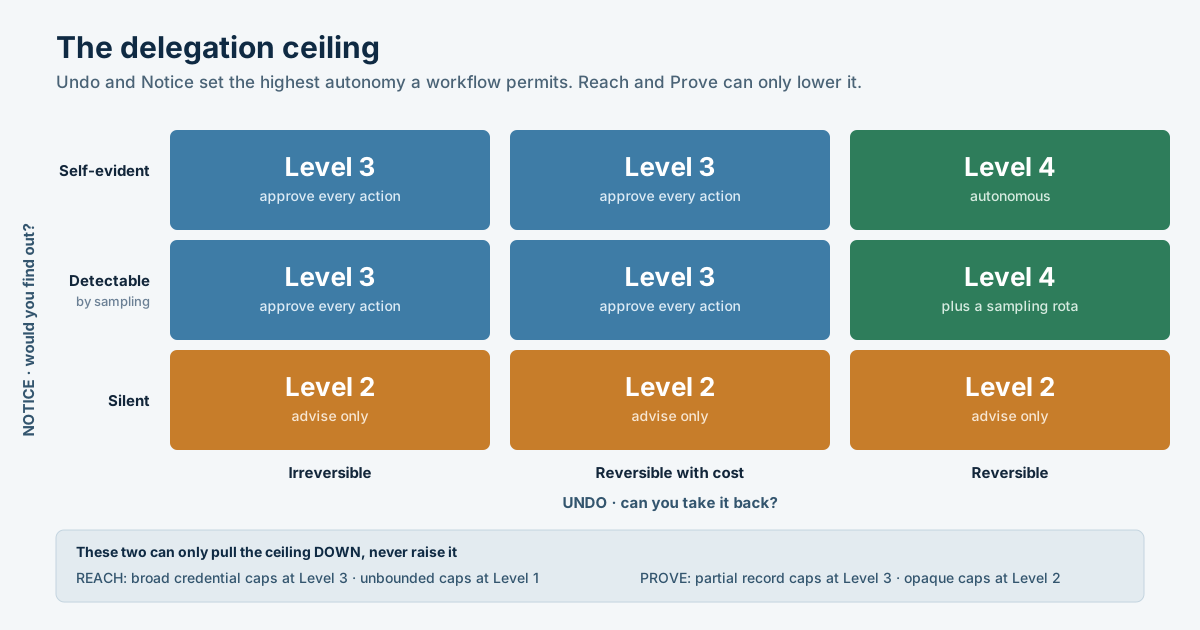
The delegation ceiling: reversibility and detectability set the quadrant, reach and provability can only lower it.
One disclosure before the argument. We have not run this test as a controlled experiment in a customer environment and measured the outcome, so nothing below is a LeapForce case study or a measured result. The framework is our synthesis of published research, a practitioner thread we read in full, and arithmetic we show working. Every number is either fetched from a named source or labelled a stated assumption.
Why "which use case" is the wrong first question
Capability is rarely the binding constraint on AI agents for business in 2026. Governance mismatch is. Gartner predicted in May 2026 that "by 2027, 40% of enterprises will demote or decommission autonomous AI agents due to governance gaps identified only after production incidents occur" (Gartner press release, 26 May 2026). Note the phrasing: not cancelled during the pilot, but demoted or decommissioned after an incident. These are agents that worked well enough to reach production and were then pulled back.
The mechanism Gartner names compresses this article's whole argument into one sentence. "Enterprises are treating AI agent governance as binary, either locked down or fully trusted," said Shiva Varma, Senior Director Analyst at Gartner, calling that the root cause of failure. The release adds that failures are likeliest when organisations "fail to distinguish between an agent's ability to act and the scope of access it is granted."
That distinction — between what an agent may do and what it may touch — is what a use-case list cannot capture. "Customer support" is not one delegation decision. Answering a shipping question from a public help centre and issuing a refund against a payment processor are the same department, the same inbox, and wildly different risk. A list that treats them as one bullet has already lost the information you needed.
The independent research points the same way. McKinsey's 2026 AI Trust Maturity Survey of roughly 500 organisations, published 25 March 2026, found that nearly two-thirds of respondents cite security and risk concerns as the top barrier to fully scaling agentic AI, "well ahead of regulatory uncertainty or technical limitations" (McKinsey). Only about 30% of those organisations reach maturity level three or higher on strategy, governance and agentic AI controls. And McKinsey frames the shift in a line worth pinning above a whiteboard: organisations can no longer worry only about AI systems "saying the wrong thing", but must now contend with systems "doing the wrong thing" — taking unintended actions, misusing tools, operating beyond their guardrails.
Saying the wrong thing is a content problem. Doing the wrong thing is a permissions problem. The second one is the one that gets an agent switched off.
There is a counter-reading of the evidence and it deserves a hearing. Google Cloud's ROI of AI report, a survey of 3,466 senior enterprise leaders written up on 5 September 2025, found that 52% of executives said their organisations were deploying AI agents in production, 39% had launched more than ten, and 74% reported achieving return within the first year (Google Cloud). Those are not small numbers, and they sit awkwardly beside a prediction that 40% of enterprises will pull agents back. Both can be true. A vendor survey of executives measures reported optimism among organisations already invested; Gartner is forecasting what happens after the first incident. The useful question is not which number is right but what separates the two populations — and on the available evidence, the separator is whether autonomy was matched to the workflow or applied uniformly.
The delegation ceiling, defined
A delegation ceiling is the highest autonomy a workflow's own properties permit, however capable the agent is. It is a property of the work, not the model. You compute it once per workflow, before building anything, by answering four questions (Undo, Notice, Reach, Prove) and taking the worst answer, not the average.
The four tests exist because each one covers a different way autonomy goes wrong:
| Test | The question | What a bad answer means |
|---|---|---|
| Undo | Can a wrong action be reversed in one step, by someone who is not the builder? | You cannot recover, so you cannot let the agent act unsupervised |
| Notice | Would a wrong output be detected, by a mechanism that is not the agent's own report? | Errors accumulate silently, so sampling replaces trust |
| Reach | What data and systems can the agent touch while doing this work? | Blast radius exceeds the task, so scope must be narrowed before autonomy rises |
| Prove | Can you reconstruct, months later, why it acted as it did? | You cannot answer an auditor or a customer, so the action needs a human on the record |
Two properties make this useful rather than decorative. The tests are about the workflow, so you can score them before choosing a tool, writing a prompt, or spending a cent. And the ceiling can only be lowered by a bad answer, never raised by a good one. That stops the common failure where a team argues its way up to autonomy on the one dimension it happens to be strong on.
The ceiling maps onto the four autonomy levels Gartner published in the same May 2026 release, each representing a different trust boundary: Level 1 Observe (read-only, output to the requesting user), Level 2 Advise (drafts and decision support, humans execute), Level 3 Act with Approval (writes data or sends communications, but only after explicit human approval for every action), and Level 4 Act Autonomously (executes within guardrails, humans review exceptions and aggregates). We use those names throughout because they are published, precise, and someone in your organisation has probably already read them.
What this is not: a maturity model, or a rubric you complete once and file. A workflow's ceiling changes when the workflow changes. Add a payment integration to a support agent and Undo collapses overnight.
Test 1 — Undo: can you reverse the action in one step?
Undo asks whether a wrong action can be reversed in one step by someone who did not build the agent. That last clause is load-bearing. Plenty of agent actions are technically reversible by a developer with database access at 2am, which is not the same as reversible by the operations lead who spots the problem on a Tuesday morning.
Score it in three bands. Reversible: a single documented action restores the prior state and no third party saw the mistake: a CRM field written back, a draft deleted, an internal report regenerated. Reversible with cost: the state can be restored but someone external was affected: a sent email needing a correction, an accepted calendar invite needing withdrawal, a message in a shared channel. Irreversible: the action cannot be recalled at all: money moved, a contract countersigned, a customer record hard-deleted, a message to a regulator.
Gartner's Level 4 description lists what autonomous operation requires: "continuous monitoring, enforced guardrails, rapid rollback mechanisms, circuit breakers that halt agent operation on threshold violations and clear ownership for agent behavior." Rollback appears in that list because without it the other controls are just alarms.
A practical trick for scoring Undo honestly: write the reversal procedure down before you build the agent, in the form someone on the rota could execute at 9am with no context. If you cannot write it in five lines, the workflow is not reversible, whatever the architecture diagram says. Teams routinely discover at this step that the reversal depends on a webhook nobody owns.
Irreversible actions do not disqualify a workflow. They cap it at Level 3 with a human approving each one, and they mean the approval must be a real control rather than a click. Which is the failure mode Gartner names at that level: without security testing, audited approval workflows and agent-specific incident response, approvals "can degrade under time pressure or approval fatigue, creating a false sense of safety while expanding the attack surface."
Test 2 — Notice: would you find out if it went wrong?
Notice asks whether a wrong output would be caught by a mechanism that is not the agent's own self-report. It is the test teams skip, and the one that decides whether a deployment quietly degrades.
The sharpest description of the problem came from a practitioner, not a research firm. In the same Hacker News thread, vincentvandeth, who described running eleven specialised agents in production for six months, added further failure modes to the original list. One of them: "Agents rarely fail catastrophically — they fail subtly." Code that passes tests but misses edge cases; documents that look complete but carry wrong cross-references. His reason this beats an obvious crash: "This is worse than obvious failures because you trust the output."
Another commenter, blakec, had spent two months cataloguing agent failure modes and naming them so mitigations could be built. Two of the five are pure detectability problems: "Confidence Mirage", an agent asserting it works without running tests, and "Phantom Verification", an agent claiming tests pass without having run them. Their conclusion is the most useful sentence in the thread: "you don't know what gate you need until you've been burned by its absence."
The research corroborates the priority. McKinsey's 2026 survey found 74% of respondents identify inaccuracy as a highly relevant risk, ahead of cybersecurity at 72%, and both persist as top concerns even as newer agentic risks emerge.
Score Notice in three bands. Self-evident: a wrong output is immediately visible to someone who cares: a broken internal report, a scheduling clash the recipient replies to. Detectable by sampling: errors are invisible individually but a 5–10% review surfaces a pattern within a week, as with ticket categorisation, lead scoring, invoice coding. Silent: a wrong output looks exactly like a right one and no downstream signal exists: a summary omitting the one clause that mattered, an enrichment filling a field with plausible but wrong data.
Silent workflows must not run at Level 4, and the reason is arithmetic rather than principle. Autonomy converts review time into sampling time, and sampling only works if the error rate is high enough that a sample finds it. At a 2% error rate a 10% sample of 1,200 monthly items catches two or three bad outputs — enough to notice. At 0.3% the same sample catches none, and you learn about the problem from a customer.
One honest caveat on Gartner's Level 2. Advisory agents look safe because a human executes every action, but the release warns they "can anchor judgment, creating downstream risk when inaccurate outputs are trusted due to automation bias." A draft that is 90% right is harder to correct than a blank page: the reviewer edits rather than rethinks. Level 2 is low-blast-radius, not zero-risk.
Test 3 — Reach: what can the agent touch while it works?
Reach asks what data and which systems the agent can access while performing the task, as distinct from what the task requires. This is the gap Gartner identifies as the most common source of failure: organisations "fail to distinguish between an agent's ability to act and the scope of access it is granted."
The distinction matters because scope is granted once, in a hurry, and then persists. A support-triage agent needs to read tickets and write a category field. It usually ends up with a full helpdesk API token, because that was the token that existed, and now it can also read every customer's billing history, merge accounts and delete threads. Nothing in the workflow required that. Someone found narrowing the scope fiddly on a Thursday.
Practitioners describe the consequences in blunt terms. One Hacker News commenter, tfrancisl, replying to a thread titled "An AI agent deleted our production database", wrote: "RBAC, sandboxing, any thing but just giving it access to all tools with the highest privileges..." Another, Damjanmb, in the unsupervised-agents thread: "Autonomy without boundaries becomes expensive noise."
Score Reach by writing three lists before you build: the data the agent must read, the fields it must write, the actions it must invoke. Compare each against what the credential you were planning to issue actually permits. The gap is your blast radius. Three bands: scoped permits approximately what the task needs; broad permits a superset including reversible actions outside the task; unbounded includes irreversible actions or personal data the task never touches.
Reach interacts with Undo in a way that catches teams out. A broadly-scoped agent inherits the worst Undo score in its scope, not the score of its intended task. An agent that only categorises tickets but holds a token that can delete them is an irreversible-action agent for ceiling purposes. Which is why "but it never does that" is not reassuring: the ceiling is set by capability, and capability is set by the credential.
Two structural points about scope that most business-side guides omit. First, an agent needs its own identity rather than borrowing a person's, a point we have covered separately in our analysis of owner, scope and expiry for non-human identities, because an agent running on a founder's OAuth token is indistinguishable from that founder in every log downstream. Second, scope should be expressed at the level of actions rather than systems: "may create a draft reply" and "may send a reply" are different permissions, and most connector integrations bundle them by default. Our connector registry approach exists precisely because action-level scoping is the part teams cannot easily retrofit.
Test 4 — Prove: can you reconstruct why it acted?
Prove asks whether, three months later, you could reconstruct what the agent did and why, from records rather than memory or a re-run. If you cannot, every action in that workflow needs a human on the record, which caps it at Level 3 however the other three tests scored.
This is the test with an external clock on it. Article 12 of the EU AI Act requires that "high-risk AI systems shall technically allow for the automatic recording of events (logs) over the lifetime of the system," for the stated purpose of traceability: identifying risk situations, supporting post-market monitoring, and tracking operation during deployment (EU AI Act, Article 12). Whether a given business agent falls inside the high-risk classification is a legal question this article cannot answer for you. The point for a delegation decision is that logging capability is now an engineering requirement rather than an operational nicety, and retrofitting it is expensive.
Score Prove in three bands. Reconstructible: the record holds the trigger, the inputs the agent saw, the tools it called, the outputs it produced and the identity it acted as. Enough that a colleague could explain a specific action without asking the builder. Partial: you have the output and a timestamp but not the inputs or the reasoning path, so you can say what happened and not why. Opaque: you have the effect and nothing else — a field changed, an email in the sent folder, no linkage.
Two things surprise teams migrating from workflow automation. A traditional automation log records that step 4 fired; an agent log has to record which branch it chose and on what evidence, because the path was never predetermined. That is why prompt-and-response logging alone is insufficient, and we cover the mechanics in our earlier work on audit trails that prove agent actions. Second, a record of what the agent was refused is as diagnostically useful as a record of what it did: a policy denial firing two hundred times a week is a scoping error waiting to become a workaround.
A cheap version for a small team: pick a random action the agent took last week and explain it to a colleague using only what the system stored. Time yourself. If it takes more than a few minutes, or it needs the builder, your Prove score is Partial at best.
Scoring the four tests into an autonomy level
You can run the full diagnostic on one workflow in a single sitting, and it produces a ceiling rather than a verdict. Score each test in its bands, translate each band to a maximum level, take the lowest of the four. The lowest wins because these are constraints, not weighted criteria.
| Test | Best band → max level | Middle band → max level | Worst band → max level |
|---|---|---|---|
| Undo | Reversible → Level 4 | Reversible with cost → Level 3 | Irreversible → Level 3, hard limits |
| Notice | Self-evident → Level 4 | Detectable by sampling → Level 4 with a sampling rota | Silent → Level 2 |
| Reach | Scoped → Level 4 | Broad → Level 3 | Unbounded → Level 1 |
| Prove | Reconstructible → Level 4 | Partial → Level 3 | Opaque → Level 2 |
Three worked scores, so the mechanics are visible:
Weekly internal revenue summary from a read-only warehouse view. Undo: reversible, you regenerate it. Notice: self-evident, the numbers are checked against a dashboard people already use. Reach: scoped, one read-only credential on one view. Prove: reconstructible, the query and the inputs are stored. Lowest is Level 4 — this workflow can run autonomously on day one, and most teams under-delegate it because it feels important.
Support ticket triage that writes a category and routes the ticket. Reversible and detectable by sampling, but Reach runs broad the moment the helpdesk token can also merge and delete, and Prove stays partial unless you deliberately store the reasoning. Lowest is Level 3, and both constraints are fixable in a week, which makes this a good first candidate rather than a bad one.
Issuing refunds under a threshold. Undo: irreversible, the money has moved. Notice: self-evident eventually, the finance reconciliation catches it, though possibly a month later. Reach: unbounded if the payment credential has no per-transaction cap. Prove: reconstructible if the processor's records are linked. Lowest is Level 1 until the credential is capped, then Level 3 with per-action approval. Not Level 4, at any error rate, because Undo cannot be improved by better prompting.
Note what happened in the third example: the ceiling moved from Level 1 to Level 3 by changing a credential, not the agent. Most ceilings are raised by narrowing scope and adding records, not by improving the model. That is the pay-off of scoring the workflow first.
Nine business workflows, scored
Below are nine common AI agent business applications with the ceiling our tests produce, in a uniform block so they compare. These are the AI agent use cases on nearly every list of AI agents for business; what changes is that each carries a ceiling rather than a recommendation. Ceilings assume the ordinary version of the workflow — add an integration and rescore. This is a list of workflow families rather than vendors; we have published a separate comparison of enterprise AI gateways for readers who want tooling.
1. Document and knowledge retrieval Best for: teams whose institutional knowledge is spread across wikis, tickets and PDFs. What the agent does: searches sources, summarises, cites the passages it used. Ceiling: Level 4, and it is the safest place to start. Controls you owe it: read-only credentials, source citation in every output, per-user output visibility. Where it breaks: a summary that omits the exception clause. Require citations so the reader can check the one paragraph that matters.
2. Drafting outbound email and support replies Best for: inboxes where the first draft, not the decision, is the work. What the agent does: reads context, writes a draft, leaves it unsent. Ceiling: Level 2 by construction, because a human executes. Controls you owe it: no send permission on the credential, not merely an instruction not to send. Where it breaks: automation bias. Reviewers edit a plausible draft instead of rethinking it, so quality converges on the agent's blind spots.
3. Support ticket triage and routing Best for: queues above roughly 600 tickets a month with stable categories. What the agent does: classifies, tags, handles ticket routing, and optionally drafts a first reply. Ceiling: Level 3 initially, Level 4 for the routing half once sampling shows a stable error rate. Controls you owe it: a scoped helpdesk credential without merge or delete, a weekly sampling rota, stored reasoning. Where it breaks: category drift. New product lines produce tickets the taxonomy has no home for, and the agent picks the nearest wrong label confidently.
4. Lead enrichment and CRM field updates Best for: sales teams losing hours to manual research on inbound leads. What the agent does: looks up firmographic data, fills fields, flags duplicates. Ceiling: Level 4 if fields are versioned and restorable; Level 2 if they are not. Controls you owe it: field-level write scope, a restore path for bulk writes, no access to closed-won revenue data it does not need. Where it breaks: plausible-but-wrong enrichment is the textbook silent failure. A wrong employee count never announces itself and propagates into segmentation and forecasting.
5. Meeting scheduling and calendar coordination Best for: roles where booking is high-volume and externally facing. What the agent does: reads availability, proposes times, sends invitations. Ceiling: Level 3. Undo is "reversible with cost": a withdrawn invite is a visible mistake to a customer. Controls you owe it: calendar-only scope, an approval gate on external invitations, a cap on invitations per hour. Where it breaks: timezone and working-pattern edge cases, which are individually trivial and collectively corrosive to trust in the agent.
6. Invoice coding and expense categorisation Best for: finance teams doing high-volume, rules-shaped classification. What the agent does: reads the document, assigns a code, routes exceptions. Ceiling: Level 4 for coding, Level 3 for anything that triggers payment. Controls you owe it: read-only access to the payment system, write access only to the coding field, sampling at month end. Where it breaks: the boundary between coding and paying. Teams build the first and then quietly extend it to the second, which changes Undo from reversible to irreversible without anyone rescoring.
7. Refunds, credits and discounts Best for: high-volume consumer support where small goodwill payments are routine. What the agent does: assesses eligibility, issues within a threshold, escalates above it. Ceiling: Level 3 with a hard per-transaction and per-day cap. Never Level 4. Controls you owe it: a payment credential that cannot exceed the cap, per-action approval above it, a spend ceiling enforced outside the agent's own logic. Where it breaks: loop behaviour. One commenter in the Hacker News thread, CodeBit26, described exactly this shape: an agent that receives ambiguous output and "starts hallucinating its own confirmation," consuming API credits exponentially without reaching the goal. Substitute credits for refunds and the same loop is a financial incident.
8. Internal report generation and dashboard narration Best for: recurring reporting that eats a senior person's Monday. What the agent does: queries known sources, assembles the narrative, flags anomalies. Ceiling: Level 4. Controls you owe it: read-only warehouse views, stored queries, an owner who reads the output weekly. Where it breaks: silent source drift. A renamed column produces a confident report built on the wrong field.
9. CRM data hygiene and list deduplication Best for: databases where duplicates are a known, quantified problem. What the agent does: identifies duplicate records, merges, normalises fields. Ceiling: Level 4 only if merges are individually reversible; otherwise Level 3. Controls you owe it: a tested bulk-restore path, a batch-size limit, a dry-run mode reviewed before the first real run. Where it breaks: merges are the classic irreversible operation that looks reversible in the vendor's demo. Test the restore before you trust the merge.
The pattern across all nine: the ceiling is usually set by Reach or Prove, both fixable in days, rather than Undo or Notice, which are properties of the work itself. That is good news, and the opposite of how the choice usually gets framed.
For the security-and-governance side of what happens after you grant an agent the ability to act, this IBM Technology session covers the risks and safeguards in more depth than we can here.

What delegation actually costs: a worked payback
Now the arithmetic, because AI agent ROI is the most-asked question here and the least-answered. The model is illustrative, not measured: every input is labelled [fetched] with its source and date, or [assumption] with the value stated so you can substitute your own. The point is the shape of the calculation, not our numbers.
Scenario: a triage-and-draft support agent at a company handling 1,200 tickets a month.
| Input | Value | Provenance |
|---|---|---|
| Ticket volume | 1,200 / month | [assumption] |
| Human handling time before | 11 min / ticket | [assumption] |
| Human time after (review and send) | 4 min / ticket | [assumption] |
| Time released | 7 min × 1,200 = 140 h / month | derived |
| Loaded labour cost | $46.60 / hour | [fetched] BLS Employer Costs for Employee Compensation, private industry total compensation per hour worked, March 2026 |
| Senior/engineering loaded cost | $89.70 / hour | [fetched] BLS ECEC, 90th wage percentile, private industry, March 2026 |
| Model input price | $2 / million tokens | [fetched] Claude Sonnet 5 introductory API rate, retrieved 30 July 2026; rises to $3 on 1 September 2026 |
| Model output price | $10 / million tokens | [fetched] same source; rises to $15 on 1 September 2026 |
| Tokens per ticket | 6,000 in / 900 out | [assumption] |
| Platform subscription | $600 / month | [assumption] |
| Build effort | 60 engineer-hours, one-off | [assumption] |
| Ongoing maintenance | 4 engineer-hours / month | [assumption] |
| Oversight beyond per-ticket review | 6 hours / month | [assumption] |
The employer-cost figures come from the U.S. Bureau of Labor Statistics release of 12 June 2026: employer costs for employee compensation averaged $46.60 per hour worked for private industry workers in March 2026, of which $32.60 was wages and $14.01 benefits (BLS). Using total compensation rather than salary is the difference between an honest model and a flattering one.
Two assumptions carry more weight than the rest, and both are soft spots. The $600 platform line is a mid-point we chose; substitute your actual quote, because at low volumes this line alone decides the outcome. And the 60-hour build is the number a CFO will attack first. It is deliberately modest — one engineer, a week and a half, on a workflow with an existing API. Double it to 120 hours and payback at 40% realisation moves from four months to about eight; quadruple it to 240 and you need roughly 1,400 tickets a month for the build to clear inside a year. Build cost changes when you break even, not whether.
Now the two sides:
| Line | Monthly |
|---|---|
| Gross labour value released (140 h × $46.60) | $6,524 |
| Model spend (7.2M in, 1.08M out, +25% for retries) | $32 |
| Platform subscription | $600 |
| Oversight (6 h × $46.60) | $280 |
| Maintenance (4 h × $89.70) | $359 |
| Recurring cost | $1,271 |
| Build cost (60 h × $89.70), one-off | $5,382 |
Two things jump out. Model spend is 2.5% of the recurring cost. The token bill that dominates the discourse is a rounding error next to platform and human time. And the gross value released is five times the recurring cost, which is why the optimistic surveys report what they report.
Then comes the line almost every published model omits. Released hours are not saved money unless they are reclaimed: redeployed to work you would otherwise have paid for, or removed from the payroll. If they become slack, the return is zero. Call it the realisation factor and be pessimistic:
| Realisation factor | Realised value | Net monthly | Payback on $5,382 build |
|---|---|---|---|
| 100% (hours fully reclaimed) | $6,524 | $5,253 | ~1.0 month |
| 40% (partially reclaimed) | $2,610 | $1,339 | ~4.0 months |
| 15% (hours become slack) | $979 | −$292 | never |
At 40% realisation, our default for a team not planning a headcount change, the break-even volume is about 580 tickets a month. The arithmetic: $1,238 of fixed monthly cost (platform, maintenance and oversight) divided by the $2.15 each ticket contributes, which is $2.18 of realised value less about 3 cents of model spend. At 100% realisation the break-even falls to roughly 230 tickets a month. That is the numeric rule worth remembering from this article, and it is why volume screening is the second filter rather than the first: a workflow can clear the delegation ceiling comfortably and still fail the arithmetic.
The costed hybrid: what buying autonomy is actually worth
The interesting comparison is not agent versus human. It is Level 3 versus Level 4 on the same workflow. That is the decision teams face six weeks in, when the approval queue starts to grate.
Moving triage-and-draft from Level 3 to Level 4 removes the 4-minute human review, releasing another 80 hours a month: $3,728 gross, $1,491 at 40% realisation. Against that, autonomy adds two costs. Sampling: reviewing 10% of tickets at 2 minutes each is 4 hours a month, $186. And remediation: at a 2% wrong-send rate, 24 tickets a month need a correction, apology and follow-up at roughly 30 minutes each — 12 hours, $559.
| Level 3 → Level 4 | Monthly |
|---|---|
| Additional value released (40% realisation) | +$1,491 |
| Sampling cost | −$186 |
| Remediation at 2% error rate | −$559 |
| Net gain from autonomy | +$746 |
Positive, but thinner than the autonomy narrative implies, and it flips negative once the error rate passes roughly 4.7%. Treat that figure as a shape rather than a constant: it falls straight out of the remediation assumption, so if cleaning up a wrong send costs an hour rather than thirty minutes, the threshold halves to about 2.3%. Recompute it with your own remediation time before quoting it at anyone. What survives the recomputation is the structure — Notice is not a philosophical position about human oversight, it is the variable that decides whether the last step of autonomy is worth taking, and a team that cannot measure its error rate cannot know which side of the line it is on. That alone is sufficient reason to stay at Level 3.
For the costs that sit outside this model entirely (integration work, security review, change management) we have covered the full picture in our analysis of enterprise AI implementation cost beyond the license.
Choose each autonomy level if...
Choose Level 1 (Observe) if the agent's value is in reading and summarising, or if Reach is unbounded and you have not yet narrowed the credential. Level 1 is also where to park a workflow you intend to promote later: it produces real usage data and real error examples at almost no risk, which is what you need to score Notice honestly.
Choose Level 2 (Advise) if a wrong output would be silent, or the work is genuinely drafting rather than deciding. Level 2 is not a waiting room. For high-judgement work it is the permanent right answer. Design against automation bias: make the reviewer state a decision rather than approve a default, and rotate reviewers so blind spots do not compound.
Choose Level 3 (Act with Approval) if any action in scope is irreversible or externally visible, or Prove is only Partial. Budget approval fatigue as a real cost, since Gartner warns approvals "can degrade under time pressure". So batch them rather than interrupting, keep the queue under a few minutes of daily work, and audit a sample of the approvals themselves, not just the agent's actions.
Choose Level 4 (Act Autonomously) if all four tests score in the best band and you have a measured error rate, a tested rollback, a spend ceiling enforced outside the agent, and a named owner. Level 4 is not the reward for a successful pilot; it is a configuration requiring four specific things, and installing them at Level 3 is cheaper than retrofitting them after an incident.
Choose no agent at all if the arithmetic fails at your volume, or the workflow is the one place your customers experience judgement. Both are legitimate outcomes, and a test that never returns "don't" is not a test.
Six governance failure modes the use-case lists leave out
Most business-side guides to AI agents for business list failure modes about effectiveness: no defined objective, too rigid to survive a variation, no feedback loop, wrong platform for the team's skill level. Those are real. They are also not what gets an agent decommissioned. The six below are AI agent governance failures, and each maps to one of the four tests.
1. The agent runs on a person's credentials. It borrows a founder's or an admin's OAuth token, so every action is indistinguishable in the logs from that person's and Prove collapses to Opaque. Offboarding that person then breaks the agent. Or worse, does not. A Reach and Prove failure at once, and the most common one described in public.
2. Scopes granted wide because narrowing them was fiddly. The credential permits a superset of the task, so the ceiling is set by the widest action in scope rather than the intended one. The tell is a sentence beginning "it never actually does that."
3. No record that reconstructs the decision. You have outputs and timestamps but not the branch the agent chose or the evidence it chose it on. Fine until someone asks why a specific customer got a specific answer.
4. No spend ceiling enforced outside the agent. A cost cap implemented as an instruction in the prompt is not a cost cap. The Hacker News thread's description of an agent hallucinating its own confirmation and burning credits exponentially is the canonical illustration; Damjanmb's summary, "Multi-tenant isolation and cost caps are not optional", is the canonical fix.
5. Irreversible actions with no approval gate. The one failure mode that cannot be mitigated after the fact. If Undo is Irreversible, an approval gate is not a nice-to-have; it is the only control that exists.
6. No owner once the builder moves on. An agent with no named owner does not get its error rate reviewed, its scope re-checked, or its credential rotated. It becomes infrastructure nobody understands, which is how a working agent turns into an incident. We wrote about this transition in our analysis of moving from personal prompts to owned company assets, because ownership is the control that makes the other five survive contact with staff turnover.
There is a symmetry here the governance-minded tend to miss. Gartner names over-restriction as a failure mode too: heavy controls applied indiscriminately cause "over-restriction of simple agents, which slows delivery and drives shadow development." A delegation ceiling used as a reason to keep every workflow at Level 1 produces exactly what it was meant to prevent — people building agents outside the sanctioned path. The test runs in both directions.
When the manual process still wins
Sometimes the honest answer is no agent. Four cases where we would not delegate, on the evidence above.
The volume is below break-even. At the assumptions in our model and 40% realisation, under roughly 580 items a month the fixed cost of platform, maintenance and oversight is not recovered. Small teams frequently automate their most annoying workflow rather than their highest-volume one, and annoyance is not a financial input.
The error rate cannot be measured. If you have no baseline for how often the current process gets it wrong, you cannot tell whether the agent improved anything, and you cannot locate yourself against the threshold (4.7% on our assumptions) where autonomy stops paying. Establish the baseline first; it costs a week and it is the only thing that makes the pilot interpretable.
The workflow is where judgement is the product. For a consultancy, a clinic, or a professional-services firm, the parts of the process that look repetitive are often where the client experiences expertise. Delegating the drafting is fine. Delegating the decision changes what you sell.
Nobody will own it. An agent without a named owner drifts silently. If the answer to "who reviews the error rate in March" is "we'll figure that out," the manual process, which at least has a person attached, is safer.
There is also a timing argument. Model capability improves faster than governance tooling, and a workflow that fails Prove today may be trivially provable in a year, once your platform stores reasoning traces by default. Waiting is a strategy; the failure is waiting without stating what you are waiting for.
Raising a ceiling on purpose: a 90-day sequence
Ceilings are meant to move. The sequence that works is the one we published for gateway rollouts and it transfers directly: observe first, enforce second, optimise third (our AI gateway approach). Applied to a single workflow over roughly 90 days:
| Phase | Weeks | What you do | What you have at the end |
|---|---|---|---|
| Observe | 1–4 | Run at Level 1 or 2. Log everything. Establish the baseline error rate of the current human process, not just the agent's. | A measured Notice score and a real error rate |
| Enforce | 5–9 | Narrow the credential to action-level scope. Add the approval gate. Install the spend ceiling outside the agent. Write and test the rollback. | Reach and Prove moved up a band; ceiling now Level 3 |
| Optimise | 10–13 | Sample at 10%. Batch approvals. Promote the reversible half of the workflow to Level 4 and keep the irreversible half gated. | A split-level workflow with a measured error rate |
Two notes on sequencing. Enforcement before observation produces controls fitted to an imagined workflow, and they get removed the first time they block something legitimate. And promoting half a workflow is usually right. In the triage example, routing goes to Level 4 while drafting stays at Level 2, capturing most of the value without the remediation cost.
Two of this article's thresholds depend on an error rate, so here is how to get one during Observe without building an evaluation harness. Sample a fixed number of items weekly (30 catches a rate above roughly 5%, 100 catches one above 2%) drawn at random rather than from complaints, because complaint-sourced samples measure detectability, not accuracy. Have one person mark each item against a written rule. Then do the same for the human output over the same period. The baseline is rarely zero, and the comparison you need is between two error rates, not between an agent and perfection. Four weeks costs about two hours a week and produces a number stable enough to act on.
This sequence answers a different question from the one in our earlier analysis of why AI pilots stall. That piece asks whether a pilot can enter production: ownership, runtime identity, unit cost at volume, security review. This one asks, before any of that, how much autonomy the work itself permits. Run the delegation ceiling first, then the production entry test; the second one is much easier to pass when you already know the level you are aiming at.
Where LeapForce fits
Once work moves from a person to an agent, the question stops being which tool and becomes who owns this agent, what can it touch, what did it do, and what did it cost. That layer is what LeapForce builds: non-human identities with owner, scope and expiry; a connector registry with action-level scoping and human-in-the-loop gates; a gateway that records what was refused as well as what ran; and workflows that chain agents and connectors behind explicit approval gates with budget caps. In this article's language, we build the things that raise a ceiling: the scoped credential, the gate, the record, the cost limit. LeapForce is in active development and per-capability build status is disclosed honestly, so ask what is live before you plan around it.
What this test will not tell you
The delegation ceiling is a constraint check, not a business case. It tells you the most autonomy a workflow permits. It does not tell you whether the workflow is worth automating, whether your team can build it, or whether the agent will be any good. A workflow can clear Level 4 on all four tests and still be a poor investment, which is what the arithmetic is for.
Four further limits, stated plainly.
The bands are judgement calls. "Detectable by sampling" versus "silent" is a real distinction, but two reasonable people will place some workflows differently, and we have not validated the bands against deployment outcomes. Nobody has, as far as we can find; the published research measures adoption and maturity, not the accuracy of classification schemes.
The arithmetic depends most on the input we can least verify. The realisation factor — how much released time becomes money, moves the payback table from one month to never, and it is the one number no survey reports. Treat our 40% as a placeholder for your own honest estimate.
Autonomy levels are a 2026 vocabulary. Gartner's four-level scheme is published and useful, and it may not survive the next two years of tooling. If your platform's own model differs, keep the four tests and remap the outputs.
Our sourcing has a known skew. Reddit is the venue most often quoted for practitioner sentiment on this topic, and it blocked automated retrieval for us, so almost every practitioner voice in this article comes from one Hacker News thread. That population skews technical relative to the operations and support leads who actually run these workflows, and their concerns may differ. The adoption figures also lag the governance ones: Google Cloud's agent-deployment numbers are from its 2025 ROI of AI survey, the most recent edition carrying them, while the Gartner and McKinsey findings are from 2026 — so the optimistic side of the comparison is a year older than the cautious side.
Frequently asked questions
A chatbot responds inside a conversation and stops. An RPA bot executes a fixed sequence of steps and fails when the screen changes. An AI agent holds context across steps, chooses between branches, and calls tools until a goal is met or it gives up. The practical consequence for delegation is that the agent's path is not predetermined, which is why logging what it did is insufficient — you have to log which branch it chose and on what evidence, or Test 4 in this article scores Opaque.
Pick the one with the highest delegation ceiling, not the one that annoys you most. Among the usual AI agent use cases that means a read-only or drafting workflow with self-evident errors, a narrow credential, and volume above your break-even. Knowledge retrieval and internal reporting almost always score Level 4 and are almost always skipped because they feel unglamorous. Support triage is the usual first real candidate because both things holding it at Level 3 — Reach and Prove — are fixable in about a week.
At the assumptions modelled above, recurring cost was $1,271 a month for a 1,200-ticket workflow, split $600 platform, $359 maintenance, $280 oversight and $32 model spend. The proportions matter more than the totals, and they are the part that transfers: model tokens were 2.5% of the bill, while human time — oversight plus maintenance — was half of it. We have deliberately not quoted vendor subscription prices here, because they move faster than an article does and the number you need is your own quote. Get it, then drop it into the $600 line and rerun the table; a subscription price on its own is not a cost model.
AI agent ROI depends almost entirely on whether the released hours are actually reclaimed. On the same worked example, payback on a $5,382 build was about one month if every released hour converted to other paid work, about four months at 40% conversion, and never at 15%. The break-even volume was roughly 580 items a month at 40% realisation, and about 230 at 100%. Any figure quoted for AI agents for business without a realisation assumption is measuring hours, not money.
The build is rarely the constraint. On the 90-day sequence above, four weeks go to observation and baselining, five to narrowing scope and installing the approval gate, spend ceiling and rollback, and four to sampling and selective promotion. Teams that skip the observation phase reach production faster and cannot tell whether the agent improved anything, because they never measured the human error rate they are comparing against.
You can build one. Whether you can raise its ceiling is a different question. The things that move a workflow from Level 2 to Level 4 (action-level credential scoping, a tested bulk rollback, a spend limit enforced outside the agent's own logic, a record that reconstructs the decision) are platform capabilities, not prompt engineering. If your tool provides them, a non-engineer can configure them. If it does not, no amount of no-code building will produce them.
Safety in a regulated context is a delegation question rather than a yes-or-no answer. Article 12 of the EU AI Act requires high-risk systems to technically allow automatic recording of events over the system's lifetime, which in practice means a workflow that cannot be reconstructed from records should not be delegated at all in a regulated context. Score Prove first. Whether your specific workflow falls inside a high-risk classification is a legal question for counsel, not an engineering one.
Accountability stays with the organisation, which is why Gartner's Level 4 description requires "clear ownership for agent behavior" alongside monitoring and rollback. Operationally, name one person who owns the agent, review its error rate on a fixed cadence, and make sure it runs on its own identity — because if it borrowed a person's credentials, your incident review cannot distinguish the agent's actions from theirs, and the accountable individual becomes whoever's token was used.
Through connectors that broker credentials on the agent's behalf. The integration question that matters for delegation is not whether a connector exists but how finely it scopes: "may create a draft" and "may send" are different permissions, and many connectors bundle them into a single grant. Before you connect anything, write out the data the agent must read, the fields it must write, and the actions it must invoke, then check what the credential you were about to issue actually permits.
AI agents for business pay off fastest in teams with high-volume, stable-taxonomy work where errors are detectable: support, sales operations, finance operations, internal reporting. Teams where judgement is the product benefit least from delegating the decision and most from delegating the drafting. But the department is not the screen: what matters is whether the specific workflow clears both the ceiling and the volume threshold.
Some platforms handle some of it. The test is specific: can you scope a credential to an action rather than a system, enforce a spend ceiling outside the agent's own logic, produce a record that reconstructs a decision months later, and offboard the agent in one step when its owner leaves? If the answer to any of those is no, that capability has to come from somewhere, and retrofitting it after an incident is the expensive path.
Four things have to be true before Level 4, and they are checkable rather than subjective: a measured error rate from a real sampling period, a rollback you have actually tested, a spend ceiling enforced outside the agent, and a named owner. Then promote the reversible half of the workflow and leave the irreversible half gated. Do the arithmetic first — autonomy on our worked example was worth about $746 a month and went negative above a 4.7% error rate, so it is not automatically the right end state.
Ready to Govern Your AI?
Talk to LeapForce — one controlled layer for every AI tool, connector, model, and agent.
Comments