
The difference between AI agents and chatbots is write access. A chatbot answers inside the conversation; an AI agent changes something outside it: issues the refund, updates the CRM record, sends the mail, restarts the service. Everything else people list when they compare AI agents vs chatbots (memory, planning, tool calls, multi-step workflows) is downstream of that one property.
Our position is that this makes "agent or chatbot" a risk decision rather than a capability upgrade, and that most teams are asking the question in the wrong order. They ask what the tool can do, then discover what it can reach. The order that survives production is the reverse. On Hacker News in January 2026, a developer deploying agents that "process refunds, send emails, modify databases" laid out the problem exactly: the agent, he wrote, "sometimes attempts actions it shouldn't, and there's no clear audit trail". He then listed his three options (trust it fully, review every action manually, or build a permission layer) and asked which one actually works. That is the real question underneath every AI agents vs chatbots comparison, and almost none of them answer it.
The short answer: If the system can write to a system of record, it is an agent and needs an identity, a scope, a reversal path, an audit trail and an approval rule before it ships; if it cannot, it is a chatbot and most of that machinery is waste.
Last updated: July 30, 2026.
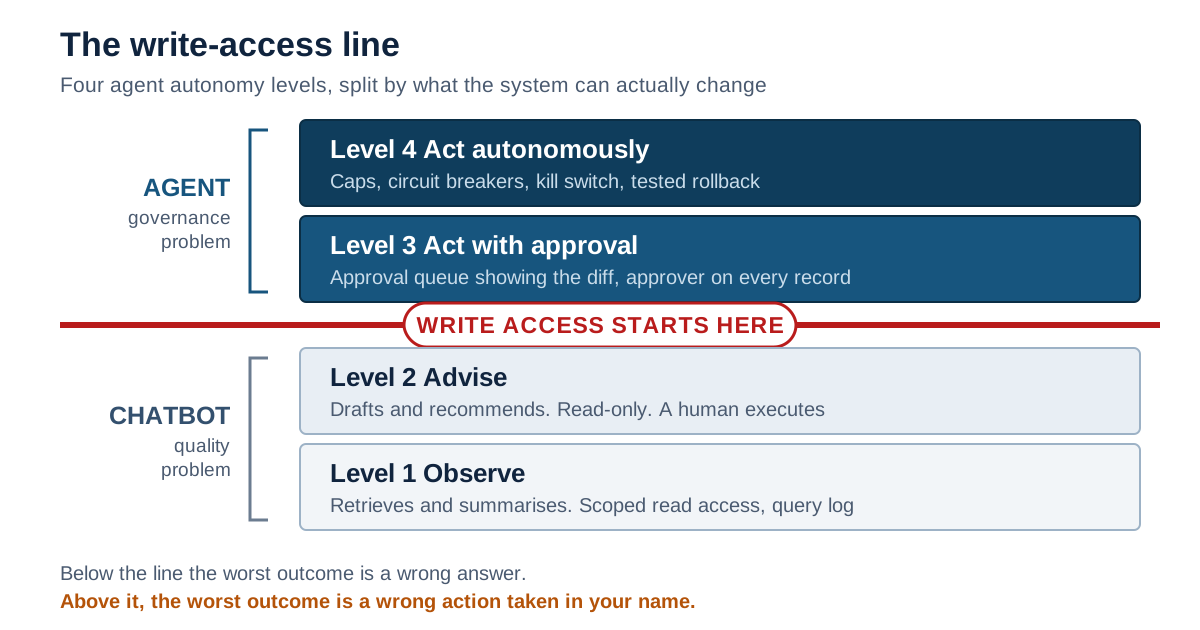
The write-access line: everything below it is a chatbot problem, everything above it is a governance problem.
The one difference that actually matters
The difference between AI agents and chatbots is not intelligence, memory or model size. It is whether the system can change state in a place the conversation does not control. A chatbot's output is text. An agent's output is text plus a side effect: a row written, a message sent, a ticket closed, a payment moved. Once a side effect exists, so does a question no chatbot ever raises: what happens when it is wrong, and who finds out?
That framing is not a rhetorical preference. It is the failure line the analysts are now measuring. In a press release published on 26 May 2026, Gartner predicted that by 2027, 40% of enterprises will demote or decommission autonomous AI agents because of governance gaps found only after production incidents. The diagnosis in that release is unusually blunt about the mechanism: failures are most likely when organisations "fail to distinguish between an agent's ability to act and the scope of access it is granted."
Read that twice, because it is the whole article in one line. Ability to act and scope of access are two different dials. Every vendor comparison of AI agents vs chatbots turns the first dial and calls it progress. Production turns the second one and sends you the bill.
Three consequences follow from the write-access line, and between them they replace most of the feature lists you will find elsewhere.
Reversibility becomes a design property, not an afterthought. A wrong chatbot answer is corrected by a better answer. A wrong agent action is corrected by another action, which may not exist. There is no undo for a sent email or a submitted payment file, so the question "can this be reversed, and by whom, within what window" has to be answered before the integration is built, not after the first incident.
Identity stops being cosmetic. A chatbot can run as "the support bot" because nothing it does needs attribution beyond a transcript. An agent that writes to Salesforce is a principal in your access model, and if it authenticates as a shared service account, your audit trail dead-ends at that account. We wrote about the fields that make an agent identity usable, owner, scope and expiry, in our earlier analysis, and the short version is that an agent without an owner is an unowned production change.
The threat model inverts. For a chatbot, the worst realistic outcome is a bad answer that embarrasses you. For an agent, the worst realistic outcome is an attacker-authored instruction that the agent executes with your credentials. Those are not the same risk, and they do not respond to the same controls.
What the write-access line is not: it is not a claim that chatbots are dumb, that agents are always better, or that the boundary is permanent for a given workflow. Plenty of workflows should cross the line. The argument is only that crossing it is the decision, and that everything else (model choice, framework, prompt design) is downstream.
Three tiers, not two: why the usual comparison is rigged
Most "AI agents vs chatbots" comparisons are rigged, and the rigging is always the same: the chatbot in the comparison is a scripted decision-tree bot from 2019. Against that strawman, an agent wins on every row. The comparison you actually face in 2026 has at least three tiers, and the middle one is where most of the working software currently lives.
| Tier | What it is | Can it write? | Typical use | Main risk |
|---|---|---|---|---|
| Scripted bot | Fixed intents, decision tree, canned replies | No | Hours, returns policy, order status lookup | Dead ends, customer frustration |
| Grounded assistant | LLM plus retrieval over your content, may call read-only tools | No | Policy Q&A, triage, drafting, summarisation | Wrong answers stated confidently |
| Acting agent | LLM plus tools that change state in other systems | Yes | Refunds, provisioning, CRM updates, ticket resolution | Wrong actions with real consequences |
The second tier is the one vendor comparisons quietly delete, because admitting it exists ruins the upgrade story. A grounded assistant already does retrieval, already keeps conversation memory, already calls tools, and already handles multi-step workflows inside a conversation. What it does not do is commit anything. For a very large share of support, HR and IT-helpdesk volume, tier two is the correct terminal state, not a stepping stone.
That matters commercially as much as technically. If someone tells you that your chatbot is obsolete, the honest reply is: which tier is it on, and is the work it does actually blocked by not being able to write? Most of the time the answer is no, and the money is better spent making tier two more accurate than making it more autonomous.
The rigging runs the other way too, and Gartner has a name for it. Its June 2025 forecast describes vendors "agent washing": rebranding assistants, RPA and chatbots as agents without substantial agentic capability. It estimates only about 130 of the thousands of vendors claiming agentic AI are real. So the tier question cuts both ways at procurement: a product sold as tier three may only write through a human, and a product you already own may write more than you realised.
There is one genuine reason to distrust tier two, and it deserves its own name because it is the strongest argument against stopping there. Gartner's May 2026 release warns that advisory agents "can anchor judgment": people trust a confident recommendation and stop checking it, so the error rate that matters is not the model's, it is the model's multiplied by however much scrutiny the human quietly dropped. That is a real cost of tier two, and it is why "the human is in the loop" is not a free pass, a point this article returns to below.
Gartner's four autonomy levels, translated into controls
If you want a finer-grained ladder than three tiers, the most useful public one is Gartner's, published on 26 May 2026, which classifies agents by autonomy level and argues that each level is a different trust boundary requiring different controls. The core recommendation is against uniform governance: "Enterprises are treating AI agent governance as binary, either locked down or fully trusted, and that is the root cause of failure," said Shiva Varma, Senior Director Analyst at Gartner, in the same release.
Here are Gartner's four levels and what each implies for the difference between AI agents and chatbots in practice. The left three columns are Gartner's; the right column is our translation into the artefacts a platform team actually has to produce.
| Level | What it does | Gartner's control focus | What you actually have to build |
|---|---|---|---|
| 1 — Observe | Read-only access to defined data sources; output visible only to the requesting user | Scoped data access, user authentication, usage logging, basic functional and security testing | Per-user token scoping, a query log, a redaction rule for anything the requester is not entitled to see |
| 2 — Advise | Generates recommendations, drafts, proposed actions; humans review and execute manually. No write access | Level 1 controls plus accuracy and hallucination testing, domain quality evaluations, user training on appropriate reliance | An evaluation set with a pass bar, a visible confidence or citation surface, and training that names automation bias out loud |
| 3 — Act with approval | Writes data, sends communications, modifies configuration, but only after explicit human approval for every action | Security testing, clear approval workflows with audit trails, agent-specific incident response | An approval queue with the actual diff in it, an approver identity on every record, and a documented rollback per action type |
| 4 — Act autonomously | Executes independently within guardrails; humans review exceptions, audit logs and aggregate outcomes | Continuous monitoring, enforced guardrails, rapid rollback, circuit breakers that halt on threshold violations, clear ownership | Rate and spend caps, a kill switch someone is on call for, an owner named in a directory, and a tested rollback runbook |
Two things are worth pulling out of that table.
First, the write-access line sits exactly between Level 2 and Level 3. Gartner's own description of Level 2 says these agents "retain read-only access with no write access to any system." Everything at Level 1 and Level 2 is, in the vocabulary of this article, a chatbot. A very good one, possibly one that drafts your quarterly report, but still something whose worst output is words. Everything at Level 3 and above is an agent.
Second, and this is the practical payoff of framing AI agents vs chatbots as an autonomy ladder rather than a binary, the control burden does not rise smoothly. It steps. Levels 1 and 2 need quality engineering; Levels 3 and 4 need security and operations engineering. Teams that budget for a "small upgrade" from Level 2 to Level 3 are usually budgeting for a prompt change and getting an access-control project. That mismatch is a plausible mechanism behind the demote-or-decommission prediction: nothing failed technically, the organisation just discovered mid-flight that it had bought the wrong kind of work.
A third observation is ours rather than Gartner's, and it is the one that changes roadmaps. Level 3 is not a stable resting place for high-volume work. An approval gate on every action converts an automation into a queue, and queues get drained by tired people. Level 3 is a migration state, the period during which you are collecting the evidence that would justify Level 4 for a narrow slice, or the evidence that you should go back to Level 2. Designing Level 3 as a permanent destination for thousands of daily actions is how approval fatigue gets built into the architecture.
The Blast-Radius Test: five questions before you grant write access
Before any workflow crosses the write-access line, run the Blast-Radius Test. It is five questions, it fits in one working session with the right people in the room, and if you cannot answer all five, the workflow is not ready to be an AI agent. It is ready to be a Level 2 assistant that drafts and hands off. This is the diagnostic we would put in front of anyone still framing the choice as AI agents vs chatbots on a feature grid.
We call it a test rather than a checklist because it has a pass condition: every question must have a named, specific answer, not a policy aspiration. "We'll use least privilege" is not an answer to question two. "Read the six Zendesk fields listed here, write only to the ticket status field, no access to billing" is.
1. Whose identity does it act as? Not "the agent". Which directory entry, with which owner, and what happens to it when that owner leaves? If your answer is a shared API key stored in an environment variable, the audit trail you will produce during an incident is "someone, or something, using this key." That is not an audit trail. This is the same failure the Hacker News thread above described from the other direction: on a related thread eleven days later, a developer noted that most platforms simply do not offer the granularity, since "most modern apps don't have fine-grained permissions". You get a token that can read logs and also delete the deployment.
2. What is it permitted to do, at the level of individual actions? Not "access Salesforce." Which objects, which fields, create or update or delete, and with what row-level filter. If the permission you can actually express is coarser than the permission you need, that gap is your real blast radius, and it should be written down before launch rather than discovered during a postmortem. A permission you cannot enforce at a chokepoint the agent has to pass through is not a permission; it is a preference expressed in a prompt.
3. Can each action be reversed, by whom, and in what window? Sort every action type into reversible (update a field, move a ticket), compensable (issue a credit to offset a wrong charge) and irreversible (send an external email, delete a record, submit a payment). Irreversible actions are where approval gates belong. Reversible ones usually do not need them, and putting gates there is how you train reviewers to click through.
4. Is every attempted action recorded, including the ones that were refused? Most logging captures what happened. For agents, what was blocked is the more valuable record, because it is the evidence that your controls are load-bearing and the early-warning signal that something is probing them. Our earlier work on audit trails that prove agent actions goes into what a defensible record contains.
5. Which actions must stop for a human, and who is that human at 2am? An approval rule with no named on-call rota is a plan to have a queue back up over a weekend. Name the role, name the escalation, and set the timeout behaviour explicitly: does the action fail closed, or does it proceed?
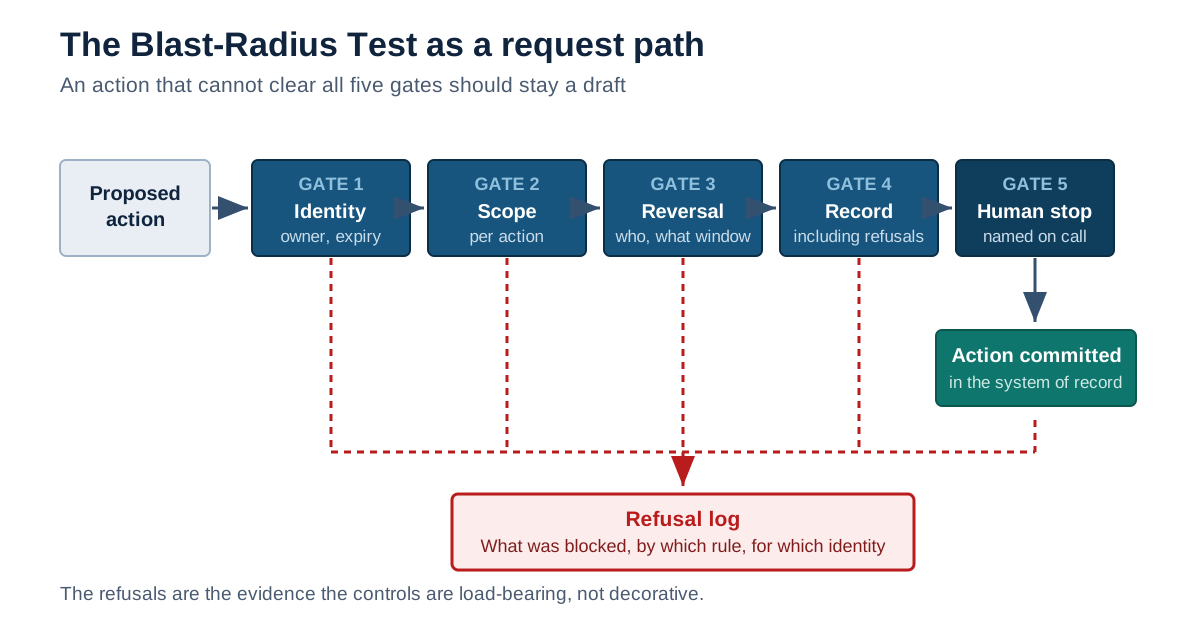
The Blast-Radius Test as a request path: an action that cannot clear all five gates should stay a draft.
Question four deserves an extra note, because it is the one most often skipped and the one that changes the security picture most. Agents that read untrusted content and can also communicate outward are exposed to a specific attack class that chatbots largely are not. Simon Willison named the combination the "lethal trifecta" in June 2025: access to private data, exposure to untrusted content, and the ability to communicate externally. His assessment of the state of mitigation is worth quoting exactly, because the industry keeps rounding it up: "we still don't know how to 100% reliably prevent this from happening". On vendor guardrails that claim to catch 95% of attacks, he adds that in web application security, 95% is "very much a failing grade."
That is not an argument against agents. It is an argument for breaking one leg on purpose. The cheapest leg to break is usually the third: an agent that reads untrusted content and holds private data should not also hold a tool that can send data outward: no arbitrary HTTP, no outbound mail, no posting to external webhooks. If the workflow genuinely needs all three, the outbound step is the one that belongs behind a human approval gate, which is precisely what question two of the test forces you to decide in advance rather than discover.
What benchmarks say about giving an agent a multi-step job
The strongest public evidence about agent reliability is not about whether an agent can complete a task once. It is about whether it completes the same task every time, and that distinction is where the numbers get uncomfortable.
The benchmark that made this measurable is τ-bench, published by Shunyu Yao, Noah Shinn, Pedram Razavi and Karthik Narasimhan in June 2024. It simulates a customer-service agent with domain tools and a policy document, and it introduced a metric that matters far more than headline accuracy: consistency across repeated attempts. The finding, in the authors' own summary, is that state-of-the-art function-calling agents such as GPT-4o succeed on under 50% of the tasks and are "quite inconsistent", with the eight-attempt consistency score falling below 25% in the retail domain. The paper closes by calling for methods that improve an agent's ability "to act consistently and follow rules reliably."
Two caveats, stated up front because they cut both ways. That evaluation is from mid-2024 and the models have moved; anyone quoting the 25% figure as current is misusing it. And a single-run success rate is genuinely the right metric for some workflows. But for a workflow that runs a thousand times a week, the relevant question is what happens in the tail, and the tail is what pass-over-repeated-attempts measures.
There is a newer edition, and it is worth reading before anyone quotes the old one. τ²-bench, released in June 2025 by Victor Barres, Honghua Dong, Soham Ray, Xujie Si and Karthik Narasimhan, adds a "dual-control" telecom domain in which the user also has tools and must be guided through actions on their own device. Its headline finding is that agents show "significant performance drops when agents shift from no-user to dual-control." In plain terms: agents get worse when the world they are acting on is also being changed by someone else. Every real customer-service, IT-support and sales workflow is exactly that world.
Earlier work set the baseline. WebArena, published by Shuyan Zhou and colleagues with a final revision in April 2024, put agents in a realistic web environment and found their best GPT-4-based agent reached an end-to-end task success rate of 14.41%, against 78.24% for humans. Current systems score considerably better than that on WebArena and we are not presenting it as a live number. The durable finding is the shape: agents degrade sharply as tasks lengthen and as the environment stops being a clean sandbox.
What should you take from this into the AI agents vs chatbots decision? Not "agents don't work." The correct reading is narrower and more useful: an agent's per-attempt success rate tells you almost nothing about the number of incidents it will generate, and incident count is what determines whether your Level 3 or Level 4 deployment survives its first quarter. Ask any vendor for consistency across repeated runs on your tasks, not accuracy on theirs.
For a well-structured tour of the risk categories that show up once agents are in production, this recorded session from the OWASP Agentic Security Summit in London, the formal launch of the OWASP Top 10 for Agentic Applications, walks through goal manipulation, tool misuse, and identity and privilege abuse in a little over twenty minutes.

Verdicts: which tier your workflow actually needs
Here is the part most AI agents vs chatbots comparisons skip: an actual answer per situation. Each block states who it is for, what you get, what it costs, and when it is wrong. Read it as guidance on when to use chatbots as much as on when to promote one into an agent.
Choose a scripted bot if your queries are genuinely closed-set and the cost of a wrong answer is a mildly annoyed customer. Best for: store hours, order tracking, password-reset routing, appointment slots. What you get: near-zero variance, trivial audit story, no model spend. What it costs: users hit dead ends and ask for a human, so measure your escalation rate honestly. It is the wrong choice when your intent list has grown past a few dozen branches and someone is maintaining it full time; at that point the maintenance cost has quietly exceeded the model cost.
Choose a grounded assistant (Level 1–2) if the work is answering, drafting or triaging, and a human is going to press the button anyway. Best for: policy Q&A over internal documents, first-draft replies, ticket summarisation, code explanation. What you get: most of the perceived intelligence of an agent with none of the write-side governance burden. What it costs: an evaluation set you actually maintain, plus the automation-bias problem: your reviewers will get less careful over time and you should plan a sampling audit for that. It is the wrong choice when the human step is pure transcription, adding latency and no judgement.
Choose an approval-gated agent (Level 3) if actions are consequential, volume is low to moderate, and you need evidence before you widen the mandate. Best for: refunds above a threshold, account changes, deprovisioning, outbound communication on regulated topics. What you get: real automation of the reasoning and drafting, with the irreversible step still owned by a person, and, critically, an approval log that becomes your evidence base for widening scope later. What it costs: a queue, and the discipline to keep it short. It is the wrong choice at high volume, where approval fatigue turns the gate into a rubber stamp and you have paid for a control you no longer have.
Choose an autonomous agent (Level 4) if the action space is narrow, every action is reversible or cheaply compensable, volume justifies the operational build, and you can name the owner and the kill switch today. Best for: tagging and routing, enrichment, low-value reversible adjustments, internal system hygiene. What you get: genuine throughput. What it costs: monitoring, caps, circuit breakers, an on-call rota and a rollback runbook that has been tested rather than written. It is the wrong choice for anything irreversible, anything customer-visible on a regulated topic, or anything you cannot roll back inside the time it takes to notice.
The diagnostic that picks between these is not "how smart is the task." It is three properties of the action: reversibility, visibility to a third party, and volume. High reversibility plus low external visibility plus high volume points to Level 4. Low reversibility plus high external visibility points to Level 3 at most, and often to Level 2 with a human executing. That is the entire decision, and it does not require knowing anything about model architecture.
Why "a human approves it" is a weaker control than it sounds
"There's a human in the loop" is the sentence that ends most AI agent risk reviews, and it is the sentence that makes AI agents vs chatbots feel like a solved argument. It should not, because the research on human oversight of automated systems is consistently unflattering, and it predates the current wave by years.
The most direct evidence comes from Ben Green's study of oversight policy, published in Computer Law & Security Review in 2022. Surveying 41 policies that prescribe human oversight of government algorithms, Green found two flaws: evidence indicates that people are unable to perform the oversight functions the policies assume, and the policies therefore legitimise flawed systems while providing "a false sense of security." The context is government decision-making rather than enterprise automation, and that limits how far the finding transfers. But the mechanism, an oversight requirement satisfied on paper while degrading in practice, is exactly what a production approval queue is exposed to.
Gartner's May 2026 release names the same failure in agent terms, warning that without strong security testing, clear approval workflows with audit trails and agent-specific incident response, approvals "can degrade under time pressure or approval fatigue, creating a false sense of safety while expanding the attack surface." The phrase "expanding the attack surface" is the part people miss: a Level 3 agent has all the write permissions of a Level 4 agent. The gate is the only thing standing between the two, and gates are made of attention.
Four things make an approval gate a real control rather than a ritual, and they are all cheap:
- Show the diff, not the intent. "Agent wants to update the account" is unreviewable. "Change plan from Pro to Enterprise, effective immediately, billing delta +$4,800/yr" is reviewable in three seconds.
- Gate irreversible actions only. If reviewers approve forty reversible actions to reach the one that matters, they will approve the one that matters without reading it.
- Record the approver, not just the approval. An audit trail that says "approved" and not "approved by whom, at what time, with what shown on screen" will not survive a regulator or an incident review.
- Measure approval latency and approval rate. A queue with a 99% approval rate and a two-second median review time is not a control. It is a metric that tells you to move that action type either up to Level 4 with proper guardrails, or down to Level 2.
There is a legal floor under this too, at least in Europe. Article 14 of the EU AI Act requires that high-risk systems be built so a human overseer can intervene or "interrupt the system through a 'stop' button or a similar procedure that allows the system to come to a halt in a safe state". Note what that requires beyond a pause: a defined safe state. For an agent halfway through a multi-step workflow, "safe state" is a real engineering problem, and it is one of the clearest differences between AI agents and chatbots in operational terms. Stopping a chatbot means it stops replying. Stopping an agent means deciding what happens to the half-finished job.
There are only three answers to that, and picking one per workflow is a design task you can finish in an afternoon. Either every action is idempotent and safe to abandon mid-sequence, so a halt leaves partial but consistent state. Or every action has a compensating action registered alongside it, so a halt triggers an unwind. Or the workflow checkpoints and resumes, so a halt parks the run and a human decides later whether to continue or discard it. Workflows that have none of these do not have a stop button; they have a power switch.
Liability and disclosure: what changes on 2 August 2026
Two legal facts should be on the table before any AI agents vs chatbots decision is signed off, and one of them lands three days from the date on this article.
Disclosure. Article 50 of the EU AI Act requires providers to ensure that people are told they are interacting with an AI system. The European Commission's own FAQ, last updated on 24 July 2026, states plainly that Article 50 "applies as from 2 August 2026" and that the notification must be given in a clear and distinguishable manner from the start of the interaction. The text of the obligation carves out cases where AI involvement is obvious to a reasonably well-informed person, as set out in Article 50(1).
One precision worth getting right before your legal team does it for you: Article 50(1) is written as a provider obligation, and a company that builds or commissions its own conversational surface is generally acting as the provider of that system rather than merely a deployer of someone else's. Deployers carry a separate and narrower set of Article 50 duties, covering emotion recognition and biometric categorisation, deepfake labelling, and AI-generated text published on matters of public interest without meaningful human review. Which hat you are wearing changes which paragraph applies, and it is not always the one people assume.
This one caught teams off guard because so much else moved. The EU's Digital Omnibus, provisionally agreed in 2026 and taking legal effect only on formal adoption in the Official Journal, postpones the high-risk obligations (Annex III systems deferred to 2 December 2027 and Annex I to 2 August 2028, per Gibson Dunn's analysis), which produced a widespread impression that the whole timeline had slipped. It did not. The same analysis states that "2 August 2026 remains an active compliance date" for Article 50, with only a four-month grace period, to 2 December 2026, for the watermarking obligation on systems already on the market. If you operate a customer-facing conversational surface in the EU, the disclosure duty is live this week.
Liability. The question "who is responsible when the bot is wrong" has a concrete answer in at least one jurisdiction, and it was settled at the chatbot tier, which makes it a floor rather than a ceiling for agents. In Moffatt v. Air Canada, 2024 BCCRT 149, the British Columbia Civil Resolution Tribunal held the airline liable for negligent misrepresentation after its website chatbot described a bereavement-fare policy that contradicted the airline's actual policy page. Air Canada argued the chatbot was effectively a separate entity responsible for its own statements. The tribunal rejected that outright, reasoning that "it makes no difference whether the information comes from a static page or a chatbot."
The damages were small. The principle is not. If a company is answerable for what its chatbot said, the exposure from what an agent did is a larger version of the same liability, not a different one. And unlike a wrong sentence, a wrong action may already have moved money or data before anyone reads the transcript.
| Question | Chatbot (Levels 1–2) | Agent (Levels 3–4) |
|---|---|---|
| Worst realistic outcome | An incorrect statement attributed to you | An incorrect action taken in your name |
| Remediation | Correct the answer, update the source content | Reverse the action if a reversal path exists |
| Evidence needed after an incident | Conversation transcript | Action log, identity, approver, policy decision, refusals |
| EU AI Act Article 50 disclosure | Applies from 2 August 2026 | Applies from 2 August 2026 |
| Article 14 "stop button" and safe state | Trivial: stop replying | Non-trivial: define the safe state mid-workflow |
What each tier costs, and what being wrong costs
Cost is where the AI agents vs chatbots comparison usually collapses into vagueness, so here are two concrete anchors and one honest gap.
The first anchor is a real, published price for the assistant tier. Intercom's public pricing page, fetched on 30 July 2026, lists its Fin AI agent at "From $0.99 per Fin outcome" across its plans, and defines an outcome as the customer confirming their issue is resolved, the customer not asking for more help after Fin responds, or Fin completing a workflow including handoffs. Whatever you think of outcome-based pricing, it gives you an order of magnitude for conversational deflection: dollars per resolved conversation, not per seat.
The second anchor is the cost that does not appear on a pricing page. Crossing the write-access line adds recurring engineering and operational work, and it is worth budgeting it separately from licence spend:
| Cost line | Level 1–2 (assistant) | Level 3 (approval-gated) | Level 4 (autonomous) |
|---|---|---|---|
| Per-interaction spend | Model tokens or per-resolution fee | Same, plus reviewer time per action | Same, minus reviewer time |
| Build once | Retrieval pipeline, evaluation set | Scoped credentials, approval UI, audit store | Guardrails, caps, circuit breakers, rollback tooling |
| Run continuously | Content freshness, eval regression | Reviewer rota and queue SLA | On-call ownership, monitoring, incident drills |
| Compliance work | Disclosure notice | Disclosure, action logging, approver records | All of the above plus a tested stop procedure |
| Cost of being wrong | A bad answer, corrected | A bad action, caught at the gate | A bad action, caught by monitoring — or not |
Since no vendor publishes the second table, here is the arithmetic to build your own version of the line that usually decides it: reviewer time at Level 3. Take the monthly volume of the action type, multiply by the median review time you measured in Move 3 of the migration sequence, and price it at the loaded hourly cost of whoever does the reviewing. A workflow running 4,000 actions a month at a 45-second median review is 50 hours of reviewer time a month, which at a loaded £45 an hour is roughly £2,250 a month of hidden operating cost sitting behind an "automated" process. Every number in that sentence is an assumption you should replace with your own; the point is that the calculation exists and takes ten minutes, and that Level 3 at high volume is frequently more expensive than the licence it was meant to justify.
The honest gap is a third number nobody publishes: a vendor-neutral, per-tier total cost of ownership. We could not find one and we are not going to invent one. What the survey evidence does show is the distance between adoption and realised value. McKinsey's State of AI survey, published on 5 November 2025, reports that 62% of respondents say their organizations are at least experimenting with AI agents while nearly two-thirds have not yet begun scaling AI across the enterprise and only 39% report EBIT impact at the enterprise level. Gartner's earlier forecast names the causes directly: over 40% of agentic AI projects will be canceled by the end of 2027, it predicted in June 2025, "due to escalating costs, unclear business value or inadequate risk controls." Two of those three are cost lines that never appeared in the licence quote.
The directional claim we will make is this: the licence delta between tiers is small and the operational delta is large. Teams that model the move as a subscription upgrade underestimate it, and the underestimate lands on the security and platform teams rather than on the budget that approved the project.
Moving one workflow up a tier without a rewrite
If the decision is "start as a chatbot, become an AI agent later," the migration has a shape, and it is the same shape we use for gateway rollouts: observe first, enforce second, optimize third. Applied to a single workflow, that becomes a four-move sequence you can run in a quarter, and it turns AI agents vs chatbots from a one-time procurement choice into a promotion path with evidence attached. Note that the sequence operates on integrations one at a time, not on the assistant as a whole.
Move 1 — Run it at Level 2 and log the decisions it would have made. Let the assistant propose the action and have a human execute. Record both the proposal and what the human actually did. After a few hundred cases you have something no vendor demo gives you: a measured disagreement rate on your own data, per action type.
Move 2 — Promote only the action types where disagreement is low and reversibility is high. Not the workflow, the action types. "Update ticket status" may be ready while "issue credit" is nowhere near it. This is the step most teams skip, and skipping it is why promotion feels like a leap rather than an increment.
Move 3 — Put the promoted actions behind an approval gate with the diff visible, and instrument the gate. Track approval rate, median review time, and reversal rate. These three numbers are your evidence base. An action type with a 99% approval rate, a two-second review and a near-zero reversal rate has earned Level 4. One with a 70% approval rate belongs back at Level 2 with a better prompt or a better retrieval corpus.
One qualification, because this move is the one most easily misread as permission to remove reviewers. Some action types should never be promoted regardless of what the numbers say: anything irreversible that leaves your perimeter, anything where the human review is itself the compliance artefact, and anything whose failure mode is reputational rather than transactional. For those, a 99% approval rate is not evidence that the gate is unnecessary. It is evidence that the gate is working, which is a different claim.
Move 4 — Widen the mandate, keep the caps. At Level 4, the controls that matter are the ones that bound damage per unit time rather than per action: rate limits, spend caps, and a circuit breaker that halts the agent when a threshold is crossed. Gartner's release names exactly these: continuous monitoring, enforced guardrails, rapid rollback and circuit breakers. That is the Level 4 requirement set.
Naming the sequence matters because it inverts the usual instinct, which is to design guardrails for the autonomous version and then decide whether to trust it. This way the workflow earns its own autonomy with data you generated. That is the only argument that survives contact with a security review.
One prerequisite is worth stating because it is invisible until it bites: all four moves assume the actions pass through a place you control. If your agent calls vendor APIs directly with its own credentials, there is no chokepoint at which to observe, gate, cap or halt, and the sequence degrades into asking the model nicely. The enforcement point has to be outside the agent's reasoning. A platform engineer put it well in a January 2026 thread when he asked what actually guarantees the tool call is not executed unless it passes policy. If the answer is "the system prompt says not to," you do not have a control.
When the chatbot is still the right answer
Choosing the less autonomous option is a legitimate architectural decision, not a failure of ambition, and the cases where it wins are more common than the market implies. On when to use chatbots rather than agents, this is the list worth remembering.
When the blast radius is customer-visible and the volume is high. Support conversations are seen by the people most likely to complain publicly. A tier-two assistant that drafts a perfect reply for an agent to send costs you a few seconds of human time and removes an entire class of incident.
When the action is irreversible and infrequent. Automating a rare irreversible action buys almost no throughput and imports the full governance burden. If a workflow runs eleven times a month, the honest answer is that a person should keep doing the last step.
When you cannot answer question one of the Blast-Radius Test. If the platform you need to write to cannot express a scoped, per-agent credential, the choice is between over-permissioning and not writing. Not writing is the better answer until the platform catches up, and saying so out loud is more useful to your security team than a compensating-control paragraph nobody will read.
When regulation makes the human step the product. In some regulated communications, the reviewing human is not overhead; the review is the compliance artefact. Automating it away does not save cost, it removes the thing being audited.
When your accuracy problem is a content problem. A striking share of "our chatbot is useless, we need an agent" complaints resolve to stale or contradictory source content. An agent built on the same corpus will act on the same wrong information, faster and with consequences. Fix the corpus first; it is cheaper and it improves both tiers.
What this analysis does not settle
Several things in this piece are genuinely uncertain, and pretending otherwise would undercut the rest of it. None of them changes the headline verdict on AI agents vs chatbots, but each of them changes how much weight a particular paragraph can carry.
The autonomy ladder is a model, not a standard. Gartner's four levels are one analyst firm's taxonomy, published in May 2026. Other useful ladders exist and they do not agree on boundaries. Our write-access line is a sharper rule than any of them, which makes it more usable and also more approximate: a "read-only" agent that can trigger a webhook has crossed the line in substance while sitting below it on paper.
Benchmark numbers age badly. The τ-bench and WebArena figures cited above are from 2024-era evaluations, and current models score higher. We use them for the shape of the reliability gap, not the level, and anyone quoting them as today's performance, including us if we let this page go stale, would be misusing them.
The liability picture is one jurisdiction deep. Moffatt v. Air Canada is a small-claims-level tribunal decision in British Columbia. It is persuasive about the direction of travel and it is not binding anywhere else. Nothing here is legal advice, and the EU AI Act dates in particular are a moving target that has already moved once this year.
We have not run this ourselves at enterprise scale. This analysis is built from published research, primary regulatory text, analyst material and practitioner threads, not from a first-hand test of an agent deployment we operated end to end. Where we describe the migration sequence, we are describing a design we can defend on the evidence above, not a case study with our own numbers behind it.
The economics of Level 3 at scale are unresolved. We argue that approval gates degrade under volume, and the supporting evidence (Green's oversight research and Gartner's approval-fatigue warning) is suggestive rather than quantitative for enterprise agent queues specifically. If someone publishes approval-rate and reversal-rate data across a large deployment, that finding could sharpen or reverse this section.
The layer this decision implies
Everything above converges on the same short list: an identity per agent, an action-level scope, a policy check the agent cannot route around, an audit record that includes refusals, and an approval gate on the actions that need one. That list is not a feature of a chatbot product or an agent framework. It is a layer underneath both, and it is what LeapForce builds — one controlled layer for every AI tool, connector, model and agent, with access, policy, cost and audit as the four things it holds. Our gateway approach follows the same rollout order this article recommends for a single workflow: observe first, enforce second, optimize third.
To be precise about scope, because the honesty convention on our site applies here too: LeapForce is not a customer-service chatbot and does not replace one, and per-capability build status across the platform is disclosed as live, in development or roadmap rather than presented uniformly. If your decision is "which support bot should we buy," this is not the product for that question. If your decision is "we are about to let something write to our systems and we need to know who it is, what it can touch, and what it did," that is the layer we work on.
Frequently asked questions
An AI agent is a system that pursues a goal by taking actions in other systems, rather than only producing text in a conversation. The operative property is write access: if it can create, update, send or delete something outside the chat window, it is an agent. If its only output is words that a human then acts on, it is a chatbot or an assistant, however sophisticated its reasoning.
No, and the framing causes real budgeting errors. A more advanced chatbot is a quality problem: better retrieval, better evaluation, fewer wrong answers. An agent is a security and operations problem: identity, scoped permissions, reversibility, audit and approval. Gartner's May 2026 guidance makes the same point structurally, treating each autonomy level as a distinct trust boundary with its own control set rather than a point on a single capability scale.
It depends entirely on what has been connected to it, which is why the question is asked so often and answered so badly. Used as a conversation with no tools attached, it is a chatbot. Given tools that can write to a calendar, a repository or a CRM, the same underlying model is operating as an agent and needs the corresponding controls. The product name does not determine the tier; the permissions granted to the session do.
Yes, but the upgrade is an access-control project, not a prompt change. The practical route is the four-move sequence in this article: run at advisory level and log what the assistant would have done, promote only the action types with low human disagreement and high reversibility, put those behind an instrumented approval gate, then widen the mandate while keeping rate and spend caps. Teams that skip the logging step have no evidence to justify the permissions they are about to request.
They usually should. The common pattern is a conversational surface at the front that handles the majority of interactions with answers only, and a small number of scoped agent actions behind it for the cases that genuinely need a write. Keeping the two separate has an operational benefit: the answer path and the action path have different failure modes, different logs and different rollback stories, and merging them makes both harder to debug.
Safe enough depends on reversibility, not on model quality. Customer-facing actions that can be undone within minutes (a status change, a re-routed ticket, an adjusted preference) are reasonable candidates for autonomy with monitoring. Actions that leave your perimeter or move money should sit behind an approval gate or stay with a person. Public benchmark work on agent consistency, including τ-bench's finding that repeated-attempt success rates fall well below single-attempt rates, is a good reason to plan for a steady trickle of wrong actions rather than an exception.
In the EU, yes, from 2 August 2026. Article 50 of the AI Act requires that people be informed they are interacting with an AI system, in a clear and distinguishable manner at the start of the interaction, unless it would be obvious to a reasonably well-informed person. The European Commission's FAQ, updated 24 July 2026, confirms that date, and the 2026 Digital Omnibus that postponed several high-risk deadlines did not postpone this one. The obligation applies to the conversational surface whether it is a scripted bot or an autonomous agent.
The organisation deploying it, on the evidence so far. In Moffatt v. Air Canada (2024 BCCRT 149), the tribunal rejected the argument that a website chatbot was a separate entity responsible for its own statements and held the airline liable for negligent misrepresentation. That decision concerned words rather than actions, and it is a single Canadian tribunal, so treat it as directional rather than settled. The practical implication is that an agent's write actions should be logged to the same standard you would want if you had to defend them.
The smallest set that lets it finish one action type, expressed at the level of individual operations rather than whole systems. OWASP's guidance on excessive agency is specific about this: limit extension permissions to the minimum necessary, execute in the individual user's context with the minimum privileges, apply the permission at the database level so a read-only need gets a read-only identity, and require human approval for high-impact actions. If your platform can only issue a token that reads and also deletes, that gap is the blast radius and it belongs in the risk register before launch.
With an action log that records the identity the agent authenticated as, the policy decision, the action attempted, the outcome, and the approver where one was required, plus the actions that were refused. The refusals matter more than teams expect: they are the evidence that controls are enforcing rather than decorative, and the first signal that something is probing the boundary. A conversation transcript alone is not an audit trail for an agent, because the interesting event happened in another system.
Usually because the governance model was uniform rather than proportional. Gartner predicts that by 2027, 40% of enterprises will demote or decommission autonomous agents due to governance gaps found only after production incidents, and attributes the pattern to organisations treating agent governance as binary: either locked down or fully trusted. Over-restriction slows delivery and pushes teams into shadow builds; under-restriction produces the incident that ends the project. Neither failure is about model capability.
When the work is infrequent, irreversible, or already reviewed by a human for compliance reasons. Automating a rare irreversible action imports the whole governance burden for almost no throughput gain, and in regulated communications the human review is often the artefact being audited rather than overhead to remove. It is also the cheaper answer when the underlying complaint is content quality: an agent built on a stale knowledge base will act on the same wrong information a chatbot merely repeated.
Ready to Govern Your AI?
Talk to LeapForce — one controlled layer for every AI tool, connector, model, and agent.
Comments