
AI business automation is the use of language models to run parts of a business process end to end: reading unstructured input, deciding what it means, and writing the result into your systems. It works when the model handles one step, not the whole path.
Our position at Leapforce is that the popular framing has the question backwards. Vendor guides ask which seven workflows should I automate first. The better question is where inside a process does a model actually belong — because every step you hand to a model is a step you convert from a fixed, replayable path into an inferred one. That trade only pays at the seam where fixed rules genuinely cannot cope. We call that seam the inference boundary, and finding it is most of the work.
That is not a theoretical worry. On Hacker News in April 2026, a developer posting as _pdp_ who says their firm has "deployed several hundred" agents for customers wrote the flattest possible summary of the gap: "They can automate but they are not reliable" (HN item 47724117). Every production example they went on to describe had a person somewhere in it. A staffer reviews the marketing drafts. A support bot watches the ticket backlog and chases the team instead of answering customers.
The short answer: Put a model only where the input is unstructured or the rules cannot be written down, keep every other step deterministic, and spend the savings on the record of inputs, model output, policy result and approver, because an inferred path is the one thing a fixed path never needed you to document.
Last updated: July 30, 2026.
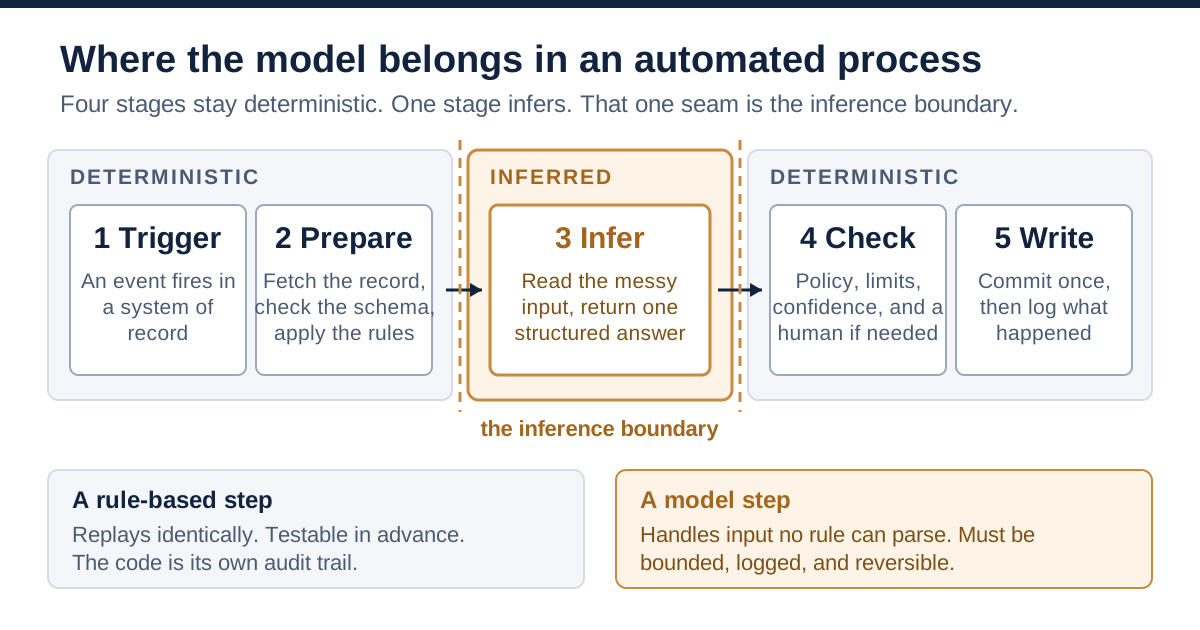
The inference boundary: the one seam in a process where a model earns its place.
We have not run a controlled deployment of the nine workflows below inside a customer estate and measured the outcomes, so nothing here is presented as our own benchmark. What follows is a design argument built on published research, primary regulatory text, and the way practitioners describe their own production systems in public.
What AI Business Automation Actually Is
AI business automation is software that completes a business task by using a model for the judgement step and conventional code for everything else. The model reads what a rule cannot parse: an email, a scanned invoice, a support thread. It returns something structured. Code then validates it, checks it against policy, and writes it somewhere. Strip out the marketing and that is the whole shape.
The contrast with traditional automation is real and it is worth stating precisely, because most descriptions get it half right. Traditional automation is a path you drew in advance: when this field changes, copy that value, send that email. It cannot handle input it was not designed for. That limitation is also its great virtue, because it can only ever touch what you wired into it, and it replays identically every time. AI business process automation removes the requirement that you enumerate every case up front. That is the feature people buy. The part nobody sells you is what leaves with the enumeration: the path stops being a thing you specified and becomes a thing the system chose, and choices need records in a way that specifications do not.
Three technologies get bundled under the same label, and separating them makes every later decision easier.
| Layer | What decides the next step | Handles messy input | Replays identically | Typical fit |
|---|---|---|---|---|
| Rule-based workflow automation | You, in advance | No | Yes | Routing, notifications, field syncs, escalation timers |
| Robotic process automation (RPA) | You, in advance, at the UI level | No | Mostly, until the screen changes | Systems with no API |
| AI business automation | A model, at one or more steps | Yes | No | Classification, extraction, drafting, summarisation |
| Agentic automation | A model, for the whole path | Yes | No | Open-ended tasks with a small blast radius |
Most of what is being sold as AI business automation in 2026 belongs in row three, and most of what is being sold as agentic belongs there too. Gartner's June 2025 assessment was blunt about the mismatch: senior director analyst Anushree Verma said that "many use cases positioned as agentic today don't require agentic implementations," in a release that also predicted over 40% of agentic AI projects will be cancelled by the end of 2027, on the grounds of escalating costs, unclear business value, or inadequate risk controls. The same release put a number on the vendor noise: Gartner estimated only about 130 of the thousands of agentic AI vendors were real.
That is the frame for everything below. AI business automation is not a category of product you buy. It is a decision you make step by step inside a process you already run.
What It Is Not: Three Things That Get Mislabelled
AI business automation is not a chatbot, not an autonomous employee, and not a rebrand of the automation you already had. Each confusion costs a different thing: the first wastes a quarter, the second wastes a year, the third wastes the credibility you need to try again.
It is not a chatbot with tools attached. A chatbot answers a person who is present, reads the reply, and corrects course. An automation runs when nobody is watching, and the correction step is gone. Nothing about the orchestration layer replaces it. The reason is timing, not intelligence. A wrong answer to a person is a wrong answer. A wrong answer to a system is a wrong record that every downstream process now reads as true.
It is not an autonomous employee. The gap between the pitch and the measured reality is large and public. In TheAgentCompany, an academic benchmark whose latest version was posted in September 2025, LLM agents are dropped into a self-contained environment that mimics a small software company, with internal websites, data and coworkers to message. The authors report that "the most competitive agent can complete 30% of tasks autonomously." Their own reading is that simpler tasks fall, and "more difficult long-horizon tasks are still beyond the reach of current systems." A 30% autonomous completion rate is a useful assistant. It is not a headcount replacement, and any plan that assumes otherwise has budgeted for the wrong thing.
It is not the same automation with a model bolted on. This is the expensive one. Gartner's sales research, published on 28 July 2026, predicts AI agents will outnumber sellers ten to one by 2028 while fewer than 40% of sellers say agents improved productivity. VP analyst Dan Gottlieb's line is the one to keep: "If those systems are fragmented, the agents will scale the fragmentation." A model does not repair a process. It runs the process faster, including the broken parts, and it does so at a volume where the breakage compounds before anyone reads a report.
McKinsey's survey data points the same way from the other end. In the state of AI in 2025, published 5 November 2025 from 1,993 respondents across 105 nations, nearly two-thirds said their organisations had not yet begun scaling AI across the enterprise — and half of the AI high performers intend to use AI to transform their businesses, with most of those redesigning workflows rather than layering AI onto the ones they already had. Redesign is the work. The model is the easy part.
Why the Standard Use-Case List Sorts on the Wrong Thing
Every guide to AI business automation opens with the same catalogue: inbox triage, invoice handling, lead qualification, scheduling, sales follow-up, support escalation, document generation. It is a good list. It is sorted on the wrong axis — ease of setup — which is exactly the axis that stops mattering the moment the thing is live.
Ease of setup measures how quickly you can get a demo working. It says nothing about the three properties that decide whether a workflow survives its first bad week. Is a mistake reversible? Would anyone notice? Can you reconstruct, afterwards, why the system did what it did? Sort the same seven items on those properties and the running order changes completely. It is not a small reshuffle. Inbox triage and invoice handling take about the same effort to prototype. One mislabels an email and someone reads it an hour later. The other approves a payment against a fraudulent invoice and you find out at month end.
There is a second problem with the catalogue, subtler and more damaging. It presents each item as a single decision — automate lead qualification, yes or no — when a workflow is five to fifteen steps and only one or two of them are candidates for a model at all. Treating "invoice handling" as one unit means either handing the model the whole chain, which is where the cancellations come from, or dropping the idea entirely. The useful unit is the step.
We made a related argument in our earlier analysis of AI agent use cases ranked by blast radius, which sorts a catalogue by what an agent can reach and how fast you can take it back. That piece answers which use case do I start with. This one answers the question that comes before it: inside the use case I picked, which steps should be a model at all? Blast radius tells you what a mistake costs. The inference boundary tells you where mistakes become possible at all.
Gartner's own recommendation, in the same 2025 release, splits the field three ways rather than two: use "AI agents when decisions are needed, automation for routine workflows and assistants for simple retrieval." That is a per-step instruction dressed as a per-project one. Read it as per-step and it becomes the most actionable sentence in the analyst literature on this topic.
The Inference Boundary: Three Questions Per Step
The inference boundary is the point in a process where a fixed rule stops being able to produce the right answer and a model has to infer one. Locating it is the whole of AI business automation design; everything else is plumbing you already know how to build. Find it by walking the process step by step and asking three questions. Every step that answers no to all three should stay deterministic, and there are usually more of those than anyone expects.
Question 1: Is the input unstructured? A model earns its place when the incoming thing is an email body, a PDF, a chat transcript, a photo, a free-text form field, or a customer sentence. If the input is a row in a database with typed columns, a rule is faster, cheaper, exactly repeatable, and testable before it ships. Extracting a total from a scanned invoice is inference. Comparing that total to a purchase order is subtraction.
Question 2: Is the rule set genuinely unenumerable? This is the question people skip. Plenty of "we need AI for this" steps are really "nobody has written the rules down." Twelve routing categories that a supervisor could list on a whiteboard are twelve rules, and twelve rules will beat a model on cost, latency, and auditability every day of the year. The honest test: ask the person who does the work today to describe how they decide. If they answer in under a minute with a list, you have a rule. If they answer "it depends, let me show you some examples," you have a model.
Question 3: Does the output need to be a judgement, or just a shape? Many model steps are only doing translation, turning prose into a structured object. Those are the safest possible model steps, because the output can be validated against a schema and rejected if it does not fit. Steps where the model picks between consequential options are a different animal. Those need a policy check behind them, and often a person.
Once you have located the boundary, three design rules follow directly and they hold regardless of which platform you use.
| Rule | What it means in practice | Why |
|---|---|---|
| Narrow the model's job | One step, one input, one structured output, validated against a schema | A narrow step can be tested; a broad step can only be observed |
| Keep writes deterministic | The model proposes, code commits, and the commit is idempotent | The most expensive failures are duplicate or malformed writes, not wrong classifications |
| Log the seam, not the process | Capture the model's input, output, confidence, policy result, and approver at the boundary | The deterministic steps document themselves; the inferred one does not |
That third rule is the one people discover late. A rule-based step is self-documenting. The code is the record of what would have happened, and you can re-run it. An inferred step has no such property. If you do not capture what went into it and what came out, you have a process whose behaviour cannot be reconstructed, which is a problem long before a regulator turns up.
Here is a seventeen-minute explainer from IBM that walks through combining deterministic decision logic with model-based steps in the same automation, which is the architecture this section is describing.

Nine Business Workflows, Cut at the Inference Boundary
Below are the workflows that appear on nearly every AI business automation list, re-cut. For each one: what the model is genuinely being asked to decide, whether a mistake is reversible, and what control the step needs. The pattern that emerges is consistent — the extraction and classification halves are safe and valuable, and the commit halves are where the design work lives.
| Workflow | What the model actually decides | Reversible? | Verdict |
|---|---|---|---|
| Inbox triage (email triage) | Which of N categories this message belongs to | Yes, within minutes | Run it. Lowest-risk starting point |
| Support ticket drafting | What a good first reply would say | Yes, if a human sends | Run it with a send gate |
| Meeting scheduling | Which slot fits the stated constraints | Mostly, an invite can be withdrawn | Run it, cap the calendars it can write to |
| Lead qualification | Whether a lead meets stated criteria | Yes, scores are re-runnable | Run it. Do not let it delete or merge records |
| Invoice processing: data extraction | What the fields on this document say | Yes, before posting | Run it, with a validation rule behind it |
| Invoice approval and payment | Whether this invoice should be paid | No, once money moves | Extraction automated, approval gated by value |
| Internal document generation | How to assemble a draft from known inputs | Yes, drafts are drafts | Run it. Gate anything that leaves the building |
| Contract or proposal generation | What terms to commit the company to | No, a sent proposal is an offer | Draft only. Named human sends, always |
| Candidate screening | Which applicants advance | Not in any way that helps the candidate | High-risk under the EU AI Act. Do not automate the decision without the oversight apparatus |
Read the "reversible" column and the shape of a sensible programme falls out of it. The first five are where teams should spend their first quarter of AI business automation work. The last four are where the governance question arrives before the automation question, and pretending otherwise is what generates the cancellation statistics.
Three of these deserve more than a table row.
Invoice handling is two workflows wearing one name. The extraction half, reading a supplier PDF and producing a structured line-item object, is a textbook inference-boundary step: unstructured input, unenumerable formats, a schema-validatable output. The approval half is a financial control with a decades-old design and an audit requirement attached. Automating the first and gating the second by value threshold gives you most of the labour saving and none of the exposure. Automate both because they sit in the same folder and you have built an unowned system with payment rights.
Candidate screening is the one to leave last. Under Annex III of the EU AI Act, systems intended to be used to "analyse and filter job applications, and to evaluate candidates" sit in the high-risk category, which brings requirements on human oversight, record-keeping, and risk management. That does not make it forbidden; it makes it a build with a compliance apparatus attached, which is a different project from wiring an inbox classifier. The timing also changed recently and most published guides have not caught up — see the section on the record below.
Support escalation looks safe and is not, quite. Classifying and drafting is safe. Deciding that a complaint does not warrant escalation is a judgement with a customer on the other end of it, The failure is invisible by construction. Nobody logs the complaint that was quietly closed. If you automate escalation, sample the closures.
Worked Example: Invoice Handling, Step by Step
Here is the complete cut for a single workflow, at the level of detail you would need to actually build it. The process: a supplier emails an invoice to accounts payable, and the goal is a posted, matched invoice with the exceptions sitting in a human queue. This is the most requested AI business automation in the back office, and it is a good one to build first.
| # | Step | Rules or model | What it does | If it fails |
|---|---|---|---|---|
| 1 | Trigger | Rules | Mail arrives at the AP address; attachment detected | Nothing runs; the mail sits |
| 2 | Intake | Rules | Store the file, assign a run ID, record sender and timestamp | Retry, then alert the owner |
| 3 | Classify | Model | Is this an invoice, a credit note, a statement, or noise? | Route to human queue |
| 4 | Extract | Model | Supplier, invoice number, date, currency, line items, totals | Route to human queue |
| 5 | Validate | Rules | Schema check, arithmetic check, currency check, duplicate check | Reject, do not pass to matching |
| 6 | Match | Rules | Compare to the purchase order and goods receipt | Flag as exception |
| 7 | Policy | Rules | Approved supplier? Within tolerance? Under the auto-approve threshold? | Escalate by value band |
| 8 | Approve | Human | A named approver sees the document, the extraction, and the match result | Run waits; it does not time out into approval |
| 9 | Post | Rules | Idempotent write to the ledger, keyed on the run ID | Retry safely; never double-post |
| 10 | Record | Rules | Log every field above, including what the model returned and who approved | Alert; a run without a record is a failed run |
Two model steps out of ten. That ratio is not a coincidence and it is close to what a well-built AI business process automation looks like in most back-office domains.
Steps 5 and 7 look like the same thing and are not, and conflating them is the most common design argument on this workflow. Validation asks whether the extracted data is internally coherent: does the schema fit, do the lines sum, is the currency one you trade in, have you seen this invoice number before. Policy asks whether a coherent invoice is one you are willing to pay automatically: approved supplier, tolerance band, value threshold, segregation of duties. A bad extraction fails validation. A perfect extraction of an invoice from a supplier you have never onboarded fails policy. Keep them as separate steps and both failures land somewhere a person can read them.
Note what step 5 does. Arithmetic validation catches the single most common extraction error — a line-item total that does not sum — without any model involvement, and it catches it deterministically, meaning the same input always produces the same catch. Note also what step 9 does: keying the ledger write on the run ID means a retry after a network failure cannot post the invoice twice. Neither of those is an AI feature. Both are the reason the AI feature is safe to use.
The threshold in step 7 is where the money is, and it is a business decision rather than a technical one. The intent is that matched invoices from approved suppliers, inside a tolerance and under a value band, clear with no human touch, while everything above the band goes to a person who now spends their time only on the interesting cases. What share of your volume that actually covers is an empirical question about your supplier mix, and the answer is in your own ledger rather than in anyone's article. Pick the band by looking at your own distribution of invoice values and your own historic exception rate. Do not pick it because a vendor's demo used a round number.
Common mistakes on this specific workflow, in the order we see them argued about:
- Letting the model do the matching. Matching is subtraction against a purchase order. Give it to code.
- Treating a low-confidence extraction as a failure rather than an exception. It is a routing signal, not an error, and exception handling is a first-class part of the design rather than a fallback you bolt on.
- Auto-approving on the model's confidence score. Confidence is not authority. The policy check decides; the model only proposes.
- Logging the outcome without logging the input. Six months later, you will need to know what the model saw, not just what it said.
- Running the whole thing under a shared service account instead of a least-privilege identity, so the ledger shows "integration user" for every posting and nobody can answer who authorised what.
The Arithmetic That Kills End-to-End Automation
Chained model steps multiply their failure rates, and this single piece of arithmetic explains most disappointing AI business automation pilots better than any discussion of model quality does. If a step succeeds with probability p and a workflow has N model steps in sequence, the end-to-end success rate is p to the power of N, assuming the steps are independent, which they roughly are when each reads a different input.
| Per-step accuracy | 3 model steps | 6 model steps | 10 model steps |
|---|---|---|---|
| 90% | 73% | 53% | 35% |
| 95% | 86% | 74% | 60% |
| 98% | 94% | 89% | 82% |
| 99.5% | 98.5% | 97% | 95% |
The table is arithmetic, not a measurement, and it is worth doing on your own numbers. What it shows is why a demo that impresses everyone in the room turns into a 60% completion rate in production: nobody chained six steps in the demo. It also shows the fix. The fix is not a better model. Halve the number of inferred steps and you improve end-to-end reliability more than a full model-generation upgrade would.
This is also the clearest reading of TheAgentCompany result. A 30% autonomous completion rate on long-horizon professional tasks is not evidence that models are bad at office work; it is what per-step reliability looks like after the exponent is applied to a realistic task length. The benchmark's authors say as much when they observe that simpler tasks are solved and long-horizon ones are not.
There is a second multiplier that the arithmetic hides. Deterministic steps do not just have higher success rates; they have known success rates. A schema validation either passes or fails and you can prove which in advance. A model step has an error rate you can only estimate from a sample, and the estimate drifts when the input distribution changes: a new supplier template, a seasonal spike in one ticket category, a customer who writes in a different language. Every model step you remove is one fewer thing that can silently get worse.
What You Lose When the Path Is Inferred
Replacing a fixed step with an inferred one costs you four specific things, and knowing which four turns a vague unease into a checklist. None of them is accuracy. Accuracy is the one everybody already worries about, and the easiest to measure.
Repeatability. The same input can produce a different output on a different day. That breaks the assumption underneath most testing practice, which is that a passing test stays passing. You move from unit tests to sampled evaluation, and sampled evaluation needs a labelled set that somebody has to maintain.
Explainability of the specific decision. A rule engine can tell you exactly why it routed a ticket: it matched clause four. A model can produce a plausible-sounding explanation that is not necessarily the mechanism. This is why the record has to capture inputs and outputs rather than the model's narration of its own reasoning.
Bounded cost per run. A fixed path costs the same every time. An inferred path costs whatever the input length and the retry count make it cost, and a retry loop with no cap is the standard way a pilot generates a surprising invoice. Budget caps belong in the platform, not in a review meeting.
A stable attack surface. A rule cannot be talked into anything. A model reading untrusted text, whether that is a supplier's invoice, a customer's email or a candidate's CV, is processing content an outsider controls, sitting next to tools that can write to your CRM or your ledger. Treat every model step that reads external input as a place where instructions can arrive, and keep the tools it can call as narrow as the step requires.
The compensations exist and they are all deterministic: schema validation, policy checks in the path, human gates at irreversible actions, idempotent writes, per-run budget caps, and a complete record. Notice that none of these are model features. The AI part of AI business automation is the easy half. The control layer around it decides whether the thing survives contact with a real month.
The Record an Auditor Will Ask For
The record is the single most under-built part of most AI business automation projects, and it is the part that regulation is now explicit about. If your automation touches a high-risk domain, the requirement is written down. If it does not, you still want the same record for the mundane reason that you cannot debug what you did not log.
The EU AI Act sets the reference standard. Article 12 requires that high-risk AI systems "shall technically allow for the automatic recording of events (logs) over the lifetime of the system," at a level of traceability appropriate to the purpose. Article 14 requires that such systems can be "effectively overseen by natural persons" while in use, and it names the specific capabilities an overseer must have: to understand the system's limitations, to remain aware of automation bias, to interpret the output correctly, to "disregard, override or reverse" it, and to stop the system through a stop button or equivalent.
The timing changed in mid-2026 and most published guidance is now stale on this point. High-risk obligations were originally due to apply from 2 August 2026. Under the Digital Omnibus package, the Council of the EU gave its final green light on 29 June 2026 to new application dates: 2 December 2027 for stand-alone high-risk AI systems and 2 August 2028 for high-risk systems embedded in products. The most widely cited AI Act reference site still displayed the superseded August 2026 date on its Article 12 and Article 14 pages when we checked on 30 July 2026, which is a good reason to read the Council text rather than a summary. If you are planning a recruitment or credit-decisioning automation, that eighteen-month difference is your build window, not a cancellation. Our earlier guide to EU AI Act compliance for deployers covers the deployer obligations in more depth.
For everything outside the high-risk categories, the same structure is simply good engineering. The NIST AI Risk Management Framework, released in January 2023, organises the work under four functions: Govern, Map, Measure, and Manage. NIST is explicit that Govern "is a cross-cutting function that is infused throughout AI risk management and enables the other functions of the process". Governance first is not a compliance posture; it is the ordering that makes the rest possible.
Practically, here is the record to capture at every inference boundary. Each line answers a question somebody will eventually ask.
| Field | The question it answers |
|---|---|
| Run ID and trigger | What started this, and when |
| Identity of the automation | Which non-human actor did this, and who owns it |
| Model input (redacted as policy requires) | What did it actually see |
| Model output and confidence | What did it propose |
| Policy evaluation result | Which rules ran, and did anything get refused |
| Approver and timestamp | Who authorised the irreversible step |
| Write result and target record | What changed in the system of record |
| Cost of the run | What did this cost, attributed to a team |
The refusals matter as much as the actions. A log that only records what ran cannot demonstrate that a control was working, because a control that is working looks exactly like a control that was never invoked. We wrote about this asymmetry in AI observability and audit trails.
One more field is easy to skip and expensive to skip: identity. If every automation writes to your systems as the same integration account, the ledger records "integration user" and the question of who authorised what has no answer. Each automation wants its own non-human identity with an owner, a scope, and an expiry, which is an argument we have made at length elsewhere.
What AI Business Automation Actually Costs
There are four cost lines, and only one of them is the one vendors quote. We do not publish benchmark prices for other people's platforms, and we would treat any article that gives you a single dollar figure for "an AI workflow" with suspicion — the range across a five-step classifier and a fifteen-step document pipeline is more than an order of magnitude. What you can do is build the model yourself in about twenty minutes.
| Cost line | What drives it | How it surprises people |
|---|---|---|
| Model inference | Input length times volume, times retries | Retries and long documents, not the base rate |
| Platform or build | Licence, or engineering time plus maintenance | Maintenance, which does not stop |
| Human review | Exception rate times minutes per exception times loaded cost | An exception rate that stays at 30% because nobody tuned it |
| Failure cost | Probability times the blast radius of a bad run | Reconciliation work, not the error itself |
The arithmetic that matters is cost per successfully completed, policy-compliant run, not cost per model call and not percentage automated. Written out, it is one line:
cost per completed run = (inference + platform + review + failure cost, per month) divided by (monthly volume × the fraction completed without a human)
Compare that against the fully loaded cost of the same volume handled the way you handle it today. Then recompute with the exception rate you actually observed in the first live month rather than the pilot's, which was measured on cleaner inputs than production will supply. We deliberately do not publish a payback period or a first-year saving figure, because the two variables that dominate both — your volume and your current cost per item — are the two we cannot know, and an article that hands you a number for them is guessing on your behalf.
Two structural points about cost, both of which follow from earlier sections. First, the inferred steps are the variable cost and the deterministic steps are nearly free. Cutting model steps therefore cuts the bill and raises reliability at once, which is one of the few genuine two-for-ones in this field. Second, cost caps have to be enforced in the path rather than reviewed monthly, because the failure mode is a retry loop that runs overnight. Gartner named escalating cost as one of three reasons agentic projects get cancelled, alongside unclear ROI and inadequate risk controls, and unbounded retries are the mechanism behind more of those than anyone likes to admit.
Where does the value actually come from? McKinsey's 2025 survey found 80% of respondents set efficiency as an objective for their AI initiatives, while the organisations seeing the most value added growth or innovation objectives on top — and, notably, most of the high performers were redesigning workflows rather than automating the existing ones in place. If your business case is entirely "fewer hours on the same process," you have picked the objective that the data associates with the weaker outcomes.
A 30-Day Path to One Live Workflow
One workflow, live, with a record. That is the whole objective of a first AI business automation project. Not a platform evaluation, not a centre of excellence. Thirty days is enough for that if the workflow is chosen well, and the choosing is the part that goes wrong.
Before you start, you need four things. A process someone can describe end to end in one sitting. Read and write access to the system of record, granted properly rather than borrowed. A named owner who will be paged when it misbehaves. And a set of historical examples with the right answers attached, because without them you cannot tell whether the thing works.
That fourth prerequisite is the one that quietly sinks projects, so treat it as real work rather than a footnote. Almost nobody has a labelled set sitting in a folder. What most teams do have is history: a month of processed invoices where the posted values are the ground truth, or a quarter of closed tickets where the final category is the label. Pulling a hundred of those and checking them is a two-day job for one person, and it is the cheapest two days in the whole plan. If your process leaves no such trail, that is a finding in itself — start by logging the human decisions for two weeks before automating any of them.
Days 1 to 5 — map and cut. Write the process out as numbered steps, at the granularity of the invoice table above. Run the three inference-boundary questions on every step. Expect to find that two or three of twelve steps want a model, and be suspicious of yourself if you find more than four.
Days 6 to 10 — build deterministic first. Wire the trigger, the fetch, the validation, the policy check, and the write, with a stub where the model will go. This is the step teams skip and the reason they cannot tell later whether a failure came from the model or the plumbing. When the deterministic skeleton runs clean end to end, you have something to attach a model to.
Days 11 to 18 — add the model step, in shadow mode. The model runs on real traffic and its output is recorded, but nothing it produces is committed. Compare against what the humans did on the same items: a hundred paired examples pins a per-step accuracy figure to within about ten points at ninety-five percent confidence, which is all the precision this decision needs. That figure is on your inputs, and it is the number every later decision depends on. No vendor can give it to you.
Shadow mode is not a free step, and it is worth naming why. The model is now reading production data, which means a data-governance decision has to happen on day 11 rather than being discovered on day 40. Decide before you switch it on which fields get masked, which model the traffic goes to, where the prompts and responses are retained, and for how long. This is exactly the decision that gets skipped when a pilot runs on someone's personal account.
Days 19 to 25 — turn on the writes, narrow band first. Pick the slice of volume with the smallest blast radius: lowest-value invoices, one supplier, one ticket category. Everything outside the slice keeps going to people. Set a confidence threshold and route below it to the exception queue rather than through it.
Days 26 to 30 — measure and decide. Four numbers: straight-through processing rate (the share completed with no human touch), exception rate, cost per completed run, and cycle time from trigger to done. Compare to the baseline you captured on day one. If you did not capture a baseline on day one, this is where the project quietly becomes unfalsifiable, which is the most common way an automation programme dies without ever failing.
Widening comes after, and it should feel boring. Widen one variable at a time. More suppliers, or a higher value band, never both in the same week. If you cannot say which change caused a change in the numbers, you have stopped running a programme and started running a hope. Our note on why AI pilots stall before production covers the organisational half of this.
Where This Advice Breaks Down
Several claims here are genuinely uncertain, and a few are simply wrong for some readers. Stating them now is cheaper than having you discover them in month three of an AI business automation programme.
The inference-boundary discipline costs upfront time, and for some workflows that is a bad trade. If a process runs twenty times a month and a mistake costs an apology, mapping ten steps and building a deterministic skeleton is over-engineering. Point a general-purpose assistant at it, keep a person in the loop, and move on. The discipline earns its cost at volume, at value, or under an audit requirement. If none of those three apply to you, ignore most of this article.
The per-step arithmetic assumes independence between steps, and real workflows violate that. A retry, a self-check, or a validation step that feeds back into the model changes the maths in your favour. Treat the table as a lower bound and a way of thinking, not a prediction. The direction is reliable; the exact figures are not.
Rules have their own rot, and this article has been kinder to them than they deserve. Anyone who ran a large RPA estate knows the failure mode: a vendor changes a screen, a field moves, and forty automations break in a morning. Deterministic does not mean maintenance-free — it means the breakage is loud and locatable rather than quiet and statistical. That is a real advantage, not a total one, and a rules layer nobody owns decays exactly like an agent nobody owns. Budget maintenance for both halves.
The strongest counterargument is that this is a snapshot, not a law. If per-step reliability rises far enough, the exponent stops biting and end-to-end delegation becomes reasonable, which is the future the agent platforms are building toward and they may well be right about the direction. Two things make us keep the boundary discipline anyway. The trajectory is not the same thing as the arrival, and the control layer you build for a two-model-step workflow is precisely the one a ten-step workflow will need — so the discipline is not wasted work even in the world where the delegation ceiling lifts.
The line between "rules can do this" and "a model is needed" moves as models improve. A step that needed a person in 2023 and a model in 2026 may be a rule again in 2028 once the pattern is understood well enough to be written down — That is the normal life cycle of automation, and the reverse happens too. Re-examine the boundary annually rather than treating a decision as permanent.
We have no first-hand deployment measurement to offer here. As stated at the top, we have not run these nine workflows in a customer estate and measured them, so the numbers in this article come from published research and the arithmetic is arithmetic. Where a vendor shows you a case study with a percentage, ask for the baseline and the sample period before you weight it more heavily than a benchmark.
And a note on sources. Reddit is the place where operators discuss this most candidly and it blocked automated retrieval throughout our research, so the practitioner voice in this piece comes from Hacker News, which skews technical relative to the finance and operations teams who own most of these workflows. Read the practitioner quote as one informed data point, not a survey.
Who Owns the Automation Once It Runs
There is one question the use-case lists never reach, and it arrives on day 31: an automation is now writing to your systems, and it is not a person. It needs an owner, a scope, an expiry, and a record. Those are the four things you would demand of a contractor with a login. That layer is what we build at Leapforce: one controlled place where every AI tool, connector, model, and agent runs under a policy, an identity, and a budget.
Concretely, it maps onto the sections above. Leapforce Workflows chains model steps and connector actions with human approval gates before a send, a payment, or a deletion, durable across the wait, with retries that stop rather than loop and per-run cost visibility. The AI Gateway puts identity, policy evaluation, and cost attribution in the request path so the record from the table above is produced automatically rather than assembled after an incident. Our rollout sequence for it is deliberately unexciting: Observe first. Enforce second. Optimize third. The first thing most organisations discover is that they did not know what was already running.
One honest caveat: Leapforce is in active development, and per-capability build status is disclosed openly rather than blurred, so ask which parts are live before you plan around them. We do not sell the invoice extractor or the ticket classifier, and nothing above requires our platform to be true.
Frequently asked questions
AI business automation is using a language model to handle the judgement step in a business process while conventional code handles everything else. The model reads something a rule cannot parse, such as an email, a scanned document or a support thread, and returns a structured answer. Code validates that answer, checks it against policy, and writes the result into your systems. The value comes from removing the requirement that you enumerate every possible case in advance.
Traditional automation follows a path you specified before it ran, so it handles only the cases you anticipated and it replays identically every time. AI business automation lets a model choose part of the path, so it copes with input you did not anticipate. The trade is determinism. A fixed path is its own audit trail and can be tested in advance. An inferred path has to be logged, bounded and made reversible, because you cannot test every case it might meet.
Start where a mistake is reversible within minutes and someone would notice the same day. Inbox triage, ticket reply drafting, lead scoring, meeting scheduling, and invoice data extraction all clear that bar. Leave payment approval, external proposals, and candidate screening until you have a working control layer, because those write to money, contracts, or people's careers and cannot be quietly undone.
Neither replaces the other and mature systems run both. RPA drives user interfaces and is the right answer when a system has no API. AI business process automation is the right answer when the input is unstructured — documents, emails, conversations — and no fixed rule can read it. A common production pattern reads the document with a model, validates and decides in deterministic code, and reaches for RPA only where a legacy screen is the sole way in.
Four lines: model inference, platform or build, human review of exceptions, and the cost of failures. Inference is driven by input length times volume times retries, and retries are what surprise people. The number to track is cost per successfully completed, policy-compliant run rather than cost per model call, and you should recompute it with the exception rate you observe in month one, not the one from the pilot. Enforce budget caps in the request path, since an uncapped retry loop is the standard way a pilot produces an unexpected bill.
Thirty days is realistic for a single well-chosen workflow with an owner, historical examples, and proper access to the system of record. Five days to map and cut the process, five to build the deterministic skeleton, a week running the model in shadow mode to get a real accuracy figure, a week writing to a narrow slice of volume, and a few days to measure against a baseline. Programmes that take longer usually spent the time choosing a platform instead of choosing a workflow.
Any step that cannot be undone by the team that owns it. Sending an external message, moving money, changing access, deleting a record, and committing the company to terms all qualify. Reversible internal steps such as classification, drafting, scoring and routing do not need a gate. They need sampling. The useful test is not how risky the step feels but how long it takes to reverse and who has to be told.
The named owner of the automation, which means one must exist before it goes live. Accountability is only real if the record supports it: you need the run's trigger, what the model saw, what it proposed, which policy checks ran, who approved the irreversible step, and what changed in the system of record. Without that trail, an incident review ends in a shrug, and every party involved has an honest reason to believe it was not them.
Its own, never a shared service account. Give each automation a non-human identity with a named owner, a scope limited to the actions it genuinely needs, and an expiry date that forces a review. Shared integration accounts make the audit log useless, because every action shows the same actor, and they make offboarding impossible, because nobody can tell which automations would break if the credential were revoked.
Ordinary back-office automation like invoice extraction or ticket triage generally falls outside the high-risk categories, though the Act's transparency provisions may still touch customer-facing systems. Employment and worker-management uses, including candidate screening, are treated as high-risk and carry obligations on human oversight and record-keeping. The application dates moved in 2026: the Council of the EU confirmed on 29 June 2026 that high-risk rules apply from 2 December 2027 for stand-alone systems and 2 August 2028 for systems embedded in products. Take legal advice on your specific case rather than relying on a category guess.
Partly. No-code builders make the connections and the model step genuinely accessible, and a capable operations person can get a reversible internal workflow live without help. What still needs engineering judgement is the deterministic half: schema validation, idempotent writes, policy checks, and the record. If your workflow only ever drafts or classifies, go ahead. If it writes to a ledger or sends externally, have someone who has debugged a duplicate-write incident look at it first.
The baseline, captured before anything is automated: how many items per month, how long each takes today, and how often the current process gets one wrong. Almost every programme that cannot prove its value skipped this, and no amount of later measurement recovers it. After go-live, track four numbers — completion rate without human touch, exception rate, cost per completed run, and trigger-to-done time — and compare each to that baseline rather than to the vendor's benchmark.
Ready to Govern Your AI?
Talk to LeapForce — one controlled layer for every AI tool, connector, model, and agent.
Comments