
An AI call center agent is software that answers or places phone calls, understands speech in real time, decides what to do, and speaks back, with no person on our side of the line. It is a contact-center worker made of four stages and one very short clock.
The interesting part is not the model. It is that a phone call is a regulated recording before it is an AI feature, and the rules attach in the first few seconds. Whether you may record depends on where the caller is sitting. Whether the caller's voice is biometric data depends on what you do with it, not on whether you stored a WAV file. Whether the agent must announce itself depends on the statute and the sector. And a text agent can think for three seconds; a voice agent cannot. Someone has already noticed that the liability question is unowned: reading the Otter.ai class action, one Hacker News commenter asked where responsibility lands when an assistant joins a call uninvited, and concluded "surely the buck stops there?" (DaiPlusPlus, Hacker News, August 2025).
The short answer: An AI call center agent is a real-time voice system in a regulated channel — build the first eight seconds of every call (disclose, consent, locate, scope) before you build the conversation, because that is where the law, the recording and the audit trail are all decided.
Last updated: July 31, 2026.
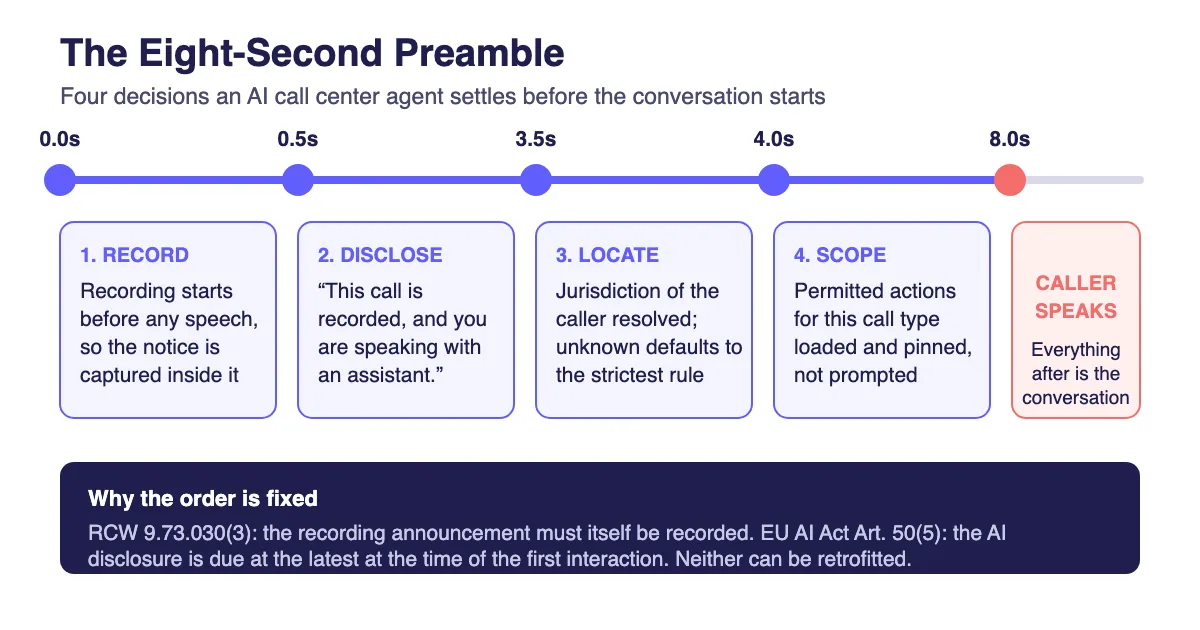
The Eight-Second Preamble: four things a call agent must settle before the conversation begins.
We have not run a production voice deployment ourselves, and nothing below is presented as our operating experience. What we did do is read the text of every statute cited here rather than a summary of it, at the official source wherever the official source was reachable, and the article says where it was not. This is not legal advice; call recording and AI disclosure rules are jurisdiction-specific and change, so treat this as a map of where to point your counsel, not as a substitute for one.
What an AI call center agent is, and what makes voice different
An AI call center agent is a system that holds a live telephone conversation with a customer: it converts speech to text, works out intent, retrieves or writes data in your systems, and speaks a reply back in a synthetic voice. Genesys defines it as a system that "uses natural language processing and machine learning to understand intent, respond to questions and route inquiries efficiently." That definition is correct and it is also the reason most buyer's guides on this topic are interchangeable. It describes the software and says nothing about the channel.
The channel is where the difficulty lives. Four things are true of a phone call that are not true of a chat widget:
| Property of the channel | Consequence for the agent |
|---|---|
| The call is captured as audio, and audio recording is separately regulated from data processing | Consent to record is a distinct legal question from consent to process, and in some states it must be obtained before the first substantive word |
| The audio carries a biometric characteristic whether or not you use it | If you match the voice against a stored template you have crossed into biometric law; if you merely transcribe, generally you have not |
| The output is synthetic speech, which several regimes now treat as a disclosable artifact | The disclosure has to be spoken, timed, and in some sectors repeated at the end of the call |
| Turn-taking is real time and unforgiving | You have a few hundred milliseconds, not a few seconds, and that budget dictates architecture |
Our position, and the reason this article exists: for an AI call center agent, the compliance envelope is not a launch checklist you complete afterwards. It is a runtime component that executes in the first eight seconds of every single call, and it constrains the architecture as hard as the latency budget does. Teams that treat it as paperwork end up rebuilding the call flow.
Because voice is the noisiest part of the AI-in-support market right now, it is worth grounding the pressure with a number. In a Gartner survey of 321 customer service and support leaders conducted in October 2025 and published February 2026, 91% reported pressure from executive leadership to implement AI. That is the environment in which the eight seconds get skipped.
How an AI call center agent works: four stages and one clock
An AI call center agent works as a streaming loop with four stages: telephony carries the audio, speech recognition turns it into text as it arrives, a model plus your tools decides what to say and do, and speech synthesis turns the answer back into audio. Every stage is streaming, and every stage adds delay to the same budget.
| Stage | What it does | What it costs you |
|---|---|---|
| Telephony transport | Carries audio between the carrier and your stack; also where recording is started and stopped | Network delay, and the point where jurisdiction is knowable from the calling number |
| Endpointing and speech recognition | Decides when the caller stopped speaking, emits partial and final transcripts | The single hardest timing problem; guess early and you interrupt, guess late and you feel slow |
| Reasoning and tools | Retrieves account data, calls internal APIs, decides the next utterance | Every tool call pauses the token stream and restarts it |
| Speech synthesis | Turns tokens into audio, ideally starting before the sentence is complete | Time-to-first-audio, not total generation time, is what the caller feels |
The stage most buyer's guides skip is endpointing. A developer who rebuilt this loop from scratch put it plainly: the hard part is not the individual models but "turn-taking: detecting when the user starts and stops speaking" (nicktikhonov, Hacker News, February 2026). That is a design decision with a compliance shadow, because a barge-in that cuts off your own disclosure is a disclosure you did not make.
There is a fifth thing happening in parallel that no diagram of the pipeline shows: the call is being recorded, transcribed, logged, and often summarised into a ticket. Those artifacts outlive the call by years. Where that record lives, who can read it, and how long it survives is a full topic of its own, and we treat it separately in our earlier analysis of transcript custody. This article is about the live call.
The latency budget: 150 milliseconds of expectation against a 790-millisecond pipeline
Human conversation runs on a very tight clock, and telephony engineering has a published number for it. Recommendation ITU-T G.114 states that "if delays can be kept below this figure" — 150 ms of mouth-to-ear delay — "most applications, both speech and non-speech, will experience essentially transparent interactivity," and sets 400 ms as the upper bound that should not be exceeded for general network planning.
That budget was written for carrying human speech. An AI call center agent spends the same budget on thinking. The measured reality is roughly five times the transparent-interactivity figure: the developer above reported reaching "~790ms end-to-end latency" by colocating the telephony, speech recognition, synthesis and orchestration layers in one region (Hacker News, February 2026). That is a good number, achieved deliberately, and it is not the only build in that region. A March 2026 Salesforce AI Research tutorial instrumented its own streaming pipeline and measured 755 ms to first audio — but that figure covers the model and synthesis stages only, and the same paper's speech-recognition-inclusive estimate is 947 to 958 ms at the median (Qiu et al., arXiv:2603.05413). So the honest reading is a band rather than a point: comparable builds land somewhere between roughly 750 ms and a second, and the two we can read both use Deepgram for recognition and ElevenLabs for synthesis, so they are not fully independent of each other. It is also about twice the 400 ms that the same Recommendation says should not be exceeded for general network planning. On the published numbers, voice agents sit outside the envelope telephony engineering was designed around.
Why does the gap matter to a caller who has waited eight minutes in a queue? Because response timing is one of the more universal things about human conversation. In a ten-language study published in PNAS and indexed at PubMed, Stivers and colleagues found that every language tested showed "a general avoidance of overlapping talk and a minimization of silence between conversational turns," with cross-language differences falling "within a range of 250 ms from the cross-language mean." People do not consciously time replies, but they notice.
The practical consequence is architectural, and it is the reason voice deployments look different from chat deployments:
| Latency decision | What it buys | What it costs |
|---|---|---|
| Colocate telephony, ASR, LLM and TTS in one region | The largest single reduction available; geography dominates | Data residency becomes a hard constraint, not a preference |
| Stream every stage instead of running them sequentially | Time-to-first-audio drops far below total generation time | Cancellation logic gets complicated when the caller barges in |
| Keep tool calls off the critical path where possible | A tool call pauses the token stream and restarts it | Some answers genuinely require a lookup; you cannot cheat all of them |
| Fill the gap with a spoken acknowledgement | Buys 500-800 ms of thinking time without silence | Overused, it reads as stalling and callers notice |
| Route to a smaller, faster model for short turns | Lower time-to-first-token on the majority of utterances | A routing decision now has a quality dimension as well as a cost one |
The last row is where an AI call center agent stops being a customer-service question and becomes an infrastructure one: per-turn model selection on a latency and privacy basis. We wrote about the general case in how AI model routing cuts LLM costs; the voice-specific twist is that the routing decision is made under a hard deadline, so the router itself must be cheap.
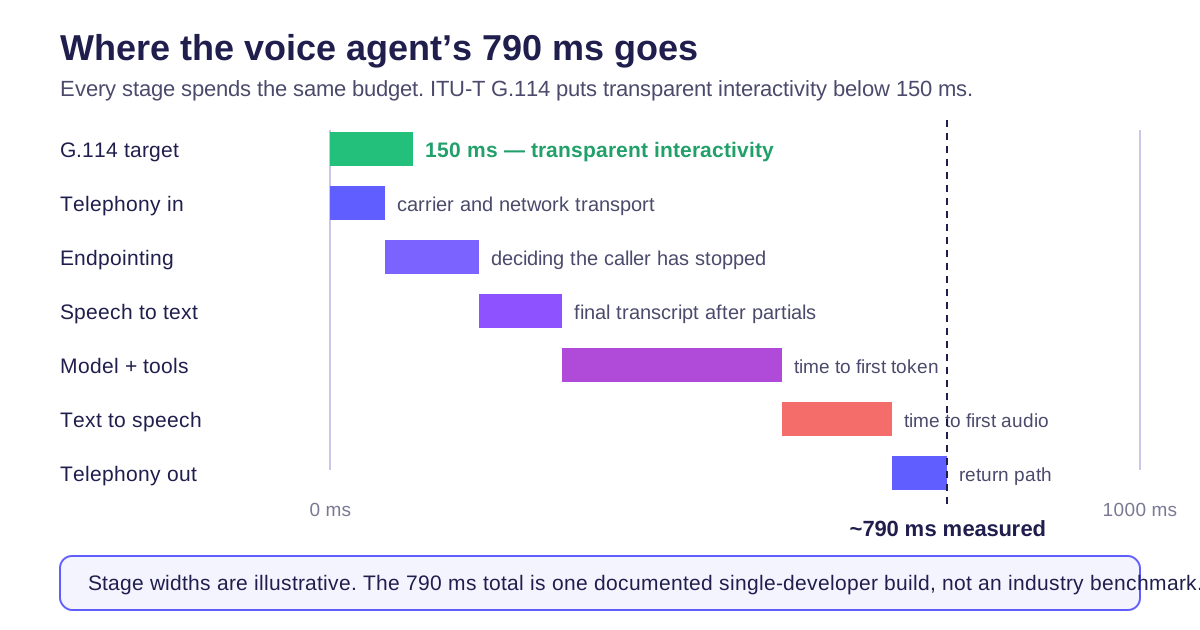
Every stage spends the same budget. The published target is 150 ms; a well-engineered pipeline lands near 790 ms.
The Eight-Second Preamble: four decisions before the caller says anything useful
Call it the Eight-Second Preamble: the four things an AI call center agent must settle before the conversation starts, in an order that survives audit. It takes about eight seconds of wall-clock time to execute and it is the cheapest governance you will ever build, because after the caller starts describing their problem it is too late to ask any of these questions.
| # | Decision | What has to be true | Where it goes wrong |
|---|---|---|---|
| 1 | Disclose | The caller is told they are speaking with an AI system, in speech, at the first interaction | The disclosure is in the IVR menu the caller skipped, or it is barge-in-cancellable |
| 2 | Consent | Recording consent is obtained, and the notice itself is inside the recording | Recording starts after the announcement, so nothing proves the announcement happened |
| 3 | Locate | The caller's jurisdiction is resolved before the recording policy is applied | The number's area code is treated as the caller's location, which mobile numbers broke twenty years ago |
| 4 | Scope | The agent's permitted actions for this call are loaded and pinned | The agent has one set of credentials for every call type, so scope is a prompt instruction rather than an enforced boundary |
Two of these have concrete statutory shapes and one is purely operational.
The disclosure ordering is fixed by the EU AI Act, which requires the information to be "provided to the natural persons concerned in a clear and distinguishable manner at the latest at the time of the first interaction or exposure" (Article 50(5), Regulation (EU) 2024/1689). "At the latest at the time of the first interaction" is not "somewhere in the call."
The consent ordering is fixed, in at least one state, by an even more specific rule. Washington's recording statute says consent is obtained when one party has announced that the conversation is about to be recorded, then adds a proviso: "if the conversation is to be recorded that said announcement shall also be recorded" (RCW 9.73.030(3)). Read that as an engineering requirement and it inverts the naive implementation. You cannot announce and then start recording. Recording starts first, the announcement is captured inside it, and the agent's first utterance therefore has to be on tape.
The obvious objection is cost. Eight seconds on every call, at a million calls a year, is roughly 2,200 hours of connected time you are paying a carrier for, and it is eight seconds during which an already-annoyed customer is listening to a robot read terms. That objection is fair and the answer is not to skip the preamble. Three of the four steps cost no wall-clock time at all: the recording start, the jurisdiction lookup and the scope load all happen while the line is still connecting or in parallel with the first utterance. Only the spoken part is real time, and a combined recording-and-AI notice runs about three seconds, not eight. The eight-second figure in the name is the outer bound including the escape-hatch sentence, which many teams shorten once they have data on how often it is used.
Suppressing barge-in during the disclosure utterance is a genuine trade-off, not a free win. It irritates repeat callers who know the menu and want to start talking. The compromise most teams settle on is to make only the disclosure sentence uninterruptible and let the caller cut in from the next sentence onward, which keeps the compliance artifact intact and gives back most of the impatience.
Step 4 is the one nobody writes a statute about and everybody gets wrong. An AI call center agent that can look up an order, issue a refund, change an address and reset a password is holding four different levels of authority in one identity. Scope belongs to the agent, not to the prompt — the same argument we make about giving every non-human identity an owner, scope and expiry.
Consent to record: the map is not the same in every state
Recording a US phone call is legal with the consent of one party under federal law and illegal without the consent of all parties in a minority of states. That single sentence is the whole problem, because an inbound line does not know which rule applies until it knows where the caller is.
The federal baseline is permissive. Under 18 U.S.C. 2511(2)(d), it is not unlawful for a person not acting under color of law to intercept a communication "where such person is a party to the communication or where one of the parties to the communication has given prior consent," unless the interception is for a criminal or tortious purpose. If your company is a party to the call, federal law is satisfied.
State law is where it stops being simple.
| Jurisdiction | Rule we verified at the statute | Practical effect on an AI call flow |
|---|---|---|
| Federal (US) | One-party consent; the company is a party (18 U.S.C. 2511(2)(d)) | No announcement strictly required |
| California | All parties must consent to recording a "confidential communication"; fines up to $2,500 per violation, and up to $10,000 for a repeat offender (Cal. Penal Code 632) | Announcement required, and it must be effective |
| Washington | Consent of all participants; the announcement itself must be recorded (RCW 9.73.030) | Recording must start before the announcement |
| Everywhere else | Varies; we did not read every state code and do not assert a count | Treat the strictest applicable rule as the default |
We deliberately do not publish a "there are eleven all-party-consent states" figure. Secondary sources disagree on the count, several states' rules turn on whether a communication was "private" or "confidential" in the circumstances rather than on a flat rule, and a number that is wrong by two states is worse than no number. The two statutes above we read in full; the rest is your counsel's job.
The operational answer that most contact centers land on is to announce on every call regardless of jurisdiction. That is defensible, and for an AI call center agent it is close to free, because the agent already has to speak a disclosure. Combine them into one preamble utterance and you have satisfied step 1 and step 2 in a single breath: "This call is recorded, and you are speaking with an automated assistant."
One caution on combining them: they are legally distinct. A recording notice is not an AI disclosure, and an AI disclosure is not consent to record. If the caller objects to one, the agent needs a branch for that one, not a single failure path that drops the call.
Which raises the branch most teams build last. What happens when the caller says "do not record this"? The system has to stop recording, log the withdrawal as an event in its own right, and then decide whether the call can continue at all, because in a contact center the recording is often the only evidence that an instruction was given. Our view is that this branch belongs in the first sprint rather than the backlog. It is the one path where the wrong behaviour is both unlawful and invisible until someone complains.
When the caller's voice becomes biometric data
A caller's voice becomes biometric data when you process it to identify that specific person. Not when you record it, and not when you transcribe it. The distinction is written into the statutes, and it is the single most misunderstood thing about voice AI.
Illinois is the aggressive jurisdiction. Under the Biometric Information Privacy Act, "biometric identifier" means "a retina or iris scan, fingerprint, voiceprint, or scan of hand or face geometry" (740 ILCS 14/10). Voiceprint is on the list explicitly. Section 15(b) then says no private entity may collect one unless it first informs the subject in writing that a biometric identifier is being collected, informs them in writing of the specific purpose and length of term, and "receives a written release." Section 20 attaches liquidated damages of $1,000 for a negligent violation and $5,000 for an intentional or reckless one, per violation, plus fees.
Read those three provisions together and one thing jumps out for a phone channel: BIPA's consent mechanism is a written release. A spoken "yes" on a call is not obviously that. If your AI call center agent authenticates callers by voice in Illinois, the enrolment step probably does not belong on the phone at all.
The European framing is different in shape and lands in the same place. GDPR defines biometric data as "personal data resulting from specific technical processing relating to the physical, physiological or behavioural characteristics of a natural person, which allow or confirm the unique identification of that natural person" (Article 4(14)), and Article 9(1) puts biometric data into the special-category list only when it is processed for the purpose of uniquely identifying a natural person. Same test: purpose, not medium.
| What the agent does with the audio | Biometric under BIPA | Special category under GDPR |
|---|---|---|
| Records the call and stores the audio | Generally no, on its own | No, on its own |
| Transcribes speech to text | Generally no | No |
| Detects the language or accent for routing | Generally no | Not on this basis alone |
| Matches the voice against a stored template to verify identity | Yes, this is a voiceprint | Yes, this is unique identification |
| Builds a template so future calls can be matched | Yes, and the written release is due before collection | Yes |
One carve-out is worth knowing before you assume you are exposed. BIPA says nothing in the Act applies "to a financial institution or an affiliate of a financial institution that is subject to Title V of the federal Gramm-Leach-Bliley Act" (740 ILCS 14/25(c)), which removes a large share of the banking contact centers that would otherwise be the most exposed. That is not a reason to skip the analysis. It is a reason to do it properly rather than by reputation.
Disclosure: which laws actually make a synthetic voice announce itself
Several laws now require an AI voice to identify itself, and the famous one does not apply to your phone line. Getting this right matters, because "California requires bots to disclose" is repeated constantly by vendors and it is not what the statute says.
California's bot law makes it unlawful to use a bot "to communicate or interact with another person in California online" with intent to mislead about its artificial identity for commercial or electoral purposes (Cal. Bus. & Prof. Code 17941). The definitions section defines "online" as "appearing on any public-facing Internet Web site, Web application, or digital application, including a social network or publication," and "bot" as "an automated online account" (Cal. Bus. & Prof. Code 17940). A phone call is not an online account on a public-facing website. Do not build your telephone disclosure policy on this statute.
Here is what does bind, with the trigger for each.
| Regime | What it requires | Trigger | Applies from |
|---|---|---|---|
| FCC Declaratory Ruling FCC 24-17 | AI-generated voices are "artificial" under the TCPA, so callers "must obtain prior express consent from the called party" before an artificial-voice call, plus identification and disclosure obligations, and opt-out obligations where the message is an advertisement or telemarketing | Outbound calls using a synthetic voice to US numbers | Effective upon release, 8 February 2024 |
| EU AI Act Article 50(1) | Natural persons must be "informed that they are interacting with an AI system," unless obvious to a reasonably well-informed person | Any AI system intended to interact directly with people | 2 August 2026 (Article 113) |
| EU AI Act Article 50(2) | Synthetic audio output must be "marked in a machine-readable format and detectable as artificially generated or manipulated" | Providers of systems generating synthetic audio | 2 August 2026 |
| Cal. Health & Safety Code 1339.75 | Generative-AI patient communications need a disclaimer; for audio it must be "provided verbally at the start and the end" of the interaction, plus instructions for reaching a human | Health facility communications about patient clinical information, unless read and reviewed by a licensed provider | In force |
Three engineering consequences fall straight out of that table.
The FCC row is about outbound, and it is the harshest of the three because the consent it demands is TCPA consent, obtained before the call. An inbound support line where the customer dialled you is a different posture from an outbound collections or appointment-reminder campaign in a synthetic voice. Many teams build one voice agent and point it both ways. That is one system with two very different legal footings.
The Article 50(2) row is a watermarking obligation on the provider of the synthesis system, not on you as deployer. It is still worth asking your text-to-speech vendor about, in writing, because "our vendor does it" is only true if they do.
The health-care row is the one that changes the shape of the call. A disclaimer at the start and the end means the agent needs a closing sequence it actually reaches, including on calls that end badly. If the caller hangs up mid-sentence, the closing disclaimer never happens. That is not a compliance edge case you can note in a spreadsheet; it is a call-flow requirement with a failure mode.
What the agent must not infer from a voice
There is a category of voice processing that is not merely regulated but prohibited outright in the EU, and it is one that contact-center software vendors sell as a headline feature: inferring the emotional state of employees.
The EU AI Act prohibits "the use of AI systems to infer emotions of a natural person in the areas of workplace and education institutions, except where the use of the AI system is intended to be put in place or into the market for medical or safety reasons" (Article 5(1)(f)). Recital 44 explains the reasoning, citing "serious concerns about the scientific basis of AI systems aiming to identify or infer emotions" alongside "the imbalance of power in the context of work." That prohibition has applied since 2 February 2025 under Article 113.
The distinction that matters operationally: this is about your agents, not your customers. Real-time sentiment scoring of the human agent's voice on a supervisor dashboard is workplace emotion inference. Sentiment scoring of the customer's voice is not covered by Article 5(1)(f). It is covered by Article 50(3), which requires deployers of an emotion recognition system to inform the people exposed to it. Either way, "we turned on sentiment analysis" is a decision that needs a named owner.
The wider version of this problem is arriving fast. Gartner now predicts that "by 2029, most privacy incidents will result not from the direct exposure of personally identifiable information (PII), but from AI-generated inferences about individuals," with VP Analyst Bart Willemsen describing "a fundamental shift underway from data exposure to insight exposure" (Gartner, 30 July 2026). A voice channel is the richest inference surface a company operates. Accent, hesitation, breathing, background noise and speaking rate are all in the signal whether you asked for them or not.
The control is not technical mystery. It is a written list of what the system is permitted to infer, enforced at the point the inference is requested, and logged when it is refused. An audit trail that records only what ran, and not what was blocked, cannot answer the question a regulator will actually ask.
Four voice roles, four different legal footings
Contact-center AI is usually categorised by capability: self-service bot, agent assist, virtual agent, analytics. That taxonomy is useless for governance because two systems in the same category can sit under completely different rules. Sort them instead by what the system does to the call, and the legal footing sorts itself.
| Role | What it does | Consent question | Biometric exposure | Disclosure duty |
|---|---|---|---|---|
| Listener — agent assist, live transcription, QA scoring | Hears the call, speaks to nobody | Recording consent applies in full; the customer may never learn a second system is listening | None from transcription alone; high if speaker identification is on | No AI-interaction duty to the customer if it never interacts; emotion inference on the human agent is prohibited in the EU |
| Speaker — outbound notifications, reminders, collections in a synthetic voice | Talks, barely listens | TCPA prior express consent required before the call, per FCC 24-17 | Low | Highest: TCPA identification and disclosure, opt-out where the message is an advertisement or telemarketing, plus AI disclosure |
| Conversationalist — inbound support, the thing people mean by "AI call center agent" | Talks and listens, takes actions in your systems | Recording consent on the call; the customer dialled you, so TCPA consent is not the issue | Low unless it authenticates | AI-interaction disclosure at first interaction |
| Authenticator — voice biometrics for identity verification | Matches the voice against a stored template | Recording consent plus a separate biometric consent, in writing under BIPA | This is the biometric case; BIPA and GDPR Article 9 both bite | Disclosure of the biometric processing, separate from the AI disclosure |
The reason to sort this way is that most projects start as a Conversationalist and quietly become an Authenticator when someone adds "and it can verify the caller by voice so we skip the security questions." That is a one-line feature request that moves the whole system into a different statute, with a written-release requirement that a phone call cannot easily satisfy.
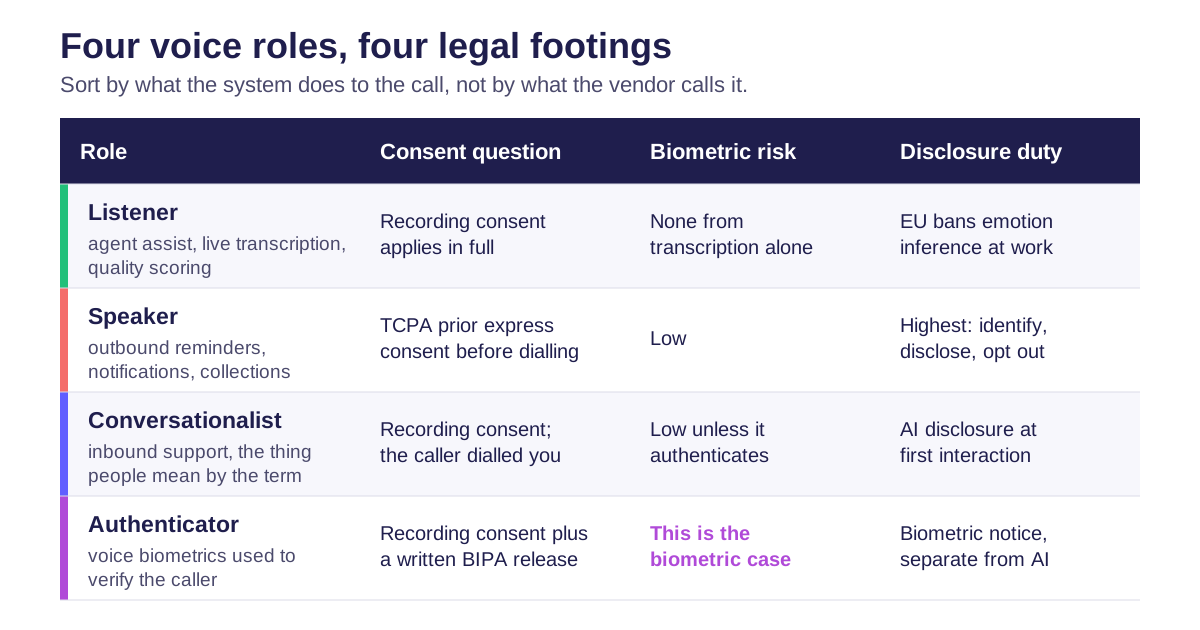
The same platform sits under four different legal footings depending on what it does to the call.
A worked call: five minutes, annotated
Here is one complete inbound call, timed, with what has to happen underneath each moment. The scenario: a customer calls a retailer about a delayed order and asks to change the delivery address.
| Time | What the caller hears | What the system does |
|---|---|---|
| 0.0 s | (ringing stops) | Call answered; recording starts before any speech, so the disclosure lands inside the recording |
| 0.3 s | — | Calling number resolved against a jurisdiction table; all-party-consent posture selected as the default when the location is uncertain |
| 0.5 s | "This call is recorded, and you are speaking with an automated assistant." | Disclosure and recording notice in one utterance; barge-in suppressed for this utterance only |
| 3.5 s | "You can ask for a person at any time. How can I help?" | Escape hatch stated aloud; the phrase that triggers it is registered, not inferred |
| 4.0 s | — | Agent scope loaded for this call type: read order status, update delivery address, no refunds, no account credentials |
| 4.2 s | (caller starts talking over the agent) | Barge-in is permitted from the second utterance onward, so an impatient caller is never blocked; the disclosure at 0.5 s was already captured on the recording |
| 4.5-8.0 s | (caller states their problem) | Preamble complete. A quick caller closes it at about 4.5 seconds; 8.0 is the outer bound when the full escape-hatch line plays. Everything after this point is the conversation |
| 0:14 | "I do not want this recorded." | Consent withdrawal branch: recording stops, the withdrawal itself is logged as an event, and the call either continues unrecorded under the applicable policy or transfers to a human. This branch is the one to build first, not last |
| 0:24 | "Let me pull that up." | Filler utterance covers a 700 ms order-lookup tool call |
| 0:31 | "Order 4471, shipped Tuesday, currently delayed." | Read action; logged with the record identifier, not just the text |
| 1:10 | "I can change the delivery address. What is the new one?" | Write action requested; the agent checks the loaded scope before offering, not after |
| 1:35 | "Repeating that back to you: ..." | Read-back before commit; the caller's confirmation is the authorisation event and is logged as such |
| 1:52 | "That is updated." | Write executed; the audit record carries agent identity, scope, before-value, after-value and the confirmation timestamp |
| 2:40 | "I cannot process a refund on this line. I will put you through to someone who can." | Refusal logged with the reason. This entry is as important as the successful actions |
| 2:48 | (hold music, 6 seconds) | Warm transfer packet assembled: transcript, actions taken, actions refused, verification status |
| 2:54 | "Putting you through now." | The AI leg ends here. Where a closing disclaimer is required, as in California health care, it has to be spoken before the transfer, not after the call, and a transfer is the path on which teams most often lose it |
Two rows in that table are the ones people leave out. The 2:40 refusal is the entry an auditor most wants and the one that most systems do not write, because logging frameworks are built around successful operations. And the 1:35 read-back is what turns a conversation into a commit with a verifiable authorisation, which is the difference between an action you can defend and an action you can only describe.
Handoff: what a warm transfer has to carry
An AI call center agent passes a call to a human by transferring the audio and, separately, transferring the context. The audio part is a solved telephony problem. The context part is where the customer experience is won or lost, because a transfer that drops context makes the AI leg worse than useless. The customer has now explained the problem twice.
A handoff packet that actually works carries five things:
- The transcript so far, not a summary of it. Summaries lose the specific detail the human needs.
- Actions already taken, with identifiers. "Changed the delivery address on order 4471 at 13:42" beats "helped with a delivery issue."
- Actions refused, and why. The human agent needs to know what the system declined so they do not repeat the refusal or, worse, unknowingly reverse it.
- Verification status. What was checked, by what method, and what was not. This is the field most likely to be assumed rather than transmitted, and assuming it is how account takeover happens.
- The reason for transfer, as a category, not free text. Categories aggregate; free text does not.
Trigger the handoff on rules, not on model judgment. The rules worth hard-coding: the caller asks for a person, the caller repeats themselves twice, the intent classifier falls below its confidence floor, the request is outside the loaded scope, or the caller uses language indicating distress or a regulated topic. Each of those is checkable without asking the model whether it thinks it is doing well. When the escalation criterion is the model's own self-assessment, the failure mode is the model being confidently wrong, which is exactly the case escalation exists for. The broader argument for approval and escalation gates as a control rather than a courtesy is in our earlier piece on human-in-the-loop automation.
Eleven questions to ask a voice AI vendor
Vendor evaluation for voice usually happens on accuracy, integrations and price. Those matter and they are also the three things every vendor is ready for. These eleven are the ones that separate a demo from a deployment, and each has a right answer you can check rather than a claim you have to trust.
| # | Question | What a good answer looks like |
|---|---|---|
| 1 | Does recording start before the first utterance, and can you show me a recording that contains the disclosure? | They play you one |
| 2 | How is the caller's jurisdiction determined, and what is the default when it is unknown? | A named data source, and "strictest applicable rule" as the default |
| 3 | Is the AI disclosure barge-in-cancellable? | No for the disclosure utterance, yes for everything after |
| 4 | What is your measured time-to-first-audio at the 95th percentile, on my traffic profile? | A number with a percentile and a test method, not "sub-second" |
| 5 | Where does audio processing physically happen, and can I pin it to a region? | Named regions, contractually |
| 6 | Do you generate a voiceprint or speaker embedding at any point, including for diarisation? | A precise yes or no, with the retention period |
| 7 | Is your synthetic audio watermarked, and by whom? | The TTS provider named, and the mechanism |
| 8 | What is logged for a refused action, and can I export it? | A worked example of a refusal record |
| 9 | Which credentials does the agent hold, and are they scoped per call type or global? | Per call type, brokered, short-lived |
| 10 | What happens to the transcript, the audio and the derived summary, on what retention clocks? | Three separate answers, because they are three separate artifacts |
| 11 | What did the system do the last time a caller withdrew consent mid-call? | An actual described behaviour, not a roadmap item |
Question 11 is the one we would ask first. It cannot be answered from a datasheet, and the answer tells you whether anyone has thought past the happy path.
What an AI call center agent is not
Precision here saves procurement arguments later.
- It is not an IVR with better speech recognition. An IVR routes; an AI call center agent resolves, which means it takes actions in systems of record and therefore needs authorisation, not just routing rules.
- It is not a chatbot with a voice. Everything above, from recording consent to biometric exposure to spoken disclosure to the latency budget, is channel-specific. Porting a text agent to the phone imports none of it.
- It is not a compliance layer. It is a thing that must be governed, not a thing that governs. Vendors that market both should be asked which one they are selling you.
- It is not a headcount forecast. In the same Gartner survey, nearly 80% of organisations planned to transition at least some agents into new roles rather than remove them, and 84% planned to add new skills to the agent role. Whatever the vendor deck says about deflection, the operating plan most leaders described is redeployment.
- It is not a single system with a single legal footing. See the four roles above. The inbound assistant and the outbound reminder campaign are different products wearing the same badge.
When a plain IVR or a human queue still wins
There are call types where the honest recommendation is to not deploy an AI call center agent, and saying so is more useful than a caveat paragraph.
| Call type | Better answer | Why |
|---|---|---|
| Single-purpose, high-volume, no variation (balance, opening hours, order status) | A well-built IVR or a callback with an SMS link | Deterministic, testable, near-zero latency, no disclosure question, and cheaper |
| Anything where a wrong answer is a regulated harm (clinical advice, benefits eligibility, legal deadlines) | Human, or AI drafting reviewed by a human before it is spoken | The exemption in California's health-care rule exists precisely because human review changes the obligation |
| Vulnerable-caller lines (bereavement, hardship, safeguarding) | Human queue with AI assist behind it | The Listener role delivers most of the efficiency with none of the exposure |
| Anything requiring identity proofing to a high assurance level | Out-of-band verification, not voice matching | Voice authentication drags you into biometric law, and synthetic voice has made the threat model worse |
| Very low call volume | Nothing; answer the phone | The eight-second preamble, the jurisdiction table and the audit pipeline are fixed costs that do not amortise over 40 calls a week |
The IVR row deserves emphasis because it is the one most often skipped for reasons of fashion. If the entire call is "what is my order status," the AI version is a more expensive way to be slower, and it adds two legal questions the IVR did not have.
Where LeapForce fits, and where it does not
LeapForce does not sell an AI call center agent, a contact-center platform, or a speech stack. We do not do telephony. What we build is the layer underneath — one controlled path for every AI tool, connector, model and agent, so that access, policy, cost and audit are answered in one place rather than per vendor.
The connection to this topic is specific rather than general. A voice agent needs a model routing decision under a hard deadline, credentials scoped to the call type, an identity of its own with an owner and an expiry, and an audit record that captures refusals as well as actions. Those are the same four problems every other AI deployment in the company has, and solving them once per vendor is how organisations end up with four control planes. Our gateway rollout model is deliberately unglamorous — Observe first. Enforce second. Optimize third. — because the observation phase is what tells you which AI surfaces already exist before you write a policy for them. You can see the shape of it on our AI Gateway and Observability and Audit pages. LeapForce is in active development and per-capability build status is disclosed on those pages; take them at their labels rather than at ours.
Honest limits and open questions
Where this analysis is uncertain, and where we would want more before betting on it:
- Two statutes are not a survey. We read California and Washington in full and cite them precisely. We did not read all fifty state codes, and we deliberately publish no count of all-party-consent states because the honest answer depends on how each state treats "private" or "confidential" communications in context.
- BIPA's application to voice AI is still moving. We cite the statute, not the case law, because what counts as a "biometric identifier" is actively contested in the courts and we did not read the docket. If your exposure turns on that question, it needs a lawyer rather than a blog post.
- Article 50 has not been enforced yet. The transparency obligations apply from 2 August 2026 — two days from this article's date. What "clear and distinguishable" means for a spoken disclosure in practice will be decided by supervisory authorities, not by us.
- The latency numbers are two instrumented builds, not a benchmark. The ~790 ms figure comes from a documented single-developer build with a named stack; the 755 ms figure from a research tutorial instrumenting its own pipeline, and it excludes the speech-recognition stage that the 790 ms includes. Read together they give a band of roughly 750 ms to a second, not a corroborated point estimate — and the two builds share their speech-recognition and synthesis vendors, so they are less independent than two sources normally are. Neither is an industry average. We found no independent, methodologically transparent latency benchmark across commercial voice platforms — the published cross-vendor comparisons we found were run by vendors in the same market — which is itself a gap worth noting.
- We could not verify some sources a reader would expect. The PCI Security Standards Council's own PDF of its telephone-payments guidance is published as scanned images and its standards library is licence-gated, so the requirement 3.3.1 text we quote comes from a third-party reproduction rather than the Council's own machine-readable document. The Illinois General Assembly's own site did not respond to any of our fetch attempts either, so the BIPA text quoted here was read at a third-party republisher that reproduces the statute in full. And Utah's AI Policy Act is frequently cited in this area, but le.utah.gov was unreachable too, so we make no claim about it.
- Vendor ROI figures are excluded entirely. Every containment-rate and cost-per-call improvement figure we found traced back to a vendor's own marketing with no published methodology. We would rather show you no number than an unfalsifiable one.
- We did not test any product. We have not operated a production voice deployment, and this article contains no first-hand operational measurements from us.
Frequently asked questions
An AI call center agent is software that holds a live phone conversation with a customer — recognising speech, deciding what to do, taking actions in your systems, and replying in a synthetic voice — without a person on the company's side of the call. It differs from a chatbot mainly in channel: the audio is recorded, the reply is synthesised, and the whole exchange happens under a few-hundred-millisecond turn-taking budget.
They work as a four-stage streaming loop. Telephony carries the audio; a speech recogniser decides when the caller stopped talking and emits text as it arrives; a model plus your tools decides what to say and what to do; a speech synthesiser starts producing audio before the sentence is finished. Every stage streams, because running them one after another rather than in a pipeline is what makes a voice agent feel slow. Recording, transcription and logging run in parallel with all four.
In the EU, yes: from 2 August 2026, Article 50(1) of the EU AI Act requires people to be informed they are interacting with an AI system, and Article 50(5) requires that information "at the latest at the time of the first interaction." In US health care, California requires an audio disclaimer "provided verbally at the start and the end" of AI-generated patient communications unless a licensed provider reviewed the content. California's better-known bot-disclosure law does not apply, because it covers "online" accounts on public-facing websites, not phone calls. Outside those, disclosure is usually a policy choice, and disclosing anyway is the low-risk default.
Federal law is satisfied by one party's consent when your company is a party to the call (18 U.S.C. 2511(2)(d)). Several states require all parties to consent — California's Penal Code 632 carries fines up to $2,500 per violation, and Washington's RCW 9.73.030 additionally requires that the recording announcement itself be recorded. Most contact centers announce on every call. For an AI agent this costs nothing extra, because a disclosure utterance is already required, but keep the recording notice and the AI disclosure legally distinct even when they share one sentence.
Only when you process it to identify that specific person. Illinois BIPA lists "voiceprint" as a biometric identifier and requires written notice and a written release before collection, with liquidated damages of $1,000 or $5,000 per violation. GDPR Article 4(14) defines biometric data by whether the processing allows or confirms unique identification, and Article 9 applies special-category rules only when that is the purpose. Recording and transcribing a call, on their own, generally do not create a voiceprint. Enrolling a caller into voice authentication does.
Payments, yes, if card data never enters the recording or the transcript. PCI DSS v4.0.1 requirement 3.3.1 states that sensitive authentication data "is not stored after authorization, even if encrypted," and 3.3.1.2 that "the card verification code is not stored upon completion of the authorization process" (requirement text reproduced here; the Council's own document is licence-gated). The usual design is to hand the caller to DTMF capture or a hosted payment step with recording suppressed, so the AI agent never hears the digits. Identity verification by voice is a different matter: it creates a voiceprint and pulls you into BIPA and GDPR Article 9, and a spoken consent is a poor fit for BIPA's written-release requirement.
By transferring the audio through the telephony layer and, separately, passing a context packet: the full transcript, the actions already taken with their record identifiers, the actions refused and why, the verification status, and a categorised transfer reason. Trigger the transfer on rules rather than on the model's own assessment of how the call is going. The rules: the caller asks for a person, repeats themselves, falls below the intent-confidence floor, or requests something outside the agent's loaded scope.
Fast enough that the gap is not conspicuous. ITU-T G.114 puts transparent interactivity below 150 ms of mouth-to-ear delay and sets 400 ms as the planning ceiling. One documented single-developer build, colocating telephony, speech recognition and synthesis in a single region, reached "~790ms end-to-end latency" (nicktikhonov, Hacker News, February 2026); a March 2026 research tutorial instrumenting its own streaming pipeline measured 755 ms to first audio excluding speech recognition, and estimated 947 to 958 ms with it (Qiu et al., arXiv:2603.05413). Roughly 750 ms to a second is the band to plan against. That works in practice, because callers tolerate a beat before a reply. Only a beat, though. The fixes that actually move the number are colocating every component in one region, streaming each stage rather than sequencing them, and keeping tool calls off the critical path or covering them with a short spoken acknowledgement.
On your own agents, in the EU, no. Article 5(1)(f) of the EU AI Act prohibits AI systems used to infer emotions in the workplace, with a narrow exception for medical or safety purposes, and that prohibition has applied since 2 February 2025. On customers, it is not prohibited but Article 50(3) requires deployers of an emotion recognition system to inform the people exposed to it. Outside the EU this is generally lawful and still worth a written decision, because voice is an unusually rich inference surface.
The conversation design is the fast part; the envelope around it is the slow part. Budget separately for the jurisdiction and consent policy, the scope definition per call type, the credential brokering, the audit schema including refusals, the handoff packet, and the retention clocks for audio, transcript and derived summary. Teams that scope only the conversation ship a demo in two weeks and then spend two quarters on everything above.
Measure containment rate, average handle time on the calls that still reach a human, first-contact resolution, and cost per resolved contact — and measure them against your own pre-deployment baseline, not against a vendor benchmark. Then subtract the costs that do not appear in the licence: the compliance envelope, the ongoing conversation design work, the escalation load on senior agents who now only get hard calls, and the retention cost of storing audio and transcripts. We deliberately publish no industry ROI percentage here; every figure we found came from a vendor with no disclosed methodology.
When you have one call type that is high volume, low variation, and low harm if wrong. Also when you can answer the eleven vendor questions above for your own environment, not just the vendor's. Starting with a hard call type to prove value is the most common way these projects stall. Starting with the highest-volume simple intent, with a rule-based escape to a human, gives you a real baseline and a real audit trail before anything difficult depends on it.
Ready to Govern Your AI?
Talk to LeapForce — one controlled layer for every AI tool, connector, model, and agent.
Comments