
AI customer feedback analysis is software that reads unstructured customer text — survey comments, reviews, support tickets, app-store replies — and turns it into themes, sentiment labels and counts. It works well enough to buy. The hard part is not accuracy. It is what the compression throws away.
Our position is that customer feedback is the only enterprise data channel with no schema, no gate on arrival, and no honest purpose limitation — and the first thing almost every team does with it is compress it. That creates two governance problems pointing in opposite directions. Things arrive that nobody scoped for: identity documents, health details, complaints naming an individual employee, safety reports. And things leave when a theme replaces an item: the single complaint that started a regulatory clock becomes "3% mention product quality" and is never read by a human again. On Hacker News in July 2026, a commenter writing as charles_f described the customer side of this plainly, saying that when something from a large company breaks he assumes "no signal possible back to whomever is responsible". He was not complaining about a bad summary. He had stopped writing feedback at all — which is the other half of the measurement problem this article is about.
The short answer: Buy AI customer feedback analysis for clustering and search, run it over the whole corpus, and treat every summary as a routing hint rather than a record — because the items a summary drops are disproportionately the ones carrying a legal clock, a named person, or a safety fact.
Last updated: July 31, 2026.
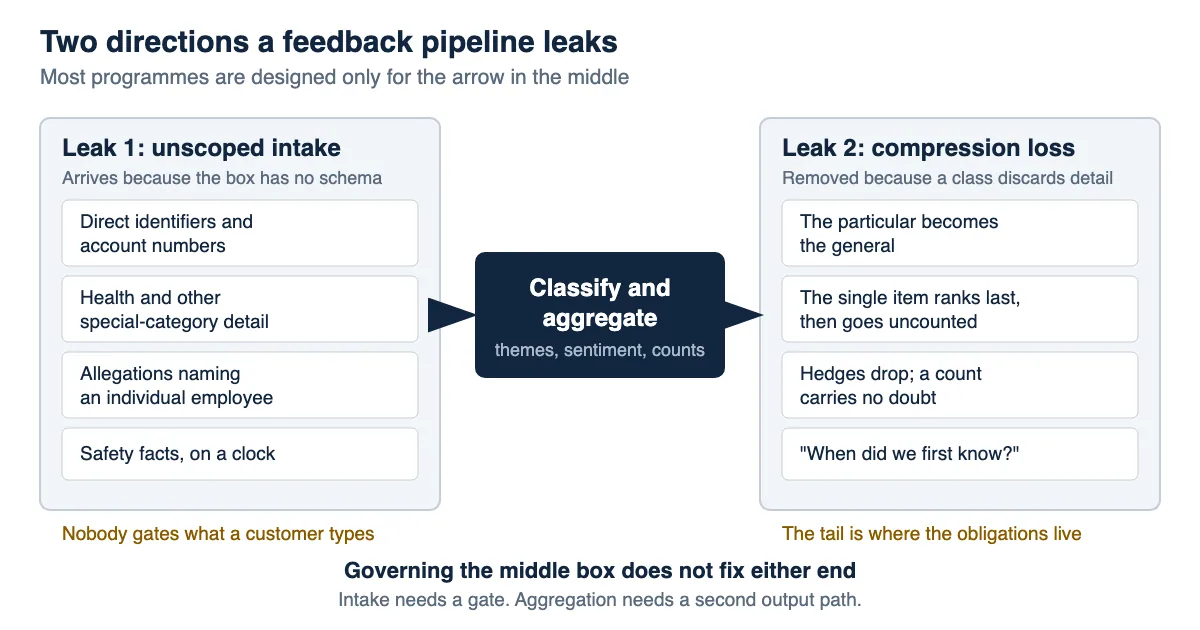
The two directions a feedback pipeline leaks. Most programmes are designed only for the arrow in the middle.
What AI customer feedback analysis actually is
AI customer feedback analysis is the use of language models and classical natural language processing to convert unstructured customer text into structured fields — a theme label, a sentiment value, an urgency score, an extracted entity — so that a volume of writing no team could read is summarised into something a dashboard can display. The inputs are the ones any voice-of-the-customer programme already collects: survey and NPS verbatims, product reviews, support tickets, chat transcripts, app-store responses and in-product feedback widgets. The output is almost always a ranked list of themes with counts attached.
The pipeline has five stages, and buying decisions concentrate on the middle three.
| Stage | What happens | What it produces | Who checks it |
|---|---|---|---|
| Intake | Text arrives from a channel the company opened | Raw verbatim, plus whatever metadata the channel carries | Nobody — it is accepted by definition |
| Normalise | Deduplication, language detection, optional redaction | Cleaned text | Sometimes, at setup |
| Classify | Theme assignment, sentiment labelling, entity extraction | Structured fields per item | Spot-checked at setup, rarely after |
| Aggregate | Counts, trends, ranked theme lists | The dashboard | Read constantly, audited never |
| Route | Alerts, tickets, roadmap inputs, closed-loop replies | Actions | Only when something goes wrong |
The industry sells stages three and four. The governance failures live in stages one and five. Intake decides what enters your estate; routing decides whether an individual item ever reaches a human who is allowed to act on it. Everything in between is a compression step, and compression is lossy by construction. That is the point of it.
That word "compression" is not a metaphor here. A wave of 900 survey responses at forty words each is 36,000 words of writing about your company by the people who buy from you. A theme dashboard renders it as maybe fifteen rows. The ratio is the value proposition and the risk in the same number.
What it is not, and why the confusions are expensive
Three confusions turn up in nearly every evaluation, and each one costs real money later.
It is not a complaints register. A theme dashboard counts. A complaints register holds individual items, each with an identifier, an owner, an outcome and a date. Regulated industries are usually required to keep the second, and a summary of the first does not substitute. Under the FDA's quality management system regulation, 21 CFR 820.35(a) requires a device manufacturer to maintain records of "the review, evaluation, and investigation for any complaints involving the possible failure of a device, labeling, or packaging to meet any of its specifications", per complaint, with the complainant's name and address, the nature and details of the complaint, and any corrective action. There is no version of that obligation that a theme count satisfies.
It is not consent, and it is not a research panel. People who write into a feedback box are answering the prompt in front of them, not agreeing to have their words mined for a purpose you invent nine months later. This is the plainest reading of GDPR Article 5(1)(b), which requires personal data to be "collected for specified, explicit and legitimate purposes". A feedback programme that starts as service recovery and quietly becomes a training corpus has changed the purpose without telling anyone.
It is not a substitute for reading. The strongest argument for this software is that it directs a human to the right thirty items out of nine hundred. The weakest deployment is the one where it replaces the reading entirely, and that is the default configuration of most products, because a dashboard that says "read these fourteen" is a worse demo than a dashboard that says "customer sentiment: 71".
The feedback box is the one channel you cannot scope
Every other data channel in an enterprise has a shape. An order form has fields. A payment flow has a schema. An HR system has a defined set of attributes and a retention policy attached to each. A free-text feedback box has none of those. It is an open pipe into your estate with a one-line prompt above it, and the person on the other end decides what goes in.
That is not a hypothetical risk. France's data protection regulator has published guidance specifically about free-comment fields, recommending that organisations limit their use and prefer drop-down menus offering objective assessments — "limiter le recours aux zones de commentaires libres et de favoriser l'utilisation de menus déroulants proposant des appréciations objectives". The same guidance notes that the CNIL has already issued several formal notices and warnings over the misuse of these fields, and gives a health example: record "hospitalisation" rather than the pathology. A regulator does not write that page unless the failure is common.
Four classes of content arrive in feedback boxes that nobody designed for, and each has a different owner.
| What arrives | Typical trigger | Why the feedback team cannot own it | Where it belongs |
|---|---|---|---|
| Direct identifiers | "Call me on 07..." or a full account number pasted into a comment | It turns an aggregate dataset into an identified one | Redaction at intake; the same masking discipline as any other channel |
| Special-category detail | Health, disability, religion or ethnicity explaining why a service failed | GDPR Article 9(1) prohibits processing of this class absent a specific condition | Suppression or a documented Article 9 basis, decided before launch |
| Allegations naming a person | "The manager at the Leeds branch shouted at me" | It is now an employment matter with an identified subject and a right of reply | HR or the relevant conduct process, on their timeline |
| Safety, harm or regulatory facts | An injury, a defect, a near miss, a mis-sold product | Statutory clocks start on receipt, not on triage | The complaints or safety function, immediately |
The fourth row is where most programmes are genuinely exposed, and the reason is a legal doctrine most CX teams have never been shown. The Consumer Product Safety Commission's reporting rules state that "an obligation to report may arise when a subject firm received the first information" about a reportable defect, and that a firm "shall be deemed to know what it would have known if it had exercised due care to ascertain the truth of complaints". The clock does not wait for you to notice. It runs from arrival, and the standard is what a diligent reader would have found.
The timescales are short. 16 CFR 1115.14 allows a reasonably expeditious investigation that "should not exceed 10 days", and requires the report "immediately, that is, within 24 hours" once the firm has information reasonably supporting the conclusion. In medical devices, 21 CFR 803.50 requires a manufacturer to report no later than 30 calendar days after becoming aware of information, "from any source", reasonably suggesting a device may have caused or contributed to a death or serious injury. From any source. A survey comment is a source.
Put those two facts beside each other. A statutory clock starts when a complaint arrives, measured against what a careful reader would have understood. Your careful reader is a summariser that will render this item as one increment in a theme count.
What the summary drops, and why that is the costly half
Summarisation is not neutral compression. There is now direct peer-reviewed evidence on the direction of the distortion. Peters and Chin-Yee tested ten prominent language models across 4,900 summaries and found that "LLM summaries were nearly five times more likely to contain broad generalizations (odds ratio = 4.85, 95% CI [3.06, 7.70], p < 0.001)" than human-authored ones, with several models overgeneralising in 26–73% of cases even when explicitly prompted for accuracy (Peters and Chin-Yee, Royal Society Open Science, 2025). The finding that should change your architecture is the last one in their abstract: "newer models tended to perform worse in generalization accuracy than earlier ones." This is not a defect that waits out the next model release.
A second, independent measurement points the same way in a different domain. Reviewing GPT-4 drafts of emergency department encounter summaries, Williams and colleagues found that "47% omitted clinically relevant information", with those omissions concentrated in the physical examination findings or the history of the presenting complaint — the specific, particular detail rather than the general narrative (PLOS Digital Health, June 2025). Different corpus, different evaluators, same failure mode: the summary keeps the shape of the account and drops the load-bearing specifics.
Neither study is about survey verbatims, and the transfer is an inference rather than a measurement, which we flag rather than hide. But the mechanism is the same one a feedback summariser performs by design: drop the qualifiers, drop the scope conditions, keep the general claim. In science summarisation that turns "in a sample of 34 adults" into "in adults". In feedback analysis it turns "the safety catch on the model 4 snapped and cut my hand" into "durability concerns".
Three specific things go missing, reliably.
The particular becomes the general. Any classifier that assigns items to themes is discarding the distinguishing detail. That is what a class is. The problem is that regulatory and safety significance lives almost entirely in the distinguishing detail. "Delivery was late" and "the driver left a medication package in the rain" are the same theme and different obligations.
The single becomes invisible. Theme dashboards rank by count. An item that appears once ranks last by construction, and a single credible report of harm is exactly the item that ranks once. Every prioritisation mechanism in this category is tuned against the tail, and the tail is where the duties are.
The uncertain becomes confident. A verbatim that says "I think it might have been the charger that burned" arrives hedged. A theme label does not carry hedges. By the time it reaches a dashboard it is a count in a bucket, and a count has no error bar and no "I think".
There is a fourth, subtler loss, and it is the one that catches mature programmes. Aggregation destroys the ability to answer a question asked later. When a regulator, a litigant or your own counsel asks "when did you first know", the answer must be reconstructed from individual dated items. A programme that retained themes and discarded verbatims, or retained verbatims but never indexed them in a way that supports that question, cannot answer it, and being unable to answer it tends to be read unfavourably.
The No-Summary List: summarise the middle, route the tail
The fix is not to stop summarising. Summarising nine hundred responses is the reason to buy the software. The fix is to decide, in advance and in writing, which classes of item are never allowed to be represented only by a summary.
We call that artifact the No-Summary List, and the rule that goes with it is short enough to survive a handover: summarise the middle, route the tail.
A No-Summary List has one row per class. Each row names the class, the detection signal, the human or function it routes to, the clock that starts on arrival, and what the summariser is still permitted to do with it. Four or five rows is a working list; twenty rows is a taxonomy nobody maintains.
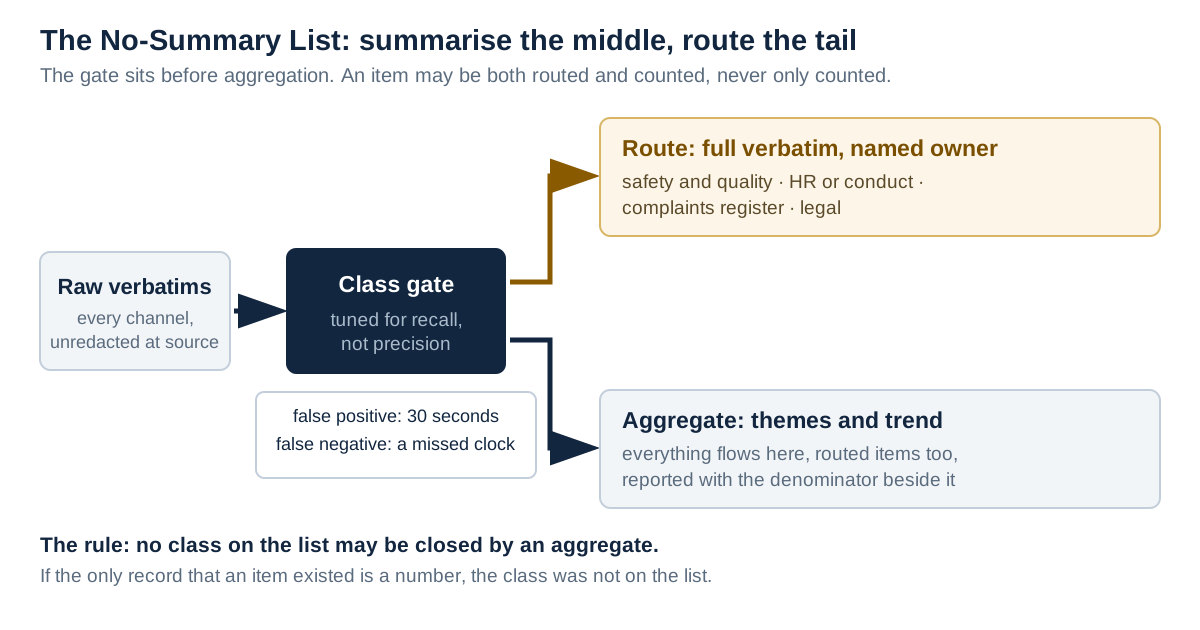
The No-Summary List sits before aggregation, not after it. An item can be both routed and counted; it may never be only counted.
| Class | Detection signal | Routes to | Clock starts | Still counted in themes? |
|---|---|---|---|---|
| Harm, injury or safety defect | Injury and product-failure vocabulary; explicit escalation phrases | Product safety or quality function | On arrival | Yes |
| Named-individual allegation | Person entity plus conduct vocabulary | HR or the conduct process | On arrival | As an anonymised theme only |
| Regulated complaint | Product or service in a regulated line, plus dissatisfaction | Complaints register, with an item identifier | On arrival | Yes |
| Special-category disclosure | Health, disability, religion, ethnicity vocabulary | Suppression path; restricted-access store | On arrival | Only as a coarse count |
| Legal or media threat | Solicitor, regulator, press, "I am posting this" | Legal | On arrival | Yes |
Three design rules make the difference between a list that works and a list that decorates a policy document.
Route on recall, not precision. The classifier that fires the No-Summary List should be tuned to over-flag. A false positive costs a human thirty seconds of reading. A false negative costs a missed statutory clock. Most feedback platforms tune their classifiers for dashboard tidiness, which is the opposite trade, so this usually has to be configured deliberately rather than accepted as shipped.
Route the verbatim, not the label. The routed item must arrive at its owner as the customer's own words, with its timestamp and its channel. A routed theme label is the same information loss you were trying to avoid, delivered to a more expensive audience.
Give every row an owner with a name. Not a team, not a queue. A role that a person occupies and that gets reassigned when they leave. Unowned classes are the ones that quietly stop being reviewed after the second reorganisation.
A rule that travels: no class on the No-Summary List may be closed by an aggregate. If the only record that an item existed is a number, the class was not on the list.
If you are not in a regulated sector, the list is shorter but it is not empty. The statutory examples above are drawn from consumer products and medical devices because those regimes write the duty down in a form you can quote. A B2B software company has no equivalent statute, and still has classes that must not be summarised: a reported security vulnerability, an accessibility complaint, a discrimination allegation, a contractual notice served through the wrong channel, and anything a customer frames as the start of a dispute. The common test is not "is this regulated" but "would we later have to prove the date we first knew". Any item that would be reconstructed in a dispute, an audit or a discovery process needs to exist as a dated item, not as an increment to a count.
What it costs. We will not put a dollar figure on this, because the number depends entirely on your volumes and rates and inventing one would be worse than useless. What we can say is which parts recur. One-off: the channel inventory, writing the list, the initial classifier tuning, and the store separation. Recurring: the reading time on flagged items, which scales with volume and is the real operating cost; the quarterly seeded test; a review each time the vendor ships classifier changes; and reassigning owners after reorganisations. The reading time is the line to model first. Take your flag rate against a week of real traffic, multiply by an honest minutes-per-item, and see whether the answer lands on somebody's existing job or needs a new one. A list whose reading load has no home is a list that silently stops being read.
Who is actually in your feedback, and who is missing
Everything above concerns what you do with the text you have. This section is about the text you do not have, and it is a measurement problem rather than a privacy one. The question is whether the aggregate means what the dashboard implies, not what you may infer about any individual.
The evidence here is unusually good, because the effect has been measured at scale. Schoenmueller, Netzer and Stahl compiled over 280 million reviews from 25 major online platforms and confirmed what they call polarity self-selection — "the higher tendency of consumers with extreme evaluations to provide a review" — as a driver of the familiar shape of review distributions: a mass at the positive end, a few in the midrange, some at the negative end. Their conclusion is the one that matters for a roadmap: polarity self-selection and the resulting distribution "reduce the informativeness of online reviews" (Schoenmueller, Netzer and Stahl, Journal of Marketing Research, 2020).
Solicited surveys have a related problem from a different mechanism. Response rates are what they are; the people who respond differ systematically from the people who do not; and the difference is not random with respect to the thing you are measuring. The customer quoted at the top of this article is the clearest case. He had concluded there was no route back to whoever broke the thing, so he wrote nothing. His experience is real and his data point does not exist.
Now stack that on top of an AI summariser and watch what the two effects do together.
| Stage | What it does to the signal | Net effect on the roadmap |
|---|---|---|
| Who writes at all | Over-represents people with extreme evaluations | The moderate majority is absent before analysis begins |
| Who writes at length | Long verbatims come from motivated writers | Fluent, articulate complaints dominate the corpus |
| Theme aggregation | Ranks by count | The largest already-over-represented group ranks first |
| Prioritisation | Cuts below a threshold | Everything from a small or quiet segment falls off |
Each stage is defensible on its own. Together they mean that "the customers say" in a quarterly review often means "the loudest tenth of a self-selected minority say", and nobody in the room can see which. That is not an argument against the software. It is an argument for two habits: state the denominator on every slide, and keep at least one channel where you go and ask people who did not volunteer.
The practical version is unglamorous. Put the response rate next to the theme count, always, on the same line. A theme carrying 60 mentions out of 900 responses out of 40,000 customers is a different object from a theme carrying 60 mentions out of 90 responses, and a dashboard that shows only "60" makes them look identical.
Where the raw text goes, and how long it stays there
Raw verbatims are the most copied class of customer feedback data in the entire stack, because they are the most persuasive. A theme count does not move a roadmap meeting. A customer's own sentence does. So verbatims get pasted into decks, quoted in Slack, exported to spreadsheets, pinned in roadmap tools, and included in board packs. Each one is a copy your feedback platform's delete button does not reach.
| Destination | What lands there | Whose retention rules apply | Reachable by the platform's delete? |
|---|---|---|---|
| Feedback platform | Full verbatim plus metadata | The programme's, if one was written | Yes |
| Analytics warehouse | Full verbatim, usually joined to an account | The data team's | No |
| Slide deck or board pack | Selected quotes, often with the customer named | None | No |
| Chat channel alert | Verbatim in an alert message | The chat tool's, often unbounded | No |
| Roadmap or ticketing tool | Verbatim pasted into a ticket description | The engineering tool's | No |
| Model fine-tuning corpus | The whole corpus | Whatever the contract says | Depends entirely on architecture |
Customer feedback data is personal data, and GDPR Article 5(1)(e) requires it to be kept in identifiable form no longer than necessary for the purposes for which it is processed. That obligation follows the copies, not the original. A retention policy written about the feedback platform and silent about the warehouse is a policy about one row of that table.
The tempting answer is redaction: strip identifiers at intake and the problem dissolves. It helps, and it should be done, but it does not dissolve the problem. Free text resists de-identification in a way structured fields do not. Automated de-identification of clinical free text is one of the most heavily studied versions of this task, with decades of work and purpose-built systems, and the residual-identifier problem persists because quasi-identifiers in narrative text are dispersed across sentences: occupations, locations, family relations, rare conditions, distinctive events. A customer who writes "my daughter's wheelchair did not fit through the door at your Truro branch on her birthday" has not typed a single formal identifier and is nonetheless findable. Redaction that catches emails, card numbers and phone numbers is worth doing and is not the same thing as anonymisation.
Two moves make more difference than better redaction. First, separate the store: keep verbatims in a restricted store with named access, and let the dashboard read derived fields from it rather than embedding the text everywhere. Second, put an expiry on the verbatim that is shorter than the expiry on the derived theme counts. Themes age into a trend line usefully; individual verbatims stop being useful long before they stop being sensitive. We have written about the intake-side controls in more depth in our earlier analysis of masking PII at the gateway, and the same logic applies here one layer up.
Is scoring a customer's sentiment regulated like scoring an employee's?
No, and the difference is sharper than most privacy summaries suggest. It is worth stating precisely because a lot of AI-governance commentary has flattened it into "the EU bans sentiment analysis", which is not what the law says.
Article 5(1)(f) of the EU AI Act prohibits the use of AI systems "to infer emotions of a natural person in the areas of workplace and education institutions", except for medical or safety reasons. The prohibition attaches to two named areas. A customer writing a product review is in neither of them. Customer sentiment analysis, applied to the customer, is not caught by Article 5(1)(f), and a vendor telling you otherwise has misread the provision.
That is the end of the good news, and there are three qualifications worth writing down.
The first is that everything else still applies. Not prohibited is not unregulated: the sentiment score is personal data about the customer, it needs a lawful basis and a purpose, it is disclosable in a subject access request, and it is subject to the same accuracy and minimisation duties as any other field you generate.
The second is that your own employees show up inside customer feedback constantly, by name. The moment a system reads verbatims about a named staff member and produces anything resembling an inference about that person, you are no longer squarely in the customer-data world, and the workplace analysis in our earlier piece on governing records derived from customer conversations is the relevant reading rather than this one. Feedback-derived scoring of a named employee is a different legal object from feedback-derived scoring of a product.
The third is that this is general information about a regulated area, not legal advice, and the boundaries of the AI Act's emotion provisions are still being worked out in practice. Get counsel on your actual deployment, your actual channels and the jurisdictions your customers sit in.
A worked example: one 900-response survey wave, traced
The following is illustrative arithmetic assembled from the sourced effects above, not a customer engagement. Every input is labelled so you can substitute your own.
A quarterly survey goes to 40,000 customers. It returns 900 verbatim responses, a 2.25% response rate, which is unremarkable for an emailed relationship survey and is the first number nobody puts on the slide.
Stage one: who wrote. By the polarity self-selection effect measured across 280 million reviews, the responses over-represent customers with extreme evaluations at both ends. The moderate majority of the 39,100 non-responders is not in the dataset at all. Nothing downstream can recover them.
Stage two: classification. The 900 responses sort into fourteen themes. The top three carry 210, 155 and 96 mentions. The bottom four carry between one and three each, and the interface renders them in a collapsed "other" row by default.
Stage three: what is in the tail. Suppose three of those singletons are, respectively: a customer describing a component that got hot enough to mark a work surface; a customer naming a branch employee and alleging they were shouted at; and a customer explaining that a service failure happened because of a disability the company had recorded elsewhere. Each is one mention out of 900. Each ranks fourteenth.
Stage four: the summary. The quarterly deck shows the top three themes, the sentiment trend, and a rollup sentence. The heat report has been generalised into "durability" and merged with complaints about a plastic clip. The named-employee allegation has been generalised into "staff attitude". The disability disclosure has been counted as "accessibility" and not read.
Stage five: the clocks. All three items started something on the day they arrived. The heat report is the class where 16 CFR 1115.12 says an obligation may arise on receipt of the first information, and where the firm is deemed to know what diligent inquiry would have revealed. The allegation gave a named employee a right of reply that nobody has told them about. The disability disclosure created special-category data that is now sitting in a warehouse with a five-year retention default.
What actually went wrong. Not the model. The classifier did its job: it assigned every item to a theme, and it ranked by count, which is what ranking means. The failure is architectural. The pipeline had exactly one output path, and that path was aggregation. Contrast the same wave with a No-Summary List in front of the aggregator: the same three items get flagged on recall-tuned patterns, arrive as full verbatims with timestamps at three named owners, and also appear in the theme counts. Nothing about the dashboard changes. The three items stop being invisible.
That is the whole intervention. It is a second output path, not a better model.
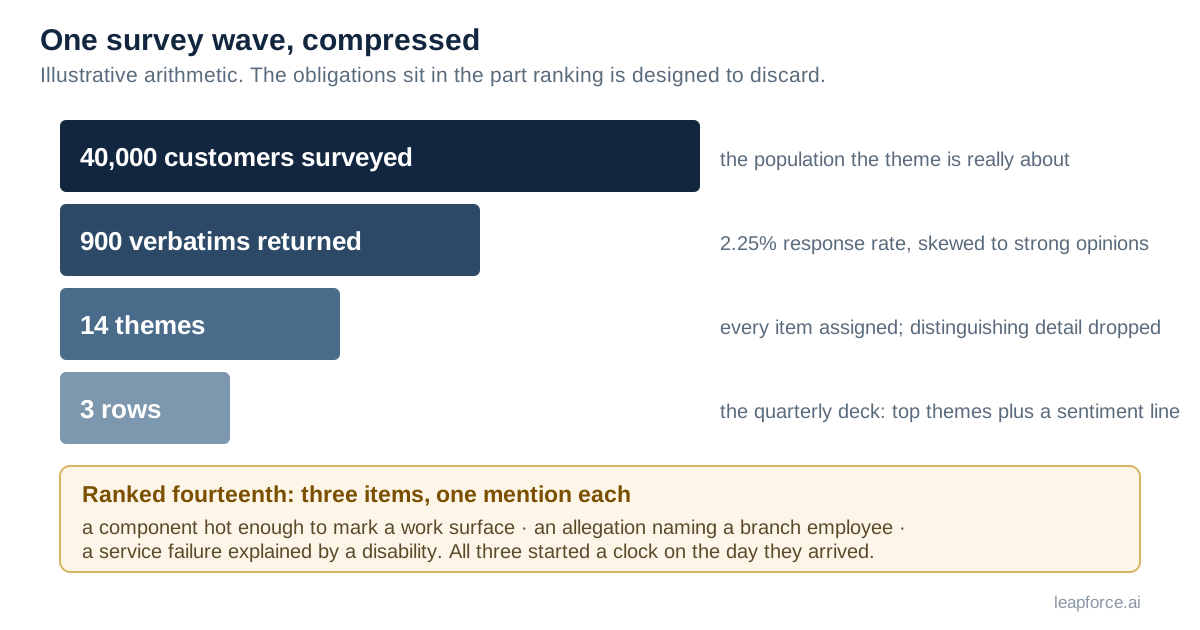
The compression path for one survey wave. The items that carry obligations sit in the part of the funnel that ranking is designed to discard.
Setting this up in one sitting: a six-step build
This is the minimum configuration that makes an AI customer feedback analysis programme safe to run at volume. It assumes you already have one of the mainstream customer feedback tools in place; none of it requires a specific vendor.
Prerequisites. Before you start, you need three things on the table: a list of every channel that accepts free text from a customer, including the ones marketing opened without telling anyone; a named owner for each of the classes you are about to define; and the answer to whether your platform can route an individual item to an external destination, because some cannot.
- Inventory the intake. List every free-text surface: surveys, in-app widgets, review sites you monitor, support forms, chat, app stores, the sales inbox. For each, record the prompt shown to the customer, whether the response is linked to an account, and the retention default. Most teams find two or three surfaces nobody owned.
- Write the No-Summary List. Four or five classes, using the table earlier in this article as a starting point and cutting anything you cannot name an owner for. A class without an owner is not a class.
- Tune the flag for recall. Build the detection patterns to over-flag, then measure the false-positive rate on a week of real traffic and confirm a human can absorb it. If the flag fires on 40 items out of 900 and reading them takes an hour, that is a working configuration. If it fires on 400, tighten the vocabulary rather than raising the confidence threshold.
- Redact at intake, and separate the store. Mask direct identifiers on arrival. Keep the full verbatim in a restricted store with named access and its own shorter retention clock; let dashboards read derived fields rather than embedding the text.
- Attach the denominator. Configure every theme view to display the response count and the population it was drawn from, on the same line as the theme count. This is a reporting-template change, not an engineering project, and it is the single highest-value hour in the list.
- Test with a seeded item. Write one synthetic verbatim per class, submit it through the real channel, and confirm it reaches the named owner as full text within the clock. Repeat quarterly, because vendors ship classifier changes and channels get reconfigured. A routing path that has never been tested end to end is a diagram.
Steps 2, 3 and 6 are the ones that fail in practice. Step 5 is the one nobody schedules and everybody benefits from.
Six mistakes that make a feedback programme worse than the spreadsheet
Ranking by count and calling it prioritisation. Count is a proxy for prevalence among people who wrote. It is not a proxy for severity, and the two diverge most sharply exactly where severity matters.
Redacting so hard the text stops being evidence. Aggressive masking that removes the branch, the product variant and the date produces text nobody can act on. Redact identity, keep circumstance.
Letting the summary become the record. If your retention policy deletes verbatims at 90 days and keeps themes for five years, you have decided that the reconstructable version of events is the one the model wrote. Decide that deliberately or not at all.
Closing the loop with an automated reply. Acknowledging a safety report with a templated "thanks for your feedback" is worse than not replying: it documents that you received it and did nothing visible with it.
Assuming the vendor's classifier knows your regulated vocabulary. Off-the-shelf theme taxonomies are built for generic CX. The words that matter in your sector — a device malfunction term, a mis-selling phrase, a specific harm — usually are not in them until you add them.
Treating a rising sentiment score as improvement. Sentiment can rise because unhappy customers stopped responding. Sentiment moving with response rate in the same direction is a signal to investigate, not to celebrate.
What AI customer feedback analysis is genuinely good at
An article that only lists risks is no use to somebody who has to make a decision this quarter, so here is the case for buying it, and it is a strong one.
Reading everything instead of a sample. The realistic alternative is a human reading 10% of verbatims and coding them by hand, with the sampling bias that implies. Full-corpus classification removes an entire error source, and it does so cheaply.
Making the corpus searchable. Being able to ask "show me every mention of the charger across two years and four channels" is a genuine capability change that needs no inference at all, only good indexing over the raw text.
Finding the theme nobody had a word for. Clustering that discovers a group before anyone has named it is the one thing this software does that a well-run tagging taxonomy cannot, because a taxonomy can only count categories somebody already thought of.
Detecting absence. Some of the most valuable checks are negative: a product line with no feedback at all, a region whose response rate collapsed, a theme that disappeared the month after a release. These are checkable, deterministic and almost never configured.
Notice the common thread. Each of these makes a human look at the right material. Each degrades the moment the product tries to replace the looking with a number.
Where LeapForce fits, and where it does not
LeapForce does not sell a customer feedback platform, survey software or CX analytics, and nothing here should be read as a substitute for evaluating those products on their merits. What we build is the layer underneath: one controlled place where AI tools, connectors, models and agents are given identity, scope, policy and an audit trail — so that when a system starts reading customer text and writing conclusions from it, somebody owns it, its reach is bounded, and what it did is provable. The pieces that matter for this use case are the connector registry, where the surfaces a tool may read from and write to are scoped once by IT rather than negotiated per team, and observability and audit, which is built to record what was refused as well as what ran. Our gateway rollout sequence applies to a feedback pipeline unchanged: observe first, enforce second, optimize third — point the traffic at the gateway in observe mode and find out which surfaces are actually sending customer text to which models, before writing a policy about any of it.
Honest limits and open questions
We have not run a controlled deployment of a commercial feedback analysis platform. This piece is built from primary regulation, peer-reviewed research, regulator guidance and practitioner discussion. Nothing here is presented as a measured result of our own, and the worked example is labelled illustrative arithmetic rather than a customer case.
The central summarisation evidence transfers by inference, not by measurement. Peters and Chin-Yee measured overgeneralisation on scientific abstracts, and Williams and colleagues measured omission of clinically relevant detail in emergency department summaries. Two independent studies in two domains is better than one, and it is still not a study of customer verbatims. We argue the mechanism is the same in feedback summarisation because the operation is the same, dropping qualifiers and keeping the general claim, but we found no equivalent study run on customer verbatims, and we would change the strength of that claim if one appeared.
This is general information about regulated areas, not legal advice. The FDA, CPSC and GDPR provisions cited are quoted accurately and are not a substitute for counsel reading your actual complaint flows, your actual sector and your actual jurisdictions. Whether a given verbatim triggers a reporting duty is a legal judgement, not a classifier setting.
We could not verify the efficiency claims this category markets on. Figures of the "AI captures 30–40% more themes" or "saves 8–12 hours a week" kind are widespread in vendor material with no published methodology, and we found none that reconciled to a documented study, so none appear here. If a vendor shows you one, ask for the sample, the period and the counterfactual.
Sentiment accuracy on customer text is not independently benchmarked in any form we could find. Vendors publish accuracy figures for their own models on their own data. There is no shared benchmark of the kind that exists for translation or speech recognition, so cross-vendor accuracy comparisons in this category are currently unfalsifiable.
The response-bias evidence is strongest for public reviews. The 280-million-review study measures platform reviews, not private survey verbatims. The self-selection mechanism plausibly runs in both, and survey non-response is separately well established, but we are extrapolating across a channel boundary and say so.
Reddit and several practitioner communities were unreachable for this research, so the field voices here come from Hacker News, which skews technical for a topic whose primary owners are CX, product and support leaders. Treat the framing as representative of engineering-adjacent concern rather than of the whole audience.
No video is embedded. The YouTube Data API quota was exhausted during this run, so the search could not be completed to our normal standard. That is a limitation of this run rather than a claim that nothing suitable exists.
Our claim about what vendors ship is a documentation review, not an exhaustive test. Across the product documentation and marketing pages we read for this piece, we found escalation routing offered on sentiment thresholds, urgency scores and keyword rules, and did not find a routing path defined by regulatory class with a per-class clock. That is a statement about what is documented publicly, not proof that no such feature exists in a configuration screen we never saw. Ask your own vendor directly.
Where this could be wrong. If feedback platforms ship recall-tuned escalation routing by regulatory class as a default, the No-Summary List becomes a configuration review rather than a build, and the argument here is overpriced. We would welcome that outcome and would say so.
Frequently asked questions
AI customer feedback analysis is software that reads unstructured customer text — survey verbatims, reviews, support tickets, chat logs, app-store responses — and converts it into structured fields such as theme labels, sentiment values and extracted entities, so a volume of writing no team could read becomes a ranked dashboard. It is genuinely useful for reading the whole corpus rather than a sample, for making that corpus searchable, and for discovering clusters nobody had named. Its governance risk sits at the two ends of the pipeline rather than in the model: what arrives that nobody scoped for, and what a summary discards on the way out.
Nobody knows in a way you can compare across vendors, because customer sentiment analysis has no shared public benchmark of the kind that exists for speech recognition or translation. Vendors publish figures for their own models on their own data. The deeper issue is that sentiment on a written complaint is a compressed judgement about a person's state, and the peer-reviewed evidence on summarisation is that models systematically generalise beyond what the source supports — nearly five times more often than human summarisers in one 2025 study of 4,900 summaries. Use sentiment to decide which items a human reads next. Do not use it as a metric anyone is accountable to.
Almost always, yes. Customer feedback data starts as text written by an identifiable person, usually attached to an account or a survey token, and frequently contains detail that identifies the writer even after direct identifiers are stripped. If it contains health, disability, religion, ethnicity or similar detail, Article 9(1) treats it as a special category with a prohibition and a narrow list of conditions, and customers volunteer exactly that kind of detail in feedback boxes without being asked. France's CNIL has published guidance recommending organisations limit free-comment fields and prefer structured options, and notes it has already issued formal notices over their misuse.
No. Article 5(1)(f) prohibits AI systems used to infer emotions of a natural person "in the areas of workplace and education institutions", with a medical and safety exception. A customer writing a product review is in neither area, so scoring that customer's sentiment is outside the prohibition. Two caveats matter. Not prohibited is not unregulated. The score is still personal data with all the duties that carries. And when the system produces inferences about a named employee mentioned in the feedback, you are in the workplace analysis instead. This is general information, not legal advice.
Volume is the wrong gate; representativeness is the right one. Classification works on a few hundred items, and clustering starts producing usable groupings somewhere in the low thousands. But a theme count derived from 90 responses out of 40,000 customers is not a smaller version of a good measurement, it is a different measurement, because the people who responded were selected by their own enthusiasm. The practical rule: report the response rate on the same line as every theme count, and treat any theme you would act on below a 5% response rate as a hypothesis to test rather than a finding to fund.
Buy the pipeline, build the routing. Classification, clustering and dashboarding are commodity capabilities where mainstream customer feedback tools will beat an internal build on cost and on time-to-value. What you will almost certainly have to build or configure yourself is the No-Summary List: recall-tuned detection of the classes that must reach a named human as full verbatim text, on a clock. Across the product documentation we reviewed for this piece, escalation routing was offered on sentiment thresholds, urgency scores and keyword rules rather than by regulatory class, so budget for that as an integration rather than a feature, and ask the vendor in evaluation whether individual items can be routed to an external destination at all.
Shorter than you keep the derived themes, and the two clocks should be set separately. GDPR Article 5(1)(e) requires identifiable data to be kept no longer than necessary for the purpose. Trend lines built from theme counts stay useful for years; an individual verbatim usually stops being useful long before it stops being sensitive. The exception is anything on your No-Summary List. Items in a regulated complaints register or a safety file are governed by that regime's retention rules, not the feedback programme's, and those are frequently longer. The retention clock also has to follow the copies into the warehouse, the deck and the ticketing tool, or it governs one system out of six.
Fewer people than currently can, and by named grant rather than by team membership. The realistic pattern is a restricted verbatim store with named access, dashboards that read derived fields rather than embedding text, and an explicit exception process for anyone who needs to quote a customer in a deck. The failure mode is not malice; it is that verbatims are the most persuasive artifact in the stack, so they get copied into slides, chat channels and spreadsheets that have no retention rules at all. Every copy is a place your delete button does not reach.
It stops being feedback and becomes an allegation about an identified person, with a right of reply attached. Route it to the conduct or HR process on arrival as full verbatim text, and let it into the theme counts only in anonymised form. What must not happen is the two silent failures: the item disappearing into a "staff attitude" bucket that nobody investigates, or the named employee acquiring an informal record they have never seen and cannot contest. If your platform scores or trends anything about that named individual, the governance question changes shape entirely, and our analysis of records derived from customer conversations covers that case.
Because the first quarter produces themes and the second quarter is asked for decisions, and themes do not support decisions on their own. The dashboard says "onboarding friction: 210 mentions" and nobody can say which 210, from whom, out of how many, or what specifically to change. Programmes that survive share two habits: they keep a path from every aggregate back to the individual verbatims underneath it, and they publish the denominator so the room can calibrate. Programmes that stall usually deleted or buried the verbatims and are left arguing about a number nobody can interrogate.
Ready to Govern Your AI?
Talk to LeapForce — one controlled layer for every AI tool, connector, model, and agent.
Comments