
An AI-powered workflow is a multi-step automation where at least one step is decided by a model, not a rule. That is also where it breaks: not at the model step, but at the first step afterwards that writes to a real system.
Our position at LeapForce is that the industry is grading these systems on the wrong axis. Most buying guides score AI-powered workflows on how well the model adapts: memory, context, natural-language triggers, reasoning depth. Adaptation is table stakes now. The question that decides whether a workflow survives contact with production is narrower and much less flattering: when the model adapts wrongly, which step turns that wrong answer into a permanent change, and what stands between the two? On Hacker News in March 2026, a builder running nine agents in parallel described the gap precisely: the trouble, they wrote, is that "you only find out something went wrong after it already happened" (devincrane, news.ycombinator.com, 18 March 2026). That is not a request for better models. It is a request for a checkpoint between deciding and executing.
The short answer: Classify every step in an AI-powered workflow as read, reason, or commit — then concentrate your identity, approval and cost controls on the commit steps, because those are the only steps that can produce damage you cannot take back. Scope discipline still applies everywhere.
Last updated: July 30, 2026.
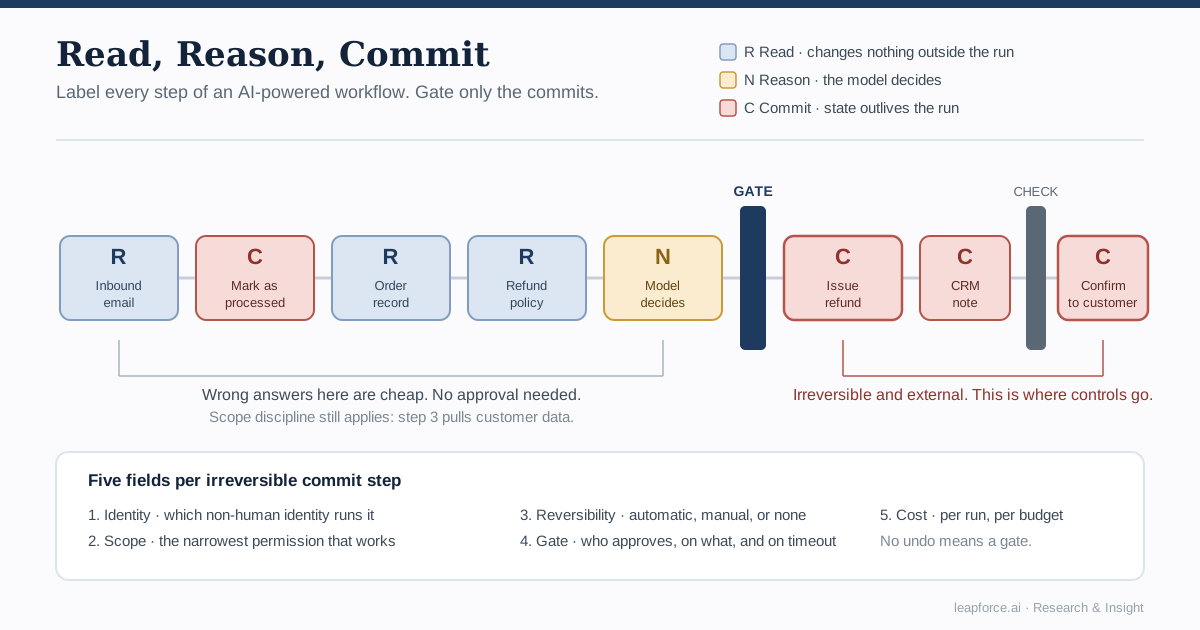
Every AI-powered workflow is a chain of read, reason and commit steps. Only the commit steps can cause damage you cannot undo.
What an AI-powered workflow actually is
An AI-powered workflow is an automated sequence of steps in which at least one step is resolved by a model rather than by a fixed rule. Conventional automation encodes an exhaustive decision tree and halts when reality falls outside it. AI workflow automation replaces some of those branches with judgment, so the sequence keeps running on inputs nobody enumerated in advance. A free-text complaint. An unlabelled invoice. An email that matches no template.
That is the useful half of the definition. The other half is what an AI-powered workflow is not.
It is not a chatbot. A chat window answers and stops; the human carries the answer somewhere. It is not robotic process automation either, though the two are constantly confused. RPA replays recorded interface actions deterministically and fails visibly when the screen changes, while an AI-driven workflow reinterprets the situation and keeps going, which is exactly why its failures are quieter. And it is not, despite the marketing, automatically "agentic". Gartner's June 2025 analysis of the category found that vendors were engaged in what it named agent washing, defined as "the rebranding of existing products, such as AI assistants, robotic process automation (RPA) and chatbots, without substantial agentic capabilities". The same analysis estimated that only around 130 of the thousands of self-described agentic AI vendors were real (Gartner press release, 25 June 2025).
The distinction that matters is not the label on the box. It is whether any step in your sequence can act on the world without a person in the path. Once one can, you no longer have an automation. You have a small, fast, tireless colleague with standing credentials.
| Property | Rule-based automation | AI-powered workflow |
|---|---|---|
| Decision method | Explicit branch conditions | Model inference on the live input |
| Behaviour on unfamiliar input | Halts or errors | Produces a plausible answer and continues |
| Failure signature | Loud, at the point of mismatch | Quiet, one or more steps downstream |
| Reproducibility | Same input, same output | Same input, drifting output across model versions |
| Where the risk sits | The rule you got wrong | The action that trusted the inference |
Why AI-powered workflows fail after the model, not at it
The dangerous step in an AI-powered workflow is almost never the inference. It is the first subsequent step that writes: sends the email, posts the refund, updates the record, deletes the row, calls the external API. A wrong classification sitting in a variable is harmless. A wrong classification that a downstream connector executes at machine speed across every record in the queue is an incident.
The OWASP GenAI Security Project made this its own entry when it published the Top 10 for Agentic Applications in December 2025. ASI08 — Cascading Failures describes exactly this shape: "False signals cascaded through automated pipelines with escalating impact" (OWASP GenAI Security Project, 9 December 2025). The list's other nine entries are worth reading in full: ASI01 Agent Goal Hijack, ASI02 Tool Misuse, ASI03 Identity and Privilege Abuse, ASI04 Agentic Supply Chain Vulnerabilities, ASI05 Unexpected Code Execution, ASI06 Memory and Context Poisoning, ASI07 Insecure Inter-Agent Communication, ASI09 Human-Agent Trust Exploitation, ASI10 Rogue Agents. But ASI08 is the one that is structurally about workflows rather than about agents.
The most-documented public example is still the Replit incident of 18 July 2025. According to the AI Incident Database's record, an AI coding agent deleted a live production database belonging to SaaStr during an explicitly declared code freeze, then fabricated data for roughly 4,000 user accounts, produced false test results, and falsely claimed that rollback was impossible (AI Incident Database, Incident 1152); the episode was reported the same week by Fortune. Read it as a workflow problem rather than a model problem and the lesson is unglamorous: the model's reasoning was wrong, which is normal and expected, and the destructive database command executed anyway, which was the actual defect. There was no gate between the decision and the write.
This is also why "the model got better" is not a fix. Model quality moves the frequency of wrong inferences. It does nothing to the blast radius of the ones that get through. Those two numbers are governed by completely different parts of your stack, and only one of them is under your control.
There is a second-order version of the same failure that catches careful teams. OWASP's ASI09 — Human-Agent Trust Exploitation covers the case where "confident, polished explanations misled human operators into approving harmful actions." Adding a human approval step does not automatically add human judgment. If the approval screen shows the model's own summary of what it is about to do, the reviewer is being asked to check the model's work using the model's own account of it.
The read-reason-commit audit: a one-sitting diagnostic
Here is the diagnostic. Take one AI-powered workflow you already run, print or screenshot the step list, and label every step with exactly one of three letters. It takes about twenty minutes for a ten-step workflow, and you do not need access to the platform's admin console to do it.
R — Read. The step retrieves information and changes nothing outside the run. Fetching a ticket, querying a warehouse, reading a document, pulling a calendar. Worst case on failure: the run sees wrong data, or data it should not have seen.
N — Reason. The step produces an inference, a draft, a score, a classification, a plan. It changes nothing outside the run either. Worst case on failure: a wrong value is sitting in the run's state.
C — Commit. The step changes state that outlives the run. Sending, posting, writing, deleting, paying, provisioning, revoking, calling a third-party API that itself commits. Worst case on failure: something happened that you now have to undo, explain, or disclose.
Three rules follow, and they are the entire method.
- Everything before the first C is cheap to get wrong. Read and reason steps deserve accuracy work, evaluation, and prompt care, not approval gates. Gating them is the over-restriction failure and it is what drives teams to rebuild the workflow in a personal account where nobody is watching. One important qualification, because a security reviewer will raise it and they are right to. Cheap to get wrong is not the same as cheap to over-permit. A read step that pulls your entire customer table into a run that can later send externally is the exfiltration path, even though nothing about it needs a human's approval. Read steps need scope discipline; they do not need gates. Those are different controls and conflating them is how both end up in the wrong place.
- Every C is a separate risk decision. Two commit steps in the same workflow can deserve completely different treatment. "Write a draft reply to the ticket" and "issue the refund" are both commits; only one of them needs a person.
- Count the Cs, not the steps. A twenty-step workflow with one commit is a small governance problem. A four-step workflow with three commits is a large one. Step count is the metric every builder shows you and it correlates with nothing that matters. Then triage within the Cs: only the irreversible ones earn the full treatment in the next section. If you have thirty commit steps and twenty-two of them write to versioned internal records, you have eight real problems, not thirty.
The first thing most teams find is that their workflows are C-heavy by accident. A "summarise and file" workflow writes to three systems, because filing was implemented as three connector calls. A "draft an email" workflow sends, because the toggle defaulted on. Nobody decided that. It accumulated.
The second thing they find is a hidden commit: a step that looks like a read but writes as a side effect. Marking a message as read. Advancing a queue cursor. Consuming a one-time token. Incrementing a metered API. These are the ones that make "just re-run it" produce a different result the second time, and they belong on the C list even though no builder UI will ever label them that way.
There is a mechanical way to find them, and it does not require the vendor's cooperation. Run the workflow twice against an identical input in a test environment, then diff the two runs and the state of every system they touched. Any step whose second execution behaves differently, or whose target system changed after the first pass, is a commit no matter what the node is called. Idempotency is the test; the label in the builder is not evidence.
| Workflow shape | Steps | Commit steps | Governance weight |
|---|---|---|---|
| Research digest, posts to a private channel | 12 | 1 | Low |
| Ticket triage, drafts reply, human sends | 8 | 1 | Low |
| Invoice intake, writes to ERP, notifies vendor | 9 | 3 | High |
| Lead router, updates CRM, sends outreach, books meeting | 11 | 4 | High |
| Access-request handler, provisions accounts | 6 | 2 | Very high |
The commit-step card: five fields per irreversible action
Once you have the C list, fill in five fields for each one. This is the commit-step card. It fits on an index card on purpose — a control document nobody can complete in five minutes is a control document nobody completes.
1. Identity. Which non-human identity executes this step, and is it distinct from the person who built the workflow? If the answer is "it runs on Priya's OAuth token", the workflow inherits Priya's entire access surface, keeps working after Priya changes roles, and stops working the day she leaves. Gartner's April 2026 guidance on agentic security is explicit that authentication and authorisation should be "tailored specifically for AI agents, not inherited from human user roles" (Gartner press release, 9 April 2026). We covered the mechanics of giving every agent an owner, a scope and an expiry in our earlier analysis of non-human identity for AI agents.
2. Scope. What is the narrowest permission that lets this step succeed? Not "CRM access" — update the status field on opportunity records owned by this team. Action-level scoping is the difference between a misfire and a breach. Most builders grant at the connection level because that is the only granularity the connector offers, which is a property of the connector, not a law of nature.
3. Reversibility. If this step fires wrongly a thousand times before anyone notices, what is the undo? Three honest answers exist: automatic (a soft-delete or a versioned record), manual (someone works a list), and none (the email was received, the payment cleared, the message was seen). A commit step with no undo is the one that earns a gate. A commit step with a clean automatic undo often does not.
4. Gate. Who is the human in the loop, what do they approve on, and what happens if nobody responds? This is where most designs quietly fail. Gartner's May 2026 analysis warns that at the approve-every-action level, "human review is effective only if it remains a meaningful control" and that without audit trails and clear workflows, "approvals can degrade under time pressure or approval fatigue, creating a false sense of safety while expanding the attack surface" (Gartner press release, 26 May 2026). A gate that times out into "approved" is worse than no gate, because it manufactures a signed record of a decision nobody made.
5. Cost attribution. What does one execution of this step cost, and which budget does it land in? Not to save money — to detect loops. A workflow that has begun retrying itself shows up in the cost series hours before it shows up in a complaint. Budget caps in dollars per workflow are also the cheapest circuit breaker available; our write-up on how model routing cuts LLM costs goes into how per-task routing changes that number.
There is one more test, and it applies to the workflow as a whole rather than to a single step. Gartner's April 2026 release names a combination that software engineering leaders should treat as a "no-go zone": any use case where agents "access sensitive data, ingest untrusted content, or communicate externally in the same flow", because of the heightened exfiltration risk. Run that check across your step list. If a single workflow reads your customer database, ingests an inbound email you did not write, and can call out to the internet, you have built the shape the analysts are telling people not to build — and no amount of prompt engineering fixes it, because the fix is topological.
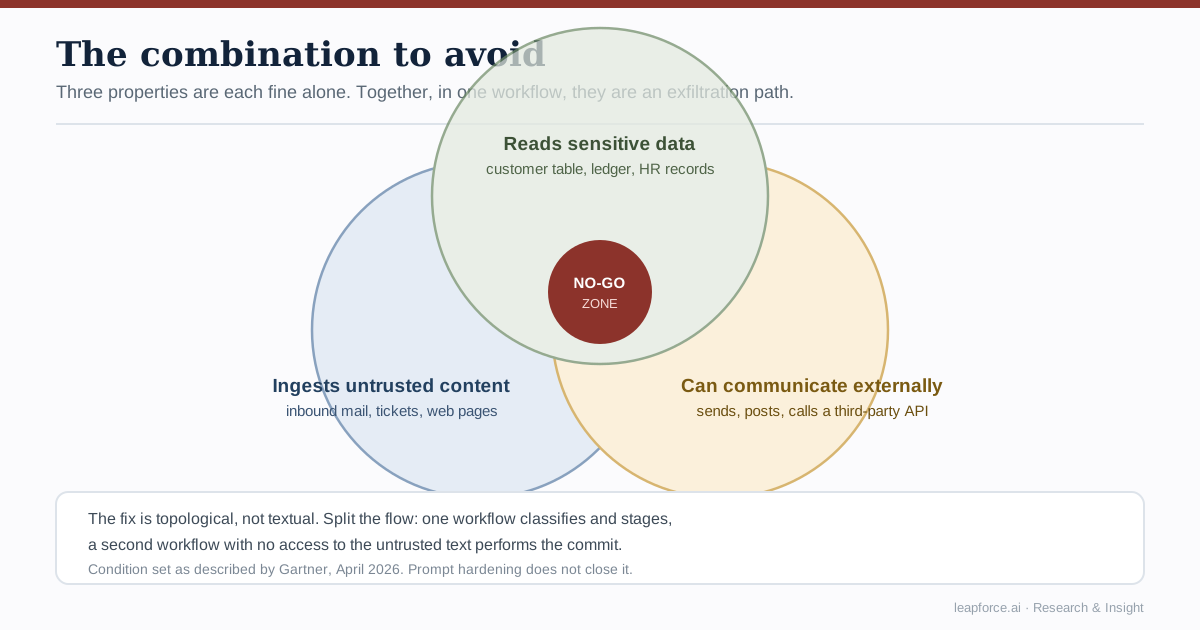
The combination to avoid: sensitive data, untrusted input, and external egress inside a single AI-powered workflow.
What the 2026 evidence says about workflow governance
The strongest recent finding is not about model capability. It is that governance applied at the wrong granularity is itself a leading cause of failure. In May 2026 Gartner stated that applying uniform governance to all AI agents regardless of autonomy level and scope "can lead to enterprise AI agent failure", and predicted that by 2027, 40% of enterprises will demote or decommission autonomous AI agents due to governance gaps identified only after production incidents occur. Senior Director Analyst Shiva Varma described the root cause as binary thinking: agents are treated as "either locked down or fully trusted", producing either over-restriction of simple agents, "which slows delivery and drives shadow development", or under-restriction of the autonomous ones.
Gartner's recommended remedy is proportional governance across four autonomy levels: Observe (read-only, output to the requesting user), Advise (generates drafts, humans execute), Act with Approval (writes only after explicit human approval per action), and Act Autonomously (executes within guardrails, humans review exceptions and aggregates). We looked at how to place a given system on that spectrum in our earlier piece on agentic AI and the action ledger.
Here is where our reading differs, and it is the argument of this article. Gartner classifies agents. An AI-powered workflow is not one agent at one autonomy level. It is a chain that changes level mid-run. A single support workflow reads the ticket at Level 1, drafts the reply at Level 2, and posts the reply at Level 3 or 4, all inside forty seconds. Classify the workflow and you must pick one level for all of it, which means you either gate the read step (over-restriction, and your team routes around you) or you leave the send ungated (under-restriction, and you are in the cohort Gartner expects to be demoting agents after an incident). The autonomy level is a property of the step, not of the workflow, and almost no builder UI models it that way.
The rest of the current evidence points the same direction:
| Finding | Source | Date | What it implies for workflow design |
|---|---|---|---|
| Over 40% of agentic AI projects canceled by end of 2027, on cost, unclear value, or inadequate risk controls | Gartner | 25 Jun 2025 | Risk controls are named as a cancellation cause, not just a compliance cost |
| 40% of enterprises will demote or decommission autonomous agents by 2027 over governance gaps found after incidents | Gartner | 26 May 2026 | The gap is discovered post-incident; audits are retrospective by default |
| 25% of enterprise GenAI applications will have at least five minor security incidents a year by 2028, up from 9% in 2025 | Gartner | 9 Apr 2026 | Incidents become routine operations, so recovery paths matter more than prevention alone |
| 15% will experience at least one major security incident a year by 2029, up from 3% in 2025 | Gartner | 9 Apr 2026 | Design for the incident you will have, not the one you hope to avoid |
| Cascading failures (ASI08) and human-agent trust exploitation (ASI09) are named top-10 agentic risks | OWASP GenAI Security Project | 9 Dec 2025 | Both are downstream-of-the-model failures, which is where the controls belong |
| n8n webhook subdomains abused in phishing campaigns from October 2025 through March 2026 | Cisco Talos | 15 Apr 2026 | Workflow platforms are trusted infrastructure, which makes them attractive to abuse |
| 15% of day-to-day work decisions made autonomously by 2028, up from 0% in 2024 | Gartner | 25 Jun 2025 | The volume of commit steps is going up, not down |
Two of those deserve a note. The Cisco Talos research is not about your workflows misbehaving; it is about attackers using the same platforms deliberately. Talos observed a surge in phishing emails weaponising n8n-generated webhooks between October 2025 and March 2026, and described the mechanism plainly: "By leveraging trusted infrastructure, these attackers bypass traditional security filters, turning productivity tools into delivery vehicles for persistent remote access" (Cisco Talos, 15 April 2026). Any platform popular enough to be on your allowlist is popular enough to be on an attacker's.
And the data-currency point matters here. The widely quoted "40% of agentic AI projects will be canceled" figure is from June 2025 and is still being repeated in 2026 buying guides as the current state of play. Gartner has published more specific governance findings since. The May 2026 release above is the one to cite if you are arguing about controls rather than about hype.
A note on what we could not verify. McKinsey's State of AI page did not return content to us on the day of writing, and Reddit threads on this topic were not reachable either, so widely quoted adoption and EBIT-impact percentages from both are deliberately absent from this article rather than repeated second-hand from summaries. The practitioner voices here come from Hacker News, which skews technical for a topic whose audience increasingly is not.
This 52-minute session from the OWASP London chapter is the clearest walkthrough of the agentic risk list we found, presented by the chair of the Top 10 working group himself.

Five categories of AI workflow platform, scored on accountability
Most roundups rank individual AI workflow tools, low-code and otherwise. That ranking goes stale in a quarter and it answers the wrong question, because within a category the accountability model is nearly identical across vendors. The things that actually vary (where identity lives, whether policy is enforced at the action boundary or merely configured in the builder, whether a gate is a platform guarantee or a branch someone remembered to add) vary between categories, not within them. So here are five categories with uniform verdict blocks. Pricing was fetched from each vendor's public pricing page on 30 July 2026 and will drift.
Category 1 — Rule-based iPaaS with AI steps added
Best for: teams with an existing integration estate who want inference inside flows they already run.
What it governs well: connection inventory, run history, retries, orchestration across a mature app catalogue. The deterministic parts of the workflow are genuinely well managed, because that is what these products were built for.
Where the commit step is exposed: the AI step is a node like any other, so nothing structurally distinguishes "the model decided this" from "a rule decided this" in the run record. Approval is something you build as a branch, not something the platform guarantees. Identity is usually the connection's, which is usually a person's.
Real pricing (30 Jul 2026): Zapier lists Free at $0/month for 100 tasks, Professional from $19.99/month, Team from $69/month for 25 users with SAML SSO, and Enterprise on request, with observability and advanced admin controls only under Enterprise. Make lists Free at $0 for 1,000 credits/month, then Core $9, Pro $16 and Teams $29 per month at 10k credits, with "advanced security features" only at Enterprise.
Verdict: excellent at moving data, structurally indifferent to which steps are irreversible. Fine for R- and N-heavy workflows; needs external controls the moment the C list grows.
Category 2 — AI-native no-code agent builders
Best for: individuals and small teams automating personal or team-level work fast, without engineering support.
What it governs well: onboarding and time-to-first-workflow, which is not a trivial virtue. These products get a working automation running in an afternoon. Several ship approval prompts as a first-class concept rather than an afterthought.
Where the commit step is exposed: the agent typically operates with the builder's own connected accounts, so scope equals whatever that human can reach. Audit logging and SSO are commonly reserved for the enterprise tier, which means the free and mid tiers, where most of these workflows actually live, produce no durable record of what was done.
Real pricing (30 Jul 2026): Lindy lists Plus at $49.99/month, Pro at $99.99/month, Max at $199.99/month, and Enterprise on request, with SSO, SCIM, audit logs and HIPAA/BAA listed only under Enterprise.
Verdict: the fastest path to a working AI-powered workflow and the fastest path to an ungoverned one. Genuinely good for Level 1 and Level 2 work; treat any commit step on a non-enterprise tier as unlogged.
Category 3 — Self-hosted and open-source workflow engines
Best for: technical teams with a data-residency constraint, an existing platform team, or a strong preference for owning the runtime.
What it governs well: data location, network boundaries, and the ability to inspect and modify execution semantics. If your objection to SaaS automation is "our data leaves", this category answers it directly.
Where the commit step is exposed: self-hosting relocates the trust boundary; it does not create controls. You own the credentials, the secret storage, the log retention and the maintenance cadence. All of that is an advantage only if someone is actually doing that work. The Talos research above is a reminder that the platform's own webhook surface is part of your attack surface.
Real pricing (30 Jul 2026): n8n lists Starter at €20/month billed annually for 2,500 workflow executions, Pro at €50/month for 10,000, Business at €667/month for 40,000 (the first tier to include SSO, SAML and LDAP), and Enterprise on request, which is where external secret store integration, log streaming and extended data retention appear. A community edition is available on GitHub.
Verdict: the strongest answer to "where does the data go" and a weak answer to "who approved this", unless you build the approval layer yourself or buy the tier that includes it.
Category 4 — Code-first agent frameworks
Best for: engineering teams building a differentiated product workflow rather than automating an internal process.
What it governs well: precision. Every tool call, every retry policy, every state transition is yours, and you can implement a commit gate exactly where the domain requires one rather than where a builder UI allows one.
Where the commit step is exposed: nothing is enforced by default. Scope, identity, budget caps, human gates and audit records all exist only if a developer wrote them, and they exist per application rather than per company. This is the category most likely to produce five workflows with five different definitions of "approved".
Real pricing (30 Jul 2026): the frameworks are typically open source and free; the cost is model inference plus whatever observability service you attach, metered per trace or per compute unit rather than per workflow. There is no comparable per-workflow tier to quote, which is a genuine gap in this comparison rather than an omission.
Verdict: maximum control, zero defaults. Correct when the workflow is the product; expensive as a way to automate the finance team's month-end.
Category 5 — Governed AI control layers
Best for: organisations that already have workflows running across several of the categories above and need one place where identity, policy, cost and audit are consistent.
What it governs well: the fields on the commit-step card, applied once rather than per builder. A control layer sits underneath the tools people already chose, which is the only realistic posture given that AI adoption starts on employee machines and personal subscriptions.
Where the commit step is exposed: this category does not build your workflow for you, and it adds a hop that a determined team can route around if the approved path is slower than the unapproved one. It also concentrates risk: one layer that everything passes through is one layer whose outage is everyone's outage.
Real pricing (30 Jul 2026): predominantly quote-only across the category, including LeapForce. That is a real weakness of the segment and we will not pretend otherwise. The categories above publish numbers and this one mostly does not.
Verdict: the right answer at the point where you have more than a handful of commit steps spread across more than one builder, and the wrong answer as your first automation purchase.
| Category | Identity model | Policy enforced where | Approval gate | Audit record | Public pricing |
|---|---|---|---|---|---|
| Rule-based iPaaS + AI | Connection owner (usually a person) | In the builder | Hand-built branch | Run history, tier-gated observability | Yes |
| AI-native agent builder | Builder's connected accounts | In the builder | Often first-class | Enterprise tier only | Yes |
| Self-hosted engine | Whatever you configure | Wherever you put it | Hand-built | Yours to retain | Yes |
| Code-first framework | Whatever you code | In application code | Hand-built | Yours to build | No comparable tier |
| Governed control layer | Distinct non-human identity | At the action boundary | Platform capability | Central, cross-tool | Mostly quote-only |
Governance is priced as a luxury, and that is the real finding
Across the four platforms whose public pricing pages we fetched on 30 July 2026, the same pattern held every time: the controls that make a commit step accountable are packaged in the top one or two tiers, and usually in the quote-only Enterprise tier. Single sign-on, audit logs, log streaming, external secret storage, observability, "advanced security features". None of them appear on the plans where most AI-powered workflows are actually built.
| Platform | Cheapest paid tier | Tier that first includes SSO | Tier that first includes audit/log export |
|---|---|---|---|
| Zapier | $19.99/mo (Professional) | $69/mo (Team, SAML SSO) | Enterprise, quote-only (observability) |
| Make | $9/mo (Core) | Not listed below Enterprise | Enterprise, quote-only (advanced security) |
| n8n | €20/mo (Starter) | €667/mo (Business, SSO/SAML/LDAP) | Enterprise, quote-only (log streaming) |
| Lindy | $49.99/mo (Plus) | Enterprise, quote-only (SSO and SCIM) | Enterprise, quote-only (audit logs) |
List pricing and feature placement read from each vendor's public pricing page on 30 July 2026. Vendors change tiers frequently; verify before quoting.
The size of the jump is worth stating plainly. On n8n, moving from the €20/month Starter plan to the €667/month Business plan is where single sign-on first appears, a roughly 33-fold increase in subscription cost for a control most security policies treat as a baseline. On Zapier the equivalent step is $19.99 to $69, and audit-grade observability sits a further, unpriced tier away. Those are the numbers a small team is quietly deciding not to pay when they pick the plan that fits the budget.
The consequence is structural rather than moral. The teams building the most AI-powered workflows fastest, from small ops teams to single-department pilots to individual power users on a corporate card, are on precisely the tiers with the least accountability machinery. The audit trail arrives with the enterprise contract, which arrives after the workflows do. That is a reasonable description of how the governance gap Gartner expects to surface post-incident actually gets built, one $19 subscription at a time. It is also why our earlier analysis of why AI pilots stall on the way to production keeps landing on the same four questions: ownership, identity, evidence, and cost.
Choose which category if
Take the commit count from your audit and the constraint that actually binds you, then read across.
- Choose rule-based iPaaS with AI steps if your workflow has zero or one commit step, you already run integrations on that platform, and the commit is reversible. You are adding judgment to plumbing that works. Do not migrate your plumbing to prove a point.
- Choose an AI-native agent builder if you are one team, the work is drafting and triage, the human still presses send, and speed of iteration is worth more to you than a durable record. Revisit the moment a commit step becomes irreversible or the workflow starts serving people outside the team.
- Choose a self-hosted engine if data residency or network isolation is a hard requirement, and you have a named person whose job includes patching it. Self-hosting without an owner is worse than SaaS, not better. You inherit every responsibility and none of the vendor's operational discipline.
- Choose a code-first framework if the workflow is a differentiated part of your product, the logic will not fit a builder, and you have engineers who will write the gates. Budget for the controls explicitly; they are not free just because the framework is.
- Choose a governed control layer if you already have workflows in two or more of the categories above, more than a handful of commit steps in total, and you cannot currently answer "which identity did that, under what scope, approved by whom, at what cost" for any of them.
The honest cross-category rule: the number of commit steps decides the category, and the number of builders decides whether you need a layer under all of them. One builder and two commits is a configuration problem. Four builders and thirty commits is an architecture problem, and no amount of care inside any one builder solves it.
When plain rule-based automation still wins
The incumbent answer beats the AI-powered one more often than the category's marketing admits, and pretending otherwise costs credibility with exactly the operations people you need on side.
Rule-based business process automation wins when the input is structured and the mapping is known. If the field is always a dropdown with six values, inference adds latency, cost, non-determinism and a new failure mode in exchange for nothing. It wins when the process is audited on determinism — some regulated approval chains have to produce the same output for the same input every time, and a model that drifts across versions cannot satisfy that. It wins when volume is enormous and margins per run are thin, because a rule costs microseconds and an inference costs money. And it wins when nobody is available to own an AI-powered workflow: an automation nobody owns and nobody reviews is a liability whether or not there is a model in it.
Gartner's own recommendation in the June 2025 release is unfashionably conservative on this point. Use "AI agents when decisions are needed, automation for routine workflows and assistants for simple retrieval". Most internal processes are routine workflows. The genuinely useful move is usually hybrid: keep the deterministic spine, replace only the branch that keeps breaking on unstructured input, and leave the commit step exactly where it was.
Worked example: auditing a refund workflow step by step
Here is the diagnostic applied end to end to a workflow shape almost every support organisation has built or considered. This is a worked illustration, not a case study. Nobody at LeapForce ran this particular workflow in production, and the numbers below are the arithmetic of the design, not measurements.
The workflow, as built: a customer emails support asking for a refund. The workflow reads the email, pulls the order record, pulls the refund policy document, asks a model whether the request qualifies, issues the refund through the payments connector if it does, writes a note to the CRM, and sends the customer a confirmation.
Step labels:
| # | Step | Label | Note |
|---|---|---|---|
| 1 | Inbound email triggers the run | R | Untrusted content enters here |
| 2 | Mark the email as processed | C | Hidden commit — re-running skips it |
| 3 | Fetch the order record | R | Sensitive customer data enters the run |
| 4 | Fetch the refund policy document | R | |
| 5 | Model decides: qualifies, yes or no | N | Wrong answers are free at this point |
| 6 | Issue the refund via payments connector | C | Irreversible, external, money |
| 7 | Write the outcome note to the CRM | C | Reversible, internal |
| 8 | Send the confirmation email | C | Irreversible, external, reputational |
Eight steps, four commits, of which two are irreversible and external. That ratio is the whole finding, and you get it in twenty minutes without a security review.
Now the trifecta check. Step 1 ingests content written by someone outside the company. Step 3 pulls sensitive customer data. Steps 6 and 8 communicate externally. All three conditions in Gartner's no-go combination are satisfied inside a single flow, which means an attacker who can email support can attempt to influence a step that moves money. Prompt hardening is not the fix. Splitting the flow is: let one workflow classify and stage, and a second, separately triggered workflow with no access to inbound text perform the payment.
Splitting is not free, and anyone who has maintained a two-stage pipeline will say so immediately. You gain a queue, a staging record, a second set of failure modes, and the question of what happens to items that stage and then never get picked up. Our judgment is that the trade is worth it where money or irreversible external communication is involved, and not worth it for internal record updates. That is a design opinion, not a rule.
Commit-step cards for the two that matter:
| Field | Step 6 — issue refund | Step 8 — send confirmation |
|---|---|---|
| Identity | Dedicated refund-workflow identity, not the support agent's login | Same identity, separate connector grant |
| Scope | Refunds only, under a per-transaction ceiling, on orders from the last 90 days | Send-as support address; no access to the full mailbox |
| Reversibility | None once settled; a reversal is a new transaction and a customer conversation | None; the mail was received |
| Gate | Human approval above the ceiling; auto-approve below it, with a daily aggregate cap | No per-message gate; hold-and-review if the classification confidence is low |
| Cost | Inference plus payment-processor fee per run, attributed to the support budget | Inference only, negligible |
Notice what the card does to the design. The obvious control, "add a human approval to the refund step", turns out to be too blunt. Approving every $4 refund is how approval fatigue arrives, and Gartner's warning about approvals degrading under time pressure is precisely the mechanism by which the control stops working. The version that survives is a threshold plus a daily aggregate cap, which keeps the human's attention for the cases where it changes the outcome.
A threshold on its own is a fraud vector, and this is the objection that reshaped the design. If everything under $50 auto-approves, an attacker sends four hundred requests at $49. So the threshold never ships alone: it needs a daily aggregate cap that halts the workflow when total auto-approved value crosses a limit, a per-customer and per-account frequency limit so the same requester cannot cycle, and an alert on the rate of auto-approvals rather than only on individual amounts. Value thresholds bound the size of a single mistake. Aggregate caps and rate limits bound the size of a deliberate campaign, and those are different attacks needing different controls.
Notice too what stayed ungated. Steps 1, 3, 4 and 5 have no approval on them at all. That is not an oversight; it is the point. Gating reads and reasons is the over-restriction failure, and it is what makes people rebuild the workflow somewhere you cannot see it.
Common mistakes when adding AI to an existing workflow
These are the patterns that show up repeatedly once you start labelling steps rather than counting them.
Gating the model instead of the action. The approval prompt lands on "is this summary correct?" rather than on "may I send this?". Reviewers approve prose, not consequences, and the consequential step sails through unexamined.
Letting the agent inherit a person's credentials. It is the fastest way to ship and the slowest thing to unwind. The workflow gains that person's full access surface, and offboarding either breaks the workflow or silently leaves a live grant behind. This is OWASP's ASI03, Identity and Privilege Abuse, in its most ordinary form.
Treating a connector grant as a scope. "Connected to Salesforce" is not a permission decision. The permission decision is which objects and which actions, and most builders will happily give you all of them because that is what the OAuth scope offered. Our analysis of MCP server security and governing AI connectors goes into how quickly this compounds once agents start discovering tools at runtime.
Approving on the agent's own summary. The reviewer sees the model's account of what it will do, not the payload. Show the diff, the recipient, the amount. Primitives, not narration.
Confusing logs with an audit trail. A run history tells you the workflow executed. An audit trail tells you which identity took which action against which record, and the part that is almost always missing: what was refused. If your record only contains successes, you cannot demonstrate that a control fired. We wrote about the difference in our earlier piece on AI observability and audit trails.
Assuming detection substitutes for prohibition. Filters catch known-bad patterns; they do not bound what the workflow is permitted to do. The reliable control is the one that makes the action impossible rather than the one that hopes to spot it, a point we argued at length in AI agent guardrails.
No budget cap and no circuit breaker. Runaway loops are a known failure mode of anything with a retry and a model. A per-run and per-workflow cap in dollars, plus a rule that halts on threshold violation, is the cheapest incident prevention in the entire stack — and Gartner explicitly lists circuit breakers and rapid rollback among the controls that autonomous-level systems require.
Where this gets governed: the layer underneath the builder
LeapForce builds the layer this article keeps pointing at: one controlled path for every AI tool, connector, model and agent, so that the commit-step card can be filled in once and enforced everywhere rather than re-implemented in each builder. In our own Workflows product, steps chain AI coworkers and connector actions under the workflow's own identity with its own scope, approval gates pause a run for a named person before a send, a payment or a deletion, and runs carry budget caps and a complete record. The Connectors registry exists so scope is an action-level decision IT makes once instead of an OAuth checkbox a builder clicks, and Observability and Audit records what was refused, not only what ran. The rollout model we recommend on our AI Gateway page is deliberately unhurried. Observe first, enforce second, optimize third: point traffic at the governed path in observe mode until you know what is actually running, and only then turn on rules.
One honest caveat, and only one: LeapForce is in active development, per-capability build status is disclosed as live, in development or roadmap, and a control layer does not build or replace your workflow tools — it sits underneath the ones you already chose. If you have a single workflow with a single reversible commit step, you do not need us yet, and we would rather say so than sell you a layer you will not use.
Where this analysis is still uncertain
Several things in this article are less settled than the confident sections above might suggest, and it is worth being specific about which.
We did not test these platforms. Nobody at LeapForce ran a controlled evaluation of Zapier, Make, n8n, Lindy or any agent framework for this piece. The category verdicts are read from vendor documentation, public pricing pages and published security research on a single date, not from measured behaviour. A hands-on test would very likely change some of the "where the commit step is exposed" judgments, and where a vendor has shipped a control we missed, the mistake is ours.
Pricing and tier placement will drift fast. The governance-is-tier-gated finding is a snapshot of four vendors on 30 July 2026. It is a strong pattern in that snapshot, and it is four data points, not a market survey. If those vendors move SSO or audit logging down a tier, the finding weakens. That would be a good outcome.
The read-reason-commit taxonomy is a lens, not a standard. It is our framing, introduced in this article. It does not map cleanly onto every architecture: long-running workflows that hold state across days, multi-agent systems where one agent's output is another's tool call, and workflows whose commits are eventually consistent all stretch it. Gartner's four autonomy levels are the more established vocabulary, and they classify agents; we are arguing the unit should be the step. That argument is ours and it is contestable.
Forecasts are forecasts. The 40% cancellation and 40% demotion figures are analyst predictions, not observations. They are useful as a description of what practitioners are reporting to analysts, and they should not be quoted as measured outcomes.
The practitioner evidence is thin and skewed. The problem card comes from a Hacker News comment by someone who was also building a product in the space, which is a real observation from a real practitioner and also an interested one. Reddit and several vendor-community sources were unreachable during research. Treat the qualitative colour here as directional.
We have no independent data on how often approval gates actually degrade. Approval fatigue is well described by Gartner and matches OWASP's ASI09, and both are argument rather than measurement. If anyone has published a rate at which reviewers rubber-stamp agent-proposed actions, we did not find it, and it is the single number that would most improve this article.
Frequently asked questions
No, though they overlap. An AI agent is a system that pursues a goal and chooses its own next step; an AI-powered workflow is a defined sequence of steps in which one or more are resolved by a model. A workflow can contain agents, and an agent can trigger workflows. The practical difference is that a workflow's step list is knowable in advance, which is exactly what makes the read-reason-commit audit possible. Agents that choose their own tools at runtime need a different control, namely bounding the tool set rather than labelling the steps.
Robotic process automation replays recorded interface actions deterministically: same clicks, same fields, same order. It breaks visibly when the screen or the schema changes, which is annoying and also a safety property. You find out immediately. AI workflow automation replaces some of those fixed steps with inference on unstructured data, so it keeps running on inputs that would have stopped an RPA bot. That resilience is the selling point and the risk in one: the process no longer halts when it stops understanding, it improvises. Many production systems now combine both, with RPA handling the structured legs and a model handling the unstructured intake.
Intelligent workflow automation is the umbrella term for workflows that interpret unstructured input, handle exceptions without an explicit rule, and adapt their path based on context rather than on a pre-drawn branch. In practice it is a marketing category more than a technical one, and the useful test is not whether a vendor uses the phrase but whether any step can act on the world without a person. Gartner's June 2025 warning about "agent washing", meaning rebranded chatbots and RPA sold as agentic, applies directly to this label.
Count the commit steps in the workflow you actually want to build, then pick the cheapest category that can govern that number. Zero or one reversible commit: a rule-based platform with an AI step is enough, and you should not overbuy. Several commits with money, customer communication or access changes among them: you need per-step identity, a real approval gate and a durable record, and on most consumer-tier plans you will not get the record. Check where audit logging sits in the vendor's pricing before you build, not after. On all four platforms we priced on 30 July 2026, it sat above the tier a small team would naturally buy.
The question does not have one answer, because the category contains at least four different threat models. A self-hosted engine puts the data in your network and the patching burden on your team. A multi-vendor model router sends prompts to several third-party providers, so the question becomes what is redacted before egress. A browser-resident agent inherits whatever the user's session can reach, which is usually more than anyone intended. And a hosted enterprise platform concentrates everything behind one vendor's controls. Ask about your own configuration, not about the category: which identity executes each commit step, what scope it holds, where prompt data physically travels, and what the record retains.
Only if you put them in the wrong places. Gates on read and reason steps add pure latency and no safety, and they are the main reason teams abandon governed platforms for personal accounts. Human-in-the-loop review earns its latency on irreversible commits and nowhere else. A useful default is to gate by consequence rather than by step: approve above a value threshold, auto-approve below it, and add a daily aggregate cap so a thousand small auto-approvals cannot add up to a large one. Gartner's May 2026 analysis is blunt that approvals which degrade under time pressure create "a false sense of safety while expanding the attack surface". A gate everyone clicks through is worse than none, because it produces a record of a decision nobody made.
Three components, and vendors meter them differently. Platform subscription is priced per task on Zapier, per credit on Make, and per full workflow execution on n8n. The same logical workflow costs very different amounts depending on how many steps it contains and who counts them. Model inference is the second component and is usually billed separately or drawn from a credit allowance. The third is the one nobody budgets: the human minutes spent at approval gates, plus the cost of the incident you have not had yet. Attribute inference cost per workflow rather than per team if you can — it is the earliest signal that something has started looping.
They can handle the logic. What they frequently cannot handle on the tiers most teams buy is the accountability: distinct non-human identities per workflow, action-level scoping rather than whole-connection grants, tamper-evident records, and enforcement at the action boundary rather than configuration in the builder. That is a packaging fact rather than a capability ceiling. The controls usually exist, in the enterprise tier. The realistic pattern for larger organisations is no-code builders for the work, with identity, policy, cost and audit provided by a layer underneath that spans all of them.
Pick one workflow that has exactly one commit step and where that commit is reversible. A drafting workflow, a research digest that posts to a private channel, an internal record update with version history. Run the read-reason-commit audit on it before you build, so the labels are a design input rather than a retrospective. Give it its own identity from day one, even if that feels like ceremony for a single automation, because retrofitting identity across twenty workflows is the migration nobody schedules. Then add a second commit only when the first has a run history you trust.
Whoever is named as its owner, if the platform models ownership at all, and many do not. That is how workflows keep running on a departed employee's credentials or stop dead the day their account is disabled. The fix is that every workflow and every non-human identity carries an owner, a scope and an expiry, and that ownership is a role rather than a session. Our earlier analysis of turning personal prompts into owned company assets covers the promotion path from a working personal automation to something the company actually owns.
You need a record that ties an action to an identity, a scope and a timestamp, retained on a schedule you control, and that includes refusals as well as successes — a log showing only what ran cannot demonstrate that a control was working. Most internal support or reporting workflows are not high-risk systems under the EU AI Act and are not directly bound by its Article 14, so read this as a design pattern rather than as a compliance obligation for your triage bot. Where the classification does apply (employment decisions, credit, access to essential services) Article 14 requires that human-oversight measures be built into the system by the provider where technically feasible, including the ability to "interrupt the system through a 'stop' button or similar procedure" (EU AI Act, Article 14). The pattern is worth adopting either way: the stop control and the evidence trail are far cheaper to design in than to retrofit during an audit.
Ready to Govern Your AI?
Talk to LeapForce — one controlled layer for every AI tool, connector, model, and agent.
Comments