
Botpress pricing in 2026 is $0 for a capped 100-conversation trial, $150/month for Plus and $750/month for Team when billed annually, $189 and $939 when billed monthly, and custom for Enterprise. Model inference is no longer a separate line. Since May 14, 2026 it is bundled into the conversation price, which means the meter you used to be able to read is now inside a number you cannot decompose.
Our position is that the interesting question about Botpress pricing was never the tier. It is what happens to a resold meter — a third party's usage clock, in this case OpenAI's and Anthropic's, appearing on somebody else's invoice. Botpress used to resell that meter at cost and show you the reading. It now absorbs it and shows you a conversation count instead. Both are defensible commercial choices, and they have opposite consequences for anyone who has to explain the invoice. One Hacker News commenter put the buyer's version of the question in a single line while discussing a different vendor's AI gateway in April 2026, asking about "potential markup on top of token usage" (6thbit, Hacker News, April 16, 2026). That is the whole procurement problem in seven words, and this article answers it for Botpress with numbers.
The short answer: Botpress bills conversations, not tokens, and the inference cost inside a conversation is real but small — on Botpress's own published assumptions it is somewhere between 1 and 13 percent of the $0.50–$0.65 you pay for one. Check the resold rate table yourself before you accept any vendor's "at cost" claim; when we checked Botpress's, 25 of 28 model rates matched the provider's published price to the cent, two sat below it, and one sat five times above it.
Last updated: July 31, 2026.
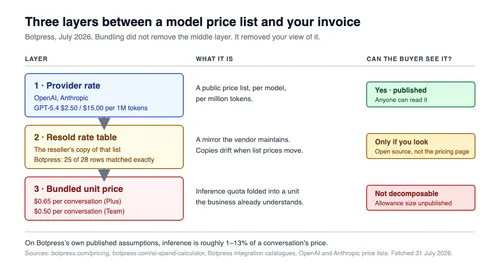
Three layers sit between a model provider's price list and the number on your invoice. Bundling removes the middle one from view.
Two notes on method before the numbers. Nobody on our side has run a Botpress invoice through a finance system, so there is no measured bill in this article. What we did do is the audit the article recommends: on July 31, 2026 we read Botpress's published pricing page, its pricing-change announcement, its documentation, its AI Spend calculator, and the open-source model catalogues in its OpenAI and Anthropic integrations, then compared each resold rate against the model provider's own published price list. That is arithmetic and source comparison, not experience, and every input is linked so you can re-run it.
Botpress pricing in 2026: every number Botpress publishes
There are four self-serve Botpress pricing plans plus a managed service. The plan sets your included conversation allowance and your workspace features; conversations beyond the allowance are bought in packs of 100. According to Botpress's pricing page, fetched July 31, 2026, Free is $0 with 100 conversations and no top-ups, Plus is $150/month billed annually with 250 conversations a month, Team is $750/month billed annually with 1,500, and Enterprise is custom.
| Plan | Billed annually | Billed monthly | Conversations included | Extra conversations | Seats |
|---|---|---|---|---|---|
| Free | $0 | $0 | 100, hard-capped | Not available | 3 |
| Plus | $150/mo | $189/mo | 250/mo | $65 per 100 ($0.65 each) | 3 |
| Team | $750/mo | $939/mo | 1,500/mo | $50 per 100 ($0.50 each) | Unlimited |
| Enterprise | Custom | Custom | Custom | Custom | Unlimited |
The page advertises "Save 20%" for annual billing, and unlike most such claims this one checks out in both directions: $150 against $189 is a 20.6% saving, $750 against $939 is 20.1%. Annualised, Plus is $1,800 a year prepaid against $2,268 paid monthly, and Team is $9,000 against $11,268.
Divide the base fee by the included allowance and you get the unit price the plan actually implies, which is the number worth carrying into a forecast.
| Plan | Implied price per included conversation | Price per top-up conversation | Top-up premium |
|---|---|---|---|
| Plus | $0.60 | $0.65 | 8.3% |
| Team | $0.50 | $0.50 | None |
That asymmetry is small but it points somewhere. On Team the marginal conversation costs exactly what the included one does, so overage is not a penalty. It is the same rate, forever, which makes Team unusually easy to forecast. On Plus you pay a modest premium for every conversation past 250, which is a mild nudge up the ladder rather than a cliff.
Two more published numbers belong in any budget. Storage is tiered and expandable: Plus includes 100,000 table rows, 1GB of vector storage and 10GB of file storage, Team includes 500,000 rows, 5GB and 50GB, and both plans can add a $40/month storage add-on that grants a further 100,000 rows, 1GB vector and 10GB file. Free is hard-capped at 1,000 rows, 100MB vector and 100MB file with no add-on available. And the managed service, listed in Botpress's own announcement table as Built For You, is $1,650/month with custom conversation volume.
What Botpress does not publish anywhere we could find: the price of an Enterprise contract, the size of the AI quota bundled into a conversation, or the ratio between the two. We come back to all three.
Two Botpress pricing regimes are live at the same time
If you are comparing Botpress pricing against something you read three months ago, you are probably comparing two different products. Botpress changed its commercial model on May 14, 2026, and stated explicitly in its pricing announcement that "Existing workspaces will keep our previous pricing" and that the changes "apply only to workspaces created after May 14th, 2026."
That single sentence has more procurement consequence than the price list. It means two Botpress invoices can look nothing alike in the same month, and it means a colleague's experience of the platform's costs may not transfer to yours at all. The first question to ask internally is not "what plan are we on" but "when was our workspace created."
| Dimension | Legacy regime (workspace created before May 14, 2026) | Current regime (created after) |
|---|---|---|
| Billable unit | Incoming messages and events | Conversations, defined as an exchange with at least two end-user messages |
| Model inference | AI Spend, a separate metered line billed at provider cost | Bundled into the conversation allowance |
| Bots | Paid add-on, $10 a month each, capped by plan | Unlimited on every paid plan |
| Seats | Collaborators quota | 3 on Plus, unlimited on Team |
| Spend ceiling | An AI Spend limit you set in the workspace | Auto-recharge, which cannot be disabled |
The change also stranded most of the internet's Botpress pricing content on the wrong side of a line. The article that seeded this topic, Lindy's Botpress Pricing: Plans, Costs, and Best Alternatives in 2026, was published on March 16, 2026 and describes five tiers built on subscription plus separate AI Spend. eesel's Botpress pricing guide, which its own byline dates "Last edited December 4, 2025," describes the same structure and calls AI Spend "a separate, variable utility bill for using the large language models." Both were accurate when written. Neither describes what a new workspace pays today, and both still describe exactly what a pre-May workspace pays.
We could not verify the older tier prices those pages quote, a Plus plan at $89/month and a Team plan at $495/month, against any Botpress-published page still online. They may well be right; they are simply not checkable at source now, so we treat them as historical third-party reporting rather than as prices, and we would not put them in a business case.
There is a general lesson here that outlives Botpress. A pricing regime change is precisely the event that makes every third-party summary wrong at once, while leaving all of them confidently published. Only two sources have a duty to be current: the vendor's own pricing page, and your invoice.
What counts as a conversation, and what quietly buys another pack
A conversation is any exchange with at least two messages in the billing month, and it costs the same whether a bot or a human handles it. Botpress's pricing FAQ, fetched July 31, 2026, is unusually specific about the edges: "AI-only and human-assisted conversations count the same. Emulator conversations count. Spam is excluded. A conversation that spans two months counts in both months. Multiple anonymous sessions each count as separate conversations."
Read that list twice, because three of those five clauses cost money in ways a forecast built from support-ticket volume will not predict.
| Rule | What it does to your count |
|---|---|
| At least two messages | A single unanswered "hi" does not bill; a two-turn exchange does |
| Bot and human count the same | Escalation to a human agent does not create a second billable unit |
| Emulator conversations count | Building and testing in the Studio consumes production allowance |
| Spans two months, counts in both | A conversation open across midnight on the 31st bills twice |
| Anonymous sessions count separately | One person who clears cookies three times is three conversations |
| Spam excluded | Botpress absorbs junk traffic rather than billing it |
The emulator rule is the one that surprises builders. Every test run during development draws from the same allowance the production bot draws from, which means an intense build week is a billing event. Set against that, the spam exclusion is a genuine concession: a vendor absorbing junk traffic is choosing not to bill something it could.
Now the clause that matters most for this article, and the reason bundling is not the same as flat-rate. Botpress's pricing FAQ states that AI usage is bundled such that "each conversation you purchase includes a proportional AI quota for your workspace," and then adds: "If your workspace hits its AI limit before its conversation limit, a conversation pack will be triggered."
So there is still an AI meter. It still runs on tokens. It can still bill you. It simply bills you in a currency denominated in conversations you did not have. A workspace running long retrieval chains, translation, summarisation and multi-step reasoning can exhaust its proportional AI quota at 900 conversations and buy a pack of 100 conversations to keep going: a $50 or $65 charge triggered by inference volume, appearing on the invoice as conversation overage.
Be precise about what is and is not being claimed there. Botpress has not been shown to add a percentage to anybody's token bill. What bundling does is remove the denominator. When a charge appears you cannot tell from the invoice whether volume or inference intensity produced it, and the vendor is under no obligation to tell you, because it has already told you the price of the thing it sells.
The old meter: AI Spend, at cost, with a limit you set
For legacy workspaces and anyone reading pre-May documentation, AI Spend is a separate quota covering LLM inference, embeddings and web search. Botpress's platform documentation, fetched July 31, 2026, defines it plainly: "AI Spend cost is charged at cost, meaning you pay for the exact amount of tokens used by your agent without any additional markup."
The Botpress Academy lesson on the same subject, still published today, is more specific still: Botpress "passes these costs directly to you without any markup, meaning you're getting the exact same price for the same number of tokens if you were to work directly with a model provider." That lesson also documents a $5 monthly free AI Spend credit and states that "AI Spend on Pay-as-you-go plans cannot currently exceed $100."
Three observations about that documentation, all of them checkable today.
It is a strong claim, stated twice, in two places. "At cost, no markup" is not marketing hedge. It is a falsifiable assertion about rates, and the next section tests it rather than taking it on trust.
It documents the regime that stopped applying to new workspaces on May 14, 2026. The docs describe an AI Spend quota, a Collaborators quota, a Bot Count quota and per-add-on auto-recharge, which is the legacy shape. If you created a workspace last week, your own vendor's current documentation describes somebody else's billing model.
The AI Spend calculator is stale in the same direction. Botpress's AI Spend calculator, fetched July 31, 2026, offers exactly two model choices: GPT-3.5 Turbo and GPT-4o. Both are generations behind the models the platform's own catalogue now lists. It is still useful, and we use its constants below because they are the only published assumptions Botpress gives about token consumption per conversation. It is also a legacy artifact.
None of that is scandalous. Documentation drifts at every vendor. It matters here for one reason only: if you are trying to work out what a conversation costs, you are reading three sources that describe two different systems, and none of them tells you which one you are on.
We audited the resold rate table against the model providers
Here is the thing most buyers never realise about a resold meter: the rate table is usually somewhere public, and checking it takes twenty minutes.
Botpress ships its model integrations as open source. The OpenAI and Anthropic integrations each carry a model catalogue with an explicit costPer1MTokens figure for input and output on every model offered. We read both files on the master branch on July 31, 2026 — integrations/openai/src/index.ts and integrations/anthropic/src/index.ts — and compared every model in both catalogues against the provider's own published price list: OpenAI's API pricing page and Anthropic's published model pricing, both fetched the same day.
The two catalogues carry 32 model entries between them. Four have no counterpart on the provider's current price list. OpenAI has retired gpt-5.3 and o1-mini from its published table, and Anthropic no longer lists either Claude 3.5 Sonnet build, which leaves 28 rows that can actually be checked.
| Result | Rows | Share |
|---|---|---|
| Identical to the provider's published price, to the cent | 25 | 89% |
| Lower than the provider's published price (in your favour) | 2 | 7% |
| Higher than the provider's published price (against you) | 1 | 4% |
The headline is genuinely good for Botpress and should be said plainly: on twenty-five of twenty-eight checkable models, including every GPT-5 variant, every current Claude Sonnet and Haiku, GPT-4.1, GPT-4o, o4-mini, o3-mini, o1 and GPT-3.5 Turbo, the resold rate table is the provider's rate table. "At cost, no markup" is not vendor prose. On the models most production bots actually use, it is arithmetic.
Then there are the three rows that differ, and they are the reason to run the check rather than trust the claim.
| Model | Botpress catalogue, input / output per 1M tokens | Provider list price | Direction |
|---|---|---|---|
| Claude Opus 4.7 | $5.00 / $15.00 | $5.00 / $25.00 | Output 40% lower — in your favour |
| Claude Opus 4.6 | $5.00 / $15.00 | $5.00 / $25.00 | Output 40% lower — in your favour |
| o3 | $10.00 / $40.00 | $2.00 / $8.00 | Five times higher on both — against you |
The o3 row is the finding. Botpress's catalogue prices o3 at $10 in and $40 out per million tokens. OpenAI publishes $2 and $8. That is a fivefold difference on both sides of the meter, on a model that is live in the catalogue and live on OpenAI's price list, sitting inside a product whose documentation states in two separate places that it charges provider cost without markup.
We are not going to tell you what any of the three rows mean, because we cannot distinguish from outside between a stale entry, a negotiated rate, and a display value the billing engine never consults. The innocent explanation for o3 is easy to construct: $10 and $40 were o3's launch prices, OpenAI cut them, and the mirror did not follow. That is almost certainly what happened. It is also exactly the point. A resold rate table is a copy, and copies drift. A vendor promising to charge you cost is promising to keep a mirror in sync with somebody else's price list. Price lists move, mirrors lag, and the lag is not symmetrical in its consequences: the two Claude rows drift in your favour and cost you nothing to miss, while the o3 row would quintuple the metered cost of every reasoning call you make on that model.
So the useful conclusion is not "Botpress marks up AI". The evidence says the opposite in twenty-five cases out of twenty-eight. It is that "at cost" is a maintenance promise rather than a structural guarantee, and the only way to know whether it is being kept on the specific model you selected is to look at the specific row. Take twenty minutes and check the models you actually use before you standardise on one.
Two more things the comparison surfaces, both of which are limits on the audit rather than findings against Botpress:
Cached input has no representation in the catalogue. OpenAI publishes a separate, much cheaper rate for cached input tokens: $0.25 per million against $2.50 for GPT-5.4. The Botpress catalogue carries one input rate per model. The platform clearly does track caching, since its hook API exposes a cached boolean per usage record and a savingsPercent field per turn. How the single catalogue rate and the runtime's caching behaviour reconcile is not documented publicly. Put that one to a sales engineer.
A catalogue is not necessarily a billing engine. These files populate the model picker developers see. Whether the same numbers rate your invoice is not something we can verify from the repository, and we are not asserting that they do.
Do the audit anyway. It is the only evidence available that turns a marketing claim into a checkable one, and the same method works on any vendor that ships integrations publicly.
What the bundle hides: deriving the AI share of a conversation
So what is the AI quota inside a $0.65 conversation? Botpress does not publish it. That is a finding, not an omission on our part: we looked at the pricing page, the pricing FAQ, the announcement and the documentation, and none of them state the size of the bundled AI allowance in dollars, tokens or any other unit.
What Botpress does publish are the assumptions behind its own AI Spend calculator, and those are enough to derive a defensible estimate. Reading the calculator's page source on July 31, 2026 gives its working constants: a Knowledge Base query is modelled at 11,000 tokens, an AI Task at 1,200 tokens, a GPT-4o-class blended rate of $0.000005 per token for KB work and $0.00000605 for AI tasks, a GPT-3.5-class blended rate of $0.00000052 and $0.00000061, a caching factor of 0.25, and an upper bound set at 5/3 of the lower.
Take one conversation containing one Knowledge Base query and one AI Task, the shape the calculator itself treats as the default unit of work.
| Component | Tokens | Rate per token | Gross cost |
|---|---|---|---|
| Knowledge Base query, GPT-4o class | 11,000 | $0.000005 | $0.055000 |
| AI Task, GPT-4o class | 1,200 | $0.00000605 | $0.007260 |
| Gross AI cost per conversation | $0.062260 | ||
| After the calculator's 0.25 caching factor | $0.015565 |
Set that against the price of a conversation and the picture is clear.
| Measure | Against Plus at $0.65/conversation | Against Team at $0.50/conversation |
|---|---|---|
| Gross modelled AI cost ($0.0623) | 9.6% of the price | 12.5% |
| After the caching factor ($0.0156) | 2.4% | 3.1% |
| Same conversation on a GPT-3.5-class model, gross ($0.0065) | 1.0% | 1.3% |
Between 87 and 99 percent of what you pay per conversation is not inference. It is platform: the builder, the runtime, the channels, the helpdesk, the storage, the support, and the margin. That is not an accusation. It is what a software company sells, and inference was never going to be the expensive part of a $0.65 unit at these token volumes. But it reframes the whole "is there a markup on AI" question. On these assumptions there is no room for a meaningful markup on inference to matter, because inference is a rounding error inside the price. The number that decides your Botpress bill is your conversation count, and the number that decides whether you blow through your allowance early is your inference intensity.
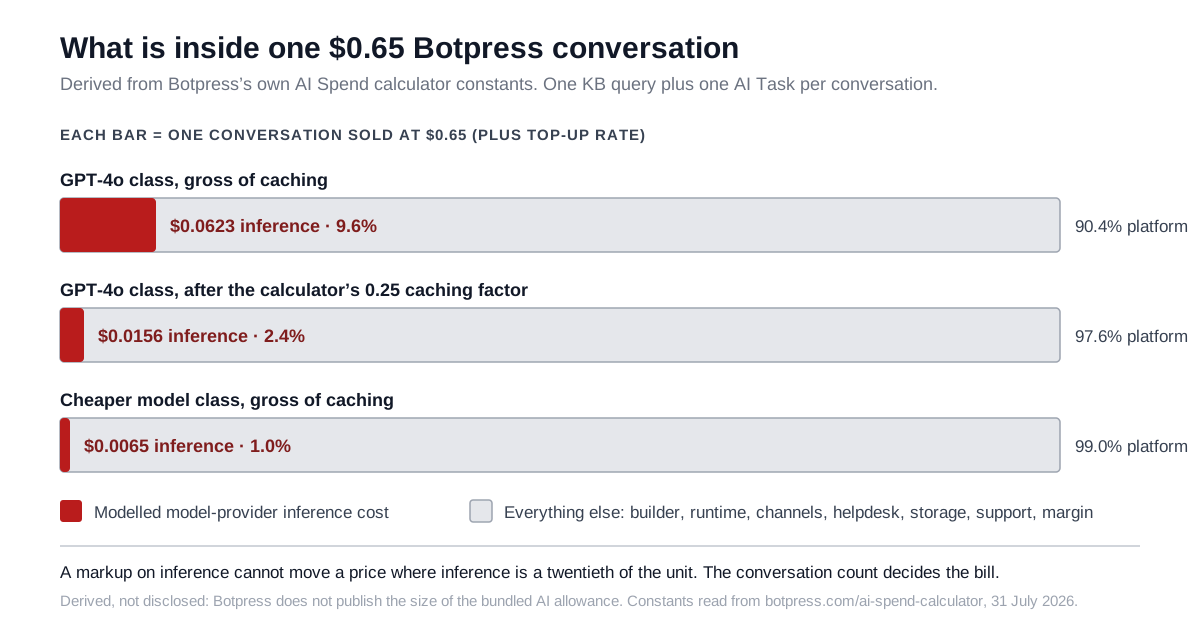
The same conversation costed three ways. The red sliver is the model provider's share.
One caveat on that caching factor, and we would rather flag it than quietly pick a side. The calculator's footnote describes a "25% caching rate" while the code multiplies the total by 0.25, which is a 75% reduction. Those are not the same statement. We have shown the arithmetic both ways above precisely because we cannot tell from outside which the author meant, and the answer moves the AI share by a factor of four, from about 2.4% to about 9.6% of a Plus conversation. Either way the conclusion holds: inference is a minority of the price, not a majority.
Scale it to a monthly figure and the same shape appears.
| Workload | Conversations/month | Modelled gross AI cost | Plan cost (annual billing) | AI as share of plan |
|---|---|---|---|---|
| Small bot, GPT-4o class | 250 | $15.57 | $150 (Plus) | 10.4% |
| Support operation, GPT-4o class | 1,500 | $93.39 | $750 (Team) | 12.5% |
| Support operation, GPT-3.5 class | 1,500 | $9.68 | $750 (Team) | 1.3% |
These are derivations from Botpress's own published assumptions, not quotes and not measurements. They are a sanity band, and their job is to tell you whether the vendor's bundling decision is likely to be working for you or against you at your volume. Below a few thousand conversations a month, on ordinary retrieval-and-answer workloads, the bundle is almost certainly in your favour.
Three costed scenarios, in the units a buyer actually uses
Budget-holders ask for the number in three units: per month, per year, and per conversation. Here are three concrete workloads costed in all three, using only published prices.
Scenario A: a solo operator with a product-support bot
400 conversations a month, one bot, one builder. Plus covers 250; the remaining 150 needs two packs of 100 at $65 each, because packs round up.
$150 + (2 × $65) = $280/month, or $3,360/year, at $0.70 per conversation.
The rounding matters at this size. You buy 200 conversations to cover 150, so a quarter of the top-up spend, $32.50 of $130, is unused headroom that expires at the end of the month. Botpress's FAQ states that "unused conversations in a pack expire at month end — they don't roll over," while the packs themselves "persist month-to-month until you remove them in billing settings," so the capacity carries forward even though the unused conversations inside it do not. At 400 conversations the effective per-conversation price is $0.70, which is 17% above the Plus list rate of $0.60, and a month that swings between 260 and 400 conversations pays that penalty repeatedly.
Scenario B: an organised support team
1,800 conversations a month, five agents, RBAC and routing required. Team covers 1,500; three packs of 100 at $50 cover the rest.
$750 + (3 × $50) = $900/month, or $10,800/year, at $0.50 per conversation.
No rounding penalty in effective rate here, because Team's pack price equals its implied included rate. This is the plan shape Botpress has optimised: at Team, overage is priced honestly and the marginal conversation costs what the average one does.
Scenario C: the same team, paid monthly instead of annually
Identical usage, no annual commitment.
$939 + (3 × $50) = $1,089/month, or $13,068/year, at $0.605 per conversation.
The flexibility premium is $2,268 a year, or 21% of the annual-billed total. That is the single largest controllable line in this whole article, and it is a treasury decision rather than a technical one.
| Scenario | Monthly | Annual | Effective per conversation |
|---|---|---|---|
| A — solo, 400 conv, Plus annual | $280 | $3,360 | $0.70 |
| B — team, 1,800 conv, Team annual | $900 | $10,800 | $0.50 |
| C — team, 1,800 conv, Team monthly | $1,089 | $13,068 | $0.605 |
Two things none of these numbers include, and both can exceed them. Channel fees are not Botpress's to charge: WhatsApp, SMS and voice carry their own provider costs that arrive on a different invoice. And storage beyond the plan allowance is $40/month per add-on unit, which is small in isolation and easy to forget in a model that indexes a large knowledge base.
Who can see the meter: Studio and ADK versus Desk
Visibility into AI usage is not a plan feature at Botpress. It is a product-surface feature, and that distinction is unusual enough to be worth naming.
Botpress's pricing FAQ, fetched July 31, 2026, states that "Botpress Studio and ADK users see a full AI spend meter and can drill into usage by category (playbooks, translation, workflows, etc.) to find optimization opportunities. For Botpress Desk users, this is handled automatically and mostly invisible." The plan comparison table carries a row for the AI usage meter labelled Studio/ADK, and the FAQ confirms that plans and prices are identical across Desk and Studio.
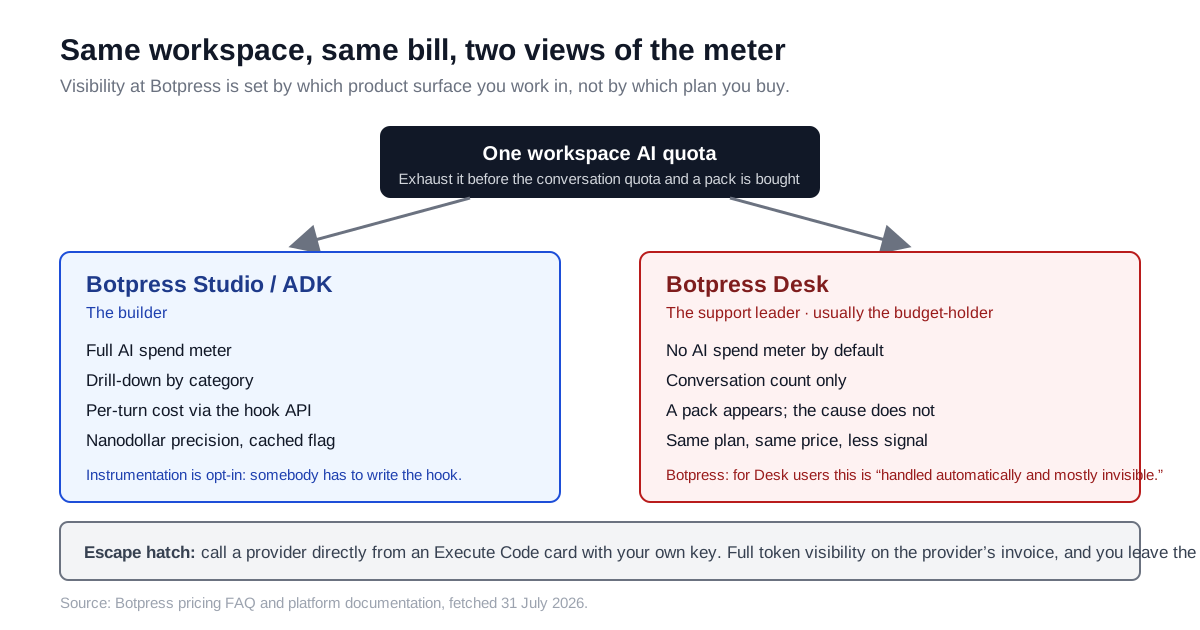
The same workspace, the same bill, two different levels of visibility depending on which surface you work in.
So the person most likely to be responsible for the invoice — a support leader running Desk — is the person Botpress deliberately shields from the meter. The rationale is stated and reasonable: normal helpdesk usage rarely approaches the AI limit, and support leaders should not be auditing inference costs. As a product decision that is defensible and probably right for most buyers.
As a governance decision it has a consequence worth putting in writing before you sign. If your workspace does hit the AI limit before the conversation limit and buys a pack, the Desk user sees a conversation overage. The information that would explain it, namely which category of AI work consumed the quota, lives in a surface they do not use. Somebody in your organisation should have Studio access purely so that question is answerable.
For teams that want the raw record, Botpress's builder tooling is unusually granular. Its documented hook API exposes AI spend per turn "in nanodollars," broken down by usage with a token count, a workflow location, a cached flag and a duration, and Botpress publishes a guide to writing that record into a Tables row on every turn. Nanodollar granularity, attributed to a location in the workflow, is genuinely excellent instrumentation. It is also opt-in and code-level: somebody has to write the hook, and nobody in a Desk-only deployment ever will.
Does bring-your-own-key change anything here?
Short answer: not in the way most buyers hope, and the reason is visible in the source code.
The usual escape from a resold meter is to supply your own model API key so the provider bills you directly. It converts an opaque line on a vendor invoice into a transparent one on the provider's, and it usually gets you your own volume discounts. On Botpress's official OpenAI and Anthropic integrations, that route is not offered.
The evidence is in the integration definitions we read for the rate audit. Both declare the provider key as a secret, OPENAI_API_KEY and ANTHROPIC_API_KEY, not as a configuration field. In Botpress's own SDK documentation, those are different things with different owners: configuration is "the form bot developers see when installing the integration" and is where an integration that wanted your key would ask for it, the way the Linear integration asks for a Linear API key. A secret is set by whoever builds and deploys the integration. For a first-party integration, that is Botpress.
| Route | Whose key | Who bills you | Visibility of token cost |
|---|---|---|---|
| Built-in models, current regime | Botpress | Botpress, as conversations | Studio/ADK meter only; no dollar line |
| Built-in models, legacy regime | Botpress | Botpress, as AI Spend at cost | Per-action, in dollars, in the workspace |
| Your own call from an Execute Code card or custom integration | Yours | The model provider, directly | Full, on the provider's invoice |
The third row is real and Botpress documents it. Its API guide shows a retrieval-augmented-generation example instantiating an OpenAI client with a comment to "Change this for your own OpenAI API key," and the SDK explicitly supports integrations that require users to supply their own key. Be honest about what you are buying with that route, though. You leave the managed model layer: the model picker, the built-in caching, the AI Spend meter, and whatever routing and fallback the platform provides. You are writing and maintaining an integration to move a cost line onto a different invoice.
For most teams that is a bad trade at Botpress's price points, and the arithmetic above explains why. When inference is around a tenth of the unit price, moving it to your own key cannot save you a tenth of the bill, because the platform still charges per conversation. Bring-your-own-key is a strong lever when a vendor resells inference as the product and marks it up. It is a weak lever when inference is bundled into a platform price.
Where it still earns its keep is not cost. It is data path, model choice and attribution: if you need a specific model the catalogue does not carry, need inference to run under your own provider agreement, or need per-team token attribution for chargeback, the code route is the only one that gets you there.
The controls you get, and the one bundling took away
Every pricing change is a trade, and this one traded a spend ceiling for predictability. It is worth being precise about both halves.
What you get. Conversation pricing is genuinely forecastable. You can multiply your support volume by a published unit price and be roughly right, which is more than can be said for token billing. Notifications arrive at 80% and 90% of quota. Spam is excluded. Failed and single-message exchanges do not bill. And Botpress made a deliberate, defensible choice not to bill per resolution, arguing in its announcement that "Resolution pricing penalizes a better bot" because improving your knowledge base and workflows "directly increases your bill." That argument is correct and most of its competitors cannot make it.
What you lose. The legacy regime had an AI Spend limit you set yourself, and a documented hard ceiling of $100 on pay-as-you-go. The current regime has neither. Botpress's pricing FAQ answers the question "Can I turn off auto-recharge?" with a flat "No," and gives the reason: "Because AI spend is bundled into conversations, pausing conversations means pausing the product entirely — whether a bot or a human is handling it."
That reasoning is honest and it is also structurally true. Once inference and conversation handling share one meter, a spend cap becomes a service cap, and no support platform can offer to stop answering customers at a dollar threshold. But state the consequence in the terms a finance function will use: there is no maximum monthly Botpress bill. Packs are added automatically, they are added whether the trigger was conversation volume or AI consumption, and the only controls are two warning emails and your own attention.
| Control a buyer wants | Botpress's answer today | Gap |
|---|---|---|
| Forecast the bill before the month | Conversations × published unit price | Good, if your volume is stable |
| Hard cap on monthly spend | Not available; auto-recharge cannot be disabled | Total exposure is unbounded |
| Warning before overage | Emails at 80% and 90% of quota | Reactive, and only to whoever gets the email |
| See what inference actually cost | Studio/ADK meter, by category | Not visible to Desk users |
| Per-turn cost record in dollars | Hook API, nanodollar precision | Opt-in, requires writing code |
| Attribute spend to a team | Not available as a billing construct | One workspace pool |
| Approve before an expensive run | Not available | No pre-spend gate |
The gap that matters most to a governance-minded buyer is the last one, and nothing in Botpress's published material offers a pre-spend approval step. We did not survey the category, so we will not tell you how rare that is; we will say it is the control we would ask about first. This is exactly the class of exposure the NIST AI Risk Management Framework, released in January 2023 for voluntary use, exists to make organisations enumerate: a third-party dependency whose consumption your own staff can raise without an approval step. Financial runaway rarely tops anybody's AI risk register. It is usually the first one that shows up on paper.
The hybrid bill: what to leave bundled and what to move
The realistic answer for most teams is not "Botpress or not-Botpress." It is a split, and the split follows directly from the derivation above: leave the work whose cost is dominated by the platform on the bundled meter, and move only the work whose cost is dominated by inference to somewhere you can see it.
| Component of your build | Leave bundled? | Why |
|---|---|---|
| Ordinary retrieval-and-answer conversations | Yes | Inference is roughly 1–13% of the conversation price; little to recover |
| Human-assisted support conversations | Yes | Same price as bot conversations; the bundle is favourable |
| Emulator and build-time testing | Yes, but count it | It draws production allowance; budget a build week |
| Heavy batch work — bulk classification, re-indexing, back-catalogue summarisation | No | High token volume, low conversation count: the worst possible shape for conversation billing |
| Long autonomous multi-step reasoning chains | Consider moving | This is what triggers an AI-limit pack; conversation billing prices it as one conversation |
| Anything needing per-team cost attribution | Move, or instrument | The bundle has no attribution construct |
The costed version, using Scenario B: a support operation at 1,800 conversations pays $900/month whether or not it also runs a nightly job that re-summarises 5,000 knowledge articles. If that job runs through Botpress it consumes the workspace's AI quota and can trigger conversation packs at $50 each, which is inference charged in a unit that has nothing to do with it. Run the same job directly against a model provider with your own key and it appears as tokens on a provider invoice, attributable to the job. Modelled at the calculator's own KB rate, 5,000 articles at 11,000 tokens each is about $275 of gross inference. That is a number worth seeing as itself rather than as five and a half conversation packs.
The cost of the split is one sentence long: you now hold a provider credential, pay a second invoice, and maintain code the platform does not manage. Below a few hundred dollars a month of moved work, that overhead is not worth it. The threshold is a judgment rather than a measurement, and we would rather say so than dress a guess as a rule.
The second reason to prefer the split has nothing to do with the total. A token bill is attributable. You can say which job, which team and which prompt spent the money. A conversation count is not, and no amount of reporting after the fact recovers attribution you never captured. This is the point the FinOps Foundation's FOCUS specification makes structurally: it defines separate columns for the entity that issues your invoice and the entity that actually provides the service, and it notes that "in reseller scenarios, if the reseller is selling resource or services that are white-labeled from another provider, the Service Provider is the reseller." When a meter is resold, the standard for billing data accepts that the original provider disappears from the record. If you need it back, you have to keep it yourself.
When a bundled resold meter is genuinely the better deal
It would be dishonest to run all that arithmetic and conclude that bundling is a trap. For most buyers of a support chatbot it is the better structure, and the case is stronger than the critique.
It removes a forecast nobody can make. Token consumption per conversation depends on prompt length, retrieval depth, model choice and user behaviour, none of which a support leader controls or can predict a quarter ahead. A conversation count is a number the business already has.
It prices the thing being bought. Botpress's own argument here is good: a conversation is what a support operation thinks in, and a better bot should lower cost rather than raise it. Resolution-based pricing, which Intercom and Zendesk use, has the perverse property that improving your bot increases your bill. Botpress named that and priced against it.
The bundle is currently generous at ordinary volumes. On Botpress's own modelled assumptions, inference is a small minority of the conversation price. A buyer with normal retrieval workloads is very likely getting inference cheaply inside the bundle rather than expensively.
Human and bot conversations cost the same. Escalation does not double-bill. For a helpdesk mixing automation and agents, that beats paying for a bot platform and a seat-based helpdesk separately.
The place bundling turns against you is narrow and identifiable: workloads with high inference intensity per conversation, or high token volume with low conversation count. If your build is a batch reasoning engine wearing a chatbot's clothes, conversation billing will price it wrongly and the AI-limit clause will find you. Everything else about the model is defensible, and if your workload is ordinary support traffic you should buy the plan that fits your volume and stop thinking about tokens, which is precisely what Botpress designed it to let you do.
The resold-meter checklist: eleven questions for any vendor
We call this the resold-meter check, and it is not specific to Botpress. Any time a vendor's invoice includes a third party's consumption, these eleven questions separate a pass-through you can audit from one you cannot.
- Is the underlying provider named, and can I see which model actually ran?
- Is there a published rate table, and where does it live: the pricing page, the docs, or a source repository?
- Does that rate table match the provider's own published list price today, row by row?
- Who updates the table when the provider changes prices, and how would I know?
- Is the meter separately visible on my invoice, or absorbed into a composite unit?
- If absorbed, is the included allowance published in any unit at all?
- Can consumption of the hidden meter trigger a charge denominated in something else?
- Who in my organisation can see the meter, and is it the same person who owns the budget?
- Can I set a hard spend ceiling, and if not, what is the theoretical maximum monthly bill?
- Is there a supported bring-your-own-key path, or only a code-level escape hatch?
- Which pricing regime is my account on, and when was it created?
Question three is the one that changes the conversation, because it is the only one that converts a marketing claim into evidence. Question eleven is the one people forget, and on Botpress specifically it determines which of two entirely different billing models applies to you.
Botpress's own walkthrough of reducing AI consumption is a reasonable companion to this list. It is a 28-minute session from February 2026 on the vendor's channel and it is more concrete than most vendor content about where token cost actually accumulates in a build.

Where a governance layer fits, and where it does not
LeapForce is not a chatbot builder and is not an alternative to Botpress. If you need a visual agent studio, a helpdesk and WhatsApp channels, buy one of those. What we build is the governed layer in front of the model calls that any of these platforms make: one endpoint to every model, an audit record of what ran and what was refused, and identity for non-human actors so every agent has an owner, a scope and an expiry. The seam this article keeps returning to — a meter you cannot decompose, visible to a builder and not to the budget-holder, with no pre-spend gate — is the seam that layer is for. Our rollout guidance is deliberately unglamorous: observe first, enforce second, optimize third, because the first useful artifact is never a policy, it is an honest picture of which teams and which agents are actually spending. One caveat in one sentence, because the honest ones matter: dollar budgets and chargeback are still in development on our platform rather than shipping today, and no governance layer changes what a vendor charges per conversation. It changes what you can see and attribute. For the fuller argument see our earlier analysis of how model routing cuts LLM costs and of what enterprise AI implementation costs beyond the licence, and our observability and audit approach.
The wider problem is not hypothetical. Writing in Forbes in June 2026, Josipa Majic Predin reported Uber COO Andrew Macdonald's assessment of the link between the company's AI token spend and consumer-facing improvement — "That link is not there yet" (Forbes, June 4, 2026). If an organisation with that engineering capability cannot connect token spend to outcome, a support team reading a conversation count has no chance of doing it from the invoice alone. The instrumentation has to be deliberate.
Honest limits on this analysis
Several things here are less certain than the tables make them look.
We did not run a Botpress invoice. Every figure is either a published price or arithmetic applied to Botpress's own published assumptions. That method is auditable, since you can re-derive any line from the linked sources. A measured invoice would beat it, and we do not have one.
The AI share of a conversation is a derivation, not a disclosure. Botpress does not publish the size of the bundled AI quota. Our 1–13% band, whose actual bounds are 1.0% and 12.5%, comes from the constants in Botpress's own calculator, which models GPT-3.5 Turbo and GPT-4o rather than the models the platform now offers, and which contains the caching ambiguity we flagged. It is also single-sourced: one artifact, no second source, no measurement. Treat the band as an order of magnitude, not a rate.
The rate audit reads a catalogue, not a billing engine. The costPer1MTokens values live in the open-source integration definitions. We checked all 28 rows that have a counterpart on a provider price list, on July 31, 2026. We did not and cannot verify that those same numbers rate an invoice, and four further catalogue entries could not be checked at all because the providers have retired them from their published tables.
We do not know why three rows disagree with their provider's published price. We report all three because they are checkable and because they make the general point about drift. We are not asserting that any of them is an error, and we are explicitly not asserting that anyone has been overcharged for o3. A catalogue entry is not proof of what an invoice does.
Enterprise pricing is entirely absent. Botpress publishes no Enterprise figure and we did not solicit a quote. Anyone whose volume points at Enterprise should assume everything in this article about unit prices is a negotiating baseline rather than a price.
Buyer voices are thin, and that is a real gap. Reddit, G2 and Capterra all refused our tooling behind bot protection, so we could not verify practitioner complaints at their source. The one practitioner voice in this article comes from Hacker News, whose audience skews technical and self-hosting, and it is about a different vendor's meter rather than Botpress's. Third-party pricing summaries exist in quantity, but the ones we checked describe the pre-May-2026 model, so we excluded them as current evidence rather than repeat them.
Prices change, and this vendor's did, twice within our sources. Everything above is current as of July 31, 2026. The May 14, 2026 change is proof that this is a live commercial model rather than a fixed one.
Frequently asked questions
There is a free tier, but it is a trial rather than a free plan in any sustained sense. Botpress's pricing page lists Free at $0 with 100 conversations, 3 seats and 3 AI agents, explicitly with "No top-ups or overages", a hard cap rather than a monthly renewing allowance, with storage capped at 1,000 table rows, 100MB vector and 100MB file and no add-on available. It is enough to build something and see whether the platform fits. It is not enough to run a support operation, and the pricing page's own recommendation logic never proposes it as a fit for a real volume.
Per Botpress's pricing page on July 31, 2026: Free is $0, Plus is $150/month billed annually or $189 billed monthly with 250 conversations, Team is $750/month annually or $939 monthly with 1,500 conversations, and Enterprise is custom. Extra conversations come in packs of 100 at $65 on Plus and $50 on Team. A managed service, Built For You, is listed at $1,650/month. Annual prepayment saves about 20%, which we verified in both directions against the monthly rates.
AI Spend is Botpress's name for the cost of the LLM calls your agent makes: inference, embeddings and web search. In workspaces created before May 14, 2026 it is a separate metered quota billed at provider cost, with a $5 monthly free credit and a $100 ceiling on pay-as-you-go. In workspaces created after that date it is bundled into your conversation allowance and is no longer a separate charge, though it still exists as an internal limit: Botpress states that if a workspace hits its AI limit before its conversation limit, a conversation pack is triggered.
Botpress states twice, in its documentation and in its Academy course, that AI Spend is charged at cost with no markup. We tested that claim rather than repeating it: on July 31, 2026 we compared the per-million-token rates in Botpress's open-source OpenAI and Anthropic integrations against the providers' own published price lists. Of the 28 models that could be checked, 25 were identical to the cent: every GPT-5 variant, every current Claude Sonnet and Haiku, GPT-4.1, GPT-4o, o4-mini, o3-mini, o1 and GPT-3.5 Turbo. Two Claude Opus rows listed output 40% below Anthropic's published price, which runs in your favour. One row runs the other way: o3 is listed at $10 in and $40 out against OpenAI's published $2 and $8, a fivefold difference. The likeliest explanation is a stale entry that never followed a provider price cut, and that is precisely why the answer to this question is "mostly no, and check the model you actually use" rather than a flat yes or no.
Between $0.50 and $0.70 depending on plan and overage. Dividing the base fee by the included allowance gives an implied $0.60 per conversation on Plus and $0.50 on Team. Top-up packs price at $0.65 and $0.50 respectively, so Team's marginal conversation costs exactly what its average one does while Plus carries an 8.3% overage premium. Because packs are sold in blocks of 100 and unused pack conversations expire at month end, the effective rate at low volumes is higher, and a 400-conversation month on Plus works out at $0.70 per conversation.
Because they were written before May 14, 2026, when Botpress replaced its previous pricing with the conversation-based model and stated that existing workspaces keep the old pricing. Widely-cited guides dated December 2025 and March 2026 describe a Pay-as-you-go tier plus Plus, Team, Managed and Enterprise plans with a separate AI Spend line, and those figures are historical rather than wrong. We could not verify the older tier prices on any Botpress page still online, so we would not put them in a business case. If your workspace predates the change, though, the old regime is still yours.
Not in the current regime. Botpress's pricing FAQ answers "Can I turn off auto-recharge?" with "No," explaining that because AI spend is bundled into conversations, pausing conversations would pause the product entirely. Packs of 100 are added automatically when you exhaust your allowance, with email warnings at 80% and 90% of quota. The practical consequence for a finance function is that there is no maximum monthly Botpress bill, only a rate and a warning. Legacy workspaces created before May 14, 2026 do have a user-settable AI Spend limit, which is one of the few respects in which the older model gave a buyer more control.
Not through the official model integrations. Both declare the provider key as an integration secret rather than as an installation configuration field, which in Botpress's own SDK terms means it is set by whoever deploys the integration. For a first-party integration, that is Botpress, not you. You can call a provider directly with your own key from an Execute Code card or a custom integration, and Botpress's API documentation shows exactly that, but you leave the managed model layer behind when you do. Given that inference is a small share of the conversation price, bring-your-own-key at Botpress is a lever for model choice, data path and attribution rather than for saving money.
Custom, with no published figure. Botpress's pricing page lists Enterprise as custom conversation volume and custom pricing, adding dedicated support, an SLA and security review, custom storage, a voice channel, custom data retention and residency policies, and a BAA for HIPAA compliance. Everything in this article about per-conversation rates should be treated as a negotiating baseline at that tier rather than as a price. Ask specifically what the bundled AI allowance is in your contract, since it is not published anywhere at the self-serve tiers.
For ordinary support automation at predictable volume, the pricing structure is one of the more honest ones in the category: a unit the business already understands, no per-resolution penalty for improving your bot, human and bot conversations priced the same, spam excluded, and inference bundled at what looks like a genuinely favourable rate. It gets worse in one specific shape: high token volume with low conversation count, such as batch reasoning or bulk re-indexing, where conversation billing prices the work wrongly and the hidden AI limit finds you anyway. The question to take into the renewal is not "is Botpress expensive." It is "which of us can see the meter, and what happens on the month nobody is watching it."
Ready to Govern Your AI?
Talk to LeapForce — one controlled layer for every AI tool, connector, model, and agent.
Comments