
Migrating from Claude to DeepSeek cuts list-price inference spend by roughly 96% on comparable tiers, and DeepSeek publishes an Anthropic-format endpoint that makes the wire change close to a one-line edit. Neither fact decides anything. The decision is whether your cost per accepted output falls, and that number can move the wrong way.
Our position is narrower than the usual advice. Most migration guides tell you to run offline evaluations and then roll out gradually. That is correct and it is not the hard part. The hard part is that a price cut of this size buys a startlingly small amount of quality headroom once you price what a bad output costs you. Often it is less than half a percentage point of acceptance rate. We call that headroom the parity band, and computing it before you write a single eval is the step almost nobody does.
The problem shows up in practice as budget relief that never arrives. Discussing cheap-model economics on Hacker News in November 2025, the commenter leo_e put it plainly: "Cost per successful task is the only metric that matters in production." They were describing burning more tokens on verification and correction loops around a cheap model than a stronger model would have consumed outright.
The short answer: Switch only if the candidate model's acceptance rate on your own replayed traffic stays inside the parity band, defined as the saving per month divided by (rework cost per failure x monthly volume), and only behind a rollback you can execute as a config change, not a deploy.
Last updated: July 30, 2026.
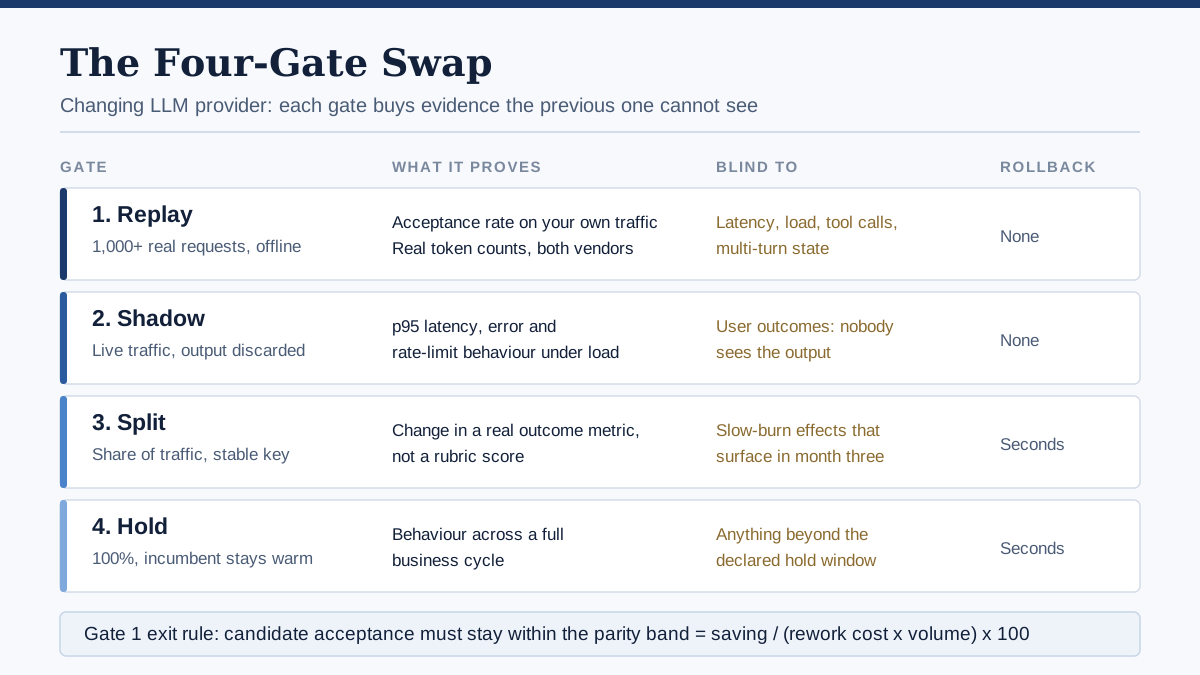
The Four-Gate Swap. Each gate buys one class of evidence the previous one cannot see.
One disclosure before the numbers. We have not run this migration ourselves on LeapForce production traffic, and nothing below is a measured result from our own systems. The pricing, benchmark and policy figures are fetched from primary sources and dated; the cost model is arithmetic you can re-run with your own inputs, and it is labelled as arithmetic wherever it appears. Where a number would have to come from a test we did not run, we say so instead of inventing it.
What the Swap Actually Costs on Paper
On published list prices fetched 30 July 2026, DeepSeek-V4-Flash costs $0.14 per million input tokens (cache miss) and $0.28 per million output tokens, against $2.00 and $10.00 for Claude Sonnet 5 under its introductory pricing, according to the DeepSeek API pricing page and the Claude platform pricing docs. For a workload of one million input and one million output tokens, that is $0.42 against $12.00, a 96.5% reduction in raw model spend.
| Model | Input / 1M tokens | Output / 1M tokens | 1M in + 1M out | Cut vs Sonnet 5 |
|---|---|---|---|---|
| Claude Opus 5 | $5.00 | $25.00 | $30.00 | — |
| Claude Sonnet 5 (from 1 Sep 2026) | $3.00 | $15.00 | $18.00 | — |
| Claude Sonnet 5 (through 31 Aug 2026) | $2.00 | $10.00 | $12.00 | baseline |
| Claude Haiku 4.5 | $1.00 | $5.00 | $6.00 | 50.0% |
| DeepSeek-V4-Pro | $0.435 | $0.87 | $1.305 | 89.1% |
| DeepSeek-V4-Flash | $0.14 | $0.28 | $0.42 | 96.5% |
List prices fetched 30 July 2026 from the two vendors' own pricing pages. DeepSeek input prices shown are cache-miss; cache-hit input is $0.0028 per million tokens on Flash. Anthropic's introductory Sonnet 5 pricing of $2/$10 runs through 31 August 2026, after which the page states standard pricing of $3/$15 takes effect.
Two operational details on the same DeepSeek page matter more to a migration plan than the headline numbers. First, DeepSeek publishes an Anthropic-format base URL at https://api.deepseek.com/anthropic alongside the OpenAI-format one, which is why the swap looks like a configuration change. Second, the published concurrency limits differ by tier, at 2,500 for Flash against 500 for Pro, so the cheaper model is also the one with more headroom under burst, which is not the trade-off people expect.
The Anthropic docs carry a third detail that quietly breaks naive comparisons. Claude 4.7 and later models use a newer tokenizer that, in Anthropic's own words, "produces approximately 30% more tokens for the same text" than the previous one, with the exact increase depending on content and workload shape. A price per million tokens is therefore not a price per unit of work, and it is not comparable across vendors, or even across model generations from the same vendor, until you have counted tokens on your own corpus.
That is the first thing a real migration measures, and it is why the first gate below is a replay rather than a benchmark run.
Why Dollars per Million Tokens Is the Wrong Unit
The unit that decides an LLM provider migration is cost per accepted output: total money spent to produce one result a human or a downstream system will actually use, including the cost of everything you had to redo. Model spend is one term in that expression and usually the smallest one. Retries, verification passes, human corrections and the occasional incident are the rest.
Here is the arithmetic on an illustrative support-triage workload. These inputs are assumptions, not measurements. The point is the shape of the result. Substitute your own numbers.
| Input | Value |
|---|---|
| Tasks per month | 100,000 |
| Input tokens per task | 4,000 |
| Output tokens per task | 600 |
| Acceptance rate, incumbent (Claude Sonnet 5) | 94% |
| Cost to fix one rejected output | $3.00 (4 minutes of loaded human time at $45/hour) |
On Claude Sonnet 5 at $2.00 / $10.00, the model spend is 400 million input tokens at $2.00 plus 60 million output tokens at $10.00, or $800 + $600 = $1,400. Six thousand rejected outputs at $3.00 each add $18,000. Total: $19,400, or $0.194 per accepted output.
Now run the same workload on DeepSeek-V4-Flash. Token counts are held equal here purely to isolate the acceptance effect; in a real gate you measure them, because of the tokenizer point above. Model spend falls to 400 x $0.14 plus 60 x $0.28, or $56 + $16.80 = $72.80. If acceptance drops from 94% to 88%, rework rises to 12,000 failures at $3.00, or $36,000. Total: $36,072.80, or $0.361 per accepted output.
| Line item | Claude Sonnet 5 | DeepSeek-V4-Flash |
|---|---|---|
| Model spend | $1,400.00 | $72.80 |
| Rejected outputs | 6,000 | 12,000 |
| Rework cost | $18,000.00 | $36,000.00 |
| Total monthly cost | $19,400.00 | $36,072.80 |
| Cost per accepted output | $0.194 | $0.361 |
Illustrative arithmetic on stated assumptions, not a measured benchmark. Model prices are real and dated; volumes, acceptance rates and rework costs are inputs you supply.
A 96.5% price cut produced an 86% cost increase. The saving was real — $1,327.20 a month — and it was consumed nineteen times over by six percentage points of acceptance loss. This is exactly the failure mode the Hacker News comment describes: the retry and verification logic you build around a cheaper model is not free, and it is rarely counted in the business case that authorised the switch.
The corollary is more useful than the example. If six points of acceptance loss destroys the case that badly, how much loss can the case actually absorb?
The Parity Band: How Much Quality a Price Cut Buys
The parity band is the maximum acceptance-rate drop a cheaper model can suffer before it stops being cheaper. It is one line of arithmetic:
parity band (percentage points) = monthly model-spend saving / (rework cost per failure x monthly task volume) x 100
On the numbers above: $1,327.20 divided by ($3.00 x 100,000), times 100, is 0.44 percentage points. A 96.5% list-price cut bought less than half a point of acceptance headroom. If the incumbent accepts at 94.0%, the candidate has to hold 93.56% or the migration loses money.
That result is counterintuitive enough that it is worth stating the general rule it implies: the parity band narrows as the cost of a bad output rises. Cheap models are economically viable exactly where mistakes are cheap, and the relationship is linear, not gentle.
| Cost to fix one rejected output | Parity band (percentage points) | Minimum acceptance for the swap to pay |
|---|---|---|
| $0.30 (automatic retry, no human) | 4.42 | 89.58% |
| $1.00 | 1.33 | 92.67% |
| $3.00 (4 minutes of human review) | 0.44 | 93.56% |
| $12.00 (specialist review of a regulated output) | 0.11 | 93.89% |
| $60.00 (a customer-visible error with remediation) | 0.02 | 93.98% |
Same workload and same $1,327.20 monthly saving throughout; only the rework cost varies. Incumbent acceptance held at 94.0%.
Read the bottom row. When a bad output costs $60 to put right, a 96.5% price cut buys you two hundredths of a percentage point. At that level the migration is not an LLM cost optimization exercise at all. It is a bet that two models are statistically indistinguishable on your traffic, and no offline benchmark can support that bet.
Read the top row too, because it is the honest case for switching. When failures are caught automatically and retried for pennies, the band opens to more than four points, and a cheap model with a verifier in front of it is a genuinely strong architecture. The band is not an argument against model provider switching. It is an argument for knowing which workload you are in before you start.
Three practical notes on using the formula.
The rework cost is the hardest input and the one people lowball. It is not just the reviewer's time. Include the queue latency the correction adds, the cost of the escalation path, and, where the output reaches a customer, the remediation. If your team cannot agree on a figure, run the band at the low and high estimates and see whether the decision changes. If it does not, you have your answer without the argument.
The saving term should use your real traffic mix, not list prices on a round million tokens. Cache-hit input on DeepSeek-V4-Flash is $0.0028 per million tokens against $0.14 on a miss, a factor of fifty. A workload with a large stable system prompt and heavy cache reuse has a very different saving term from one with long unique documents, and Anthropic's prompt-caching rates change the incumbent side of the ratio too.
Volume cuts both ways. Doubling task volume doubles the saving and doubles the rework exposure, so the band is invariant to volume at a fixed acceptance rate. What volume does change is your ability to measure acceptance precisely enough to tell 93.6% from 94.0%. At 100,000 tasks a month you can. At 2,000 you cannot, and that is a reason to leave the incumbent alone.
What Actually Changed in the Model Market
The reason this question is live in 2026, rather than a fringe cost-engineering exercise, is that top-tier model quality converged. According to the 2026 AI Index Report from Stanford HAI, as of March 2026 the top four companies on the Arena Leaderboard were separated by fewer than 25 Elo points: Anthropic at 1,503, xAI at 1,495, Google at 1,494 and OpenAI at 1,481. The report states that as leading models become harder to distinguish on benchmark performance, "factors such as cost, latency, reliability, and domain-specific optimization may play a greater role in user adoption."
That is the market condition an AI model migration is responding to, and it is why migrating from Claude to DeepSeek is now a budget conversation rather than a fringe experiment. The same report supplies the number that should temper the enthusiasm: DeepSeek sat at 1,424 on the same March 2026 export, 79 Arena points behind Anthropic's leader, with Alibaba at 1,449 between them. Convergence at the frontier is not the same as parity with the frontier, and a cost-driven switch to DeepSeek is not a switch between two models the leaderboard considers equivalent.
The report also records that the US–China model performance gap "has effectively closed" — the top US model led the top Chinese model by 2.7% as of March 2026, with the gap fluctuating between near parity and low single digits over the preceding year. Both things are true at once: the national gap is negligible, and the specific gap between the model you are leaving and the model you are joining may not be.
| Arena standing, March 2026 | Elo | Gap to leader |
|---|---|---|
| Anthropic (top closed model, Claude Opus 4.6) | 1,503 | — |
| xAI | 1,495 | 8 |
| 1,494 | 9 | |
| OpenAI | 1,481 | 22 |
| Alibaba | 1,449 | 54 |
| DeepSeek | 1,424 | 79 |
Source: 2026 AI Index Report, Chapter 2, from the Arena historical leaderboard (Public, Style Control On) exported March 2026. Arena Elo is a human-preference ranking; it is not a proxy for accuracy on your workload.
None of this tells you what DeepSeek will do on your traffic. That is the point of the gates.
Prerequisites Before Gate One
Migrating from Claude to DeepSeek safely starts before the first gate opens. Do not open it until all six of these exist. Each one is a thing a migration has failed on, and each is cheaper to build before the switch than during it.
A named owner with authority to roll back. One person, named in the record, who can revert without a meeting. If the rollback decision needs three approvals, you do not have a rollback, you have an incident review.
A model alias, not a hardcoded model string. Every call site resolves the model through one alias or route definition. If changing models means editing and deploying application code, gates three and four are unavailable to you and the migration is riskier than it needs to be. This is the same routing indirection we described in our earlier analysis of how model routing cuts LLM costs, used here for reversibility rather than for savings.
A captured request corpus. At least 1,000 real production requests, sampled across the actual distribution, including the ugly tail rather than just the golden path. Strip or tokenise anything you are not permitted to send to a new vendor before it leaves your boundary. If you have no request log, that is the first project, not this one.
A written acceptance rubric. What counts as an accepted output, decided in advance, in enough detail that two reviewers agree. "Looks good" is not a rubric. A rubric that changes between the incumbent measurement and the candidate measurement invalidates both.
An incumbent baseline measured on the same rubric. You cannot compute a parity band against a number you assumed. Measure the incumbent's acceptance on the same corpus with the same rubric, in the same week. Teams routinely discover the incumbent is at 89%, not the 94% everyone believed, which changes the decision entirely.
A rework cost per failure, agreed with whoever pays it. Finance or the owning business unit signs this number. It is the denominator of the whole exercise.
Prompts are the seventh item and the one that causes arguments, so it gets its own line: decide in advance whether prompts are in scope. Migrating the model and rewriting the prompts at the same time means any regression has two candidate causes and you will not be able to tell them apart. Do the model swap on the incumbent prompts, take the result, and treat prompt optimisation as a separate project afterwards. If the candidate model genuinely requires a different prompt format to function, that is a finding about migration cost, and it belongs in the record.
The Four-Gate Swap: Replay, Shadow, Split, Hold
Four gates, in order. Each buys one class of evidence the previous gate structurally cannot see, and each has an exit criterion written before it opens. The discipline that makes this work is not the gates themselves. It is refusing to move to the next one until the current exit criterion is met on paper.
Gate 1 — Replay: does it produce acceptable outputs at all
Run the captured corpus through the candidate model offline. Score every output against the rubric. Record three things: acceptance rate, token counts on your own text for both models, and a category breakdown of the failures.
The token counts are the deliverable most teams skip and most need. This is where you replace list-price arithmetic with real arithmetic, and it is where the tokenizer difference stops being trivia. Recompute the saving term with measured tokens before you compute the parity band.
Exit criterion: candidate acceptance is at or above (incumbent acceptance minus the parity band), measured on the same corpus and rubric, with the band recomputed from measured token counts. If it fails here, stop. Replay is by far the cheapest gate and it should reject most candidates.
What replay cannot see: latency under load, rate limits, streaming behaviour, tool-call schema differences, anything that depends on multi-turn state, and any failure mode that only appears in traffic you did not capture.
Gate 2 — Shadow: does it survive your actual infrastructure
Send live production traffic to the candidate in parallel with the incumbent, discard the candidate's output, and serve the incumbent's. Nothing user-visible changes. Run it long enough to cross a weekend and a month-end.
Shadow mode is where the unglamorous failures surface: p95 latency that is fine at low concurrency and unacceptable at peak, a rate limit you did not know applied, tool-call arguments that arrive in a subtly different shape, streaming chunk boundaries that break a downstream parser, timeouts on your longest documents. DeepSeek's published concurrency ceilings differ by model tier, and a shadow run is how you find out whether yours is the tier that matters.
Exit criterion: error rate, p95 and p99 latency, and rate-limit rejections all inside thresholds you wrote down before the run. Plus zero schema surprises in tool calls.
What shadow cannot see: whether users behave differently, because they never see the output. Shadow proves the pipe works. It proves nothing about outcomes.
Gate 3 — Split: does it change what users do
Route a real share of live traffic to the candidate. Start small, and split on a stable key (tenant, user, or session) so a single conversation never straddles two models mid-thread. Then measure a downstream outcome, not a rubric score.
This is the gate that distinguishes a serious migration from a confident one. The rubric is your opinion of quality; the outcome metric is the user's. Depending on the workload that is escalation rate to a human, task completion, thumbs-down rate, edit distance between the model's draft and what the human actually sent, or repeat-contact rate within 48 hours. Pick it before the split opens, and pick one that would move if quality degraded in a way your rubric does not capture.
Exit criterion: the outcome metric stays within a pre-declared band across enough volume to be statistically meaningful, and the acceptance rate observed in production is consistent with the acceptance rate replay predicted. A large gap between the two is a finding in itself. It means your corpus was not representative, and the honest response is to go back to gate one with a better sample.
What split cannot see: slow-burn effects. A model that is marginally worse at one thing does not show up in a two-week split; it shows up as a support backlog in month three.
Gate 4 — Hold: can you still get back
Move all traffic to the candidate and keep the incumbent wired, credentialed and warm for a declared hold period. Rollback stays a config change on the alias, not a deploy. Keep both models' logs for the full hold, and longer if you are subject to retention obligations.
The hold period is the only gate with a defined end, and it should be long enough to include whatever your business's slowest feedback loop is: a billing cycle, a monthly report, a quarterly audit. Thirty days is a reasonable default for a support workload; a finance workload should hold through a close.
Exit criterion: the hold expires without a rollback trigger firing. Then, and only then, decommission the incumbent path. Write down what decommissioning costs to undo, because that is the real switching cost you have taken on.
| Gate | What it buys | What it cannot see | Rollback cost |
|---|---|---|---|
| 1. Replay | Acceptance rate and real token counts, offline | Latency, load, tools, state | None — nothing is live |
| 2. Shadow | Infrastructure behaviour under real traffic | User outcomes | None — output is discarded |
| 3. Split | Outcome change on a real cohort | Slow-burn quality effects | Seconds, one config change |
| 4. Hold | Full-volume behaviour across a business cycle | Effects beyond the hold window | Seconds, if the incumbent stayed warm |
The Assembled Model Swap Record
Every gate above produces evidence that evaporates unless someone writes it down. This is the artifact: one page, filled in as you go, and the thing you hand to whoever asks in six months why production runs on a different vendor. Below is a complete worked example. Every value in it is invented for illustration, including the gate-one result — none of it is a measurement from a real migration, ours or anyone else's. Copy the shape and overwrite the contents with your own.
MODEL SWAP RECORD
| Field | Entry |
|---|---|
| Workload | Tier-1 support triage and draft reply |
| Incumbent | claude-sonnet-5 via alias support.triage.model |
| Candidate | deepseek-v4-flash via Anthropic-format endpoint |
| Owner (may roll back unilaterally) | Head of Support Engineering |
| Approver for gate 3 and 4 entry | VP Customer Operations |
| Date opened | 2026-07-30 |
| Monthly volume | 100,000 tasks |
| Rework cost per failure (agreed with Finance) | $3.00 |
| Measured saving term | $1,327.20 / month |
| Parity band | 0.44 pp |
| Incumbent acceptance (baseline, same rubric) | 94.0% |
| Minimum candidate acceptance | 93.56% |
| Outcome metric for gate 3 | Human-escalation rate, 48h window |
| Rollback mechanism | Alias repoint, no deploy |
| Hold period | 30 days from 100% cutover |
| Data-residency review | Completed, see governance section |
| Prompts in scope | No — incumbent prompts unchanged |
Gate log
| Gate | Opened | Result | Exit criterion met | Decision |
|---|---|---|---|---|
| 1. Replay (1,200 requests) | 2026-08-03 | Acceptance 91.2% vs 94.0% baseline | No — 2.8 pp drop against a 0.44 pp band | Stop, or re-scope |
| 2. Shadow | — | not opened | — | — |
| 3. Split | — | not opened | — | — |
| 4. Hold | — | not opened | — | — |
Decision: Do not migrate this workload wholesale. Re-scope to the subset of tasks where an automatic verifier can catch and retry failures, dropping rework cost to roughly $0.30 and widening the band to 4.42 pp. Re-run gate 1 on that subset only.
That last line is the outcome the record exists to produce. A failed gate one is not a wasted project; it is a finding that redirects the migration to the part of the workload where the economics genuinely work. Partial migrations are the normal result of running this honestly, and a routing layer that sends easy tasks to the cheap model and hard tasks to the incumbent is a better end state than either provider alone.
Why Offline Evals Pass and Production Fails
Offline evaluation is necessary and it is not sufficient, and the reason is structural rather than a matter of effort. Benchmarks measure a distribution that is not yours, and increasingly they struggle to measure even that reliably.
The 2026 AI Index reports that benchmarks "face growing reliability and gaming concerns, with error rates up to 42% on widely used evaluations," citing a review that found invalid question rates ranging from 2% on MMLU Math to 42% on GSM8K. It also notes that contamination, meaning models seeing test data during training, can inflate scores, that the most capable modern models are now among the least transparent, and that "strong benchmark performance does not always translate to real-world utility." A published leaderboard position is a weak input to a production decision even when it is honest.
Your own offline evals are better, because the distribution is yours. They still miss three categories reliably.
Distribution gaps. Your captured corpus is a sample of the traffic you logged, which is a sample of the traffic that worked. The requests that failed hardest are often the ones that never made it into a clean log. Sample the tail deliberately: the longest inputs, the non-English ones, the ones that arrived malformed, the ones from the noisiest tenant.
Interface behaviour. Tool calls, structured output, streaming and multi-turn state are where two models with near-identical prose quality diverge sharply. A model that emits a tool argument as a string where the previous one emitted a number will pass every content rubric you own and break the integration underneath it. This class of failure is invisible offline and obvious in shadow mode, which is why shadow exists as its own gate.
Long-horizon degradation. The AI Index notes that AI agents "still fail roughly one in three attempts on structured benchmarks," and that failure rate compounds across steps. A model that is 2% worse per step in a six-step workflow is meaningfully worse end to end, and a single-turn eval will not show it. If your workload chains steps, your eval must chain them too.
There is a fourth category worth naming because teams argue about it rather than measuring it: outputs that are different without being worse. A new model will phrase things differently, structure lists differently, and be more or less verbose. If your rubric penalises difference rather than defect, you will reject a perfectly good candidate; if it ignores difference entirely, you will miss the case where the difference breaks a downstream parser or a customer's expectations. The rubric has to distinguish the two explicitly, in writing, before gate one opens.
The Governance Half Nobody Prices
A model provider switch is a change of data processor, and that is a governance event whether or not anyone treats it as one. Three things need answering before gate three, because gate three is the first point at which real customer data reaches the new vendor in a way that affects a user.
Where the data goes. DeepSeek's privacy policy names Hangzhou DeepSeek Artificial Intelligence Co., Ltd. as the data controller and states that "we directly collect, process and store your Personal Data in People's Republic of China," per the published policy. Whether that is acceptable is a decision for your legal and privacy functions, not an engineering preference, and it is a decision that has to be made before the traffic moves rather than discovered afterwards. It may also rule the migration out entirely for some data classes while leaving it open for others. That is another argument for routing by data class rather than swapping wholesale.
What the regulator expects of you. Under the EU AI Act, deployers of high-risk systems must "monitor the operation of the high-risk AI system on the basis of the instructions for use" and keep automatically generated logs for a period appropriate to the purpose and "of at least six months," according to Article 26. A migration that discards the incumbent's logs at cutover, or that runs the candidate without the same log coverage, walks into that requirement rather than out of it. The hold gate and the log-retention obligation are the same requirement wearing different clothes.
Whether the change is documented as a change. The NIST AI Risk Management Framework is organised around four functions — Govern, Map, Measure and Manage — and a provider substitution touches all four in one action. The Model Swap Record above is, in practice, the Map and Measure evidence for that change. If your organisation has an AI risk register, the swap is an entry in it.
Two operational governance points round this out, and they are the ones engineering owns.
Credentials multiply during a migration and rarely get cleaned up. You now hold live keys with two vendors, often issued in a hurry, sometimes in a developer's name. Decide at gate one who owns each key, what it is scoped to, and when it expires — including the incumbent's key after the hold ends. The same review discipline we set out for AI vendor security assessment applies to the vendor you are adding, and the questions that matter most here are what the new provider retains, and what you get back on exit.
Second, spend visibility. Posting on Hacker News in February 2026 about running Claude across several departments, reshevyas described a console that showed total spend but "not who spent it, on which model, or whether the usage is even productive." A migration undertaken to reduce spend, run on a platform that cannot attribute spend, produces a smaller invoice and no more understanding than before. If you cannot say which team's traffic drove the saving, you cannot defend the migration when the invoice moves back up.
Common Mistakes in AI Model Migration
Seven failure patterns, drawn from what the gates above are designed to catch. They are not specific to migrating from Claude to DeepSeek; they apply to any AI model migration between two vendors with different tokenizers, different tool-call conventions and different pricing shapes.
Comparing list prices instead of measured token counts. Two vendors' tokenizers do not agree, and Anthropic's own documentation notes a roughly 30% token increase between its model generations for the same text. Any saving computed before gate one is provisional.
Migrating the model and the prompts in the same change. Two variables, one result, no attribution. Regressions become unfalsifiable arguments.
Measuring the candidate against an assumed incumbent baseline. If nobody measured the incumbent's acceptance rate this quarter, the comparison has no left-hand side. Measure both in the same week, on the same corpus, with the same rubric.
Splitting traffic on the wrong key. Splitting per-request rather than per-session means a single conversation is answered by two models with different styles and different memory of the thread. Users notice, and the outcome metric picks up the incoherence rather than the quality difference you were trying to measure.
Treating rollback as a deploy. If reverting requires a code change, a build and a release window, you will not do it at 2am, which means in practice you will absorb the regression instead. Rollback has to be a config change made by the named owner.
Decommissioning the incumbent at cutover. The hold gate exists because the expensive failures arrive after the celebration. Keep the old path warm and credentialed for the full hold period, then decommission deliberately.
Skipping the governance review because the change is "just infrastructure." It is a change of data processor and, in the EU AI Act's terms, a change to a system you are obliged to monitor and log. Discovering that at gate three costs weeks; discovering it after cutover costs more.
Where a Governed Layer Changes the Math
Every gate above assumes one capability: that the model behind a workload can be changed, split, and reverted as a configuration decision rather than an engineering project. Without that, gates three and four are unavailable and the migration reduces to a single risky cutover. This is the layer LeapForce builds — an AI gateway that puts one governed endpoint in front of every model, with model routing that decides per task on cost, speed, privacy and quality, budgets denominated in dollars rather than tokens, and observability and audit that records what ran, what was refused, and what it cost by team. Our published rollout model for it is deliberately sequential — observe first, enforce second, optimize third — and a provider migration is the clearest example of why: you cannot optimise a route you have never observed, and the split gate is an enforcement decision that only makes sense once the observation exists. Leapforce is in active development and per-capability build status is disclosed honestly, so treat this as our platform approach rather than a claim that every capability named here ships today.
Where This Approach Falls Short
The parity band is a decision aid, not a forecast, and it rests on assumptions that will not hold everywhere.
It assumes every failure has a knowable, roughly constant cost. In workloads where the loss distribution has a long tail, such as a single bad output that becomes a legal matter or a public incident, an average rework cost is the wrong statistic, and the right response is not a wider band but a hard rule that the incumbent stays. If you cannot bound the worst case, do not run this arithmetic on it.
It assumes acceptance is measurable at the precision the band requires. Distinguishing 93.6% from 94.0% needs enough labelled outputs to make that difference significant. At low volume, or where labelling is expensive, the honest answer is that you cannot tell, and a migration justified by "no measurable difference" on 200 samples is justified by nothing.
It says nothing about the second-order effects of vendor concentration. Being able to move between providers has strategic value that does not appear in cost per accepted output, and a team that runs the gates once has built a capability worth more than the saving it produced. Conversely, a cheaper vendor with a shorter track record carries availability risk this model does not price.
The pricing here is a snapshot. Both vendors state their prices are subject to change, Anthropic's Sonnet 5 introductory rate ends on 31 August 2026 by its own documentation, and the wider trend in inference pricing has been downward and volatile. A parity band computed today is a decision input for this quarter, not a standing policy.
We could not verify some sources a reader might expect. Reddit was unreachable from our environment during this research, so every practitioner voice here comes from Hacker News, which skews toward technical and startup teams rather than the enterprise operations functions that usually own these workloads. We also did not run this migration on our own systems, so no acceptance rate, latency figure or saving in this article is a measurement from LeapForce production.
Finally, this article deliberately does not tell you whether DeepSeek is better than Claude. That question is not answerable in the abstract, and the Arena standings above suggest the honest general answer currently favours the incumbent. What the gates tell you is whether the difference matters on your traffic, at your rework cost, at your volume. That is the only version of the question with an answer.
Frequently asked questions
At the wire level, migrating from Claude to DeepSeek really is close to a one-line change. DeepSeek publishes an Anthropic-format base URL at https://api.deepseek.com/anthropic alongside its OpenAI-format endpoint, so a client configured for Claude can often point at DeepSeek by changing the base URL and the model name. Behaviour is a different matter: tool-call shapes, token counts, latency profiles, rate limits and output style all change, and none of those are visible in the config diff. Treat the one-line change as the start of the migration, not the migration.
On list prices fetched 30 July 2026, DeepSeek-V4-Flash costs $0.42 for a million input plus a million output tokens against $12.00 for Claude Sonnet 5 under introductory pricing, a 96.5% cut in model spend. Whether that becomes a saving depends on your acceptance rate. In the worked example above, a 96.5% price cut paired with a six-point acceptance drop produced an 86% increase in total cost per accepted output. Compute the parity band before you quote a saving to anyone, and treat LLM cost optimization as a claim about cost per accepted output rather than about the price list.
The parity band is the maximum acceptance-rate drop a cheaper model can absorb before it stops saving money. Divide your monthly model-spend saving by (rework cost per failure x monthly task volume), then multiply by 100 to express it in percentage points. In our illustrative support workload, with $1,327.20 saved, $3.00 per rework and 100,000 tasks, the band is 0.44 percentage points. The higher the cost of a bad output, the narrower the band gets.
Yes, and a 50/50 split is a legitimate gate-three configuration if the volume supports it. Two constraints matter. Split on a stable key — tenant, user or session — so a single conversation is never answered by two different models mid-thread. And declare the outcome metric and the acceptance band before the split opens, because a split you interpret after the fact is not a test, it is a story. Most teams start well below 50% and increase in stages.
Decide in advance which differences are defects. A model that phrases things differently, orders lists differently, or is more verbose is not necessarily worse, and a rubric that penalises novelty will reject good candidates. But difference becomes defect the moment it breaks a downstream parser, violates a format contract, or contradicts a customer's expectation of your product's voice. Write that distinction into the rubric before gate one, not during the argument at gate three.
Through shadow mode, through the entire split, and through a declared hold period after full cutover — long enough to cross your slowest business feedback loop. Thirty days from 100% cutover is a reasonable default for a support workload; a finance workload should hold through a month-end close. The incumbent stays credentialed and warm the whole time so rollback remains a config change. Decommission deliberately after the hold, and note what re-establishing the old path would cost.
Latency is a gate-two finding and it should be tested against a written threshold, not judged by feel. Where latency is user-visible, treat a p95 regression as an acceptance failure and fold it into the rubric rather than tracking it separately. Where the work is asynchronous — batch classification, overnight document processing — a slower, cheaper model is often the right answer, and this is one of the cleanest cases for routing by task rather than migrating wholesale.
For a single well-instrumented workload with the prerequisites already in place, migrating from Claude to DeepSeek through all four gates takes roughly one to two weeks for replay, two to four weeks of shadow, two to six weeks of split, and a thirty-day hold — so about three months to a defensible full cutover. Teams without a model alias, a captured request corpus or a measured incumbent baseline should add the time to build those first. Compressing the hold is the most common shortcut and the one that produces the month-three surprises.
That is a legal determination, not an engineering one, and it has to be made before customer data reaches the new vendor. DeepSeek's privacy policy names a Hangzhou-registered controller and states that personal data is collected, processed and stored in the People's Republic of China. For some data classes that will be a hard stop; for others — synthetic data, public content, internal non-personal text — it may be acceptable. The practical middle path is routing by data class rather than a wholesale switch, so the sensitive traffic never leaves the incumbent.
Engineering owns the gates; the business unit that pays for rework owns the rework cost input; legal and privacy own the residency determination; and one named person owns the rollback. That last role is the one most often left implicit, and it is the one that decides whether a regression at 2am becomes a five-minute revert or a morning-long incident. Put the name in the Model Swap Record, not in a chat thread.
When your parity band is a rounding error. If bad outputs are expensive to correct, your volume is too low to measure acceptance precisely, or the workload touches regulated data whose residency is unresolved, the arithmetic will not support the switch no matter how large the list-price gap looks. Model spend also has to be material in the first place. If inference is a small share of the workload's total cost, a 96% cut in that share is not a business case, and the engineering time is better spent raising the acceptance rate itself — which is usually the higher-yield LLM cost optimization anyway, because it shrinks the rework term that dominates the arithmetic.
Ready to Govern Your AI?
Talk to LeapForce — one controlled layer for every AI tool, connector, model, and agent.
Comments