
Enterprise AI agents are software workers that decide and then act inside your systems: they read context, choose a plan, call tools, and change real records without a person driving each step. That last clause is the whole risk, and it is where the deployment decision actually gets made.
Our position: the deciding variable for enterprise AI agents in 2026 is not model capability. It is reversibility. Frontier agents are now good enough to attempt almost any office task and still wrong often enough that the interesting question is what happens on the failures: who the agent was authenticated as, what it was allowed to touch, whether the action can be undone, and whether anyone can prove afterwards what it did. Capability sets the ambition. Blast radius sets the scope.
The problem shows up in public regularly. In April 2026 a founder's write-up titled "An AI agent deleted our production database" collected 860 points and over a thousand comments on Hacker News. The thread did not mostly argue about the model. It argued about access. One commenter's summary of the fault was blunt: "You can't have production secrets sitting where they are accessible like this." The agent was the trigger. The standing credential was the defect.
The short answer: Deploy enterprise AI agents by blast radius, not by capability — give an agent its own identity, scope it to reversible actions, put a human gate in front of anything you cannot undo, and cap its spend before you widen it.
Last updated: July 30, 2026.
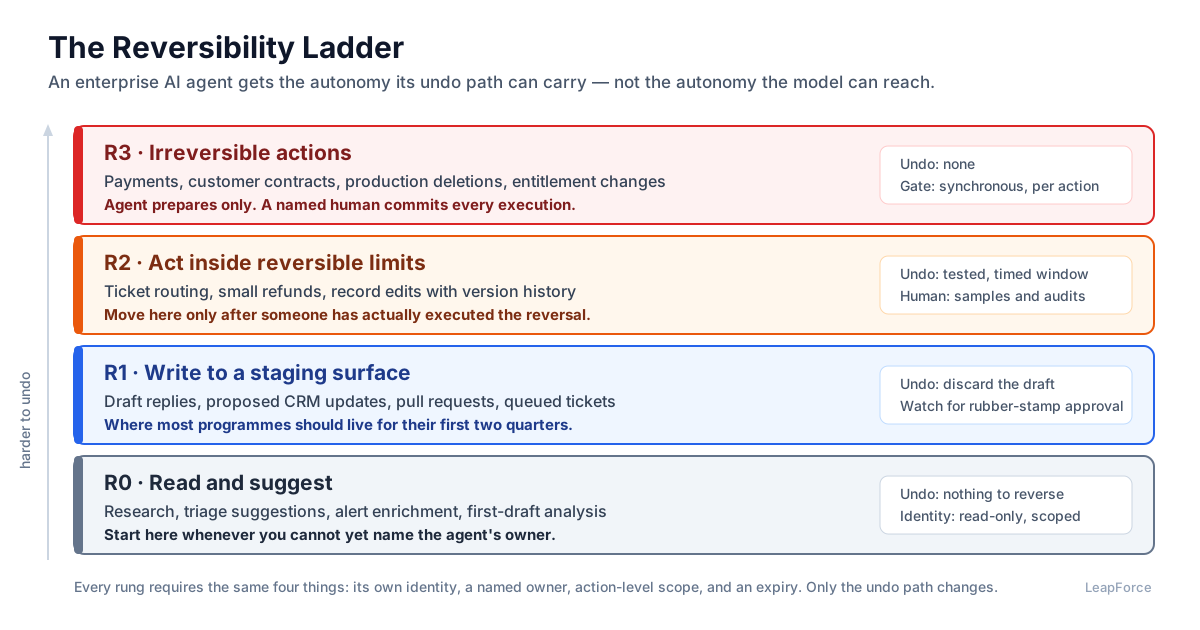
The Reversibility Ladder: the autonomy level an enterprise AI agent gets is set by how hard its actions are to undo.
Two notes on sourcing before we start. We have not run a controlled deployment of the agent platforms discussed here, so nothing below is presented as a first-hand benchmark: every number is attributed to the organisation that measured it. And some sources a reader would expect are missing for a reason. Reddit returned 403 to every request we made while researching this piece, so the practitioner voices below all come from Hacker News, which skews toward engineers rather than the business owners who usually sponsor agent projects. OWASP's agentic threat catalogue also refused our fetches, so its threat taxonomy is absent where it would have fitted.
What an enterprise AI agent actually is
An enterprise AI agent is a system that takes a goal, decides on a sequence of steps, calls tools and APIs to carry them out, and keeps memory of state across those steps. The distinguishing feature is not intelligence. It is that the software commits actions in systems of record on its own initiative. Everything else in the category — chatbots, copilots, scripted bots — either answers or waits to be told exactly what to do.
That boundary matters commercially, because Gartner reports that vendors have blurred it deliberately. In its June 2025 analysis of agentic AI, Gartner named the practice "agent washing", defining it as the rebranding of assistants, robotic process automation and chatbots without substantial agentic capability, and estimated that "only about 130 of the thousands of agentic AI vendors are real". If you are buying against a definition, the definition needs edges.
Here is the one we use. Four questions separate the categories, and they are the same four questions that later determine how much autonomy a thing should get.
| Scripted bot / RPA | Chatbot or copilot | Bare language model | Enterprise AI agent | |
|---|---|---|---|---|
| What triggers it | A schedule or an event | A human message | An API call | A goal, an event, or another agent |
| How it decides | Fixed rules, written by a person | It does not decide, it answers | Predicts the next token | Plans, re-plans, and chooses tools at runtime |
| What it can change | Exactly what the script names | Nothing directly | Nothing directly | Anything its credentials reach |
| What it remembers | Nothing between runs | The conversation | The context window | Task state across steps, sessions, and tools |
| Who is accountable | The person who wrote the script | The person who sent the message | The developer who called the API | Whoever owns the agent's identity — which is often nobody |
Read the last row twice. In an RPA estate, the blast radius was written down in advance: the bot could do what the script said and nothing else. With an agent, the blast radius is whatever the credential can reach. It is discovered at runtime, by a planner that is optimising for task success rather than for staying in its lane.
What it is not
An enterprise AI agent is not a smarter chatbot with permissions bolted on, and it is not RPA with a language model in the middle. It is also not, in most current deployments, autonomous in the way the marketing implies. The pattern that recurs in the practitioner write-ups we read for this piece is narrower than the pitch: a bounded loop, an escalation path when the situation is ambiguous, and a human confirmation step in front of anything expensive or irreversible. That is not a failure of the technology. It is the design that survives contact with an audit.
The reliability numbers that should set your scope
Three published measurements should shape any enterprise AI agent scope, and they point the same way: capability is climbing fast, reliability at long horizons is not yet good enough to remove the human, and the failure rate is high enough that the exit path deserves more design effort than the happy path.
Stanford's 2026 AI Index reports that on OSWorld, which tests agents on real computer tasks across operating systems, agents "made a leap from 12% to ~66% task success", while noting they "still fail roughly 1 in 3 attempts on structured benchmarks." A third of attempts failing is a fine result for a research benchmark. It is a terrible property to discover in your accounts-payable ledger.
The second number is about task length. METR measures the "time horizon" of frontier models: the duration of task, measured by how long a human expert takes, at which an agent succeeds half the time. In its Time Horizon 1.1 update of 29 January 2026, METR put Claude Opus 4.5 at a 50% time horizon of 320 minutes, with a confidence interval of 170 to 729 minutes, and measured the doubling time for models since 2024 at 88.6 days. That is sharply faster than the "around every 7 months" its original March 2025 paper reported for 2019 to 2025. That is the honest version of "agents are getting better fast." It is also a coin flip, by definition, at the stated horizon.
| Measurement | Source and date | What it says | What it implies for scope |
|---|---|---|---|
| OSWorld task success 12% to ~66% | Stanford AI Index, 2026 | Agents complete most real computer tasks, fail about 1 in 3 | Design for the failing third, not the succeeding two |
| 50% time horizon 320 min (CI 170–729) | METR Time Horizon 1.1, Jan 2026 | A task a human expert needs about five hours for succeeds about half the time | Keep autonomous runs short and checkpointed |
| Doubling time 88.6 days since 2024 | METR Time Horizon 1.1, Jan 2026 | Capability roughly doubles each quarter | Re-scope quarterly; do not hardcode today's limits |
| Documented AI incidents 362, up from 233 | Stanford AI Index, 2026 | Real-world incident volume is rising | Incident response for agents is now a real function |
| Over 40% of agentic AI projects canceled by end-2027 | Gartner, June 2025 | Cost, unclear value, weak risk controls kill projects | Scope for demonstrable value before scale |
The third number is commercial rather than technical. Gartner predicted in June 2025 that "over 40% of agentic AI projects will be canceled by the end of 2027, due to escalating costs, unclear business value or inadequate risk controls." Note the three causes: none of them is "the model was not smart enough."
Data-currency note: we checked whether Gartner has revised that view. Its most recent agent release, dated 28 July 2026, sharpens rather than reverses it: by 2028, AI agents will outnumber sellers ten to one, "yet fewer than 40% of sellers will say AI agents have improved productivity." Gartner VP Analyst Dan Gottlieb named the failure mode "agent sprawl", meaning more digital activity with little improvement in impact, and put the cause in the surrounding systems: "If those systems are fragmented, the agents will scale the fragmentation."
That sentence is the argument of this article in eleven words. An agent does not fix a broken process; it executes the broken process faster and at greater volume, with less human friction to catch it.
The Reversibility Ladder: four levels of agent autonomy
Most agent frameworks grade autonomy by capability — can it use tools, can it plan, can it call other agents. That grading tells you what the agent can do, and nothing about what it should be allowed to do. We grade by reversibility instead, because reversibility is the property that decides how bad a failure gets.
We call it the Reversibility Ladder. Four levels, one rule each. An agent moves up a rung when it has earned it with evidence, not when the vendor demo suggests it could.
R0 — Read and suggest
What it is: the agent reads systems and produces drafts, summaries, recommendations. It writes nothing back except into a scratch surface a human reviews.
Identity it needs: a read-only, scoped service identity. Not a person's session token.
When to choose it: any process where the cost of a wrong action exceeds the cost of a human reading the output. Research, triage suggestions, first-draft analysis, monitoring.
Where it fails: the productivity ceiling is low, and it fails silently. If a human has to check everything anyway, you have built a slower way to do the work. Measure how often the human changes the draft. If that number is near zero after a few hundred runs, you have evidence for R1. Not before.
R1 — Write to a staging surface
What it is: the agent creates real artifacts in a place that is not yet live. A draft invoice, an unsent reply, a pull request, a ticket in a triage queue, a proposed CRM update held for approval.
Identity it needs: its own identity with write permission scoped to the staging object only, and no permission on the production object.
When to choose it: high-volume work with a natural review step that already exists. This is where most enterprise AI agent programmes should live for their first two quarters, because the staging surface is a free audit trail. Every artifact the agent produced is inspectable before it mattered.
Where it fails: review fatigue. When an approver is handed 400 near-identical items a day, approval becomes a rubber stamp, and the EU AI Act's own language for this, the "possible tendency of automatically relying or over-relying on the output produced by a high-risk AI system (automation bias)", describes exactly what happens next. Our working rule of thumb, offered as judgement rather than measurement: if a month passes with no rejections at all, the gate has stopped being a gate. Sample-audit it, or move the work to R2 with real limits.
R2 — Act inside reversible limits
What it is: the agent executes for real, without waiting for a human, but only within a boundary where every action has a defined undo: a refund below a threshold, a ticket reassignment, a calendar change, a non-destructive config update, a record edit with full version history.
Identity it needs: its own identity, an owner, an expiry date, action-level scoping, and an emitted audit event for every call.
When to choose it: the action is genuinely reversible, the reversal is cheap and tested, and the volume justifies removing the human. The test is not "can it be undone in principle" but "have we undone one, this quarter, and how long did it take."
Where it fails: reversibility that only exists on paper. The Hacker News post-mortem thread we opened with turned on precisely this. One commenter noted that on the hosting platform involved, volume-level backups were stored in the volume itself, so deleting the volume deleted the backups with it — which converts a "reversible" delete into a terminal one. Test the undo before you trust the tier.
R3 — Act on irreversible things
What it is: payments that leave the building, external communications to customers or regulators, production deletions, contract execution, anything that changes a person's entitlement.
Identity it needs: everything R2 needs, plus a named human accountable for each execution and a synchronous approval gate.
When to choose it: almost never, autonomously. R3 is not a level of agent autonomy; it is a level of human approval with agent assistance. Keep the agent in the preparation and let a person commit.
Where it fails: the fantasy of the "fully autonomous" enterprise, which is what most cancelled projects were chasing.
| Level | The agent may | Reversal | Human role | Typical first use |
|---|---|---|---|---|
| R0 Read and suggest | Read, draft, recommend | Nothing to reverse | Reads everything | Research, triage suggestions |
| R1 Write to staging | Create artifacts not yet live | Discard the draft | Approves each item | Draft replies, proposed updates |
| R2 Act in reversible limits | Execute bounded actions | Tested undo within a window | Samples and audits | Ticket routing, small refunds |
| R3 Irreversible actions | Prepare only | None | Approves each execution | Payments, customer contracts |
Choose R0 if you cannot yet name the agent's owner. Choose R1 if the process already has a review step. Choose R2 if you have personally executed the undo. Choose R3 only for preparation, never for commitment.
Run the blast-radius worksheet in one sitting
You can place every candidate process on the ladder in an afternoon. Take the five to ten tasks somebody has proposed for enterprise AI agents, put the process owner and one security reviewer in a room, and score each task on four questions. No modelling, no vendor, no proof of concept.
- If this action is wrong, how do we undo it, and who has done that? Score 0 if there is a tested undo, 1 if there is a theoretical one, 2 if there is none.
- What is the widest set of records the agent's credentials could reach on a bad day? Not what the task needs. What the token permits. Score 0 for a single scoped object type, 1 for one system, 2 for anything crossing systems or customer data.
- If this runs 1,000 times overnight, what does it cost and what does it break? Score 0 if bounded by a budget cap and a rate limit, 1 if bounded only by convention, 2 if unbounded.
- Six months from now, can we show a regulator or a customer exactly what it did and why? Score 0 for immutable action logs tied to an identity, 1 for application logs, 2 for nothing.
Total the four scores. 0–1 goes to R2, 2–4 goes to R1, 5 or more starts at R0 and does not move until the underlying score changes. Anything scoring 2 on question one is R3 by definition, regardless of the total, because an untested undo is not an undo.
The point of scoring the credential rather than the task is that agents do not reliably stay inside the task. One vendor operating sandbox infrastructure for agents published an analysis of logs from more than 14,000 sessions in February 2026, reporting scope creep in roughly 38% of sessions where the agent had filesystem access beyond its working directory, and about 86% compliance when explicitly instructed not to touch files outside a named path. Treat those figures as vendor-collected rather than independent — they have not been replicated by a neutral party, and the platform has a commercial interest in the finding. But the direction is consistent with what the Hacker News incident threads describe, and with the AI Index failure rate: a boundary stated in a prompt is a suggestion, and a boundary stated in a credential is a boundary.
A worked example
Take a real, common candidate: an agent that handles inbound supplier invoices: it reads the PDF, matches it to a purchase order, flags mismatches, and posts the approved ones to the ledger.
| Question | Score | Reasoning |
|---|---|---|
| Undo | 1 | A ledger posting can be reversed with a journal entry, but nobody on the team has done it for an automated posting |
| Credential reach | 2 | The finance system role that can post can also see every supplier's banking detail |
| Runaway cost and breakage | 1 | Bounded by invoice volume, not by an actual budget cap or rate limit |
| Provable afterwards | 1 | The ERP logs the posting, but not the reasoning, the source document version, or which agent version ran |
| Total | 5 |
Score 5 means R0 on the first pass, which will annoy the sponsor, and it should, because the fix list is short and specific. Split the credential so the posting role cannot read banking details. Add a per-day posting cap. Emit an action log carrying the agent identity, the document hash and the model version. Rehearse one reversal. Do those four things and the same task scores 1, which is R2, and the agent can post low-value matched invoices unattended while the mismatches go to a person.
That is the useful output of the worksheet. It does not tell you whether to buy an agent. It tells you the four engineering tasks standing between you and the autonomy you wanted.
Where enterprise AI agent use cases pay off first
The enterprise AI agent use cases that reach production share a shape: high volume, a review step that already exists, a bounded set of systems, and a cheap undo. The ones that stall share the opposite shape, and they are usually the ones on the slide that got the budget approved.
| Function | Task | Ladder level | Why it lands there |
|---|---|---|---|
| Support | Triage, classify, draft the reply, escalate on sentiment | R1 to R2 | Drafts are free to discard; sending externally is not |
| Finance | Match invoices to purchase orders, flag exceptions | R1 first, R2 once capped | Posting is reversible only if someone has tested the reversal |
| IT operations | Enrich alerts, correlate, propose a runbook step | R0 to R1 | Executing a runbook step touches production; proposing it does not |
| Sales | Research an account, assemble a brief, update non-critical CRM fields | R1 to R2 | Field edits have version history; outbound email does not |
| HR | Screen applications against stated criteria, prepare a shortlist | R0, with a legal review | Employment decisions are regulated and a wrong one is not undoable |
| Procurement | Draft the RFP, compare responses on stated criteria | R1 | The artifact is the value; the award decision stays human |
| Security | Gather context on an alert, assemble the timeline | R0 to R1 | Containment actions are high blast radius by construction |
Two patterns are worth naming. First, the highest-value early wins are usually preparation, not execution. The agent assembles the thing a human then commits, and the saving is in assembly. Second, the same functional task lands on different rungs at different companies, entirely because of how the credentials and the undo happen to be built. Two identical "invoice agent" projects can be R2 in one company and R0 in another. That is not a maturity difference. It is a plumbing difference, and plumbing is fixable.
Multi-agent collaboration deserves a note here, because it is on every vendor slide. Handing work between specialised agents is real and useful, but the orchestration multiplies the identity problem rather than solving it: each hop needs its own scope, and a chain of agents where step three inherits step one's credentials has no meaningful boundary at all. Start with one agent, one scope, one owner. Add a second when you can answer who is accountable when agent B acts on agent A's bad output.
What identity does the agent act under?
Ask your team one question this week about any of your enterprise AI agents: when it calls Salesforce, whose credential does it use? The answers you get back tend to be a personal API key, a shared service account nobody owns, or a token minted by the platform with permissions nobody has reviewed. All three are the same defect wearing different clothes.
This is the gap between how agents are sold and how they are secured. Human access control has decades of machinery behind it: an identity provider, joiner-mover-leaver processes, access reviews, session expiry, least-privilege role design. Agents mostly get an API key in an environment variable. As our platform approach to access and identity puts it, agents need what employees have had for decades — an identity, an owner, a scope, and an expiry.
Four properties turn an agent from an anonymous process into an accountable one.
- Identity. Every agent authenticates as itself, not as the engineer who built it and not as a shared account. Actions in downstream logs resolve to a specific agent, not to "svc-integration."
- Owner. A named human is accountable for what it does. When that person changes team, ownership transfers explicitly rather than lapsing.
- Scope. Permissions are action-level, not system-level. "Can create a draft reply" is a scope; "has API access to the helpdesk" is not.
- Expiry. Credentials expire by default. An agent that nobody renews stops working, which is the correct failure mode for an unowned automation.
When an agent genuinely has to act for a specific person, say pulling that person's calendar or filing under their approval, the pattern is delegation with reduction, not impersonation: the agent presents its own identity plus a short-lived, on-behalf-of grant carrying a narrower scope than the person holds. The downstream log then shows both the agent and the human it acted for, which is the pair an investigator needs.
We have written about this at length in our earlier analysis of non-human identity: owner, scope and expiry for AI agents, so the short version here is the operational consequence: without these four, offboarding is impossible. When an employee leaves and their agents keep running on their personal key, you have created an access path that survives the person, which is the specific thing every access review is designed to prevent.
For a practitioner treatment of the same problem, this recorded conference session on securing agent identity and access is worth the 37 minutes:

Approval gates, kill switches and the undo path
An approval gate is a synchronous pause where a named human confirms a specific action before it commits. It is the single highest-value control in enterprise AI agents, and it is also the one most likely to decay into a rubber stamp, so it needs to be designed like a control rather than added like a disclaimer.
Regulation is converging on the same requirement, and it uses the phrase human oversight for it. The EU AI Act's Article 14 obliges deployers of high-risk systems to enable oversight personnel to "intervene in the operation of the high-risk AI system or interrupt the system through a 'stop' button or a similar procedure", and to be able to "decide to disregard or reverse the system's output in any situation." Article 12 goes to the record: high-risk systems "shall technically allow for the automatic recording of events (logs) over the lifetime of the system". Whether or not your agent is high-risk under that Act, those two obligations describe the minimum any auditor will eventually ask for: a stop, and a record.
Four controls, in the order we would build them.
1. The gate itself. Gate on the action, never on the run. "Approve this agent's session" is meaningless; "approve this payment of $4,120 to this supplier" is a control. The approval screen must show what will change, not a summary of what the agent thinks. A diff, not a paraphrase.
2. The kill switch. One control that stops a class of agent actions immediately, without a deploy. Test it during business hours, on purpose, at least once a quarter. A kill switch nobody has pulled is a hypothesis.
3. The undo path. For every R2 action, a documented and rehearsed reversal with a stated time window. Write down who executes it. The gap between "reversible" and "reversed" is where the incident lives.
4. The record. An action log tied to the agent's identity that captures what was attempted, what policy decided, what was refused, and what actually ran. Emit it at a chokepoint rather than inside each agent, on a gateway or a connector layer every call already passes through, because logging written into agent code is logging that a new framework silently drops. Refusals matter as much as executions. A log that only records successes cannot answer "was this thing ever asked to do something it should not have," which is the first question in any investigation. Our earlier work on AI observability and audit trails covers the evidence side of that in more depth.
The NIST AI Risk Management Framework, released in January 2023 and intended, in NIST's words, "for voluntary use and to improve the ability to incorporate trustworthiness considerations into the design, development, use, and evaluation of AI products, services, and systems," organises this work into four functions: Govern, Map, Measure and Manage. It is a useful spine for a programme document, and it is not a substitute for the four controls above, which are code.
What agents cost when nobody caps the loop
Agent economics differ from chatbot economics in one structural way: a chat turn costs what one exchange costs, while an agent run costs whatever the loop decides to spend. A stuck agent that retries a tool call, re-reads its context and re-plans can burn thousands of times the tokens of the run that worked.
The unit prices are public, and the gap between the cheapest and the most capable model is wide enough that routing matters more than negotiating. Fetched on 30 July 2026, Anthropic's published pricing lists Claude Opus 5 at $5 per million input tokens and $25 per million output tokens, Claude Sonnet 5 at $2 and $10 under introductory pricing through 31 August 2026, and Claude Haiku 4.5 at $1 and $5. OpenAI's pricing page, fetched the same day, lists gpt-5.6-sol at $5 per million input tokens and $30 output, against gpt-5-nano at $0.05 and $0.40.
| Model (as listed by the vendor, 30 July 2026) | Input per 1M tokens | Output per 1M tokens |
|---|---|---|
| Claude Opus 5 | $5.00 | $25.00 |
| Claude Sonnet 5 (introductory, to 31 Aug 2026) | $2.00 | $10.00 |
| Claude Haiku 4.5 | $1.00 | $5.00 |
| gpt-5.6-sol | $5.00 | $30.00 |
| gpt-5.6-luna | $1.00 | $6.00 |
| gpt-5-nano | $0.05 | $0.40 |
The spread between the cheapest and most expensive output token on that table is 75 times. An agent that routes every step to the strongest available model, classification and extraction and formatting alike, is paying frontier prices for work a small model does correctly. That is the ordinary case for cost overrun, and it is a routing decision rather than a procurement one. We covered the mechanics in our earlier piece on how AI model routing cuts LLM costs.
Three cost controls belong in the first sprint, not the second quarter.
- A hard ceiling per run and per agent, denominated in currency. Token budgets are unreadable to the person who owns the outcome. Dollars are the unit an owner can approve.
- A no-progress limit. A raw step cap punishes legitimate long work, so cap on spend and on repetition instead: terminate when the run exceeds its currency ceiling, or when it repeats a failing tool call more than a few times without the state changing. Most runaway spend is one agent failing to notice it is not making progress.
- Attribution. Spend tagged to the agent, its owner and its team from day one. Retrofitting attribution after the invoice arrives is how programmes end up in the "unclear business value" column that Gartner named as a cancellation cause.
Tokens are also rarely the biggest line. In most programmes the dominant costs are integration engineering, the identity and logging work described above, and evaluation — the recurring job of checking the agent is still right after a model or prompt change. Our earlier analysis of why AI pilots stall before production covers where that budget actually goes. Treat inference as the variable cost on top of a fixed cost that arrives first.
There is a second cost line most business cases omit: the human review time that enterprise AI agents at the R0 and R1 tiers deliberately introduce. If your agent drafts 400 replies a day and each takes 20 seconds to approve, you have added over two hours of daily review work. That is often still a large net saving against writing them, but it belongs in the model. A business case that counts only token cost against fully loaded salary is not a business case.
Telling a real platform from agent washing
Buying enterprise AI agent platforms is currently harder than it should be, because the category label is applied to products that do very different things. Gartner's estimate that roughly 130 of thousands of self-described agentic vendors are real is a strong claim, and even if the true number is several times higher, the practical consequence stands: the demo will not tell you which kind you are looking at. Ask for the things that only a real platform can show you.
| Ask this | A real platform shows you | Agent washing sounds like |
|---|---|---|
| Show me an agent's identity record | An identity with an owner, a scope, and an expiry date | "It uses your API key" |
| Show me one action being refused by policy | A live refusal and the log entry it produced | "You can configure guardrails in the prompt" |
| Show me the approval gate on a specific action | A synchronous gate with the change diff visible | "There's a confirmation setting" |
| Show me last week's spend by agent and team | Per-agent cost attribution and a currency budget | "You can see total API usage" |
| Show me what it did on 3 March at 14:12 | An immutable action log resolving to an identity | "Everything is logged" |
| How do I revoke one agent's access to one system | Action-level revocation without breaking other agents | "You can rotate the key" |
| What happens when a step fails halfway | Durable state, retry semantics, defined compensation | "It retries" |
Two more selection notes. First, insist on seeing the failure demo, not the success demo. Any vendor can show an agent completing a task; ask them to show you an agent being wrong, and watch what the platform does with it. Second, separate the agent builder from the control layer in your evaluation. Treat that as an architecture decision rather than a shortlist preference: teams often need several builders over time as frameworks change, and a control layer that only governs one vendor's agents will be obsolete on the day the second framework arrives. If you are shortlisting the governance layer specifically, our comparison of enterprise AI gateways covers that market rather than repeating a vendor list here.
Pricing is the other place to press. Agent platforms price on seats, on runs, on tasks, on consumed tokens, or on some blend, and the blend decides whether success is affordable. A per-run price is a tax on retries. Ask the vendor to price the pilot you actually intend to run, at the volume you actually expect, including failed runs.
When an agent is the wrong answer
Sometimes the honest recommendation is not to deploy enterprise AI agents at all, and the field's own analysts say so. Gartner's June 2025 assessment put it plainly: "Many use cases positioned as agentic today don't require agentic implementations," and recommended organisations "start by using AI agents when decisions are needed, automation for routine workflows and assistants for simple retrieval."
The incumbent still wins in four situations.
The process is deterministic. If the rules can be written down and they do not change, a script or an RPA bot is cheaper, faster, more predictable and infinitely easier to audit. Adding a reasoning step to a task with no judgement in it buys nothing and costs a failure mode. This is the single most common wrong call we see in agent shortlists.
The volume is low. An agent carries a fixed cost: build, review, monitoring, ownership, ongoing evaluation. If the process runs forty times a month and takes a person ten minutes, the return on investment arrives in years rather than quarters, and the maintenance will outlive the enthusiasm. Existing workflow automation, or nothing at all, wins here.
The action is irreversible and high-value. Wire transfers, contract execution, regulatory filings, anything affecting someone's employment or credit. Keep the human on the commit. Let the agent do the preparation, which is usually where most of the minutes are anyway.
The underlying process is broken. This is the one Gartner's July 2026 sales research names directly: fragmented systems mean agents "scale the fragmentation." If three teams disagree about which system holds the truth, an agent will pick one, confidently, several hundred times a day. Fix the disagreement first. It is cheaper than automating it.
There is also a timing argument for waiting. With measured capability doubling roughly every quarter, a difficult use case that fails an evaluation today may pass in two quarters without any work on your side. That is not an argument for inaction; it is an argument for putting the identity, logging, budget and approval plumbing in now, the parts that do not change when the model does, and re-running the worksheet each quarter.
Where this analysis is still uncertain
Several claims in this analysis of enterprise AI agents could be wrong, and it is worth being specific about which.
The benchmark numbers may not transfer. OSWorld and METR's task suite measure software and computer-use tasks performed by capable engineers. Your agent is probably doing finance operations against a bespoke ERP with twenty years of local convention in it. METR is explicit about the limits of its own figures — the confidence intervals on long-task horizons are wide, the current interval for the leading model spans 170 to 729 minutes, and human baseline times were measured for only 5 of its 31 tasks of eight hours or more. Treat these as direction and order of magnitude, not as a specification.
The vendor-collected field data is not independent. The 38% scope-creep figure and the roughly 86% instruction-compliance figure come from a company selling agent sandboxing. They match the qualitative reports we found, but nobody neutral has replicated them, and we could not verify the underlying dataset.
Our sourcing skews technical. With Reddit's enterprise communities unreachable and the major analyst agent forecasts behind paywalls, the practitioner voices in this piece come from Hacker News. Engineers are more likely to describe permission failures than process failures, so the article may under-weight the organisational reasons agent projects stall — change management, unclear ownership, and the review capacity problem described in the cost section.
The ladder is a heuristic, not a standard. The Reversibility Ladder is our framework, offered because we think reversibility is the property most often left out of autonomy discussions. It has not been validated across a sample of deployments, and a mature risk function may reasonably fold it into an existing control framework rather than adopt it as-is.
We have not run the platforms. This article compares approaches, not products, and it deliberately does not rank vendors. We have not conducted a controlled deployment of the named tools, so we make no claims about their behaviour in production beyond what their own documentation states.
How LeapForce approaches agent deployment
This is the one section about us. LeapForce does not sell an agent builder and does not compete with the frameworks your engineers are already using; we build the control layer underneath them — one governed layer for every AI tool, connector, model, and agent.
Concretely, that means the four properties in the identity section are enforced rather than documented. Agents get their own identity through your existing identity provider, with an owner, a scope and an expiry, so offboarding one person removes what their agents could touch. Every model call passes through a single AI gateway that identifies the caller, checks policy before egress, routes on cost or privacy, and records what ran — and what was refused. Our published rollout model for that gateway is deliberately staged: Observe first. Enforce second. Optimize third. Point one team's traffic at it in observe mode, find out what is actually in use, then turn on rules. For agents specifically, our AI Coworkers product runs a Build, Scope, Review, Share, Improve lifecycle so a workflow that started on one person's laptop becomes a named company asset with a reviewed scope — the transition we described in our earlier analysis of turning personal prompts into owned assets. LeapForce is in active development and per-capability build status is disclosed on the site rather than blurred, so check the current state of any capability there before you plan around it.
Frequently asked questions
An enterprise AI agent is software that takes a goal, plans a sequence of steps, calls tools and APIs to carry them out, and keeps state across those steps — changing real records in company systems without a person driving each action. The distinguishing property is not intelligence but initiative: it commits actions rather than only answering. That is also why the deployment question is a governance question rather than a model question.
Robotic process automation follows a script written in advance: it does exactly what the rules say, breaks when the screen changes, and has a blast radius you can read off the script. An agent decides its own steps at runtime and can reach anything its credentials permit. The practical consequence for AI agents vs RPA is that RPA risk is reviewable in code, while agent risk lives in the permission grant. If a process has no judgement in it, RPA is usually the cheaper and more auditable answer — Gartner notes that many use cases positioned as agentic today do not require agentic implementations.
A chatbot answers a message. A copilot suggests inside a tool a human is already driving. An agent acts on its own initiative across systems and remembers state between steps. In the AI agents vs chatbots comparison, the difference that matters operationally is accountability: a chatbot's output is attributable to the person who acted on it, while an agent's action needs its own identity, owner and audit record, because no human was in the loop at the moment of execution.
Start where volume is high, a review step already exists, the systems touched are few, and the undo is cheap. Support ticket triage with drafted replies, invoice matching with exceptions routed to a person, and alert enrichment in IT operations all fit that shape. Avoid starting with anything irreversible or customer-facing, and avoid low-volume processes where the build and maintenance cost never pays back. The pattern that lands first is preparation, not execution.
Score enterprise AI agent platforms on what they can demonstrate rather than what they claim. Ask to see an agent's identity record with an owner and an expiry, one action refused by policy with its log entry, an approval gate showing the actual change diff, last week's spend broken down by agent and team, and action-level revocation for one system. Then ask for the failure demo. Separate the agent builder from the control layer in your evaluation, since you will likely change builders before you change the governance layer.
Cap it in currency before you start, not in tokens. Among the models we priced from the vendors' own pages on 30 July 2026, output tokens ranged from $0.40 to $30 per million, so the model routing decision moves cost far more than any discount you will negotiate. Set a hard per-run and per-agent ceiling in dollars, a maximum step and tool-call count so a stuck loop terminates instead of spending, and per-agent spend attribution from day one. Budget the human review time as well — it is a real cost of the safer autonomy tiers.
The gating work is rarely the agent. It is the identity, the logging, the budget cap and the approval gate — and how long those take depends on whether your identity provider can already issue scoped, expiring credentials to non-human callers. Teams that have that plumbing move in weeks; teams that do not usually discover it in month two. Gartner attributes over 40% of expected agentic project cancellations by end-2027 to escalating costs, unclear business value and inadequate risk controls, all three of which are visible early if you scope by blast radius first.
Yes, at the lower autonomy tiers and with the record-keeping built in from the start. Vendor attestations such as SOC 2 or a HIPAA business associate agreement are table stakes for procurement, but they describe the vendor's own controls, not what your agent is permitted to do inside your systems. Do not mistake one for the other. The EU AI Act requires that high-risk systems allow automatic logging of events over the system's lifetime, and that oversight personnel can interrupt the system and reverse its output. Practically, that means an immutable action log tied to an agent identity, a tested kill switch, and human approval on anything irreversible. What fails regulatory review is not agent autonomy as such — it is autonomy nobody can reconstruct afterwards.
Its own. Not a developer's personal API key, not a shared service account, and not an impersonated end-user session. Each agent should have an identity issued through your identity provider, a named human owner, action-level scope, and an expiry that forces renewal. This is what makes offboarding possible: when the owner leaves, one revocation removes what their agents could reach. Agents inheriting human credentials is the most common finding we see discussed in agent security threads, and it is the one that makes every downstream log ambiguous.
Start with one. Multi-agent collaboration is real, but it multiplies the identity and accountability problem rather than dissolving it. Every handoff needs its own scope, and a chain where the third agent inherits the first agent's credentials has no boundary at all. Add a second agent when you can answer clearly who is accountable when agent B acts on agent A's wrong output, and when each hop has a distinct scope and its own audit trail.
Not because the model was too weak. Gartner's stated causes are escalating costs, unclear business value and inadequate risk controls, and its July 2026 sales research adds a fourth: fragmented underlying systems, where agents scale the fragmentation rather than fixing it. The pattern we would add is scope by capability instead of by blast radius. The pilot is designed around what the agent can do, security discovers what the credential can reach, and the project stalls in review. Scoping by reversibility first makes that conversation happen in week one rather than month four.
Only if you designed for it. Application logs typically record what changed but not which agent, which version, which policy decision, or what was refused. An auditable agent emits an action record tied to its own identity, capturing the attempted action, the policy outcome including refusals, the inputs it relied on, and the executed result. Refusals are the part most teams omit and the part investigators ask for first, because a log of successes cannot answer whether the agent ever tried something it should not have.
Ready to Govern Your AI?
Talk to LeapForce — one controlled layer for every AI tool, connector, model, and agent.
Comments