
Humanizing AI content means putting a named person in substantive control of the draft and recording that they were. It does not mean rewriting machine text until a detector stops flagging it. That distinction stopped being a matter of taste on 2 August 2026, when the EU AI Act's transparency obligations became applicable.
Our position, and the reason this piece exists: the "AI tells" everyone tries to edit out are a symptom, not the disease. A draft reads generic because nobody with a stake in the subject has committed to a claim in it. Fix the ownership and most of the style problems dissolve; fix only the style and you have produced a better-disguised document that still fails every test that matters — Google's, the regulator's, and the reader's. The industry is already moving this way. On 6 February 2026 a developer posting on Hacker News as dweekly announced a new W3C AI Content Disclosure Community Group, writing that it would let publishers be "compliant with this law as well as the EU AI Act's Article 50". He was not trying to make anything sound more human. He was trying to give publishers a way to say, in machine-readable form, exactly how much of a page a machine wrote.
The short answer: Humanize AI content by assigning a named human owner who verifies every factual claim, adds something the model could not know, and signs a retained record of that review. Style edits come after ownership, never instead of it, because detector-passing prose with nobody behind it fails Google's scaled-content-abuse policy and does not qualify for the EU AI Act's editorial-responsibility exemption.
Last updated: July 30, 2026.
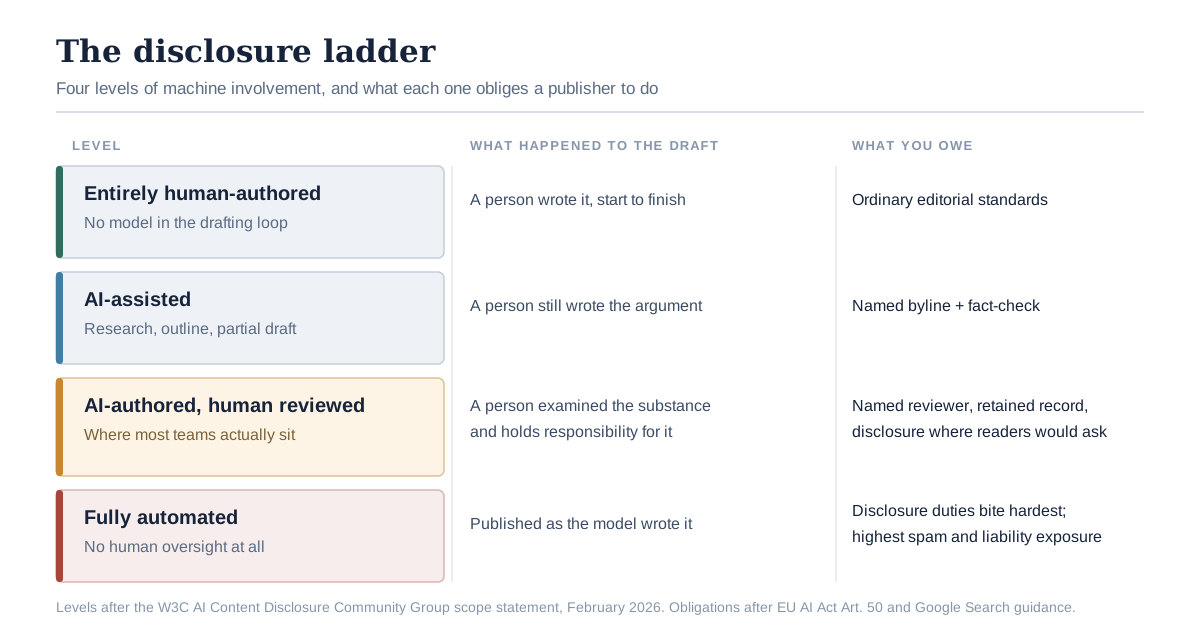
The disclosure ladder: what a publisher owes at each level of machine involvement.
One disclosure before we start. Nobody on our side ran a controlled test for this article — we did not publish paired human and AI-assisted articles and measure their search performance, and we have no proprietary detector data. Everything numeric below comes from named third-party research and primary regulatory text, each fetched and linked. Where a widely quoted figure could not be verified at its source, we say so rather than repeating it.
What Humanizing AI Content Means in 2026
Humanizing AI content is the process of converting a model's draft into a document a named person is willing to be accountable for: every claim checked, at least one contribution the model could not have made, and a durable record of who did the reviewing. The phrase used to mean loosening up stiff prose. It now describes a chain of custody.
The most useful framing available comes from an unlikely place. The W3C AI Content Disclosure Community Group, created on 3 February 2026, describes its own scope as expressing "the degree to which content (especially textual content) has been authored by generative AI models, ranging from attesting that a portion of a page has been entirely human-authored, to AI-assisted, to AI-authored but human reviewed, to entirely automatically created with no human oversight." That is four rungs, and they are not four flavours of the same thing. They carry different obligations, different reputational exposure, and different failure modes.
| Rung | What it describes | What the publisher owes |
|---|---|---|
| Entirely human-authored | No model in the drafting loop | Ordinary editorial standards |
| AI-assisted | Model used for research, outlining, or partial drafting; a person wrote the argument | Named byline; fact-check of model-sourced claims |
| AI-authored, human reviewed | Model produced the draft; a person examined the substance and holds responsibility | Named accountable reviewer; retained review record; disclosure where readers would ask |
| Fully automated, no oversight | Published without substantive human examination | Disclosure obligations bite hardest; highest spam and liability exposure |
Almost every team that searches for how to humanize AI content is operating on rung three and hoping to be judged as rung one. That is the actual problem. The technique everyone reaches for — rewrite until the text stops sounding like a model — attacks the surface of rung three while leaving its substance untouched. What moves you up the ladder is not the rewriting. It is a person taking on responsibility for the claims.
There is a second reason to think in rungs rather than in "is this AI or not". The binary question has become almost meaningless. Research firm Graphite classified 55,400 article URLs pulled from Common Crawl published between January 2020 and March 2026, and found the share of primarily AI-generated articles crossed the halfway mark in the fourth quarter of 2025, at 50.9%, before returning to rough parity with human-written articles. When half of everything published is machine-drafted, "was AI involved" tells a reader nothing. "Who checked it, and what did they check" tells them everything.
What it is not
Humanizing AI content is not paraphrasing. It is not adding contractions, rhetorical questions, or a manufactured anecdote about your cousin's bakery. It is not running the file through a tool that promises to defeat classifiers. Those interventions change the token distribution of the text without changing a single fact in it, which means they leave the two real risks — an unchecked claim and an unowned publication — exactly where they were. They also, as the next section shows, target a measurement instrument that does not work well enough to be worth targeting.
Why Chasing AI Detectors Is the Wrong Target
AI detectors are unreliable enough at the level of a single document that optimising against them is a waste of editorial budget. The most-cited academic evaluation, Weber-Wulff and colleagues' test of 14 detection systems, concluded that "the available detection tools are neither accurate nor reliable and have a main bias towards classifying the output as human-written rather than detecting AI-generated text." The study covered 12 publicly available tools plus Turnitin and PlagiarismCheck.
The same paper found that "content obfuscation techniques significantly worsen the performance of tools". Read that sentence from the perspective of someone selling a humanizer. It means the product category works. Light paraphrasing does push detector scores down. It also means the score was never measuring what the buyer thought it measured, because a score you can move by shuffling synonyms is not a measure of whether a machine wrote the text.
Then there is who gets hurt. Liang and colleagues ran seven commercial GPT detectors against two corpora of writing that was unambiguously human: essays by US eighth-graders and TOEFL essays by non-native English speakers. Their published results report near-perfect accuracy on the eighth-grade essays and an average false positive rate of 61.22% on the TOEFL essays. Eighteen of the 91 TOEFL essays were unanimously called AI-authored by all seven detectors; 89 of 91 were flagged by at least one. The authors' own summary is blunt: detectors "consistently misclassify non-native English writing samples as AI-generated, whereas native writing samples are accurately identified", and "simple prompting strategies can not only mitigate this bias but also effectively bypass GPT detectors".
The mechanism matters here. Most classifiers key on perplexity, a measure of how surprising each next word is given the ones before it, and writing with a constrained vocabulary scores low on it whether a machine or a careful second-language writer produced it. That is the whole bias in one sentence, and it is not a bug anyone can patch out, because low perplexity is a property of plain writing. In the same experiment, the tool that flags a non-native speaker's honest essay can be defeated by anyone who asks a model to make their text sound more literary. The instrument punishes the innocent and clears the deliberate. Practitioners noticed long before the papers landed. On Hacker News in May 2026, a commenter posting as numpad0 described the category as "comically bad", arguing detectors might reasonably be classified as pseudoscience.
The nuance that makes the field confusing
Here is where most coverage gets sloppy, including the coverage that quotes the studies above. Detector performance at population scale is a genuinely different problem from detector performance on your document, and the two get conflated constantly.
The Graphite study used three classifiers (Pangram, Copyleaks and GPTZero) and validated them against articles published before ChatGPT existed. Measured that way, false positive rates came in between 1.36% and 1.84%, with false negatives averaging below 2% against 6,000 synthetic articles. Those are respectable numbers, and they are not in conflict with the academic findings. Averaged over tens of thousands of documents, a 1.5% error rate produces a trustworthy aggregate trend. Applied to one article that decides whether a freelancer gets paid or a student gets expelled, a 1.5% error rate means roughly one wrongful accusation in every sixty-seven judgements, and there is no appeal mechanism because the evidence is a number with no reasoning attached.
| What you want to know | Can a detector answer it? | What to use instead |
|---|---|---|
| Roughly how much AI content is on the open web | Yes, with stated error bars | Population studies over large samples |
| Whether this specific article was model-drafted | Not reliably | The publisher's own provenance record |
| Whether a contractor secretly used AI | No | Contract terms plus a required disclosure field |
| Whether this page will rank | No, and it is not an input | Google's own quality guidance |
| Whether you meet an EU disclosure duty | No | Your documented review process |
The practical conclusion is narrow and firm. Use detectors as a smoke alarm on inbound work at volume, never as a verdict on one piece, and never as the target your editing optimises against. Anyone setting out to humanize AI content by watching a detector score is optimising toward a metric that the research says is biased, gameable, and disconnected from every outcome they actually care about.
What Google Actually Says About AI-Generated Content
Google does not penalise content for being AI-generated, and has said so in writing since February 2023. The guidance from Danny Sullivan and Chris Nelson on the Search Central blog is unambiguous: "Using AI doesn't give content any special gains. It's just content." The same post states that "appropriate use of AI or automation is not against our guidelines", and frames the whole question around E-E-A-T — expertise, experience, authoritativeness and trustworthiness — and the helpful content system, neither of which has an input for how the words were produced. Nothing published since has reversed that.
What Google does penalise has a name. Its spam policies define scaled content abuse as "when many pages are generated for the primary purpose of manipulating search rankings and not helping users", adding that the practice "is typically focused on creating large amounts of unoriginal content that provides little to no value to users, no matter how it's created". The first listed example is "using generative AI tools or other similar tools to generate many pages without adding value for users". The policy was deliberately written to be method-agnostic: an outsourced content farm staffed entirely by humans violates it identically.
Notice what none of this rewards. A single AI-drafted article that a subject expert corrected, sourced and signed is not scaled content abuse under any reading. Two hundred AI-drafted articles pushed live in a week with no review are, whether or not each one passes a detector. The policy is about volume, originality and intent, and the humanizing pass moves none of those three levers.
Google's disclosure position is softer than the AI Act's and points the same way
Buried in the 2023 FAQ is the sentence most relevant to this article. Asked whether creators should add AI disclosures, Google answered: "AI or automation disclosures are useful for content where someone might think 'How was this created?'. Consider adding these when it would be reasonably expected." On bylines: "You should consider having accurate author bylines when readers would reasonably expect it." And on the obvious shortcut: "Giving AI an author byline is probably not the best way to follow our recommendation to make clear to readers when AI is part of the content creation process."
Google's current documentation on generative AI content goes further on the technical side. It points creators at the Search Quality Rater Guidelines sections on scaled content abuse (4.6.5) and on main content "created with little to no effort, little to no originality, and little to no added value" (4.6.6). It also records a hard requirement in an adjacent surface: for Merchant Center, AI-generated images "must contain metadata using the IPTC DigitalSourceType TrainedAlgorithmicMedia metadata", and AI-generated product titles and descriptions "must be specified separately and labeled as AI-generated". That is a mandatory machine-readable provenance marker, live today, in a commercial Google product. Anyone who believes provenance marking is a distant European problem should sit with that paragraph.
What the EU AI Act Requires From 2 August 2026
Article 50 of the EU AI Act became applicable on 2 August 2026, and it splits the duty in two. Providers of systems that generate synthetic content must mark the output. Deployers who publish AI-generated text about public-interest matters must disclose it, unless a human took editorial responsibility. Penalties reach €15 million or 3% of worldwide annual turnover.
Take the provider duty first. Article 50(2) requires that providers of AI systems generating synthetic audio, image, video or text "shall ensure that the outputs of the AI system are marked in a machine-readable format and detectable as artificially generated or manipulated". If you use a commercial model through an API, this obligation sits with the model provider, not with you. It is still your business, because the marks they apply travel with the content you publish.
The deployer duty is the one that catches marketing, communications and content teams. Article 50(4) provides that deployers of a system generating or manipulating text "which is published with the purpose of informing the public on matters of public interest shall disclose that the text has been artificially generated or manipulated".
The exemption is the whole story
That same paragraph carries an exception, and it is the most important sentence in this article. The obligation does not apply "where the AI-generated content has undergone a process of human review or editorial control and where a natural or legal person holds editorial responsibility for the publication of the content".
Read the two conditions separately, because they are cumulative. There must be a review of substance, and there must be somebody who owns the result. The European Commission's own FAQ on Article 50 tightens the first condition considerably: qualifying human review means "deliberate examination of the substance of the content by one or more natural persons" with relevant expertise, or control by "a responsible editorial entity" with authority to approve or reject. The Commission then closes the loophole everyone was reaching for: "Superficial, solely formal, or procedural checks" do not qualify.
A humanizing pass is a superficial, formal check. It examines the surface of the text and changes it. It does not examine the substance. Under the Commission's own reading, an organisation that runs AI drafts through a style-rewriting step and publishes them has done nothing at all toward the exemption. An organisation whose subject expert reads the draft, corrects two claims, rejects one and signs off is doing the thing the exemption describes, even if the resulting prose still reads a little flat. Whether any particular process satisfies a regulator is not yet settled by anyone, and the following section says so at length.
| Who you are | What Article 50 asks | When |
|---|---|---|
| Model provider (you built or placed the system on the EU market) | Mark outputs in a machine-readable, detectable format, Art. 50(2) | Applicable 2 Aug 2026; grace to 2 Dec 2026 for systems already on the market |
| Deployer publishing public-interest text | Disclose that the text is artificially generated, Art. 50(4) | 2 Aug 2026 |
| Deployer with genuine editorial review and a responsible person | Exempt from the Art. 50(4) disclosure | 2 Aug 2026 |
| Anyone in scope who ignores it | Up to €15,000,000 or 3% of worldwide annual turnover, Art. 99(4) | On enforcement |
The Commission has also published a Code of Practice on Transparency of AI-generated Content, finalised on 10 June 2026 after three drafting rounds running from November 2025, with separate working groups for providers and for deployers. The Commission and the AI Board assessed it as an adequate voluntary tool for demonstrating compliance, and it ships with an official EU icon set for labelling AI-generated content. Signing up is voluntary. Being able to show what your review process was is not.
Two scoping caveats before anyone over-reacts. The deployer text duty is tied to publication "with the purpose of informing the public on matters of public interest" — politics and democratic processes, public administration and services, the administration of justice, and comparable subjects. A product release note is not that. A vendor explainer about pending legislation might be. And the Commission's FAQ records a limited grace period extending the marking obligation to 2 December 2026 for systems placed on the market before the application date. We covered the wider deployer picture in our EU AI Act compliance guide for deployers, and the parallel Article 50(1) duty for conversational interfaces in our analysis of why you own every sentence a bot says.
Prerequisites: What to Fix Before You Edit a Sentence
Before the first editing pass, six things must exist. Teams that skip them end up doing the same work three times, because there is nothing to attach the work to. This block is short by design; none of it takes longer than an afternoon to decide.
1. A named accountable person per piece, not per team. "Marketing reviewed it" satisfies nothing. Article 50(4)'s exemption turns on a natural or legal person holding editorial responsibility, and Google's byline guidance turns on readers being able to answer "who wrote this?". One name, in the CMS, on every item.
2. A written definition of what review means at your organisation. Two lines is enough: what the reviewer must check, and what they may not skip. Without it, review degrades into reading for typos within about a month.
3. A place to store the record. A field in the CMS, a row in a spreadsheet, an entry in a log. It has to survive the reviewer leaving the company, which rules out anything living in a personal inbox or a chat thread.
4. A decision about which content is in scope for disclosure. Not everything is. Decide once whether your policy is disclosure by default, disclosure on public-interest topics only, or disclosure on request, then write it down and apply it uniformly. Inconsistent disclosure is worse than no disclosure, because it invites the reader to wonder what the undisclosed pieces have in common.
5. Knowledge of which model actually produced the draft. You cannot record provenance you never captured. If your writers are using personal accounts on tools nobody has inventoried, the record will be fiction. This is the same visibility gap we described in our analysis of why half a company ends up on ungoverned AI, and it is the prerequisite most often missing.
6. A source of truth the reviewer can check against. Verification is only as good as what it is verified against. If the reviewer's only reference is a search engine that now returns machine-written articles about half the time, verification becomes a loop. Point reviewers at primary documents: regulations, filings, product docs, original research.
The Own-It Pass: Seven Moves From Draft to Publishable
We call the procedure below the Own-It Pass, because every move is a step toward somebody owning the document rather than the document disguising itself. It is the working answer to how to humanize AI content once you accept that the target is accountability rather than register. Run it in order. The order matters: verification before style, because verification frequently deletes the paragraph you were about to polish.
Move 1 — Assign. Put a name on the draft before anyone touches it. Not the person who ran the prompt. The person whose professional judgement is being asserted by the claims in the piece. If nobody will take the name slot, that is the finding, and the correct action is not to publish.
Move 2 — Verify. Go claim by claim. Every number, date, name, quote, statute reference and causal assertion gets checked at a primary source, and anything unverifiable gets deleted rather than softened. This is the move that catches the failure mode unique to model drafts: confident, specific, well-formed statements about things that did not happen. Budget most of your review time here. A human writer who is out of their depth usually hedges or leaves a gap; a model fills the gap with something that reads like a citation. Those two failure modes need different reading habits, and the second one is invisible to a skim.
Move 3 — Cut. Delete every sentence that survives verification but says nothing. Models produce a characteristic filler class: transitional throat-clearing, restatements of the heading, and hedged summaries of the paragraph above. Cutting typically removes 15% to 25% of a model draft without losing an idea. If you cannot delete anything, you are not reading closely enough.
Move 4 — Contribute. Add at least one thing the model could not have produced: a number from your own system, a decision your team made and regretted, a price you were actually quoted, a constraint peculiar to your industry. One genuine contribution outweighs a page of style adjustments, and it is the only part of the process that makes the article worth reading rather than merely acceptable.
Move 5 — Cite. Link every retained external claim to the document it came from, inline, in the sentence that makes the claim. This does two jobs: it lets a reader audit you, and it converts your verification work from invisible to visible. Unlinked verification is indistinguishable from no verification.
Move 6 — Disclose. Apply the policy you wrote in the prerequisites. If the piece falls inside your disclosure scope, add the visible line, in plain language, near the byline rather than in a footer nobody reaches. "Drafted with AI assistance and reviewed by [name], who is responsible for its accuracy" is a complete disclosure and takes one line.
Move 7 — Record. Write the provenance record and store it. Which model, which version, what the reviewer changed, what they rejected, when they signed. This is the artefact that proves the exemption, answers a client's procurement questionnaire, and settles an internal argument two years later. Recording after the fact does not work; the reviewer has already forgotten what they rejected.
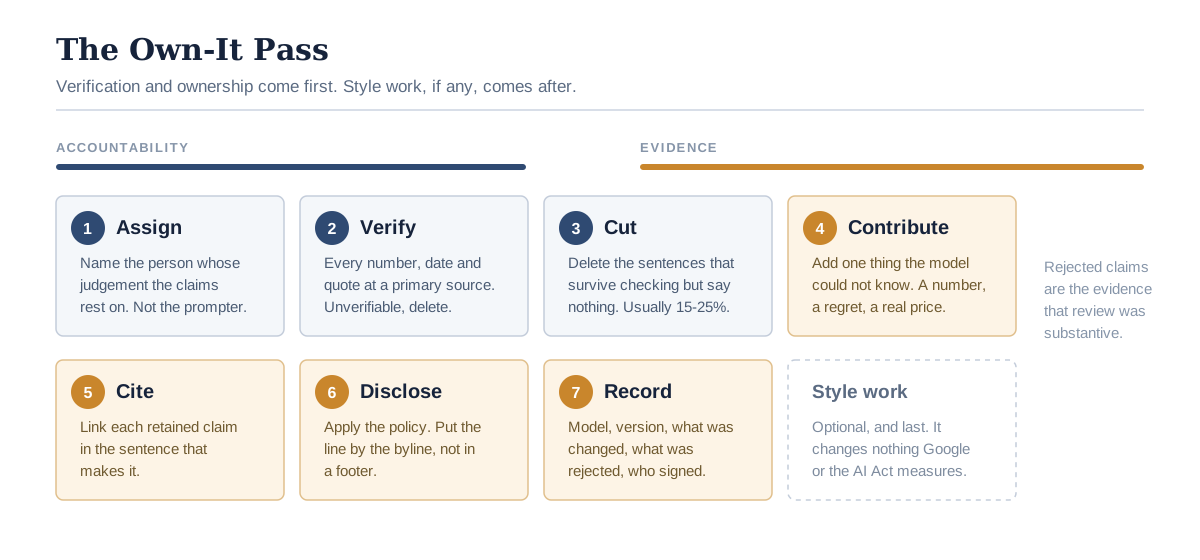
The Own-It Pass: verification and ownership come before any style work.
The Edits That Actually Change How AI Writing Reads
Once ownership is settled, style work is worth doing, and it is worth doing for the reader rather than for a classifier. Model prose has recognisable habits, and most of them come from the same source: the model is optimising for an answer that is acceptable to everyone, which produces text that commits to nothing.
The table below pairs each habit with the edit that fixes it. These are diagnostic, not cosmetic. In every case the fix requires knowing something, which is why no tool can do it for you.
| Habit in the draft | Why the model does it | The edit |
|---|---|---|
| Hedged claims ("can help", "may improve") | Trained to avoid being wrong | State the claim, or delete it. A hedge you cannot resolve means you do not know |
| Symmetrical structure, every section the same length | Pattern completion across the outline | Let the important section run three times longer and the weak one become a sentence |
| Category nouns instead of specifics ("a leading provider") | No access to the specific | Name the vendor, the version, the price, the date |
| Both-sides summaries with no verdict | Optimised for acceptability | Pick a side and say why. If both genuinely work, say when each does |
| Definitions of terms the reader already knows | No model of who is reading | Delete. Assume the reader's job |
| Lists where a sentence would do | Lists score well on structure | Convert to prose unless the items are genuinely parallel |
| Uniform sentence length | Statistical regression to the mean | Vary it. A short sentence after three long ones is the cheapest human signal available |
| Adjectives doing the work of evidence | Fluency substituting for content | Replace "significant improvement" with the measurement |
Two of these deserve expanding, because they are the ones that actually move a reader.
Hedging is a knowledge problem wearing a style costume. When a draft says an approach "can significantly improve outcomes", the sentence is empty in a specific way: it makes a claim while pre-emptively disclaiming it. The instinct is to rewrite it more confidently, which produces an unfounded assertion instead of an empty one. The correct move is to go and find out. Either the improvement is documented somewhere, in which case cite it, or it is not, in which case cut the sentence and lose nothing.
Specificity is not a writing technique, it is an access problem. A model cannot name the price you were quoted, the queue depth on your system, or the reason your last rollout slipped, because it was never told. Every writer who has tried to add specificity by inventing plausible detail has produced the worst possible outcome: something that reads human and is false. The only sustainable source of specificity is your own organisation, which is an argument for pulling real operational data into the drafting process rather than for editing harder.
A note on the "detectable" register
There is a school of advice that says to add contractions, strip the jargon, ask rhetorical questions, and open with an anecdote until the piece matches your brand voice. Some of that is fine writing advice, and a documented tone of voice is worth having for its own sake. None of it is humanizing in any sense that survives contact with the two governing frameworks in this article. Google is looking at whether the page has value and originality. The AI Act is looking at whether a person examined the substance. Contractions do not register on either instrument, and the reader who came for the answer notices the anecdote as a delay.
A Complete Worked Example: One Filled-In Provenance Record
Below is a complete provenance record for one hypothetical article, filled in as it would look after a real Own-It Pass. It is illustrative rather than an extract from any LeapForce system, and the details are constructed to show the shape of the artefact. Copy the field names; supply your own values.
Article: "Q3 pricing changes for our logistics API" Published: 12 September 2026 Disclosure rung (W3C scale): AI-authored, human reviewed
| Field | Value |
|---|---|
| Accountable reviewer | Named product manager, Logistics |
| Reviewer expertise basis | Owns the pricing model under discussion |
| Draft origin | Generative model, vendor and version recorded, accessed via the company gateway |
| Prompt and source material retained | Yes, linked in the record |
| Claims checked | 11 |
| Claims corrected | 3 (two price figures, one effective date) |
| Claims deleted as unverifiable | 2 (a competitor comparison, a customer-count assertion) |
| Original contribution added | Migration timeline from the internal rollout plan; the one customer segment the change hurts |
| Word count before review | 1,410 |
| Word count after review | 1,090 |
| Public-interest scope under Art. 50(4)? | No — commercial product communication |
| Visible disclosure applied? | Yes, by internal policy despite being out of legal scope |
| Reviewer sign-off timestamp | Recorded automatically at approval |
| Retention | Seven years, with the article record |
Three things about this artefact are worth arguing over, because they are where teams disagree in practice.
It records deletions, not just approvals. The two deleted claims are the most valuable rows in the table. They demonstrate that the review was substantive rather than procedural, which is precisely the distinction the European Commission drew. A record that only ever says "approved" proves nothing except that a button was pressed. This is the same principle we apply to platform logging, where recording what was refused matters as much as recording what ran, described in our work on AI observability and audit trails.
It discloses beyond the legal minimum. This article is out of scope for Article 50(4) — it is commercial communication, not public-interest information — and the team disclosed anyway. That is a policy choice, and a defensible one: uniform disclosure removes the inference that undisclosed pieces are hiding something. The opposite choice is also defensible if applied consistently. What is not defensible is deciding case by case.
It captures the model and version. Six months later, when a model provider discloses a systematic failure mode in a specific version, the only teams that can answer "were we exposed?" are the ones that wrote the version down. Nobody regrets having captured this field, and the cost of capturing it is zero if the drafting happens through a governed endpoint rather than an unlogged personal account.
Machine-Readable Marking: What Exists and What Does Not
Machine-readable marking of AI content exists in production today for images and is far less mature for text. Understanding which is which will save you from either over-promising to a compliance team or dismissing the whole area as vapour.
For images and other media, the working standard is Content Credentials from the Coalition for Content Provenance and Authenticity, which describes the mechanism as functioning "like a nutrition label for digital content, giving a peek at the content's history available for anyone to access, at any time". It is a cryptographically signed manifest that travels with the file. Alongside it sits the IPTC DigitalSourceType vocabulary, whose TrainedAlgorithmicMedia value is the marker Google already mandates in Merchant Center. Both are shipping.
The NIST overview of technical approaches to digital content transparency groups the available mechanisms into authenticating content and tracking its provenance, labelling synthetic content with watermarking, and metadata recording. Practitioners usually split that middle category further, into overt marks a person can perceive and covert marks only a machine can read. Each mechanism has a distinct failure mode. Metadata is trivially stripped by any pipeline that re-encodes the file. Covert watermarks survive re-encoding better but degrade under aggressive transformation. Overt marks survive everything and can be cropped off.
Text is the hard case, and it is worth being honest about why. A watermark in an image can hide in pixel values the eye ignores. A watermark in text has nowhere comparable to hide: the only signal available is the choice of words, and changing the words is exactly what any editor or paraphraser does. That is the same property the Weber-Wulff study measured from the other direction when it found obfuscation degrades detection. Text marking therefore leans on the container rather than the content, which is why the W3C group is working on page-level syntax rather than on invisible in-text signals.
| Approach | Status for images | Status for text | Main weakness |
|---|---|---|---|
| C2PA Content Credentials | Shipping, signed manifests | Applicable to files, not to text on a page | Stripped by re-encoding pipelines |
| IPTC DigitalSourceType | Shipping; required by Google Merchant Center | Not applicable | Metadata removal |
| Covert watermarking | Deployed by some model providers | Fragile against editing | Degrades under paraphrase |
| Page-level disclosure syntax | N/A | In development at W3C, from Feb 2026 | Not yet a standard, no consumption path |
| Visible human-readable disclosure | Works | Works | Depends entirely on publisher honesty |
The practical reading for a publisher: do not wait for text watermarking to arrive before building a disclosure practice. The mature control available today is the one you administer yourself — a visible statement plus a retained record — and every emerging standard is designed to carry that same information, not to replace it.
Common Mistakes When Humanizing AI Content
The failures below are the ones that recur in public discussion of AI editorial workflows, and each follows directly from the two frameworks above. Every one is cheap to avoid and expensive to discover late.
Treating the humanizer tool as the control. It changes nothing that either Google or the AI Act measures. If it is in your workflow, it sits after review, never instead of it, and it should not be in the workflow at all if the reason for using it is to defeat a classifier.
Reviewing for tone before reviewing for truth. Style edits applied to an unverified draft are work invested in sentences that verification may delete. Order the pass correctly and you do less total editing.
Making disclosure a footer line. A disclosure that a reader has to hunt for fails the reasonable-expectation test Google articulates and does nothing for trust. Put it where the byline is.
Assigning review to the person who ran the prompt. They have already read the text several times and have the worst possible perspective on whether it is true. Review needs someone who was not in the drafting loop.
Recording approval without recording changes. The record's entire evidential value comes from showing that something was examined. "Approved" is a procedural check by definition.
Letting the policy live in a document nobody opens. A policy that is not enforced in the publishing workflow is a statement of intent. If the CMS lets a piece publish with an empty reviewer field, the field will be empty.
Assuming the exemption is automatic because a human "looked at it". The Commission's language rules out superficial and purely formal checks. Skimming is a formal check.
Scaling first and reviewing later. The volume that triggers Google's scaled content abuse policy is reached far faster than the review capacity to cover it. If throughput exceeds review capacity, the excess is unreviewed by definition, and unreviewed volume is exactly what the policy targets.
When Sounding Human Is the Wrong Goal
There are cases where making machine-drafted text read as human is actively the wrong objective, and they are more common than the content-marketing framing suggests.
When the reader is entitled to know they are reading machine output. A support response, a summarised transcript, an automated notification: in each of these the value to the reader depends on knowing the provenance. Polishing them into something that reads as personally written removes information the reader needs to calibrate how much to trust the content.
When the content is a testimonial or a review. In the United States the FTC's rule on consumer reviews and testimonials, published at 89 FR 68077 on 22 August 2024, makes it an unfair or deceptive act for a business to write, create or sell a review or testimonial that materially misrepresents "that the reviewer or testimonialist exists". A machine-drafted testimonial from a person who does not exist is unlawful in the US regardless of how convincingly human it reads. Here, sounding human is the aggravating factor rather than the mitigation.
When the humanising would obscure a limitation. If a draft is thin because the model had nothing to work from, the flat prose is a signal, and smoothing it hides a real defect from your own editors. The flatness is doing you a favour.
When the audience is other machines. A meaningful share of your content is now read by retrieval systems and answer engines before a person sees it. Those consumers reward self-contained factual passages with clear attribution, which is close to the opposite of the conversational register humanizing advice recommends. Writing for both audiences at once is possible; writing exclusively for the human-sounding one costs you the other.
Where This Analysis Is Uncertain
Several load-bearing parts of this article rest on evidence that is thinner than it appears, and readers should discount accordingly.
Enforcement of Article 50(4) is untested. The obligation became applicable on 2 August 2026. At the time of writing we are aware of no enforcement action, no regulator guidance interpreting "public interest" against a marginal case, and no published view on how much review documentation satisfies the exemption. Everything above about the exemption is a reading of the text and the Commission's FAQ, not a prediction of how an authority will behave. Take legal advice for your own situation; this article is not legal advice.
"Matters of public interest" is genuinely ambiguous at the edges. A vendor blog explaining a new regulation is arguably informing the public about public administration. A vendor blog explaining its own pricing is not. Between those poles sits a large grey area that nobody has mapped.
The population-level detector figures come from a commercial vendor. Graphite is a growth firm with a commercial interest in the AI-content conversation, and the classifiers it used are commercial products. Its methodology is disclosed and its error-rate validation is more careful than most, which is why we cite it, but it is not peer-reviewed and it has not been independently replicated.
Detector research ages quickly. The Weber-Wulff and Liang studies are from 2023 and tested the tools available then. Detector vendors claim substantial improvements since. We could not find a peer-reviewed 2026 replication at comparable scale, so the honest position is that the per-document reliability problem is well-documented as of 2023 and unresolved rather than proven-still-broken today.
We ran no first-hand test. No paired publication experiment, no internal detector benchmark, no measured effect on search performance. Where this article makes a recommendation, it is reasoning from primary regulatory text and third-party research, not from our own measurement.
Some sources a reader would expect are missing. We could not verify claims about a 2026 FTC rulemaking on AI transparency in advertising at any primary source, despite several secondary sites asserting one exists, so nothing about it appears above. The only FTC instrument cited is the 2024 reviews rule, which we read directly in the Code of Federal Regulations.
The Governance Layer This Implies
Everything above turns on one operational fact: you can only record provenance you actually captured. If drafting happens on personal accounts across a dozen unlogged tools, the reviewer's record is reconstructed from memory, and the model-and-version field is a guess. That is the layer we build. LeapForce puts one governed endpoint in front of the models a company uses, so which model produced which draft, under whose identity, at what cost, is recorded as a by-product of the work rather than as a separate compliance chore, with the same discipline our observability and audit approach applies to agent actions. Our rollout model for that gateway is deliberately staged — observe first, enforce second, optimise third — because a team that starts by blocking tools learns nothing about what its writers were actually using. To be plain about the boundary: LeapForce does not write your content, does not review it, and cannot tell you whether a claim is true. Editorial responsibility is a human job and the Act is explicit that it must be. What a governed layer supplies is the substrate the record sits on.
Ready to Govern Your AI?
Talk to LeapForce — one controlled layer for every AI tool, connector, model, and agent.
Frequently asked questions
No. Google's Search Central guidance states that "using AI doesn't give content any special gains. It's just content", and that appropriate use of AI or automation is not against its guidelines. What Google acts against is scaled content abuse, defined in its spam policies as generating many pages primarily to manipulate rankings rather than to help users, "no matter how it's created". A human content farm violates the same policy. The lever is volume, originality and intent, not whether a model was involved.
It depends on jurisdiction and subject matter. Under EU AI Act Article 50(4), deployers publishing AI-generated text to inform the public on matters of public interest must disclose it, unless the content underwent human review and a person or entity holds editorial responsibility. Ordinary commercial marketing content generally falls outside that trigger. Google's position is softer: add disclosures "for content where someone might think 'How was this created?'". Most organisations land on a uniform internal policy because inconsistent disclosure is harder to defend than either extreme.
Not reliably, at the level of a single document. A study of 14 detection systems concluded they are "neither accurate nor reliable" and are biased toward calling output human-written, and that obfuscation techniques significantly worsen their performance. A separate evaluation of seven commercial detectors recorded an average 61.22% false positive rate on TOEFL essays written by non-native English speakers while achieving near-perfect accuracy on US eighth-grade essays. At population scale, across tens of thousands of documents, classifier error rates below 2% do support usable aggregate estimates. One article is not a population.
No, and it may be worse than doing nothing. Tools sold to humanize AI content operate on word choice alone. Compliance under the AI Act turns on substantive human review plus editorial responsibility, and the European Commission's FAQ states explicitly that "superficial, solely formal, or procedural checks" do not qualify. A style-rewriting pass is a formal check. Google's policies measure originality and value, which a paraphrase does not change. The only outcome a humanizer reliably produces is a lower detector score, and detector scores are not an input to search ranking or to any legal test.
The Commission's guidance describes it as "deliberate examination of the substance of the content by one or more natural persons" holding relevant expertise, or control exercised by a responsible editorial entity with authority to approve or reject. Two elements have to be present together: examination of substance, and someone holding editorial responsibility for the publication. In practice that means a reviewer who can be named, who has domain competence in the subject, and who left evidence of what they checked, corrected, and rejected.
The Article 50(4) text-disclosure duty applies to text "published with the purpose of informing the public on matters of public interest", which the Commission illustrates with politics and democratic processes, public administration and services, and the administration of justice. A product announcement or a pricing page is not that. A post explaining pending legislation to a general audience plausibly is. The safer operating assumption for a mixed content programme is to build the review-and-record capability once and apply it everywhere, rather than adjudicating scope per article.
A person, and specifically the person whose expertise the article's claims rely on. Google's guidance recommends accurate author bylines "when readers would reasonably expect it", and states that giving AI an author byline is "probably not the best way" to make AI involvement clear. Naming the model as author fails both the reader's question and the Act's requirement that a natural or legal person hold editorial responsibility. Name the reviewer, and add a separate line describing the AI assistance.
The dominant cost is reviewer time, not tooling, and the only honest way to size it is to time your own first ten reviews rather than trust anyone's benchmark, including ours. We have not measured this and are not going to quote a figure we did not produce. What we can say is which variable dominates: the number of independently checkable claims in the draft, multiplied by the seniority of the person who can check them. Count the claims in a typical piece, watch one expert verify them once, and you have a defensible per-article cost. Most teams that run that exercise discover their publishing target and their review capacity were never reconciled, which is the argument to take upstairs. Record-keeping itself is a CMS field and costs effectively nothing once drafting runs through a logged endpoint.
The policy decisions take an afternoon; the enforcement takes a quarter. Naming reviewers, defining what review means, and choosing disclosure scope are all same-day decisions. What takes time is making the workflow refuse to publish without a reviewer and a record, and getting visibility into which tools writers are actually drafting on, since provenance you never captured cannot be recorded later. Teams that sequence it the other way, starting with a policy document, typically find nothing has changed six months on.
Because they are documents rather than gates. Most policies written to humanize AI content describe an intention and stop there. A policy that lives in a wiki depends on every writer remembering it under deadline; a required field in the publishing workflow does not. The second common failure is capacity: a policy demanding substantive review of every piece, imposed on a team whose targets assume unreviewed throughput, will be quietly abandoned rather than renegotiated. The third is scope creep in the wrong direction, where disclosure gets applied case by case, which teaches readers to read the absence of a disclosure as a signal.
Yes, and the tooling is further along. For images there are shipping standards: C2PA Content Credentials attach a signed provenance manifest to the file, and the IPTC DigitalSourceType value TrainedAlgorithmicMedia is already mandatory for AI-generated images in Google Merchant Center. For text there is no equivalent production marking, because any watermark carried in word choice is destroyed by ordinary editing, which is why the W3C effort is working on page-level disclosure syntax instead. Mark images with metadata; disclose text with a visible statement and a retained record.
Comments