
n8n pricing starts at nothing and ends wherever your compliance requirements do. Self-hosting the Community edition is free forever. n8n Cloud runs 24 euros a month for 2,500 workflow executions and 60 euros for 10,000. The moment you need single sign-on, the cheapest plan that includes it is 800 euros a month.
That last sentence is the whole article. We fetched n8n's list prices on 30 July 2026 and worked out what each tier costs per thousand executions, and the curve does something unusual: it falls as you scale, then jumps 6.9 times at exactly the point where the first security control appears, and never comes back down. Most pricing write-ups treat that as a footnote. For anyone who has to put single sign-on, role separation and log export in a procurement document, it is the only number that matters.
Somebody on Hacker News put the same problem more plainly. In October 2025, a commenter posting as seer described trialling n8n as a backend replacement and hitting the licence meter while already paying for their own servers: "even their highest enterprise license was cutting it close". They were self-hosting. They were also being billed by execution count. Both of those things are true at once, and the pricing page does not make that obvious.
The short answer: n8n's per-execution rate is the cheapest in its class right up to the tier where SSO appears, at which point the effective unit price rises from 2.42 euros to 16.67 euros per 1,000 executions and stays above 8.74 euros no matter how much volume you buy. Price the plan your controls require, not the plan your volume requires.
Last updated: July 30, 2026.
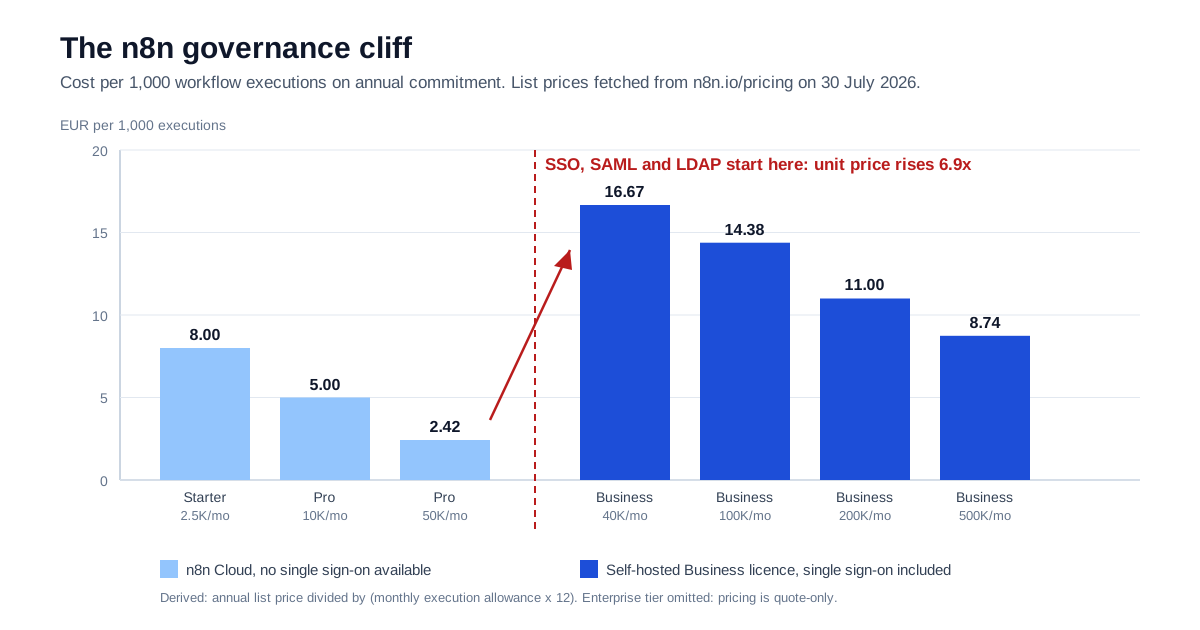
The unit price falls across the Cloud tiers, then jumps at the plan where SSO first appears.
What n8n costs right now, in every unit
n8n pricing has four paid tiers plus a free Cloud tier, and every tier is quoted two ways. Month-to-month, the entry Cloud plan is 24 euros for 2,500 monthly workflow executions, Pro is 60 euros for 10,000 or 145 euros for 50,000, and the self-hosted Business licence is 800 euros for 40,000. Commit annually and the same plans cost 240, 600, 1,450 and 8,000 euros a year, a saving of about 17 percent. Enterprise is quote-only. Every figure in this section comes from n8n's pricing page, fetched 30 July 2026, and prices there are quoted in euros. Throughout this article, "a month" means the month-to-month list price and "a year" means the annual-commitment total.
Here is the full ladder, with the derived unit rate that the vendor does not publish.
| Plan and allowance | Hosting | Monthly list | Annual list | Executions/month | EUR per 1,000 executions |
|---|---|---|---|---|---|
| Free | n8n Cloud | 0 | 0 | 50 | 0 |
| Starter 2.5K | n8n Cloud | 24 | 240 | 2,500 | 8.00 |
| Pro 10K | n8n Cloud | 60 | 600 | 10,000 | 5.00 |
| Pro 50K | n8n Cloud | 145 | 1,450 | 50,000 | 2.42 |
| Business 40K | Self-hosted | 800 | 8,000 | 40,000 | 16.67 |
| Business 50K | Self-hosted | 985 | 9,852 | 50,000 | 16.42 |
| Business 75K | Self-hosted | 1,456 | 14,555 | 75,000 | 16.17 |
| Business 100K | Self-hosted | 1,726 | 17,260 | 100,000 | 14.38 |
| Business 150K | Self-hosted | 2,189 | 21,890 | 150,000 | 12.16 |
| Business 200K | Self-hosted | 2,639 | 26,390 | 200,000 | 11.00 |
| Business 300K | Self-hosted | 3,512 | 35,120 | 300,000 | 9.76 |
| Business 400K | Self-hosted | 4,381 | 43,810 | 400,000 | 9.13 |
| Business 500K | Self-hosted | 5,245 | 52,450 | 500,000 | 8.74 |
| Business overage | Self-hosted | — | 4,000 per 300,000 | — | 13.33 |
| Enterprise | Either | quote | quote | custom | not published |
The unit column is ours, not n8n's. It is the annual list price divided by the monthly allowance multiplied by twelve. Starter at 240 euros a year against 30,000 annual executions gives 8.00 euros per thousand. Pro 50K at 1,450 euros against 600,000 gives 2.42. Business 40K at 8,000 euros against 480,000 gives 16.67. Nothing clever, but the arithmetic is the point: a buyer reading down the price column sees numbers rising smoothly and assumes the value rises with them.
Two conversions worth having in your head before any vendor call. A workflow on a five-minute schedule burns roughly 8,600 to 8,900 executions a month, a figure n8n itself publishes in its pricing FAQ. That single workflow consumes 86 percent of the Pro 10K allowance on its own. A workflow on a daily schedule costs about 30 executions a month, so you could run 80 of those inside Starter and still have room. Frequency, not complexity, is what moves the bill.
The billing unit is a whole run, not a step
n8n bills one execution per complete run of a workflow, no matter how many nodes that workflow contains. This is the single most misreported fact about n8n pricing, and getting it wrong will make your estimate wrong by an order of magnitude in either direction. Every comparison of n8n pricing plans against a competitor's is meaningless until both meters are converted to the same unit. The vendor states it directly on the pricing page: however many steps run and however much data moves, "it's still a single execution".
That is a genuinely different meter from the per-task and per-operation models used by most connector platforms, and it changes which shape of automation is cheap. Under a per-step meter, a workflow that fans out over 500 records and calls three APIs each is expensive because it is 1,500 billable units. Under n8n's meter it is one. Under a per-step meter, a webhook that fires 40,000 times a month to do one trivial thing is cheap. Under n8n's meter it is 40,000 executions and it will not fit on Business 40K.
| Workload | Runs per month | Steps per run | Billable units, per-step meter | Billable units, n8n meter |
|---|---|---|---|---|
| Nightly CRM sync over 2,000 records | 30 | ~2,000 | 60,000 | 30 |
| Webhook on every form submission | 20,000 | 4 | 80,000 | 20,000 |
| Five-minute polling job | 8,700 | 6 | 52,200 | 8,700 |
| Monthly finance report assembly | 1 | 120 | 120 | 1 |
Read that table twice before you estimate. The teams that get the best value from n8n are the ones doing heavy work infrequently. The teams that get the worst value are the ones doing trivial work constantly, and those teams often arrive from a per-task tool where the same workload looked fine. If most of your automations are triggered by high-frequency events rather than schedules, the execution meter will punish you regardless of how simple each workflow is. Our earlier analysis of what AI workflow tools actually cost per 1,000 runs makes the same point across the category; this piece prices one named vendor against it.
One more wrinkle. Sub-workflows called from a parent workflow have historically been an area where users report differing behaviour depending on how the call node is configured, and n8n's own guidance is to review your instance's execution logs rather than reason about it from first principles. If your architecture leans on sub-workflows, measure before you commit to a tier.
The governance cliff: what the first security control costs
The steepest step in n8n pricing is not a volume step. Single sign-on is not available on any n8n Cloud tier below Enterprise, and the cheapest published plan that includes it is Business at 800 euros a month. The nearest plan below it, Pro 50K, is 145 euros a month. So the first identity control costs 655 euros a month more, or 6,550 euros a year, and it comes with 20 percent fewer executions than the plan you left. That is the cliff in the chart above.
Expressed as a unit rate the move is worse than it looks. Pro 50K is the cheapest execution on the whole ladder at 2.42 euros per thousand. Business 40K is 16.67. That is a 6.9-fold increase in unit price paid for an identity feature, and buying your way out of it does not work: even at 500,000 executions a month, ten times the volume, Business still costs 8.74 euros per thousand, or 3.6 times the Pro rate. There is no volume at which the governed tier becomes as cheap per unit as the ungoverned one.
One objection to that comparison deserves answering, because it is the first thing a vendor rep will say. Pro is a managed Cloud plan and Business is a self-hosted licence, so the step spans two hosting models and not only a feature gate. True. It also makes the step worse rather than better: you pay 6,550 euros a year more and you also take over the servers, the upgrades and the backups that the Cloud plan was absorbing. The mitigation is not to argue about the ratio. It is to shrink the number of executions that have to sit on the governed side of the line, which is the hybrid costed later in this article.
| What you gain at Business | What it costs |
|---|---|
| SSO, SAML and LDAP | 6,550 EUR/year more than Pro 50K |
| Six shared projects instead of three | 20% fewer executions included |
| Separate environments (dev, staging, prod) | You take over hosting and patching |
| Git-based version control of workflows | Support stays forum-only |
| 30 days of insights instead of 7 | — |
The industry has a name for this shape and a public position on it. The CISA Secure by Design pledge asks software manufacturers to ship products that are secure out of the box, with security features including "logging, and single sign-on (SSO) available at no extra cost". The pledge is voluntary and no vendor is obliged to sign it. But when a buyer's security review lists SSO as mandatory, that language is the argument to bring to the negotiation, and the 6.9x figure is the number to bring with it.
There is a second cliff above the first. Log streaming to an external system, external secret-store integration, extended data retention and dedicated support with an SLA all sit on Enterprise, which is quote-only. So a mid-sized company that needs SSO and needs its automation logs in Splunk or Datadog cannot price its stack from the website at all. It has to enter a sales process to find out. If you are documenting a budget for a board or a procurement committee, that is a real planning cost and it should be flagged early, not discovered in week six.
The problem card at the top of this article has a companion. In August 2025 a Hacker News commenter posting as phito wrote that they wanted to try n8n at home but were "very disappointed to see the SSO behind a paywall even in the community edition". That is a hobbyist's complaint, and hobbyists are not the buyer this article is written for. It matters anyway, because the same gate that stops a homelab is the gate that stops a fifteen-person company with a SOC 2 questionnaire in front of it.
What free self-hosting actually excludes
The free Community edition of n8n is genuinely free and can be run indefinitely, and it includes almost the complete feature set. n8n's own documentation lists what it does not include, and the list reads like a governance checklist: SSO (SAML and LDAP), Projects, Environments, external secrets, log streaming, Git-based version control, workflow and credential sharing, custom variables, external binary storage and multi-main mode. All of it is documented on n8n's compare editions page.
Read that list against the way a real team works. No Projects means no role-based separation between the finance automations and the marketing ones. No sharing means only the instance owner and the user who created a workflow can access it, which is a bus-factor problem the day someone leaves. No environments means you edit production. No Git means no code review of a change that can move money. No log streaming means your automation's audit trail lives inside the automation tool, which is exactly where an auditor does not want it.
There is a middle step people miss. Registering a free Community instance with an email address unlocks a free licence key that adds folders, debug-in-editor and custom execution data. It is still free and still lacks every item in the paragraph above, but it is worth doing on day one because you will want folders long before you want SAML.
The part that surprises people most: paid self-hosting is still metered. To use Business or Enterprise features on your own servers you receive a licence key that, per n8n's pricing FAQ, "must ping our license server daily to stay active", and that ping reports your production execution count. Your quota follows you onto your own hardware. One key can be applied to unlimited instances, but the usage from all of them combines against a single quota. Exceeding it does not stop workflows, but overages are invoiced at 4,000 euros per additional bucket of 300,000 executions. That is 13.33 euros per thousand, worse than every published Business tier above 100K.
This is precisely what the Hacker News commenter quoted at the top ran into. They described "paying for the servers, load balancers, key value store and database" and still burning through a licensed execution allowance. Self-hosting removes the hosting bill. It does not remove the meter.
The licence is a procurement question, not a philosophy one
n8n is fair-code, not open source, and the distinction has a concrete effect on what you are allowed to build. The Sustainable Use License permits use, modification and redistribution with three limits, the binding one being that you may use the software "only for your own internal business purposes or for non-commercial or personal use", per n8n's licence documentation. Source files containing .ee. in the filename sit under a separate n8n Enterprise License rather than the Sustainable Use License at all.
n8n gives worked examples in the same document. Syncing your own company's CRM data: allowed. Building a node for your own product: allowed. Consulting on n8n for clients: allowed. White-labelling n8n and selling it: not allowed. Hosting n8n and charging people to access it: not allowed.
The grey zone is the one agencies keep walking into. A Hacker News commenter posting as JimDabell quoted the clause directly in July 2025 and made the reading explicit: the test is commercial versus non-commercial and internal versus external, not big versus small. If you run automations on behalf of clients inside your own instance and bill for the outcome, read the licence with your lawyer rather than with a forum thread. If your product's value derives substantially from n8n functionality, you are in Enterprise-licence territory regardless of your execution count.
For a governance-minded buyer this belongs in the same risk register as data residency and log retention, because it is the item most likely to require re-architecture rather than a plan upgrade. A plan upgrade takes a purchase order. A licence violation takes a rebuild.
Costing the self-hosted path: a model you fill in
The n8n self-hosted cost is not zero, it is unbilled. Self-hosting shifts cost from an invoice you can forecast to a labour line you probably cannot, which is why the total cost of ownership rarely matches the plan comparison. Here is the component model. We are giving you a template rather than a total, because two of the five components depend on numbers only you have.
Component 1 — infrastructure. A single-container n8n on one small virtual machine is fine for a hobby instance. A production instance is not that. n8n's queue mode documentation specifies a main instance handling triggers and webhooks, one or more worker instances doing the actual execution, Redis as the message broker, and a database holding workflow and execution data. If your workflows persist binary data, queue mode does not support filesystem storage and you need S3-compatible external storage as well. So the minimum production footprint is four moving parts, not one, plus backups and failover for the database. We deliberately do not quote cloud list prices here: we could not verify current per-instance rates for any major provider within this run, so pricing this component against your own provider's calculator is left to you.
Component 2 — the licence, if you need governed features. Zero for Community. From 8,000 euros a year for Business. Quote-only for Enterprise.
Component 3 — build labour. The same as any internal tool. Not specific to n8n, and usually the number teams already know.
Component 4 — keeping it patched. This is the component that gets left out, and the next section measures it.
Component 5 — the compliance work you inherit. Log retention, secret rotation, access reviews, backup verification. On Cloud, some of this is the vendor's problem. On your own infrastructure it is yours, and NIST's log management guidance describes it as a full lifecycle — "generating, transmitting, storing, accessing, and disposing of log data" — in SP 800-92 Revision 1. Note the ordering problem this creates for the tier gate: log streaming to an external system is an Enterprise feature, so the self-hosted Community user with the strongest compliance obligation is the one with the fewest tools to meet it.
For labour rates we use a public benchmark rather than a guess. The US Bureau of Labor Statistics puts the national mean hourly wage for software developers (occupation 15-1252) at 71.20 dollars and the mean annual wage at 148,100 dollars, May 2025 estimates, retrieved 30 July 2026 from the BLS Occupational Employment and Wage Statistics series via the agency's public data API, because the HTML page blocks automated retrieval. Treat 71.20 dollars as a floor: it is wage only and excludes benefits, employer taxes and overhead, so a fully loaded rate at your organisation is higher.
The patch load we measured, and how to measure it yourself
We did not run n8n in production ourselves, so nothing in this article is a first-hand report of using the product. What we did run is the patch-load measurement this section recommends, against public data, on 30 July 2026, and the numbers are large enough that leaving them out of a self-hosting business case makes the case wrong.
Querying the National Vulnerability Database for records naming n8n, and excluding entries that describe third-party projects such as n8n-MCP and the unrelated n8n-workflows repository, we counted 119 CVE records for the n8n platform published between 30 July 2025 and 30 July 2026. Of those, 24 are rated CRITICAL and 43 HIGH under CVSS, with a maximum base score of 10.0. Separately, the n8n GitHub repository published 100 releases between 27 May 2026 and 30 July 2026, 46 in June and 49 in July, which is roughly eleven releases a week.
| Measurement (12 months to 30 July 2026) | Value | Source |
|---|---|---|
| n8n platform CVE records published | 119 | NVD API, keyword n8n, third-party projects excluded |
| Rated CRITICAL | 24 | NVD CVSS base severity |
| Rated HIGH | 43 | NVD CVSS base severity |
| Highest base score observed | 10.0 | NVD CVSS |
| Distinct publication days | 28 | NVD published field |
| Largest single-day batch | 21 records (23 June 2026) | NVD published field |
| Releases in the 65 days to 30 July 2026 | 100 | GitHub Releases API |
The distribution matters more than the total. Advisories do not trickle in. They land in batches of ten to twenty on a couple of dozen days a year, which means the work is not a steady half hour a week but a series of unplanned afternoons. Thirty-four of the 119 records mention credentials or secrets, and nine describe an authentication or authorisation bypass or a privilege escalation, which is the class that turns "we should upgrade soon" into "we upgrade tonight".
Put a rate on it. Twenty-eight advisory events a year, at a conservative two hours each to read the advisory, test the upgrade against your workflows and deploy it, is 56 hours. At the BLS mean of 71.20 dollars that is 3,987 dollars a year of wage-only labour, before benefits and before any incident that actually requires investigation. That is not a large number next to an 8,000-euro licence. It is a very large number next to zero, which is what "free and self-hosted" implies.
Run it yourself before your next renewal. Both queries are public and take under a minute:
curl -s "https://services.nvd.nist.gov/rest/json/cves/2.0?keywordSearch=n8n&resultsPerPage=200"
curl -s "https://api.github.com/repos/n8n-io/n8n/releases?per_page=100"
Two caveats we will not paper over. A high CVE count partly reflects a healthy disclosure programme and an actively maintained project, not simply an insecure one, since a codebase nobody researches produces zero advisories. And a managed Cloud plan does not make the vulnerabilities disappear; it makes patching somebody else's shift. That transfer of work is a large part of what the Cloud premium buys, and it is rarely priced into the self-hosting comparison.
Three worked scenarios with totals
Sticker prices only become decisions when you attach them to a shape of team. These three are constructed, not customer accounts, and every price in them traces to the ladder table above.
Scenario A — two-person ops team, no compliance obligation. Twelve scheduled workflows, mostly daily and hourly, roughly 4,000 executions a month. Nobody outside the two of them touches the instance. Four thousand executions overshoots Starter's 2,500, so the answer is Pro 10K on annual commitment: 600 euros a year. Governance features are worth nothing to them because there is nobody to separate from. Annual cost: 600 euros. Self-hosting Community would cost nothing in licence and several thousand dollars a year in patch labour on the arithmetic above, so managed Cloud wins outright and it is not close.
Scenario B — thirty-person agency running client automations. 60,000 executions a month across client accounts, needs project separation so account teams cannot see each other's credentials, needs an audit trail per client. Pro caps at 50,000 and has three shared projects. Business 75K is 14,555 euros a year and brings six projects, SSO and environments. But the licence question bites first: if the agency's commercial offer derives substantially from n8n functionality, the Sustainable Use License does not cover it and this is an Enterprise-licence conversation before it is a tier conversation. Annual cost: 14,555 euros in licence, plus roughly 56 hours of patch labour because the Business plan is self-hosted, and subject to a licence review that could change the answer entirely.
Scenario C — regulated mid-market, 150 staff. 90,000 executions a month, SSO mandatory, logs must stream to the existing SIEM, retention must survive an audit window. SSO puts them on Business at minimum: Business 100K is 17,260 euros a year. Log streaming and external secret storage are Enterprise features, so the honest budget line is "Business 100K plus an unpriced Enterprise uplift", and the finance team should be told that before the pilot rather than after. Annual cost: 17,260 euros in licence, plus roughly 56 hours of patch labour on their own infrastructure, plus an Enterprise quote of unknown size.
The costed middle option. There is a hybrid that most write-ups skip and it is often correct. Run Community edition free on your own infrastructure for development, prototyping and any workflow that never touches regulated data, and buy exactly one governed production instance at the tier your controls require. You are then paying the cliff price only on the executions that need to be governed, not on the whole estate. In Scenario C, if 30,000 of the 90,000 monthly executions are internal experiments that could live on an ungoverned Community instance, moving them off the licensed instance drops the production requirement from Business 100K (17,260 euros) to Business 75K (14,555 euros), a 2,705-euro annual saving for an afternoon of re-pointing triggers. The cost is a second instance to patch and a rule about which workflows may live where, and that rule has to be enforced by something, which is the subject of the second-to-last section.
Seven line items that never appear on the invoice
The bill shows a plan name and a number. Published n8n pricing plans do not show these seven costs, which are real, are set by which tier you are on, and turn up in month four.
| Line item | What it costs you | Where it is gated |
|---|---|---|
| Execution history retention | Debugging a failure you can no longer see | Saved-execution and retention limits per plan |
| Insights window | You cannot show a trend longer than your window | 7 days on Pro, 30 on Business, 365 on Enterprise |
| Concurrency ceiling | Queued work during bursts, not failed work, but slower | 5 on Starter, 20 on Pro, 200+ on Enterprise |
| Support tier | Forum-only until Enterprise; Business is explicitly self-serve | Dedicated support with SLA is Enterprise |
| Data residency | Cloud data sits on servers in Frankfurt, Germany | Cloud has no region choice; self-host does |
| AI Assistant credits | Monthly allowance, no top-ups, no rollover | 2,300 on Starter, up to 13,700 on Pro |
| Environments and Git | Editing production directly; no reviewable change history | Business and above, or self-hosted licence |
Two of these deserve a sentence each. Support is the one buyers assume scales with price and does not: n8n states that the Business plan is a self-serve option and that dedicated support is supported only on Enterprise. You can be paying 17,260 euros a year and still be asking the community forum why your workflow stopped. And data residency is a genuine constraint in the other direction: Cloud stores data in the EU, which is an advantage for a European buyer and a blocker for anyone with a US-only or in-country residency requirement, who is pushed to self-hosting and therefore back onto the licence meter.
The retention line is the one that quietly breaks incident response. If an automation silently produced wrong output eleven days ago and your plan keeps only a few days of execution history, the evidence is gone. That is not a pricing inconvenience, it is an audit finding, and it is the reason we keep arguing that audit trails belong outside the tool that generates them.
The Tier-Gate Test: a procurement pass you can run today
Most people read n8n pricing by estimating executions and looking across to a plan. That gets the wrong answer whenever a control requirement exists, because controls are gated by tier and volume is not. Run it the other way instead. We call this the Tier-Gate Test and it takes about twenty minutes.
- List the controls you must have, not the ones you would like. Typical list: single sign-on, role separation between teams, workflow change review, log export to your SIEM, secret storage outside the tool, retention long enough for your audit window.
- Find the cheapest plan that includes each one. SSO, projects, environments and Git: Business. Log streaming, external secret store, extended retention, SLA support: Enterprise. Everything else: Starter or Pro.
- Take the highest tier on that list. That is your plan. Your execution volume does not get a vote here; it only decides which rung of that tier you buy.
- Now price your executions at that tier's unit rate, from the table in the first section. This is the step everyone skips, and it is where the 6.9x shows up.
- Subtract the workloads that do not need the controls. Anything that never touches regulated data, never runs unattended against production systems and never needs to be shown to an auditor can live on a free Community instance. Re-price the licensed instance without them.
- Add the labour line. Twenty-eight advisory events a year at your loaded hourly rate if you self-host; zero if you are on Cloud and let the vendor absorb it.
- Write down what happens at the quota. Overage on Business is 4,000 euros per 300,000 executions, invoiced up to 45 days after the fact. Decide in advance whether you accept overage or upgrade, because the default is a surprise invoice.
The test is deliberately blunt. Its value is that it produces a number you can defend in a procurement meeting rather than a range, and it surfaces the Enterprise-quote dependency in step two rather than in week six. If your control list is empty, which is a genuinely possible answer for a small internal team — the test tells you to buy Pro and stop reading, which is also useful.
Where this analysis is uncertain
Several things here could be wrong, or could be right today and wrong next quarter, and you should know which.
Prices change. Every figure is a list price fetched on 30 July 2026 from a single page, in euros, and n8n's own documentation says the pricing page is the source of truth and that exact features per plan can change. Anything negotiated, discounted, start-up-programme-adjusted or invoiced in dollars will differ. The 6.9x ratio is a property of the published ladder, not a law of nature, and n8n could close it tomorrow by putting SSO on Pro.
The feature matrix is partly unreadable to us. n8n's detailed comparison table toggles between Cloud and self-hosted columns and renders its ticks and crosses as scripted graphics, which a static fetch cannot reliably distinguish. Everything we assert about which plan includes what comes from the plan cards themselves and from the documentation's compare-editions page, both of which are unambiguous prose. Where the two could conflict, treat the vendor's live page as authoritative and re-check before signing.
The labour model is a template, not a measurement of your team. We used a national mean wage from a public statistical series and a conservative two hours per advisory event. If your team already patches a fleet of Node.js services on a schedule, the marginal cost of adding n8n is much lower than 56 hours. If n8n would be your first self-hosted service, it is higher, and the four-component queue-mode footprint is a bigger step than the licence fee.
We could not verify current infrastructure list prices. DigitalOcean's droplet pricing page renders client-side and did not yield figures to a static fetch within this run, and we would not quote a hosting cost we had not read. That leaves a real gap in the self-hosting total, and it is the component you should price yourself first.
We have not run n8n in production. Nobody on our side operated a licensed instance, blew through a quota or argued with a sales team about an overage invoice. The patch-load numbers in this article are our own measurement of public data and are reproducible from the two commands above; everything else is the vendor's published position, read carefully. Where a claim needed first-hand operational experience we have left it out rather than dressed it up.
Finally, the CVE count is a blunt instrument. It counts advisories, not exploitability in your configuration, and many of the records require an authenticated user who can already create workflows. That is a meaningful mitigation if your instance has three trusted users and a meaningless one if it has ninety.
The layer that sits above whichever plan you buy
LeapForce does not replace a workflow automation platform, and if you need n8n you should buy n8n. What we build is the control layer that sits in front of tools like it: one governed endpoint for models, SSO in front of every AI surface rather than per-tool, non-human identities with an owner, a scope and an expiry so an automation's credentials can be revoked when its owner leaves, and tracing and tamper-evident action audit that lives outside the tool being audited. Our rollout model is deliberately unglamorous and it is published on our AI Gateway page: Observe first. Enforce second. Optimize third. In cost terms that ordering matters, because you cannot right-size a plan you have never measured. Phase one exists to tell you what is actually running before anyone signs for a tier. Per our honesty convention, gateway endpoints, tracing and SSO are live today while budget controls and inline data-loss prevention are in development; do not plan a quarter around the latter.
The connection to this article is narrow and worth stating plainly rather than stretching. The hybrid option in Scenario C only works if something enforces which workflows are allowed to run on the ungoverned instance, and the retention problem only goes away if the audit record is written somewhere the plan tier cannot delete. Those are governance-layer jobs, not automation-platform jobs, and they are the ones we work on. For the wider version of this argument, our earlier analysis of enterprise AI implementation cost beyond the licence covers the same economics across a whole stack rather than one vendor, and our write-up of self-hosted versus own-cloud deployment covers the hosting decision this article prices.
Frequently asked questions
n8n Cloud costs 24 euros a month for 2,500 workflow executions on Starter, 60 euros for 10,000 on Pro and 145 euros for 50,000 on the larger Pro tier, billed monthly. The self-hosted Business licence starts at 800 euros a month for 40,000 executions and rises to 5,245 euros for 500,000. Enterprise is quote-only. Annual commitment cuts roughly 17 percent off each figure. All n8n pricing figures here were fetched from n8n.io/pricing on 30 July 2026 and are quoted in euros.
The Community edition is free forever and includes almost the entire feature set, so yes, the software costs nothing. What it excludes is the governance layer: no SSO, no Projects for role separation, no environments, no Git version control, no log streaming, no external secrets and no workflow sharing. And the moment you add any of those you buy a Business or Enterprise licence, which is still metered by production execution count even on your own hardware, with a licence key that pings n8n's licence server daily to report usage.
Per workflow. One complete run of a workflow is one execution regardless of how many nodes it contains or how much data it moves. This is the opposite of the per-task and per-operation meters used by most connector platforms, and it is frequently reported incorrectly. The practical effect: heavy work done rarely is cheap on n8n, and trivial work done constantly is expensive.
The cheapest published plan with SSO, SAML and LDAP is Business, at 800 euros a month for 40,000 executions. It is not available on Starter, Pro or the free Community edition. On n8n Cloud specifically, single sign-on sits on the Enterprise tier, which is quote-only. The nearest plan below Business is Pro at 145 euros a month for 50,000 executions, so the identity feature carries a 6,550-euro annual premium and a 20 percent reduction in included executions.
On Business and Enterprise, workflows keep running and overages may be invoiced instead — 4,000 euros per additional bucket of 300,000 executions on Business, billed up to 45 days after they occur, with sales reaching out first. n8n also notifies annual Business subscribers at around 80 percent of quota. Decide your policy in advance: the default outcome of doing nothing is a retrospective invoice at 13.33 euros per thousand executions, worse than every Business tier above 100,000.
Usually yes, with one important limit. The Sustainable Use License allows use for your own internal business purposes, so automating your own company's operations is fine even though it is commercial. What is not allowed is selling access to n8n itself: white-labelling it, hosting it and charging for it, or shipping a product whose value derives substantially from n8n functionality. Agencies running client automations should read the licence with counsel rather than with a forum thread, because the fix for getting it wrong is a rebuild, not an upgrade.
Count triggers, not nodes. A workflow on a daily schedule is about 30 executions a month; one running every five minutes is roughly 8,600 to 8,900, which alone consumes most of a Pro 10K allowance. Webhook workflows execute once per event, so estimate the event volume directly. If you already run n8n, read the actual counts out of your instance's execution logs rather than modelling them, and do it over a full month so weekly and monthly jobs are included.
Only if you need what it gates. Business costs 6,550 euros a year more than Pro 50K and includes fewer executions, so on volume alone it is a bad trade at every rung. It becomes correct the moment a control requirement appears — single sign-on, six shared projects, separate environments, Git-backed change history — because none of those can be bought at any Pro price. Run the Tier-Gate Test: list your mandatory controls, find the cheapest plan carrying each, take the highest, then price your volume at that tier.
Forum support is included on every plan and n8n's community is large, but dedicated support with a service-level agreement is an Enterprise feature only. n8n describes the Business plan explicitly as a self-serve option. For a governed production deployment this is a genuine risk line rather than a nicety: at 17,260 euros a year on Business 100K you still have no contractual response time when a revenue-critical workflow stops.
On hosted plans, data is stored within the EU on servers in Frankfurt, Germany. There is no published region selection on Cloud. For a European buyer that is an advantage worth counting. For anyone with a US-only or in-country residency obligation it is a blocker that forces self-hosting, which in turn puts you back on the licence meter if you also need governed features. That combination is worth catching in week one of an evaluation rather than week six.
Treat n8n pricing as four budget lines, not one. Line one is the plan at the tier your controls require, escalated for expected execution growth. Line two is the overage policy you have decided in advance. Line three is patch labour if you self-host. We counted 119 n8n platform CVE records in the twelve months to 30 July 2026 across 28 publication days, which at two hours each is 56 hours a year. Line four is the Enterprise quote if log streaming, external secrets or an SLA are on your control list, and get that quote before the pilot rather than after.
Ready to Govern Your AI?
Talk to LeapForce — one controlled layer for every AI tool, connector, model, and agent.
Comments