
The product adoption lifecycle is the sequence a new product moves through as different groups of people take it up: five stages for one user (awareness to habit) and five adopter segments for a market (innovators through laggards). For enterprise AI, that sequence runs backwards. Your staff finish it before your company starts it.
That inversion is our whole argument. Under the classic model, a vendor launches, controls exist on day one, and the market arrives in order. With AI, the order is reversed: employees adopt on personal accounts, a business case is written months later, and by the time IT is asked to "roll out AI," a substantial installed base already exists that nobody owns, scopes or logs. On Hacker News in July 2026, a commenter describing their company's sanctioned AI suite put the practical symptom plainly: "The agent discoverability is non existent, so teams end up repeating work" (Hacker News user kjellsbells, item 48827019). They were not complaining about model quality. They were describing an adoption lifecycle in which the approved path arrived after the unapproved one had already won.
The short answer: For enterprise AI, treat the product adoption lifecycle as inverted — assign each adopter segment the one governance control that must exist before that segment arrives, because usage precedes procurement rather than following it.
Last updated: July 30, 2026.
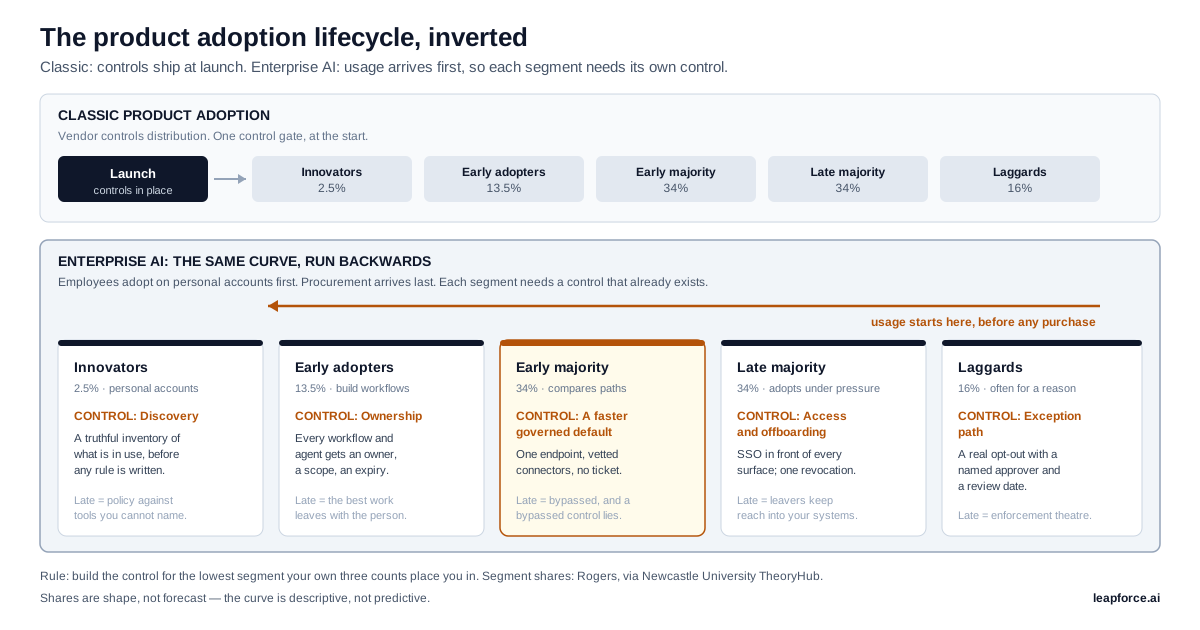
The classic lifecycle puts controls at launch. Enterprise AI needs one control per segment, arriving before the segment does.
We should say up front what this article is and is not. We have not run a controlled adoption study inside a customer's estate and we are not going to pretend otherwise; every number below is attributed to a named, fetched public source, and the worked example in the middle is explicitly a constructed illustration built from those numbers, not a client story. What we bring is the design argument: a re-reading of a very old framework for a situation the framework was never built for.
What the product adoption lifecycle actually is
The product adoption lifecycle bundles two different models that get used interchangeably and should not be. One describes a single person deciding; the other describes a population deciding over time. Everett Rogers set both out in Diffusion of Innovations, and the version most marketing pages reproduce is the segment split: innovators 2.5 percent, early adopters 13.5 percent, early majority 34 percent, late majority 34 percent, laggards 16 percent, per Newcastle University's TheoryHub review.
The individual model is the one that gets dropped. Rogers called it the innovation-decision process, and TheoryHub lists its five phases as knowledge, persuasion, decision, implementation and confirmation, with the specific note that at confirmation a person "may reverse the decision, if exposed to conflicting messages about it." Adoption, in the original, was never a finish line. It was a state that could be lost.
Most commercial write-ups of the product adoption process replace those five phases with a funnel: awareness, interest, evaluation, trial, adoption. That funnel is fine as a marketing artefact and useless as a governance artefact, because it stops at the moment a user becomes regular. The two phases that matter most to a company deploying AI — implementation and confirmation — are exactly the two the funnel truncates.
| Model | Unit | Phases or segments | What it is good for |
|---|---|---|---|
| Innovation-decision process (Rogers) | One person | Knowledge, persuasion, decision, implementation, confirmation | Understanding why an individual keeps or abandons a tool |
| Adopter segments (Rogers) | A population | Innovators 2.5%, early adopters 13.5%, early majority 34%, late majority 34%, laggards 16% | Understanding who is arriving next and what they need |
| Commercial adoption funnel | One user account | Awareness, interest, evaluation, trial, adoption | Marketing and onboarding design |
| Stage-Matched Control (this article) | A company's AI estate | One control per adopter segment | Knowing which control must exist before the next wave lands |
Two limits on the segment percentages should be stated at the point of use, not buried. First, they come from a statistical convention, slicing a normal distribution at standard deviations — not from a count of any real product's users. Second, the curve is descriptive rather than predictive; Geoffrey Moore's later "chasm" argument exists precisely because the smooth bell shape does not hold for discontinuous technologies where adopters must change behaviour. Treat 2.5 / 13.5 / 34 / 34 / 16 as shape, never as a forecast, and never as a budget input.
Why enterprise AI runs the lifecycle backwards
In the classic product adoption lifecycle, distribution is controlled by the seller: the product ships, then innovators find it, then the curve fills in. Enterprise AI breaks that in one specific way. The product is available to every employee with a browser and a personal email address before any company decides to buy it. Usage precedes procurement. That single reversal changes what every downstream stage means.
The evidence for the inversion is now unusually direct. Verizon's 2026 Data Breach Investigations Report states that 67 percent of users are "using non-corporate accounts on their corporate devices to access AI services," and that 45 percent of employees "are now considered regular users of AI (authorized or not) on their corporate devices, up from 15% in the previous year." The same report puts shadow AI as the third most common non-malicious insider action in its data-loss-prevention dataset for 2025, a fourfold increase in share year over year, with source code the most commonly submitted data type.
Read those two numbers together and the inversion is arithmetic rather than rhetoric. Regular AI use on corporate devices tripled in a year. Two thirds of it runs through accounts the company does not own. The innovators and early adopters — Rogers' first 16 percent — did not wait for a launch. They finished their own adoption lifecycle on infrastructure the company cannot see, and they did it in the same year the company was still writing its AI policy.
There is a second-order effect that is easy to miss. In the classic curve, early adopters generate the social proof that pulls the early majority across. That still happens with AI. But the proof they generate is a personal workflow living in a personal chat history, which is not transferable, not reviewable, and disappears when the person leaves. This is the problem we examined in our earlier analysis of turning personal prompts into owned assets: the most valuable thing the early adopters built is also the least portable thing they built.
So the inversion produces three specific debts, and they compound in this order:
- A visibility debt. You do not know which tools are in use, so you cannot scope a policy to them.
- An ownership debt. The workflows that work belong to individuals, not the company, so they cannot be reviewed, improved or inherited.
- A proof debt. When a regulator, customer or auditor asks what your AI did with their data, the record sits in accounts you have no access to.
None of these is a model-quality problem, and none of them is solved by choosing a better vendor. They are all consequences of a control arriving after the segment it was supposed to govern.
The adoption number nobody can agree on, and why it matters
Before you can place a control against a segment, you need to know which segment you are actually in. This is where most AI adoption planning quietly falls apart, because "AI adoption" is not one measurement — it is at least three, and they disagree by a factor of four.
A Federal Reserve FEDS Note published 3 April 2026 compares three high-quality surveys and finds exactly that spread. The Census Bureau's firm-level Business Trends and Outlook Survey put adoption at "about 18 percent of firms at the end of 2025." The individual-level Real-Time Population Survey put work-related generative AI adoption at "about 41 percent of the workforce" in November 2025. The Atlanta Fed's Survey of Business Uncertainty, which targets senior executives, "estimates that 78 percent of the labor force works at firms that have adopted AI." The note's own explanation of the gap is the important sentence: "The biggest driver of variation in these estimates likely relates to differences in sampling distributions and units of analysis."
| Survey | Unit of analysis | Reported AI adoption | What the number is actually good for |
|---|---|---|---|
| BTOS (Census Bureau) | Firms, firm-weighted | ~18% of firms, end of 2025 | The share of US businesses that have adopted AI |
| RPS | Individuals | ~41% of the workforce use GenAI at work, Nov 2025 | The share of workers personally using GenAI |
| SBU (Atlanta Fed) | Firms, employment-weighted | ~78% of the labour force at adopting firms; ~54% at firms using LLMs | An upper bound on workplace access to AI tools |
| McKinsey Global Survey | Organizations, self-reported by respondents | 88% report regular use in at least one function | Executive perception of organizational use |
The McKinsey row belongs in the same table because it is the number most often quoted in board decks. Its State of AI survey published 5 November 2025 reports that "88 percent report regular AI use in at least one business function, compared with 78 percent a year ago", while "approximately one-third" have begun to scale, and only 39 percent attribute any level of EBIT impact, "most of those respondents say that less than 5 percent."
Here is the practical consequence, and it is the reason this section exists rather than being a footnote. The segment you are in depends entirely on which unit you count. Count firms and your industry looks early: innovators and early adopters territory, where a discovery-first posture is right. Count individual workers and you are already deep into the early majority, where the governing question is whether the sanctioned path is fast enough. Count employment-weighted access and you are at the late majority, where the question is offboarding and evidence.
Most companies pick the number that flatters the story they already want to tell. The disciplined move is to measure your own estate on all three units: how many teams have adopted, how many individuals are using it weekly, and what share of headcount has access to a sanctioned tool, and let the lowest of the three set the control you build next. The lowest number is the one describing your governance reality.
One honest note on sourcing: census.gov blocked automated fetching from this machine (HTTP 403 on both a normal request and a browser-agent request), so the BTOS figures here are taken from the Federal Reserve's published analysis of that survey rather than from the Census release directly. Iso.org returned 403 as well, so ISO/IEC 42001 is named below from AWS's compliance FAQ rather than the standard's own page.
Stage-Matched Control: one control per adopter segment
Stage-Matched Control is the rule this article is built to deliver, and it fits in one line: for each adopter segment, name the single control that must exist before that segment arrives, and build it in that order. Not a control programme. Not a maturity model. One control, one segment, sequenced by who shows up next.
The reason to sequence it this way rather than building a governance platform up front is that the segments have genuinely different failure modes. What the innovators need governed is not what the late majority needs governed, and a control built for the wrong segment is expensive and ignored. The map below is the artefact. Five rows, and the only thing you have to do is find your row and build the control in it.
| Adopter segment | Share (Rogers) | What they actually do with AI | The control that must already exist | The failure if it arrives late |
|---|---|---|---|---|
| Innovators | 2.5% | Sign up personally, paste real work into unvetted tools, chase every new model | Discovery: a truthful inventory of what is in use, before any rule | You write policy against tools you cannot name, and it binds nobody |
| Early adopters | 13.5% | Build repeatable workflows that genuinely work, share them informally | Ownership: every workflow and agent has a named owner, a defined scope, an expiry | The company's best AI work is personal property and leaves with the person |
| Early majority | 34% | Adopt only if the approved route is at least as fast as the unapproved one | A governed default that is faster: one endpoint, pre-vetted connectors, no ticket per use | The sanctioned tool is bypassed; adoption looks flat while shadow use grows |
| Late majority | 34% | Adopt under peer or policy pressure, minimum effort, minimum learning | Access and offboarding: SSO in front of every AI surface, one-step revocation | Access sprawl; leavers keep reach; no way to answer "who could touch this?" |
| Laggards | 16% | Hold out, often for a defensible reason | A documented exception path: a real opt-out with a named approver and a review date | Enforcement theatre; a permanent grey zone nobody will admit to |
Three things about this map are worth stating explicitly, because they are where it differs from a normal governance roadmap.
It is ordered by arrival, not by risk. A discovery capability is not the highest-risk control in the list; access revocation is. But discovery has to come first, because every later control needs an inventory to bind to. Building revocation before discovery gives you the ability to revoke access to systems you have not enumerated.
Each row's control is a precondition, not a phase gate. You do not finish discovery and move on. Discovery runs forever; it simply has to start before the innovator wave, and by definition it already did not, which is why nearly every company begins this at row one no matter how mature it believes it is. A common objection here is that a discovery exercise produces a list of tool names that is stale within a month, which is true and is why the deliverable should be a repeatable count rather than a snapshot inventory: three numbers you can regenerate on demand decay far more slowly than a list of forty product names.
The early-majority row is the only one where speed is the control. The other four rows describe things that must exist. That row describes a comparison: the governed route must beat the ungoverned route on time-to-first-answer. This is the row where most enterprise AI programmes fail, and it gets its own section below.
For the ownership row specifically, the shape of the control is not a spreadsheet of tool names. It is a record per non-human actor — owner, scope, expiry — which is the structure we set out in our earlier analysis of non-human identity for AI agents. An agent without an owner is not a governance gap you can close later with reporting; it is a gap you can only close by re-deriving who built it, which gets harder every month.
The five product adoption stages, re-read as a records problem
Now take the individual model — the one the commercial funnel truncates — and apply it to one employee adopting one AI tool. Rogers' five phases map onto a company's obligations far better than awareness-to-adoption does, because two of the five are about what happens after the person commits.
| Rogers phase | What the employee is doing | What the company must be able to show afterwards |
|---|---|---|
| Knowledge | Hears the tool exists, tries it once | Which tool, on which account, from which device |
| Persuasion | Forms an opinion, usually from a colleague | Nothing yet, but this is where the sanctioned option must be visible |
| Decision | Starts using it for real work | Whether the data class involved was permitted |
| Implementation | Builds it into a routine or a workflow | Who owns the resulting workflow, and what it can reach |
| Confirmation | Keeps using it, or reverses under conflicting information | A trace of what ran, what was refused, and what it cost |
The confirmation phase is the one worth dwelling on. Rogers' framing, that a decision can reverse when the person meets conflicting messages, describes precisely what happens when an employee's AI workflow produces one bad output on something that mattered. Without a trace, that reversal is invisible to the company and unrecoverable: the person quietly stops, the productivity gain evaporates, and no one learns why. With a trace, it is a defect report.
This is also the honest answer to the question "what should we log?" You log at implementation and confirmation, because those are the two phases that produce durable company consequences. Logging at knowledge and persuasion is surveillance with no governance payoff, and it will cost you the trust of exactly the innovators whose behaviour you most need to see. Our earlier work on audit trails that prove agent actions covers the shape of that record in more depth.
The real chasm is a speed chasm
Moore's chasm — the gap between early adopters and the early majority, is usually described as a credibility problem: the pragmatic majority does not trust the enthusiasts. For enterprise AI, that is not what stalls the curve. The early majority already believes AI works; they have watched a colleague do in four minutes what used to take an afternoon. What stops them adopting the sanctioned tool is that the sanctioned tool is slower than the tab they already have open.
The Hacker News thread that produced this article's problem card is a clean illustration. It sat under a July 2026 report that Microsoft 365 Copilot paid adoption remained under 4.5 percent, based on a leaked internal memo. We flag that figure as second-hand: it is a press account of a leaked internal memo, not an audited disclosure, so treat it as directional at best. The commenter's diagnosis, however, does not depend on the number. Their complaint was about reach and friction: the tool could not see into the non-Microsoft systems where the work actually lived, and anything useful required admin-level approval. Their prediction was that staff would bring their own tools instead.
That is the shape of the early-majority failure, and it explains an otherwise puzzling pair of statistics. McKinsey finds 88 percent of organizations regularly using AI in at least one function, but only about a third scaling and 39 percent seeing any EBIT effect. Verizon finds regular AI use on corporate devices tripling to 45 percent, two thirds of it on non-corporate accounts. Both can be true simultaneously, and they are describing the same company: adoption is high, sanctioned adoption is low, and the difference is friction.
The design conclusion is uncomfortable for governance teams but hard to escape. At the early-majority row, a control that adds latency is a control that will be bypassed, and a bypassed control is worse than none. It produces a false record. The only governance design that survives contact with this segment is one where the governed path is the fastest path: a single endpoint that already knows who you are, connectors IT vetted once rather than per-request, and approval gates only on the actions that genuinely need them. We wrote about why pilots die at exactly this transition in our analysis of pilot-to-production stalls.
Our own rollout guidance for the AI Gateway is built on the same ordering — Observe first. Enforce second. Optimize third. Observation before enforcement is not a courtesy to employees; it is the only sequence in which the enforcement you eventually write is aimed at the tools people actually use. Enforcing first produces a rule set written against an imagined estate, which is the fastest way to teach a workforce that the approved path is theatre.
A worked example: 900 people, twelve months
The following is a constructed illustration, not a client engagement. Every input is a public figure cited above; the arithmetic is ours and it is deliberately simple so you can substitute your own headcount. We are showing it because an abstract map is hard to act on and because the shape of the numbers, not their precision, is the point.
Take a 900-person professional-services firm. Apply the Real-Time Population Survey's ~41 percent work-related GenAI figure and roughly 370 people are using generative AI for work in some form. Apply the DBIR's 67 percent non-corporate-account share to those users and roughly 248 of them are doing it through accounts the company does not control. The firm has one sanctioned assistant, bought nine months ago, with 120 licences assigned and, applying the 20-to-30-percent weekly-usage range from the same second-hand report flagged above, so treat it as illustrative, perhaps 25 to 35 people opening it in a given week.
| Measure | Count | Share of 900 | Which segment this puts the firm in |
|---|---|---|---|
| People using GenAI for work at all | ~370 | 41% | Well past the early majority |
| Using it on non-corporate accounts | ~248 | 28% | Ownership and proof debt, both large |
| Sanctioned licences assigned | 120 | 13% | Roughly the early-adopter share |
| Sanctioned tool used weekly | ~30 | 3% | Innovator territory |
Read down the right-hand column and the firm is in four different segments at once depending on which row you believe. That is not a measurement error. It is the actual condition, and it is what the Stage-Matched Control map is for: the lowest row governs the control you build next.
By the rule, this firm's next control is not an expanded licence pool and not a new policy document. It is discovery, because the 248-person gap between real usage and sanctioned usage is invisible, and every subsequent control would be scoped against the wrong estate. In the twelve-month sequence below, note how little of the work is procurement.
| Month | Control being built | Concrete deliverable | Segment it unblocks |
|---|---|---|---|
| 1–2 | Discovery | A truthful list of AI tools, accounts and data classes actually in use, gathered without disciplinary consequence | Innovators |
| 3–4 | Ownership | Every workflow that more than one person depends on gets a named owner, a written scope, an expiry date | Early adopters |
| 5–8 | Governed default | One endpoint, SSO-backed, with the ten most-used connectors pre-vetted; measured against the ungoverned path on time-to-first-answer | Early majority |
| 9–10 | Access and offboarding | Every AI surface behind SSO; a single revocation action that covers human and non-human identities | Late majority |
| 11–12 | Exception path | A documented opt-out with a named approver and a review date, plus the evidence pack that proves the rest | Laggards |
Two deliberate features of that sequence. Discovery is granted amnesty. If the inventory step carries disciplinary risk, it returns fiction, and a fictional inventory is worse than no inventory because it looks authoritative. And the governed-default phase carries an explicit measurement, not just a launch: if the sanctioned path is slower than the personal tab at month eight, the phase has not finished regardless of what the project plan says.
What this example does not show, and cannot, is cost. We have no defensible per-seat or per-programme figure to publish here, and the wide variance in what companies count as an "AI programme" means anything we invented would mislead more than it helped. The FAQ below says what the cost drivers are without putting a number on them.
What Stage-Matched Control is not
Being clear about the boundaries of a framework is more useful than extending it, so here are four things this one explicitly is not.
It is not a maturity model. Maturity models score you on every dimension at once and produce a radar chart. Stage-Matched Control deliberately produces a single next action, because the failure it is designed against is companies building five controls badly instead of one control well.
It is not a ban policy. Nothing in the map tells you to prohibit a tool. Prohibition is available at any row, and at the laggard row an explicit exception path is a control in its own right. But a ban issued before the discovery row is a rule written against an unknown estate, which is the definition of unenforceable.
It is not a replacement for a risk framework. NIST's AI Risk Management Framework, released 26 January 2023, organizes AI risk work into Govern, Map, Measure and Manage. ISO/IEC 42001 specifies "requirements for establishing, implementing, maintaining, and continually improving an Artificial Intelligence Management System." Both tell you what good looks like. Neither tells you what to build first when 248 of your 900 people are already on personal accounts. Stage-Matched Control is a sequencing heuristic that sits inside those frameworks, not beside them.
It is not a prediction. The segment shares are shape, not forecast, for the reasons given at the top. If your organization's real distribution is 5 percent innovators and no meaningful laggard population, use your distribution. The map's value is the pairing of control to segment, not the percentages attached to it.
Run the inversion audit in one sitting
This is the part you can do today, without a vendor, in about ninety minutes with two people. It produces one output: which row of the map you are on.
- Count three ways. Get (a) the number of teams that have adopted AI for any recurring task, (b) the number of individuals who used a generative tool for work in the last seven days, and (c) the number of employees who have access to a sanctioned AI surface. Do not reconcile them. The disagreement between them is the finding.
- Divide by headcount and place each on the curve. Use Rogers' shares as a ruler: under 2.5 percent is innovator territory, up to 16 percent is early-adopter, up to 50 percent is early majority, and so on. You will get three different placements. That is expected.
- Take the lowest placement. That row of the Stage-Matched Control map names your next control. The higher numbers describe what your people are already doing; the lowest describes what your governance can actually account for.
- Test the ownership question on five artefacts. Pick five AI workflows more than one person relies on. For each, write down the named owner, the systems it can reach, and its expiry date. If you cannot complete a row without asking someone, you are on the ownership row regardless of what step 3 said.
- Time the two paths. Have one person answer a real, ordinary work question through the sanctioned tool and another answer it through whatever they would normally use. Record wall-clock time from question to usable answer; this is your time to first value, measured rather than asserted. Do this on five ordinary questions rather than one, because a single pair of timings is an anecdote and the variance between question types is large. If the sanctioned path is slower on the median of five, the early-majority row is open no matter how mature the rest of the programme looks.
- Write the exception down. Identify one team that has a legitimate reason not to adopt. Name the approver and set a review date. A framework with no documented opt-out will acquire an undocumented one.
The output is a single sentence: "We are on the [row] row; our next control is [control]; we will know it worked when [measure]." If your audit produces a programme plan instead of that sentence, it has failed in the specific way this framework exists to prevent.
Where this is still uncertain
Several things in this article are weaker than they read, and it is more useful to name them than to hedge every paragraph.
The segment percentages are a convention, not a measurement. They come from slicing a normal distribution, and no one has demonstrated that enterprise AI adoption inside a single company follows that distribution at all. The pairing of control to segment survives if the shares are wrong; the arithmetic in the worked example does not.
We have no first-hand adoption study. We have not run this audit inside a customer estate and published the result. Route (d) under our own evidence rules: no first-hand test, stated plainly. The framework is a design argument supported by public data, and it should be read as one until someone — including us — publishes a measured before-and-after.
The survey numbers measure different things and none of them measure your company. The Federal Reserve note makes this point about its own sources: the biggest driver of variation is the unit of analysis. A four-fold spread between credible national surveys should make you distrust any single external benchmark applied to your own estate, including the ones in this article.
The Copilot adoption figure is second-hand. It comes from press reporting of a leaked memo rather than an audited disclosure, and we have not independently verified it against the vendor's own reported figures. We used it as an illustration of a pattern the DBIR and McKinsey data support independently, and the argument does not rest on it.
Regulatory timing is moving. The EU AI Act implementation timeline records 2 August 2026 as the point where the remainder of the Act starts to apply except Article 6(1), with Article 6(1) following on 2 August 2027. Reporting through 2026 indicates that a simplification package has pushed several high-risk obligations later still, and we have not resolved the final position. If your control sequencing is driven by a compliance date, verify the current date directly rather than trusting any article, including this one.
Where the framework may simply be wrong: in a company that has genuinely never had ungoverned AI use — a defence contractor on an air-gapped estate, say — the lifecycle is not inverted, the classic sequence holds, and building discovery first would be wasted work. The inversion premise is empirical. Check it before you accept the conclusion.
Where LeapForce fits
The honest bridge is narrow. LeapForce does not sell product-adoption software, onboarding analytics, or anything that will improve your customers' activation rate. The marketing side of this topic is not our layer. What we build is the layer the map's middle three rows describe: one governed endpoint that every tool, model and agent goes through, SSO and non-human identity so every agent has an owner, a scope and an expiry, and tracing and action audit that records what was refused as well as what ran. Our per-capability build status is disclosed as live, in development or roadmap rather than presented uniformly, so if you are evaluating us against the ownership or proof rows, ask which is which before you plan around it.
Frequently asked questions
Not quite, and the difference matters. "Product adoption process" usually refers to the stages one person moves through, while the product adoption lifecycle more often refers to the market-wide sequence of adopter segments. Rogers described both: a five-phase innovation-decision process for individuals and a five-segment distribution for populations. Mixing them produces plans that treat a market-level statistic as if it described a single user's behaviour.
There is no defensible single answer, and the honest framing is that the two halves run on different clocks. Individual adoption of a generative tool can complete in a week. The Real-Time Population Survey recorded work-related generative AI use reaching about 41 percent of the US workforce by November 2025. Organizational adoption is far slower: McKinsey's November 2025 survey found only about a third of organizations had begun to scale, three years after the technology became widely available. Plan for the gap, not for an average.
A ban issued before you have a truthful inventory is unenforceable, and enforcing an unenforceable rule teaches people to route around governance permanently. The sequence that works is discovery first, then a sanctioned path that is genuinely faster, then enforcement against a named estate. Prohibition is a legitimate tool at the laggard and exception rows; it is a poor first move at the innovator row, where the thing you most need is truthful information about what is in use.
Three counts, kept deliberately unreconciled: teams that have adopted AI for a recurring task, individuals who used a generative tool for work in the last seven days, and employees with access to a sanctioned surface. Divide each by headcount and place it on the adoption curve. You will get three different segments; take the lowest, because it is the one your governance can actually account for. The gap between the highest and lowest is a direct measure of your visibility debt.
Whoever can both see the estate and change the default path: in practice a named individual in IT or platform engineering with a security counterpart, not a committee. The failure mode of committee ownership is that discovery gets delegated to a survey, and surveys of AI use return the answer people think is safe to give. If ownership sits with a group that cannot change the sanctioned tool's latency, the early-majority row can never be closed.
Yes, with two changes. The segment percentages become useless at that size, since 2.5 percent of 60 people is one and a half people — so use raw counts instead of shares. And the ownership row usually collapses into the discovery row, because at that headcount everyone already knows who built which workflow; what they lack is the written scope and the expiry date. The early-majority speed test is unchanged and remains the highest-value hour you can spend.
We do not publish a figure, because the honest answer depends on decisions you have not made yet and any number we invented would mislead. The cost drivers, in rough order of size, are: the engineering time to put a single governed endpoint in front of existing tools, the licence cost of the sanctioned surface at full rather than pilot headcount, the connector-vetting effort for the systems your work actually lives in, and the ongoing cost of retention for whatever audit records your regulators require. Discovery, the first control, is usually the cheapest thing on that list and it is where the sequence starts. We will not quote a payback figure either. The nearest defensible framing is McKinsey's finding that 88 percent of organizations use AI regularly while only about a third have begun to scale and 39 percent see any EBIT effect. That gap tells you unsequenced spend has a poor record, but not what your own return will be.
It is smaller and it sits inside them. NIST's AI Risk Management Framework, released 26 January 2023, organizes risk work into Govern, Map, Measure and Manage; ISO/IEC 42001 specifies requirements for an AI management system. Both describe a complete target state. Stage-Matched Control answers a narrower question those frameworks leave open: given that adoption already happened without you, which single control do you build next. Use it to sequence the work, then use the frameworks to check the work is complete.
Because the early majority compares paths rather than evaluating a product. They already believe AI works; they watched a colleague prove it. What they will not do is accept a slower route to the same answer. If the sanctioned tool needs an approval ticket per connection, cannot reach the systems the work lives in, or takes longer to first useful answer than the browser tab already open, the segment routes around it, and the adoption chart goes flat while shadow usage keeps climbing. The fix is latency and reach, not change management.
Only if you have genuinely never had ungoverned AI use, which is now rare. Verizon's 2026 DBIR reports 45 percent of employees as regular AI users on corporate devices, with 67 percent of that going through non-corporate accounts. If you already have an innovator population, a controlled pilot does not skip the stage; it runs a second, parallel adoption lifecycle alongside the one that already happened, and the two do not merge on their own. Do the discovery first, then the pilot inherits a real estate to govern.
The curve is about who decides to adopt, and for agents that decision-maker is still a person. But the number of adopting entities can grow far faster than headcount, because one employee can stand up many agents. McKinsey found 62 percent of organizations at least experimenting with AI agents but no more than 10 percent scaling them in any given function. The practical consequence is that the ownership row stops being a nice-to-have: an agent with no named owner, defined scope and expiry date is an adopter you cannot count, revoke or explain.
Yes, and buying often makes the inversion worse rather than better. Purchasing a sanctioned tool changes what is available; it does not remove what employees adopted first. The three debts the inversion creates — visibility, ownership and proof — all survive a procurement decision intact, because they are properties of the estate rather than of the contract. A purchase closes the early-majority row only if the thing you bought is faster than what people are already using.
Ready to Govern Your AI?
Talk to LeapForce — one controlled layer for every AI tool, connector, model, and agent.
Comments