
AgentGPT pricing in July 2026 is $0 for the free tier, $40 a month for Pro, and "Custom" for Enterprise. Those three numbers are still live and still take payment. The software behind them stopped changing in April 2025, and the repository was archived by its owner on January 28, 2026.
Our position is that AgentGPT pricing is not a tiers question at all. It is a continuity question, and continuity is the one line no pricing page has a row for. A price only means something if somebody is still on the other end of it: patching the stack, renewing the model access, answering the support address, and honouring the refund. When that stops, the sticker does not move. Everything underneath it does. A GitHub user filed the whole problem as an issue title in March 2025. See athuljayaram, reworkd/AgentGPT issue #1659, still open, three words long: "is this project abandoned?" Two commenters arrived to ask the same thing and nobody from the project ever answered.
The short answer: Price AgentGPT as a Continuity Bill — sticker, model clock, maintenance, support, exit — because the $40 sticker is the only one of those five lines the vendor is still quoting, and it is the smallest.
Last updated: July 31, 2026.
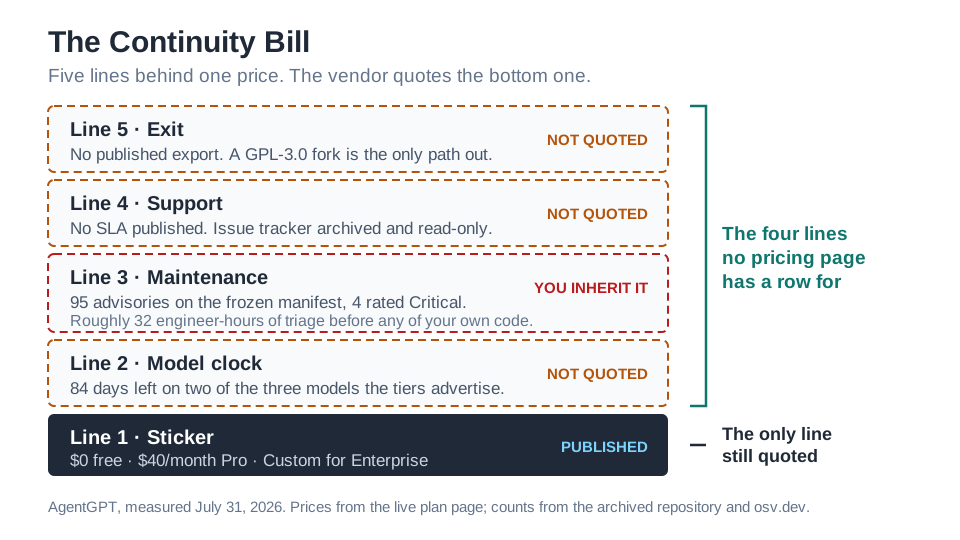
The Continuity Bill. The vendor quotes the bottom line. You inherit the four above it.
We ran this check ourselves rather than describing it. On July 31, 2026 we fetched the live AgentGPT plan page, the archived repository and both dependency manifests, and queried the OSV vulnerability database for every pinned direct dependency in them. We also probed the hosted app's own surfaces, and all of them answered: the dashboard, the plan page and the templates page each returned HTTP 200 in under half a second. The product is up. Every count below is that query's output, and every price is quoted from a page fetched the same day. We did not buy a Pro subscription, so nothing here describes the paid product from the inside, and that gap is stated again in the limits section.
AgentGPT pricing in July 2026: every published number
AgentGPT publishes three tiers and one price. Fetched from the AgentGPT plan page on July 31, 2026, the ladder is Free Trial at $0/month, PRO at $40/month, and Enterprise at "Custom / month". There is no annual discount, no seat tier, no usage meter, and no published overage rate. For a category where per-run and per-task metering is now the norm, that is unusually simple. It is also, as the rest of this article argues, unusually uninformative.
| Tier | Published price | Daily run cap | Model access | Governance features |
|---|---|---|---|---|
| Free Trial | $0/month | 5 demo agents a day | GPT-3.5-Turbo | None published |
| PRO | $40/month | 30 agents a day | GPT-3.5-Turbo 16k, GPT-4 access | Priority support |
| Enterprise | Custom | Not published | Not published | SAML single sign-on, dedicated account manager |
The Pro tier's full published feature list is: 30 agents per day, GPT-3.5-Turbo 16k access, GPT-4 access, 25 loops per agent, unlimited web search capabilities, access to the latest AgentGPT plugins, and priority support. Enterprise is described as "Everything in the Pro plan" plus "Features based on enterprise requirements", SAML single sign-on, and a dedicated account manager.
Three observations before we price anything.
The cap is a rate limit, not a meter. Thirty agents a day is a ceiling, not an allowance you draw down. You cannot bank yesterday's unused runs, and you cannot buy the thirty-first. That makes AgentGPT pricing genuinely predictable in a way most agent platforms are not: there is no overage line to model, because there is no overage.
A loop is the unit that actually matters. Each agent is capped at 25 loops, which is the number of reasoning cycles the agent gets before it stops. A task that needs 40 loops does not cost more; it fails. The plan page's own FAQ carries a question titled "How do I bypass the 25 loops?", which tells you how often people hit it.
SSO sits behind a sales call. Single sign-on is the only identity control published anywhere on the page, and it is Enterprise-only, priced by conversation. That is the standard shape across this market, and we costed the same pattern in our earlier analysis of Flowise's license boundary, where the identity layer also sat on the paid side of a line. What is different here is that the sales call may no longer connect to anyone.
The five dates that reprice all three tiers
Every discussion of AgentGPT pricing we have read treats the tier table as the input. Five verifiable dates sit between the price you can see and the product you would receive. Taken together they say the same thing: the pricing page is the last surface of AgentGPT that anyone is still maintaining, and it is being maintained by not being touched.
| Date | Event | Source |
|---|---|---|
| April 7, 2023 | Repository created | GitHub API, created_at |
| November 2, 2023 | Last tagged release, v.1.0.0 | GitHub releases API |
| February 6, 2025 | Reworkd announces it is sunsetting its product | reworkd.ai homepage banner |
| April 29, 2025 | Last commit pushed to main | GitHub API, pushed_at |
| January 28, 2026 | Repository archived by the owner, now read-only | GitHub repository banner |
The vendor's own homepage is the blunt one. As of July 31, 2026, reworkd.ai still opens with a banner reading: "We'll be sunsetting the product on February 6, 2025. If you have any questions or need support with migration, please reach out to Srijan@reworkd.ai". That notice is about Reworkd's web-data-extraction product rather than AgentGPT specifically, and we want to be precise about the distinction. But the same small company operated both, and just under twelve months after that sunset date the AgentGPT repository went read-only.
The repository state is not ambiguous. GitHub's API reports archived: true, and the banner on the page reads "This repository was archived by the owner on Jan 28, 2026. It is now read-only." Frozen alongside it: 132 open issues and 87 open pull requests, none of which can now be merged, closed or discussed. Thirty-six thousand stars and nine thousand forks point at a project that cannot accept a patch.
None of this is hidden. It is simply on a different website from the price. A buyer who reads the plan page and nothing else in July 2026 sees a $40/month product with priority support. A buyer who spends four minutes on GitHub sees a product that has not shipped a release in thirty-three months.
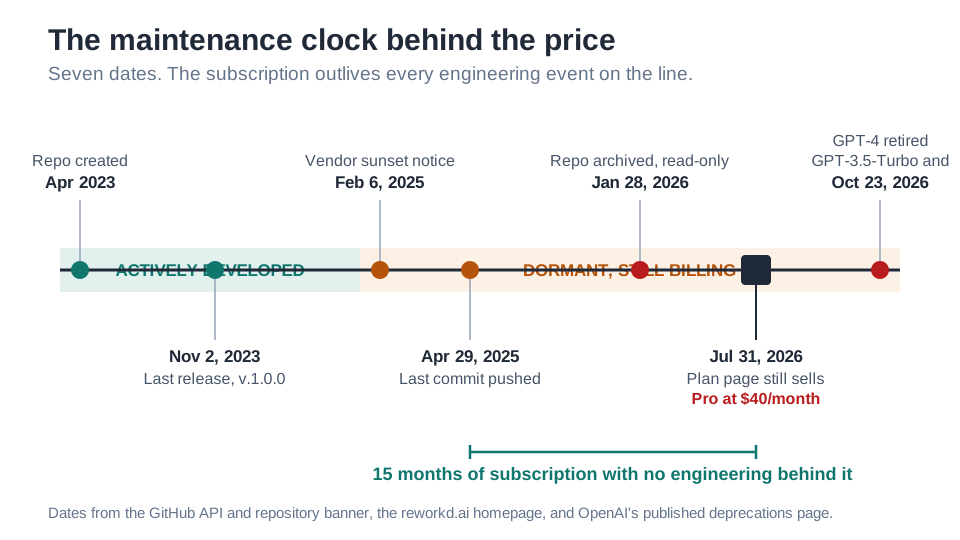
The gap between the last engineering event and the still-live subscription is fifteen months and counting.
The Continuity Bill: five lines to price when a vendor stops
Here is the method behind our AgentGPT pricing analysis, and it generalises well past this one product. When you evaluate any AI tool whose vendor may have stopped, price five lines rather than one. We call it the Continuity Bill, and the point of naming it is that four of the five lines are invisible on every pricing page in this category.
| Line | The question it answers | Who quotes it | AgentGPT status, July 31 2026 |
|---|---|---|---|
| 1. Sticker | What does the vendor charge? | The vendor | Published: $0 / $40 / Custom |
| 2. Model clock | How long do the models in the feature list survive? | The model provider | 84 days on two of them |
| 3. Maintenance | Who patches the stack, and at what labour cost? | Nobody — you inherit it | 95 advisories on the frozen manifest |
| 4. Support | Who answers, and against what SLA? | The vendor, in principle | No published SLA; archived issue tracker |
| 5. Exit | What does leaving cost in migration and data? | Nobody | No published export; self-host is the only path |
Work them in that order, because each one reprices the one above it. A $40 sticker is cheap until line two says the paid features expire in eighty-four days. Line three is zero until you decide to self-host, at which point it becomes the largest number on the page. Line five is the one that quietly decides whether lines one through four were ever worth paying.
The Continuity Bill is not an anti-open-source argument, and it is not specific to small vendors. It is the arithmetic that turns a maintenance status into a currency figure, which is the only form in which a procurement conversation can actually use it. The OWASP Top 10 Risks for Open Source Software already names the underlying hazards precisely. OSS-RISK-4, Unmaintained Software, is defined as a component that "may not be actively developed any more, thus, patches for functional and non-functional bugs may not be provided in a timely fashion (or not at all)". OSS-RISK-5 is Outdated Software. What OWASP does not do, because it is a risk taxonomy rather than a budget, is tell you what those two risks cost per month. That is the gap the Continuity Bill fills.
Line one: the sticker, in every unit you might search for
The published Pro price is $40 a month. Here it is in the other units buyers actually search for, all derived by arithmetic from that single published figure.
| Unit | Free Trial | PRO | Provenance |
|---|---|---|---|
| Per month | $0 | $40.00 | Published |
| Per year | $0 | $480.00 | Derived: $40 × 12 |
| Per day | $0 | $1.32 | Derived: $480 ÷ 365 |
| Runs available per year | 1,825 | 10,950 | Derived from the published daily caps |
| Cost per run at the cap | $0 | $0.044 | Derived: $480 ÷ 10,950 |
| Cost per run at 10 a day | $0 | $0.13 | Derived: $480 ÷ 3,650 |
| Cost per run at 2 a day | $0 | $0.66 | Derived: $480 ÷ 730 |
That last block is the slice that matters, because the effective cost of AgentGPT pricing moves fifteen-fold on nothing but your own habits. At the published ceiling of thirty agents a day, every day, Pro is 4.4 cents a run, genuinely cheap for an agent platform. At the two-runs-a-day rate that describes most people who buy a tool like this, it is 66 cents a run. Nothing on the invoice changes. Only the denominator does.
There is a second slice worth running, by team size. AgentGPT publishes no team or seat tier, so a team buys Pro repeatedly.
| Buyers | Monthly | Annual | What you do not get by buying more copies |
|---|---|---|---|
| 1 | $40 | $480 | — |
| 5 | $200 | $2,400 | No shared workspace, no shared billing, no admin view |
| 20 | $800 | $9,600 | No SSO, no central offboarding, no per-user audit trail |
The reason a $480 line deserves this much scrutiny is not the $480. It is what gets built on top of it in the twelve months before anyone looks again. Twenty individually-purchased Pro accounts is a $9,600 annual line with no administrative surface at all: no way to see who is running what, no way to revoke access when someone leaves, and twenty separate credit-card relationships. The tier that fixes this is Enterprise, and Enterprise pricing is a conversation. This is the ordinary shape of the governance cliff in this market, and we have costed it in detail elsewhere; what makes it acute here is the state of the counterparty.
Line two: the model clock, and the 84 days left on it
The single most concrete thing wrong with AgentGPT pricing today is that its paid feature list sells access to models that OpenAI has already scheduled for retirement. Per OpenAI's model deprecations page, gpt-3.5-turbo and gpt-4 both have a shutdown date of October 23, 2026, and gpt-3.5-turbo-16k was shut down on September 13, 2024.
Line those against the Pro feature list.
| Pro feature, as published | Model status | Shutdown date | Days remaining from July 31, 2026 |
|---|---|---|---|
| "GPT-3.5-Turbo 16k access" | Already retired | September 13, 2024 | −686 |
| "GPT-4 access" | Scheduled for retirement | October 23, 2026 | 84 |
| Free tier: "GPT-3.5-Turbo" | Scheduled for retirement | October 23, 2026 | 84 |
Two of the seven bullets in the Pro feature list refer to a model retired nearly two years ago. The other model bullet, and the free tier's only model, both stop being available in eighty-four days. A maintained product would have updated that page a dozen times by now; the model landscape has turned over completely since it was written. An unmaintained product cannot, because updating a model name in the pricing copy is the easy half. The hard half is the code that calls the model, and that code is in a read-only repository.
There is corroborating evidence in the app itself. The plan page's help copy still tells users that a personal key without GPT-4 access must "first join OpenAI's wait-list", a mechanism OpenAI retired in 2023. The pricing surface is a preserved snapshot of a 2023 product, still charging 2023 prices, still describing a 2023 access model.
This is why the model clock deserves its own line on the Continuity Bill rather than a footnote. In an ordinary SaaS purchase, the supplier absorbs model churn: providers retire endpoints, the vendor migrates, your feature keeps working, your price stays flat. That absorption is a large part of what a subscription buys in this category. When the vendor stops, the model provider's deprecation calendar becomes your deprecation calendar, and you find out on the day. Our earlier analysis of how model routing cuts LLM costs makes the same point from the optimisation side: the ability to change which model serves a task is worth money, and a frozen client has none of it.
Line three: maintenance, measured against the frozen manifest
The maintenance line is the one that turns AgentGPT pricing from a subscription question into a staffing question. If you self-host the archived repository, which, as line five explains, is the only continuity option AgentGPT actually gives you, you inherit its dependency tree. We measured what that tree currently carries.
Method, so you can reproduce it: pull platform/pyproject.toml and next/package.json from the archived main branch, resolve each pin to the newest version its constraint still permits (so this is the best case, not the shipped lockfile), and query OSV for each. Results as of July 31, 2026:
| Direct dependency | Pinned constraint | Best-case version | Known advisories | Highest severity |
|---|---|---|---|---|
next | ^13.5.6 | 13.5.11 | 29 | High |
langchain | ^0.0.295 | 0.0.295 | 23 | Critical |
axios | ^0.26.0 | 0.26.1 | 23 | High |
cryptography | ^41.0.4 | 41.0.7 | 12 | High |
next-auth | 4.20.1 | 4.20.1 | 5 | Critical |
requests | ^2.31.0 | latest 2.x | 2 | Moderate |
fastapi | ^0.98.0 | 0.98.0 | 1 | Unrated |
openai | ^0.28.0 | 0.28.1 | 0 | — |
pydantic | <2.0 | 1.10.x | 0 | — |
sqlalchemy | ^2.0.21 | 2.0.21 | 0 | — |
@prisma/client | ^4.9.0 | 4.9.0 | 0 | — |
stripe (Python) | ^5.5.0 | 5.5.0 | 0 | — |
Ninety-five advisories across seven of the twelve direct dependencies we checked, including four rated Critical: three in langchain 0.0.295 (arbitrary code execution via CVE-2023-36281, CVE-2023-39631 and CVE-2023-39659) and one in next-auth 4.20.1. That count excludes transitive dependencies entirely, so it is a floor rather than a total.
Two of those pins are structural rather than incidental. openai = "^0.28.0" is the pre-1.0 Python client, superseded in November 2023 by a rewritten SDK; pydantic = "<2.0" blocks the entire Pydantic 2 ecosystem. Those two constraints together mean the platform cannot be dragged forward by a routine dependency bump. Somebody has to port it.
Now price it. At a deliberately conservative twenty minutes per advisory to read, assess reachability and decide whether it applies to your deployment, ninety-five advisories is about thirty-two engineer-hours of triage before anyone writes a line of your own code. That is an estimate built on a stated assumption, not a measurement, and your number will differ. But it is the right order of magnitude, and it is the number that belongs in the budget next to $480.
The wider pattern is well documented. The Linux Foundation's Census III study, built from over 12 million observations of open-source libraries across more than ten thousand companies, lists "Legacy software persists in the open source space" among its headline findings and warns that when "the supplier is effectively one anonymous GitHub user account, the cybersecurity and software hygiene decisions of those individuals could introduce unexpected business risks". AgentGPT is a better-resourced case than that. It was a funded, Y-Combinator-backed team, which is precisely the point. Funding is not continuity either.
For a longer treatment of the risk taxonomy behind this line, this LASCON conference talk walks the full OWASP Top 10 open-source risk list, including the unmaintained and outdated categories that AgentGPT now sits in:

Line four: priority support, and what it was worth when someone was home
"Priority support" is one of the seven things the Pro tier sells, and it is the only line in AgentGPT pricing that is entirely people-shaped. AgentGPT publishes no response-time commitment, no support hours, no escalation path and no service credit for a missed target. The only published channel is an email address, support@reworkd.ai, listed at the bottom of the plan page.
There is public evidence of what that channel delivered while the company was still operating. In March 2024, a paying user opened issue #1506 on the repository, titled "Refund Request", because email had not worked. Their description: "I have already sent 4 emails regarding my refund request". A Reworkd maintainer replied the same day from an @reworkd.ai address, apologised for the miss and offered to sort it out directly, which is a genuinely good outcome. But note the mechanism that produced it: the user had to escalate publicly on GitHub, in a bug tracker, to get a billing response.
That escalation route no longer exists. The issue tracker is read-only. You cannot open #1507.
| Support surface | Status, July 31 2026 |
|---|---|
| Published SLA or response target | None |
support@reworkd.ai | Listed; response behaviour unknown to us |
| GitHub issues | Archived, read-only, cannot open a new issue |
| GitHub pull requests | Archived; 87 open PRs permanently unmergeable |
| Discord / community | Linked from the app; activity not assessed here |
We want to be careful and fair here: we did not email the support address, so we cannot tell you whether it answers today. What we can tell you is what a procurement reviewer is entitled to ask for and cannot get: a written response target, a named escalation contact, and evidence of recent tickets closed. On a $480 annual line that gap is survivable. On the Enterprise tier, where a "dedicated account manager" is one of the three published differentiators, it is the whole product.
Line five: the exit, and why GPL-3.0 is the only continuity you own
The exit line asks the question no AgentGPT pricing page answers: if this stops tomorrow, what does it cost to get your work out and running somewhere else? For AgentGPT the answer has an unusual shape, and it is genuinely the best news in this article.
The hosted product publishes no data export, no API for retrieving your agent definitions, and no documented migration path. What it does have is a complete, permissively-published source tree. AgentGPT is licensed GPL-3.0, and archiving a repository does not revoke a licence already granted. Every line of the frontend, the FastAPI platform and the Docker composition is yours to fork, run and modify in perpetuity.
That is a real asset and it should be scored as one. Compare it with the alternative failure mode in this market, where a hosted-only vendor goes quiet and takes your workflow definitions with it. Here, the worst case is that you take over maintenance of software you can read.
Two conditions attach, and both belong in the exit line rather than the maintenance line.
GPL-3.0 is a copyleft licence, and that is a policy question before it is a cost question. If you modify AgentGPT and distribute the result, the licence obliges you to release your modifications under the same terms. For internal deployment that obligation generally does not trigger; for anything you ship to customers it very much does. Route that past legal before it becomes an engineering decision. Many organisations have a standing policy on GPL-3.0 in production, and it is usually easier to discover the policy than to reverse a build.
A fork is a hiring decision. Owning the fork means owning the thirty-two hours of advisory triage from line three, plus the SDK port that the openai < 0.29 and pydantic < 2 pins imply, plus everything after. That is not a one-off cost; it is a standing one, and it recurs every time an upstream dependency you depend on cuts a security release.
| Exit scenario | One-off cost | Standing cost | What you keep |
|---|---|---|---|
| Cancel and walk away | $0 | $0 | Nothing; no published export |
| Fork and self-host | Advisory triage plus SDK port | Hosting plus ongoing patching | Everything, in perpetuity, under GPL-3.0 |
| Migrate to a maintained platform | Rebuild the agents on new primitives | New vendor's subscription | Your prompts and your process knowledge |
What the free repository actually bills you to run
Self-hosting is free the way a puppy is free. Here is the actual monthly bill, built only from published prices fetched on July 31, 2026, for the architecture the repository's own docker-compose.yml describes: a Next.js frontend, a FastAPI platform, and MySQL 8.0.
| Component | Minimum viable | Production-shaped | Source |
|---|---|---|---|
| Application host | $24.00 — 4 GB / 2 vCPU droplet | $48.00 — 8 GB / 4 vCPU droplet | DigitalOcean droplet pricing |
| Database | $15.15 — managed MySQL, 1 GiB / 1 vCPU | $30.30 — same with a standby node | DigitalOcean managed database pricing |
| Infrastructure subtotal | $39.15/month | $78.30/month | Derived |
| Annual | $469.80 | $939.60 | Derived |
| OpenAI API usage | Your key, your invoice | Your key, your invoice | Not public: depends entirely on volume |
| SerpAPI (web search) | Your key | Your key | Required by REWORKD_PLATFORM_SERP_API_KEY |
| Replicate (image steps) | Your key | Your key | Required by REWORKD_PLATFORM_REPLICATE_API_KEY |
| Maintenance labour | ~32 hours of triage to start | Recurring | Estimated, method above |
Look at the subtotal line. The minimum viable self-hosted deployment costs $39.15 a month against a $40 Pro subscription. Eighty-five cents cheaper, before a single token, before the search and image API keys, and before any of the thirty-two hours. The free option and the paid option are priced within a rounding error of each other, and the free one comes with a job attached.
That symmetry is the most useful single number in this article, because it collapses the "free vs pro plan" question that most AgentGPT pricing comparisons spend their whole length on. The two options are not cheap-versus-expensive. They are identical in cost and opposite in obligation: one gives you a running service and no control, the other gives you total control and a maintenance rota.
Three keys also deserve a note of their own. Self-hosting AgentGPT means putting your own OpenAI, SerpAPI and Replicate credentials into a .env file on a server. Those are bearer credentials with no per-agent scoping, no spend cap and no attribution: whatever the agent spends appears on your invoice as one undifferentiated line, and any agent that runs can spend it. That is a governance problem well before it is a cost problem, and it is the same one we described in our analysis of non-human identity, owner, scope and expiry for AI agents.
The six dormancy signals: a check you can run in one sitting
Everything above generalises. The AgentGPT pricing exercise is just the worked example. Before you subscribe to any AI tool built on an open-source project, run these six checks. They took us under twenty minutes for AgentGPT, and they are all free.
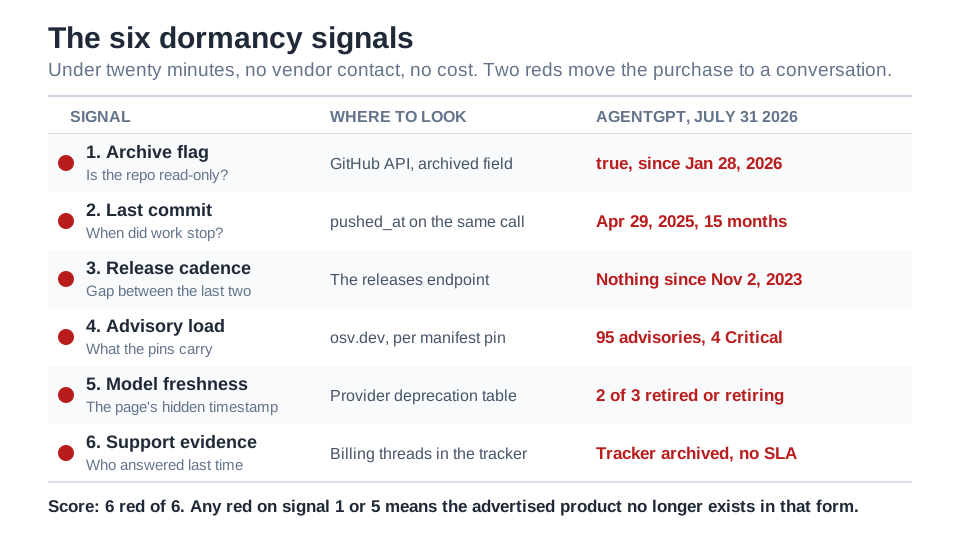
Six signals, one sitting. Any two reds should move the purchase to a conversation.
| # | Signal | How to check it | AgentGPT result |
|---|---|---|---|
| 1 | Archive flag | `curl -s https://api.github.com/repos/OWNER/REPO \ | grep archived` |
| 2 | Last commit | The pushed_at field on the same API response | April 29, 2025 — 15 months ago |
| 3 | Release cadence | /releases on the API; look at the gap between the last two | Last release November 2, 2023 |
| 4 | Advisory load | Resolve the manifest pins, query osv.dev for each | 95 advisories, 4 Critical |
| 5 | Model freshness | Compare model names on the pricing page against the provider's deprecation table | 2 of 3 named models retired or retiring |
| 6 | Support evidence | Search the issue tracker for billing and support threads and read the replies | Refund escalated publicly; tracker now read-only |
At renewal the six signals become one instruction: re-run them, and if any answer has gone red since you last bought, do not auto-renew until somebody has costed lines two through five. The scoring rule we use is deliberately blunt: any two red signals move the purchase from a card swipe to a conversation, and any red on signal 1 or 5 means the price on the page is describing a product that no longer exists in the form advertised. AgentGPT is red on all six.
Signal 5 is the one people skip and the one that pays for the exercise. Model names in a feature list are dated artefacts. They are effectively a timestamp the vendor cannot avoid publishing. A pricing page still advertising GPT-3.5-Turbo in mid-2026 has told you when it was last edited without meaning to. We built the same instinct into the vendor questions in our earlier piece on AI vendor security assessment; the model-name check is the cheapest question on any such list because you can answer it without the vendor's help.
The costed hybrid: keep the sandbox, move the work
The honest recommendation coming out of this AgentGPT pricing analysis is not "avoid AgentGPT". It is a split, and it costs less than either pure option. Use the free tier as a scratchpad for the thing it is still genuinely good at, which is showing a non-technical colleague what a goal-decomposing agent loop looks like, in a browser, in ninety seconds. Put anything that touches company data on a maintained stack.
| Approach | Monthly | Annual | Continuity exposure |
|---|---|---|---|
| AgentGPT Pro, five people | $200 | $2,400 | Full: all five Continuity Bill lines |
| Self-hosted fork, production-shaped | $78.30 plus tokens and labour | $939.60 plus tokens and labour | Maintenance and exit lines, permanently |
| Hybrid: free tier for demos, maintained platform for work | $0 for the demo half | $0 for the demo half | None on the demo half |
The hybrid works because the free tier's five demo agents a day is a genuinely adequate allowance for its remaining honest use case. Nobody demonstrates an agent concept six times a day. You are not paying $480 a year for capability; at two runs a day you are paying 66 cents a run for a rate limit you were never going to hit.
What replaces the paid half is a decision this article deliberately does not make for you, because a single-vendor cost analysis is the wrong place to run a market comparison. We have written that comparison separately, in the best AI gateways for enterprise governance in 2026 and in our survey of AI automation platforms. Whatever you pick, price it with the same five lines. The Continuity Bill is not an AgentGPT test.
One caution on the hybrid. "Free tier for demos" is exactly the sentence that produces shadow AI six months later, because demos become prototypes and prototypes become things a customer relies on. If you adopt the split, write down the boundary. No company data, no customer-facing output, no credential in the settings tab. Then make it somebody's job to check.
When paying a dormant vendor is still the right call
It would be dishonest to run an AgentGPT pricing analysis this sceptical and then conclude that a $40 subscription to an archived project is always wrong. There are cases where it is fine, and they share a shape: short horizon, low stakes, no data.
You need it for weeks, not years. If a consultant needs an agent sandbox for a four-week engagement, the Continuity Bill's lines two through five never come due. $40 once is cheaper than any evaluation process you could run.
The output is disposable. Ideation, first drafts, exploratory search summaries. Work where the agent's output is reviewed by a human and then discarded. The model clock does not matter if you would have thrown the result away anyway.
You are learning the pattern, not shipping the product. AgentGPT's browser-based agent loop remains one of the clearest demonstrations of goal decomposition available, which is a large part of why it earned 36,000 stars. Learning from it costs nothing and expires nothing.
Nothing sensitive goes in. No customer records, no source code, no credentials beyond a scoped, rate-limited, separately-billed API key you can revoke in one click.
Against that, the cases where it is clearly wrong: anything a customer sees, anything on a compliance boundary, anything you would have to explain to an auditor, anything with a renewal date more than a quarter out, and anything where the answer to "who patches this" is currently nobody. Those are not exotic conditions. They describe most business use.
Where a governance layer helps, and where it does not
The pattern underneath this whole article is not really about AgentGPT pricing. It is that a tool's price and a tool's continuity are published on different websites, and only one of them shows up on the invoice. That is the layer LeapForce works on: one controlled path for every AI tool, connector, model and agent, so that spend, access and activity are attributable to a person and a purpose rather than to a credit card and a .env file.
Two of the five Continuity Bill lines get materially cheaper with a gateway in front of the tools. The model clock stops being a per-application emergency when the application talks to one governed endpoint and the routing decision lives there. Our AI Gateway is built around that, and its published rollout guide is deliberately incremental: Observe first. Enforce second. Optimize third. You point one team's traffic at the gateway in observe mode, learn which tools, models and prompts are actually in use and what they cost, and only then write rules. And the credential problem from the self-hosting section, three bearer keys in a file spending money nobody can attribute, is exactly what identity-scoped, per-agent access is for.
To be plain about the limit: LeapForce does not maintain anyone else's abandoned repository, does not extend a retired model's life, and will not get you a refund from a dormant vendor. Lines three, four and five of the Continuity Bill stay yours. What a governance layer changes is that you find out a tool has gone dormant from your own telemetry rather than from a failed customer demo.
Honest limits on this analysis
Several things here are weaker than they look, and you should know which.
We did not buy Pro. Everything we say about AgentGPT pricing above the free tier comes from the published plan page. We cannot tell you whether the Subscribe button still completes a charge, whether GPT-4 access still functions, or how quickly support@reworkd.ai replies today. A reader with $40 and ten minutes can establish all three, and that reader would know more than we do about the thing that matters most.
The advisory count is a ceiling on relevance, not a measure of exploitability. Ninety-five advisories against the pinned dependency set does not mean ninety-five exploitable paths in AgentGPT. Most will be unreachable in this application's code paths. The number's honest use is comparative. It is what a security review would put on the table, and it is a great deal larger than a maintained project's equivalent.
The thirty-two-hour triage figure is arithmetic, not observation. It is ninety-five advisories at twenty minutes each. We did not run the triage. Treat it as a starting assumption to argue with rather than a benchmark.
The Reworkd sunset banner is about a different product. Reworkd's homepage announces the sunsetting of its web-data-extraction product, not AgentGPT by name. We have not found a public statement that AgentGPT itself is discontinued, and we are not asserting one. The repository archive is the direct evidence; the banner is context.
Hosting prices are one provider's list prices. DigitalOcean's published rates are a reasonable mid-market benchmark, but a team already inside AWS, GCP or Azure will get a different subtotal, and reserved or committed-use pricing changes it again.
Prices move and archives sometimes reopen. Every figure here was fetched on July 31, 2026. If you are reading this later, re-run the six signals before you trust a single number in it. That is the point of the check.
Frequently asked questions
AgentGPT costs $0 for the Free Trial tier and $40 a month for PRO, with Enterprise quoted as "Custom", per the plan page fetched July 31, 2026. There is no annual discount and no usage-based overage. $40 a month works out to $480 a year, or about 4.4 cents per agent run if you use the full published allowance of 30 agents per day.
Yes, in two senses. The hosted free tier gives you five demo agents a day on GPT-3.5-Turbo with limited plugin and web-search access. Separately, the entire source code is published under GPL-3.0 and can be self-hosted. Neither is free of running costs: the hosted tier is capped, and self-hosting bills you for infrastructure, model tokens and maintenance.
No. GitHub's API reports the repository as archived and read-only since January 28, 2026, with the last commit pushed on April 29, 2025 and the last tagged release, v.1.0.0, published on November 2, 2023. A March 2025 issue asking "is this project abandoned?" remains open and unanswered by the project. The hosted service and its paid tiers are still live.
For a short, disposable, non-sensitive use, whether a demo, a sandbox or a four-week engagement, $40 is a defensible spend and the tool still does what it always did. For anything with a renewal date, a customer-facing output, or a compliance boundary, no: you would be buying a subscription whose paid feature list names models that OpenAI retires on October 23, 2026, from a project that cannot ship a fix.
The free vs pro plan gap is a rate limit and a model list, not a feature architecture. Free gives 5 demo agents a day on GPT-3.5-Turbo with limited plugins and limited web search. Pro gives 30 agents a day, 25 loops per agent, GPT-3.5-Turbo 16k and GPT-4 access, unlimited web search, the latest plugins, and priority support. Neither tier publishes any identity, audit or spend control; those are Enterprise-only.
Not for the hosted tiers, but supplying one changes the economics. AgentGPT's own help copy states that using your own key means you "pay for your own OpenAI usage" while gaining "greater access", including the ability to select any model OpenAI offers. If you self-host, a key is mandatory. The deployment reads it from REWORKD_PLATFORM_OPENAI_API_KEY, along with separate SerpAPI and Replicate keys.
Nobody has said, which is the answer. OpenAI's deprecation page schedules gpt-3.5-turbo and gpt-4 for shutdown on October 23, 2026, which is 84 days after this article's fetch date. In a maintained product the vendor migrates the backend and you notice nothing. Here, the code that calls those models sits in a read-only repository. Assume the paid feature list's model bullets stop being accurate on that date and plan accordingly.
Using DigitalOcean's published July 2026 rates, a minimum-viable deployment of the composition in the repository is $39.15 a month, being a $24.00 4 GB droplet plus a $15.15 managed MySQL instance, or $469.80 a year. A production-shaped version with a larger host and a database standby is $78.30 a month. On top of that sit your own OpenAI, SerpAPI and Replicate usage, and roughly 32 hours of initial security triage against the frozen dependency manifest.
The plan page's FAQ carries "How can I cancel my subscription?" and "Can I please get a refund?" entries and lists support@reworkd.ai as the contact. The historical escalation route, opening an issue on the GitHub repository, which is how one user got a stalled refund resolved in March 2024 after four unanswered emails, no longer exists, because the tracker is archived. If you subscribe, keep the card-issuer chargeback window in mind as your only enforced backstop.
AgentGPT enterprise pricing is published only as "Custom". The three differentiators listed are everything in Pro, "features based on enterprise requirements", SAML single sign-on, and a dedicated account manager. Two of those four are people-dependent, which makes the tier the hardest one to value against an archived repository: you are buying a relationship rather than a rate, and the relationship is the part we could not verify.
Run six checks: the repository's archive flag, its last commit date, the gap between its last two releases, the advisory count across its pinned dependencies via osv.dev, whether the model names on the pricing page are still current with the model provider's deprecation table, and what the issue tracker shows about support and billing responses. It takes under twenty minutes and costs nothing. Two reds should move the purchase from a card swipe to a conversation.
It can be, but only if you accept that you are now the maintainer. Archiving does not revoke the licence you already have, so the code is yours to fork and run indefinitely. What archiving removes is upstream patching. The OWASP Top 10 Risks for Open Source Software calls this OSS-RISK-4, Unmaintained Software. Budget the security triage, confirm your organisation's GPL-3.0 policy for anything you distribute, and make ownership of the fork somebody's named responsibility rather than an assumption.
Ready to Govern Your AI?
Talk to LeapForce — one controlled layer for every AI tool, connector, model, and agent.
Comments