
AI agents for marketing are software workers that hold their own credentials to your marketing stack and act inside it without a person clicking each step. That last clause is the whole story. A marketing agent is not a smarter content generator; it is an account holder in your CMS, your CRM, your email platform, and your ad accounts.
Our position is that the useful question is not which marketing tasks to hand an agent. It is which of three keys you are handing it: Voice (write access to what the brand says in public), List (read and write access to customer records), and Wallet (the ability to move a number that costs money). Those three keys have different caps, different scoping controls, and wildly different reversal costs, and the marketing use-case lists that dominate this topic treat them as one undifferentiated bucket called "automation." A brand lead at a large CPG company described the gap precisely on Hacker News in December 2025 after running agents across a real product launch: "No single agent had ownership of correctness after launch" (deliass, Ask HN, December 15, 2025). That is not a description of hallucination. It is a description of a permissions and ownership problem that no prompt fixes.
The short answer: Before you scope an AI agent for marketing by task, scope it by key — Voice, List, or Wallet — and for each key set a platform-enforced cap, a credential narrower than any human's, and a reversal path the agent cannot block.
Last updated: July 31, 2026.
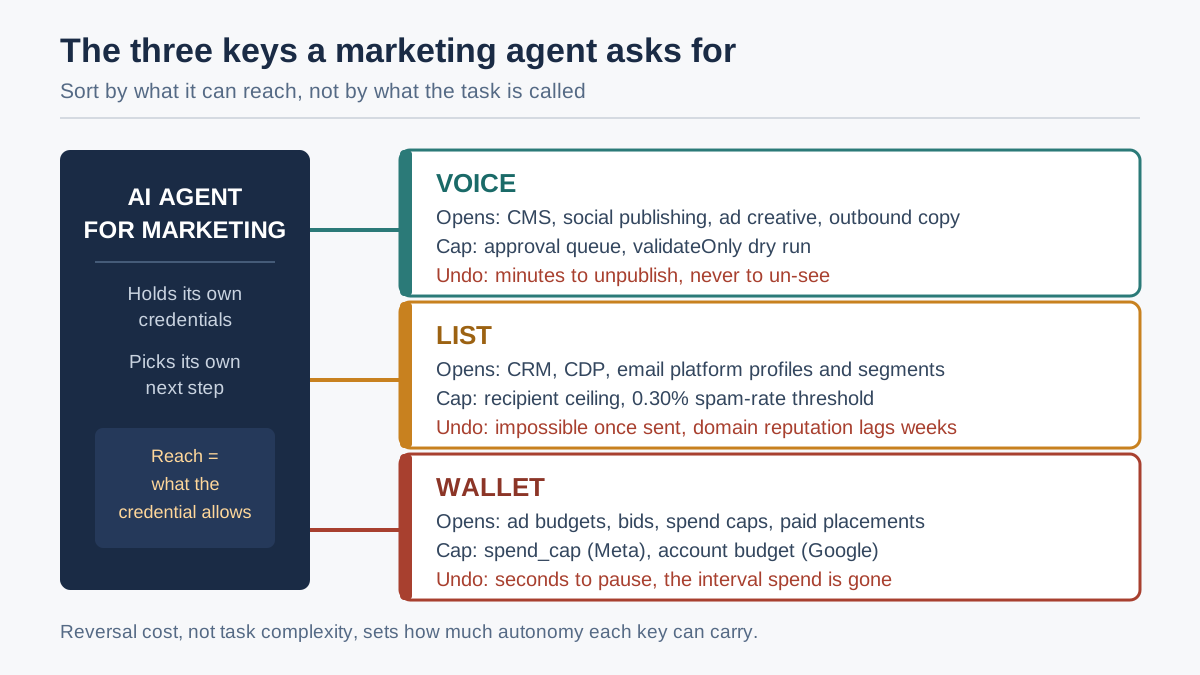
Every marketing agent asks for at least one of three keys. Each one has a different cap, a different scoping control, and a different undo cost.
We have not run an autonomous agent against a live brand's ad account or customer list ourselves, and we are not going to pretend otherwise. What follows is built from two things you can check: the permission and budget documentation each platform publishes, every page of it fetched on July 31, 2026 and linked at the claim it supports; and arithmetic applied to the multipliers those platforms publish. Where a number is derived rather than published, it says so.
What an AI agent for marketing actually is
An AI agent for marketing is a system that receives a goal, decides its own sequence of steps, calls marketing tools through their APIs using credentials it holds, and continues until the goal is met or a limit stops it. The distinction that matters operationally is not intelligence. It is that a rules-based workflow can only do what a human wired into it, while an agent chooses which tool to call, which means the set of things it might touch is the set of things its credential allows, not the set of things you imagined.
That is a sharper line than "adaptive versus static." If someone builds a branch that sends a discount email on cart abandonment, the branch sends that email and nothing else. Give an agent the same goal, "recover abandoned carts", plus a write-scoped email API key, and the reachable action set is every endpoint that key unlocks. Creating a new list. Editing a template. Launching a campaign to a segment nobody reviewed. None of that requires the model to misbehave, only to be resourceful inside a credential that was scoped generously.
Here is the same distinction in a table, because the difference shows up as a governance property rather than a feature:
| Property | Rules-based marketing automation | AI agent for marketing |
|---|---|---|
| What determines the next step | A branch a person drew | The model's own plan at runtime |
| Reachable actions | Only the nodes in the flow | Every endpoint the credential allows |
| Failure mode | The flow does the wrong right thing | The agent does a right thing you never listed |
| What you audit | The flow definition | The action log, after the fact |
| What limits it | The flow's own logic | The platform's caps and the credential's scope |
What a marketing agent is not. It is not a replacement for a marketing operations person, because someone still has to own the outcome — the CPG brand lead quoted above found the gap was ownership of correctness, not throughput. It is not a compliance control; an agent that writes disclosure text is not a policy that requires disclosure. It is not a way to skip martech consolidation, since an agent inherits the mess it is pointed at. And it is not one kind of thing: an agent that drafts blog outlines and an agent that raises bids share a budget line and almost nothing else.
Adoption is real but earlier than the category's volume suggests. Salesforce's Tenth Edition State of Marketing report, based on 4,450 responses from marketing decision makers gathered between October 8 and November 17, 2025, found that 78% of marketers need more personalized content than they can produce, 75% are turning to AI to close that gap, and 98% hit barriers to personalization, most often data issues (Salesforce, State of Marketing, 2026). Teams are adding agents on top of data access they already describe as incomplete.
The three keys: Voice, List, and Wallet
Sort AI agents for marketing by which keys they hold, and the governance work becomes finite. Voice is write access to anything a customer or the public can see: the blog, social accounts, ad creative, landing pages, outbound email copy. List is access to customer records: the CRM, the customer data platform, the email service provider's profile store. Wallet is the ability to change a number that causes money to leave: bids, budgets, spend caps, paid placements.
Most published marketing use cases are one or two keys wearing a task name. An "SEO content agent" is Voice. A "lifecycle email agent" is Voice plus List. A "PPC optimization agent" is Wallet, and often Voice too, because ad copy is public. A "reporting agent" is ideally none of them. Read-only, which is exactly why it should be the first one you deploy.
| Key | What it opens | Typical marketing agents | Worst realistic day |
|---|---|---|---|
| Voice | CMS, social publishing, ad creative, outbound copy | SEO content, social scheduling, ad copy generation | A false or off-claim statement is public and indexed before anyone reads it |
| List | CRM, CDP, ESP profile and segment stores | Lifecycle email, lead scoring, segmentation, enrichment | A send to the wrong segment, or customer data leaving the boundary it was collected under |
| Wallet | Ad platform budgets, bids, spend caps | Bid management, budget pacing, campaign launch | A budget field edit multiplies monthly exposure while everyone is asleep |
The keys are not equally reversible, and that is the point of separating them. A wrong bid can be reverted in a minute and costs whatever was spent in the interval. A wrong email to 40,000 customers cannot be recalled at all. A wrong published claim can be deleted in a minute and screenshotted in ten seconds. Reversal cost, not task complexity, is what should decide how much autonomy each agent gets — an argument we developed for business workflows generally in our earlier analysis of the delegation ceiling. This piece narrows it to the marketing stack, where the caps and scopes are concrete and published.
Key one: Voice, and the brand's public record
The Voice key is the one marketing teams hand over first and think about least, because drafting feels harmless. It stops being harmless at the moment the agent holds the credential that publishes rather than the credential that drafts, and in most marketing platforms those two are the same credential.
Google Ads is the cleanest illustration, because its access model is published and short. There are five user access levels: Email-only, Billing, Read-only, Standard, and Admin. Read-only can "view campaigns and use planning tools" and run reports. Standard can "edit campaigns." Admin can "give account access, change access levels, and cancel invitations from other users" (Google Ads Help, access levels, fetched July 31, 2026). Notice what is missing. There is no level that means "may write ad copy but may not change a budget." If your agent needs to create an ad, it needs Standard, and Standard also edits budgets. The role model cannot express the separation the risk model requires.
There is a real control that closes part of that gap, and almost nobody uses it. The Google Ads API supports a validateOnly flag on mutate requests. Google's own sample describes it as a way "to check a responsive search ad for errors without actually creating it," and the sample notes that validation errors, "specifically policy violations, which are returned as PolicyFindingError", come back without anything being created: "No objects will be created in the given customer account, but exceptions will still be thrown" (Google Ads API, validate ad sample, fetched July 31, 2026). That is a dry run against Google's real policy engine. An agent architecture that runs every creative through validateOnly, surfaces the result to a human, and only then issues the real mutate gets policy checking for free and keeps the publish decision with a person.
The disclosure obligation is now a control requirement
Two published rules turn Voice from a brand-reputation topic into a compliance one.
The EU AI Act's Article 50 requires that providers ensure synthetic audio, image, video, or text output is "marked in a machine-readable format and detectable as artificially generated or manipulated." For deployers, it requires disclosure when AI-generated text is "published with the purpose of informing the public on matters of public interest" — with a carve-out that matters enormously for marketing operations. The obligation does not apply where the content has "undergone a process of human review or editorial control and where a natural or legal person holds editorial responsibility" (EU AI Act, Article 50, fetched July 31, 2026). In other words, the regulation itself treats a named human reviewer as the alternative to a labelling obligation. An approval gate is not overhead you bolt on afterward; it is one of the two compliant paths the text offers.
Separately, the FTC has already stated its position on AI-assisted marketing claims. Announcing Operation AI Comply on September 25, 2024, the agency brought five enforcement actions, and then-Chair Lina M. Khan said: "Using AI tools to trick, mislead, or defraud people is illegal... there is no AI exemption from the laws on the books" (FTC press release, September 25, 2024). Substantiation obligations do not thin out because a model wrote the sentence. If an agent generates a performance claim and it publishes, the company made that claim.
Brand safety practitioners are reaching the same conclusion from the media-buying side. In this short Beet.TV interview, Nico Greco of Channel Factory argues that brand-safety frameworks built for human creators do not survive contact with AI-generated content at machine speed:

The Voice control set that actually exists
You have four real levers, and only four:
- Split the credential. Give the drafting agent an account that writes to a staging destination: a CMS draft state, a scheduling tool's unapproved queue, an ads
validateOnlypath — and keep the publishing credential with a person. Where the platform cannot express the split, the staging destination has to be a separate system. - Gate on the action, not the agent. Approve the publish event, not the agent's existence. The distinction is the whole subject of our analysis of when human approval is genuinely a control rather than a rubber stamp.
- Record the refusal, not just the send. A Voice log that only contains published items cannot answer "did the agent try to say something we blocked?" That question comes up in every incident review.
- Name the editorial owner. Article 50's human-review carve-out requires that a natural or legal person hold editorial responsibility. That is a name in a document, decided in advance, not a scramble after publication.
Key two: List, and the PII the agent inherits
Hand an agent the List key and it inherits your obligations along with your customer records. This is the key where least privilege is most achievable, because the major marketing platforms have built genuinely granular scopes. It is also the key where teams most often skip the work, because generating one broad API key takes ten seconds and reasoning about scope takes an afternoon.
HubSpot separates read from write per object. The scope crm.objects.contacts.read lets an app "view properties and other details about contacts," while crm.objects.contacts.write lets it "view properties and create, delete, and make changes to contacts" (HubSpot developer docs, scopes, fetched July 31, 2026). The same read/write split repeats across companies, deals, and the rest. An agent that scores leads needs the read scope and nothing else. It is a one-line decision that most teams never make, because the default instinct is to grant both and move on.
Klaviyo goes further and adds a constraint with real operational teeth. Private API keys are scopable per resource — campaigns:read, campaigns:write, lists:read, profiles:write, events:read, and so on across more than twenty endpoints, and a key can be created as Custom, Read-Only, or Full Access. Then comes the line that should change how you provision: "you cannot add a scope to an existing private key. You also cannot edit a private API key after it's been created" (Klaviyo developer docs, authentication, fetched July 31, 2026).
There is a sharper trap in the same scope list, and we only found it while checking the permission spec below. campaigns:write is the scope that lets an app create a campaign. It is also the scope Klaviyo requires on the campaign-send-jobs endpoint, documented as "Trigger a campaign to send asynchronously" with "Scopes: campaigns:write" (Klaviyo API reference, Send Campaign, fetched July 31, 2026). One scope, both actions. So a credential that lets an agent build a draft campaign also lets it send that campaign, and there is no narrower scope that separates the two. This is the same structural gap as Google Ads Standard access covering both creative and budget: the platform's permission vocabulary is coarser than the risk decision you need to make. When that happens, the only honest options are to withhold the write scope entirely and stage the draft somewhere else, or to accept that "may draft" means "may send" and gate the agent's whole run instead.
That scope immutability, back at the top of this section, is a gift disguised as a limitation. Because scope cannot be widened after issue, a key issued narrowly stays narrow for its whole life. The correct pattern falls straight out of it: every agent gets its own key, minted at the narrowest scope that lets it work, and a scope change means minting a new key and revoking the old one. What you must not do is issue one Full Access key, share it across three agents and a Zapier connection, and lose track of which one is doing what. Non-human identities need the same owner, scope, and expiry that human accounts get, which is the case we made in our earlier work on non-human identity.
The deliverability cap nobody sets
There is a hard, externally enforced ceiling on the List key that most marketing teams have never mapped to their agents. Google's bulk sender guidelines require senders of 5,000 or more messages per day to "keep spam rates reported in Postmaster Tools below 0.30%," to authenticate with SPF, DKIM, and DMARC, and to support one-click unsubscribe with both the List-Unsubscribe-Post: List-Unsubscribe=One-Click and List-Unsubscribe headers (Google, email sender guidelines, fetched July 31, 2026).
Do the arithmetic on that threshold. At 0.30%, a 50,000-recipient send can absorb 150 spam complaints before the sender is out of compliance. An agent with campaigns:write that decides a broader segment will lift open rates can cross that line in a single send, and the consequence lands on the sending domain, not on the campaign. Domain reputation recovers slowly and it degrades every other email the company sends, including transactional mail. This is the marketing agent failure that is genuinely hard to reverse, not because the action was irreversible, but because the damage accrues to a shared asset.
The obligations that travel with the record
GDPR's Article 5 sets out the principles that follow customer data wherever an agent takes it: purpose limitation, so data is "collected for specified, explicit and legitimate purposes and not further processed in a manner that is incompatible with those purposes"; data minimisation, so it is "adequate, relevant and limited to what is necessary"; integrity and confidentiality; and accountability, under which "the controller shall be responsible for, and be able to demonstrate compliance" (GDPR Article 5).
Two of those bite specifically on agents. Purpose limitation is strained when an agent pulls a customer list collected for order confirmations into a prospecting sequence because the goal it was given rewarded reach. And "demonstrate compliance" is an evidence requirement, not an intent requirement — it means being able to show, months later, which records an agent read and what it did with them. That is a logging design decision made before deployment, not a report you generate afterward. If the agent's model calls carry customer records in the prompt, masking PII at the point the request leaves your boundary is the control that keeps the record from spreading, which we cover in our analysis of inline data loss prevention at the gateway.
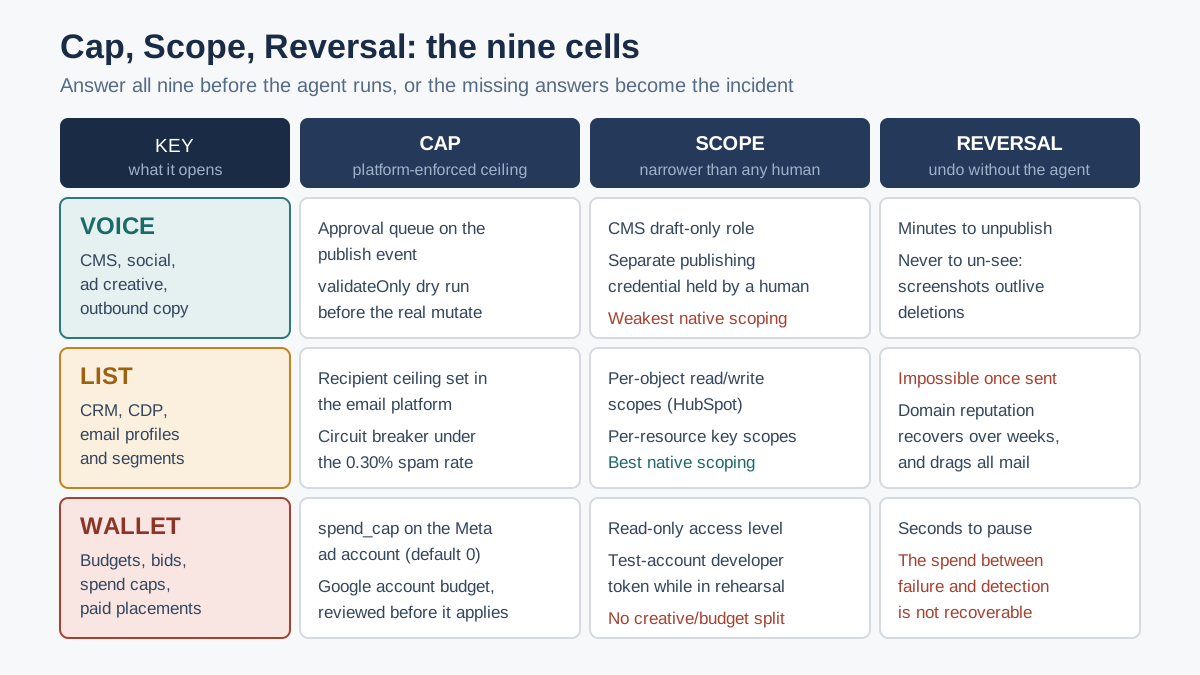
The nine cells. Every marketing agent deployment answers all nine, explicitly or by accident.
Key three: Wallet, and the one field that moves $9,120
Of the three keys AI agents for marketing ask for, Wallet is the only one where the loss is denominated in currency the moment the mistake happens, and it is the one where the platforms' published mechanics make the exposure calculable in advance. Here is the calculation, using only multipliers Google publishes.
Google enforces two spending limits above your campaign budget. The daily spending limit is "your average daily budget multiplied by 2," and the monthly limit multiplies "the average daily budget you set by the average number of days in a month, which is 30.4" (Google Ads Help, about spending limits, fetched July 31, 2026). So a campaign's real ceiling is not the number in the budget field. It is 2× that number on any one day and 30.4× that number across the month.
Now put an agent with Standard access on it. Standard access can edit campaigns, and the average daily budget is a campaign field.
| Average daily budget | Google's daily ceiling (2×) | Google's monthly ceiling (30.4×) |
|---|---|---|
| $200 | $400 | $6,080 |
| $350 | $700 | $10,640 |
| $500 | $1,000 | $15,200 |
| $1,000 | $2,000 | $30,400 |
An agent that raises one campaign's average daily budget from $200 to $500 has moved the monthly exposure on that campaign from $6,080 to $15,200. That is a $9,120 swing from one field edit, executed by a credential you provisioned, entirely within the platform's normal rules. Nothing malfunctioned. The multipliers are ours to compute from Google's published figures; the figures themselves are Google's.
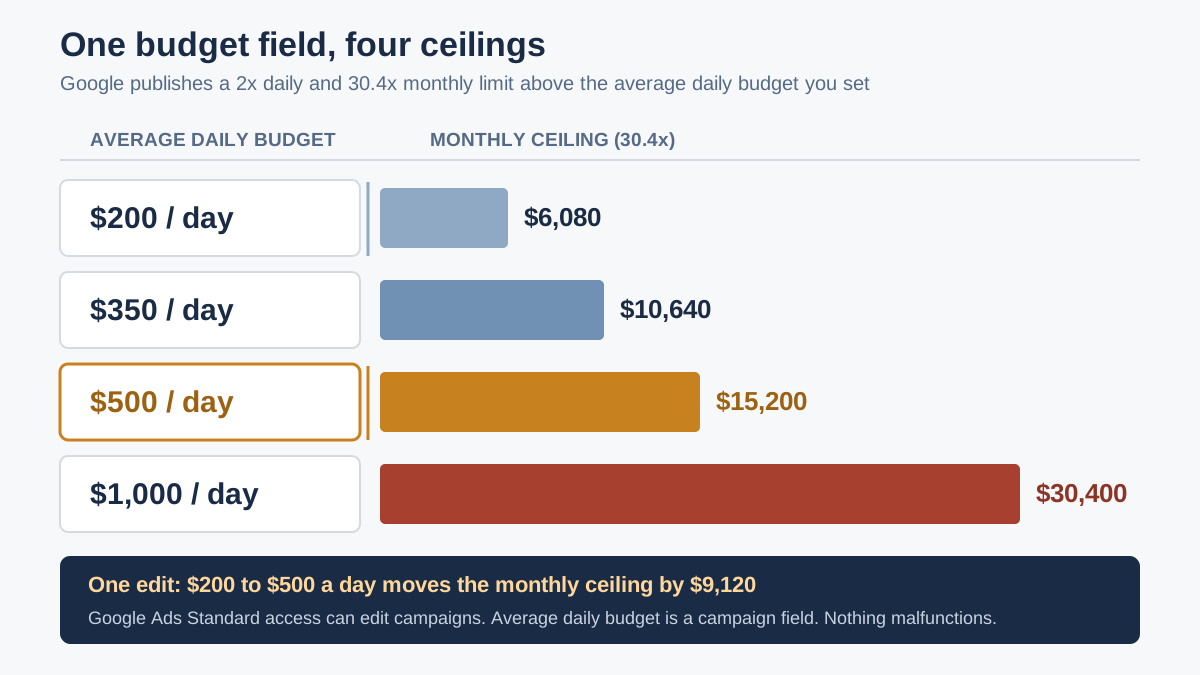
The ceiling is 30.4 times the field, not the field. An agent with Standard access can change the field.
Ad scheduling does not shrink that ceiling. Under "Budget pacing with Ad Scheduling," the same Google page states that "the system will pace to reach this full monthly limit regardless of how many days the campaign is scheduled to be active." So a campaign that runs three days a week still has a 30.4× monthly ceiling; the spend is concentrated into the active days rather than reduced. If your mental model was "we only run Tuesdays, so exposure is a fifth," it is not.
The caps that do exist, and their latency
Two account-level brakes exist, and both have properties worth knowing before you rely on them.
On Google, an account budget "controls what an account can spend over a specific period of time by defining budget properties like spend limit, start time, and end time." Changes go through AccountBudgetProposal objects, which "are reviewed by Google prior to being applied," with reviews "typically completed in less than one hour." Only one active account budget is allowed per customer (Google Ads API, account budgets, fetched July 31, 2026). Read that carefully: the account budget is a real cap, but tightening it is a proposal with review latency. It is a fence you build in advance, not a brake you slam in an emergency.
On Meta, the equivalent field is spend_cap on the ad account: "The maximum amount that can be spent by this Ad Account. When the amount is reached, all delivery stops. A value of 0 means no spending-cap" (Meta Marketing API, ad account reference, fetched July 31, 2026). The default state of that field on an uncapped account is the state where nothing stops delivery. If you deploy a Wallet agent against a Meta ad account and never set spend_cap, you have chosen no cap; you just did not experience it as a choice.
One more control lives at the developer-token layer and rarely gets used deliberately. Google Ads API developer tokens carry a graduated access level. The published table lists Test Account access, Explorer access allowing "2,880 operations / day for production accounts," Basic allowing 15,000 operations per day, and Standard allowing unlimited operations (Google Ads API, access levels, fetched July 31, 2026). An agent under development belongs on a test account. Running a new marketing agent's first two weeks against a test-account token is the cheapest rehearsal available, and it costs nothing but the setup.
The Cap, Scope, Reversal check
Three questions per key, nine answers, and they are the whole governance checklist for AI agents for marketing. If you cannot answer all nine for an agent before it runs, it is not ready, and the missing answers tell you exactly what to go build.
Cap — what is the platform-enforced ceiling that does not depend on the agent behaving well? A prompt instruction is not a cap. A cap is a number stored in the platform that the platform enforces whether or not your agent is functioning: spend_cap on a Meta ad account, a Google account budget, a send-volume limit in the ESP where it offers one, a publishing queue that requires approval. If the only thing between your agent and the worst case is a sentence in a system prompt, you have no cap.
Scope: is the credential strictly narrower than the human who issued it? Not "the same as," narrower. If the agent runs under the marketing ops manager's own key, then every incident review starts with disambiguating her actions from the agent's, and offboarding her breaks production. Narrower means a dedicated credential, the minimum scope set, and a written statement of what the agent is not allowed to reach.
Reversal: how long does undo take, and can a human do it without the agent's cooperation? Time it, once, in a rehearsal. Pausing a Google campaign takes seconds if someone has Admin access and knows the campaign name. Reverting a published blog post takes minutes and does not un-index it. Un-sending an email takes forever, because it is impossible. Write down the real number for each surface, because the reversal time is what actually sets the tolerable autonomy level.
Applied across the three keys, the pattern is not symmetric:
| Cap | Scope | Reversal | |
|---|---|---|---|
| Voice | Approval queue; validateOnly dry run before mutate | CMS draft-only role; separate publishing credential | Minutes to unpublish; never to un-see. Screenshots outlive deletions |
| List | Send-volume ceiling where the ESP offers one; the 0.30% spam-rate threshold | Per-object read/write scopes (HubSpot); per-resource key scopes (Klaviyo) | Impossible for sent mail. Domain reputation recovers over weeks |
| Wallet | spend_cap (Meta); account budget (Google, with review latency) | Read-only access level; test-account developer token | Seconds to pause, but the spend between failure and detection is gone |
The asymmetry is the finding. Voice has the weakest native scoping and the fastest undo. List has the best scoping controls and the worst reversal. Wallet has real caps and fast pausing, but the caps have latency and the losses are irreversible in the interval before anyone notices. Any framework that treats "marketing automation" as one risk profile is averaging three different shapes.
What the marketing platforms actually give you
We fetched each vendor's own developer or help documentation on July 31, 2026 and recorded what the platform can express, not what a governance layer could add on top. The gaps in this table are the work.
| Platform | Native role granularity | Native spend or volume cap | Per-agent credential possible? | The gap |
|---|---|---|---|---|
| Google Ads | Five access levels: Email-only, Billing, Read-only, Standard, Admin | Account budget (proposal, reviewed, typically under an hour); 2× daily and 30.4× monthly campaign limits | Yes, via API user or linked account | No level separates "edit creative" from "edit budget" |
| Meta Ads | Task-based permissions on assets in Business Manager | spend_cap on the ad account; defaults to 0, meaning uncapped | Yes, via system user | The cap is opt-in and its default is no cap |
| HubSpot | Per-object OAuth scopes with separate .read and .write | None for spend; publishing depends on Hub tier | Yes, via private app | Marketing email sits under a broad content scope |
| Klaviyo | Per-resource scopes across 20+ endpoints; Custom, Read-Only, or Full Access keys | None native; the 0.30% Google spam-rate threshold is the real external ceiling | Yes, and keys are immutable after creation | Scope cannot be edited later, so provisioning discipline is permanent |
| The stack as a whole | Five different permission models | Three different cap mechanisms, two of which default to none | Yes, but in five separate admin consoles | Nobody can answer "what can this one agent touch?" in one place |
That last row is the honest summary. Each platform alone gives you almost enough. Together, a single marketing agent with four connectors has four credentials in four consoles with four expiry stories, and "what can this agent reach, and who owns it?" has no single place to be answered. That is not a marketing problem. It is an identity and connector problem that lands on marketing first because marketing has the most third-party tools.
A worked permission spec for one marketing agent
Abstract principles do not survive a provisioning ticket. Here is the complete artifact for one real agent, a weekly newsletter drafting agent: the single most commonly proposed marketing agent and one that touches two of the three keys. Copy the shape, change the values.
AGENT: Newsletter Draft Agent
OWNER: Priya R., Marketing Ops Manager (named human, not a team alias)
BUSINESS PURPOSE: Draft the Tuesday customer newsletter from last week's
  published content and product release notes. Human sends.
REVIEW DATE: 2026-10-31 (90 days)
EXPIRY: 2027-01-31. Credential auto-revokes; renewal requires re-review.

KEYS HELD
  Voice: YES, staged only. Cannot publish or send.
  List:  YES, read only. Cannot create, edit, or delete a profile.
  Wallet: NO. No ad platform credential of any kind.

CREDENTIALS (one per system, none shared, none belonging to a human)
  Klaviyo private key  scopes: campaigns:read, lists:read, profiles:read
                       explicitly NOT: campaigns:write, profiles:write,
                                       events:write
                       WHY NOT campaigns:write: that one scope authorizes
                         BOTH creating a campaign and the send-job endpoint.
                         Klaviyo cannot express "may draft, may not send",
                         so the agent gets no write scope at all and its
                         draft lands in the CMS instead. A human creates
                         the campaign in Klaviyo from the approved draft.
                       note: scopes are immutable; a change means a new key
  HubSpot private app  scopes: crm.objects.contacts.read
                       explicitly NOT: crm.objects.contacts.write
  CMS                  role: Contributor (draft only, no publish capability)

CAPS
  Platform-enforced:
    CMS Contributor role  cannot publish; the role has no publish capability
    No Klaviyo write scope the agent cannot create or send any campaign
  Agent-side, enforced by the layer between the agent and the platform:
    Spam-complaint circuit breaker: pause agent if 7-day rate exceeds 0.20%
                                  (0.30% is Google's threshold; 0.20% is our
                                   margin, chosen so the alarm precedes the harm)
    Recipient ceiling on any list the agent proposes: 40,000
                                  (this is OUR limit, not a Klaviyo feature.
                                   Do not write it in the platform-enforced
                                   column just because it is written down.)

APPROVAL GATE
  Trigger: any draft leaving the CMS for the email platform
  Approver: Priya R. or a named delegate on the marketing ops rota
  Evidence retained: the draft as approved, approver identity, timestamp
  EDITORIAL RESPONSIBILITY: Priya R. (EU AI Act Art. 50 human-review path)

LOGGING (destination is outside the agent, and append-only)
  Every API call: system, endpoint, record count, timestamp
  Every draft created, with a content hash
  Every refusal or blocked action, not only successes
  Retention: 24 months

REVERSAL
  Discard a draft:            CMS, under 1 minute, any editor
  Revoke the agent entirely:  revoke 3 credentials in 3 consoles, ~10 minutes
  Rehearsed on:               [date] by [name]  <- fill this in, then time it

WHAT THIS AGENT MAY NOT DO, WRITTEN DOWN ON PURPOSE
  Send any email to any recipient
  Create, modify, or delete any customer profile
  Publish to the website, blog, or any social account
  Touch any ad account or budget field
  Add a new data source without a new review
Three things in that spec do the heavy lifting, and they are the three most likely to be dropped under time pressure. The explicitly NOT lines, because a scope list is ambiguous about absences and a refusal list is not, and because writing them forced the discovery in the Klaviyo line above. The rehearsed on line, because a reversal path nobody has timed is a hope. And the what this agent may not do block, because six months later, when someone proposes adding ad-copy generation to the same agent, that block is the document that forces a fresh review instead of a quiet scope extension.
Note what the spec does not contain: any instruction to the model. Prompt content is a product decision that changes weekly; the permission spec is a control decision that should change only through review. Keeping them in separate documents stops a prompt edit from quietly becoming a permission change.
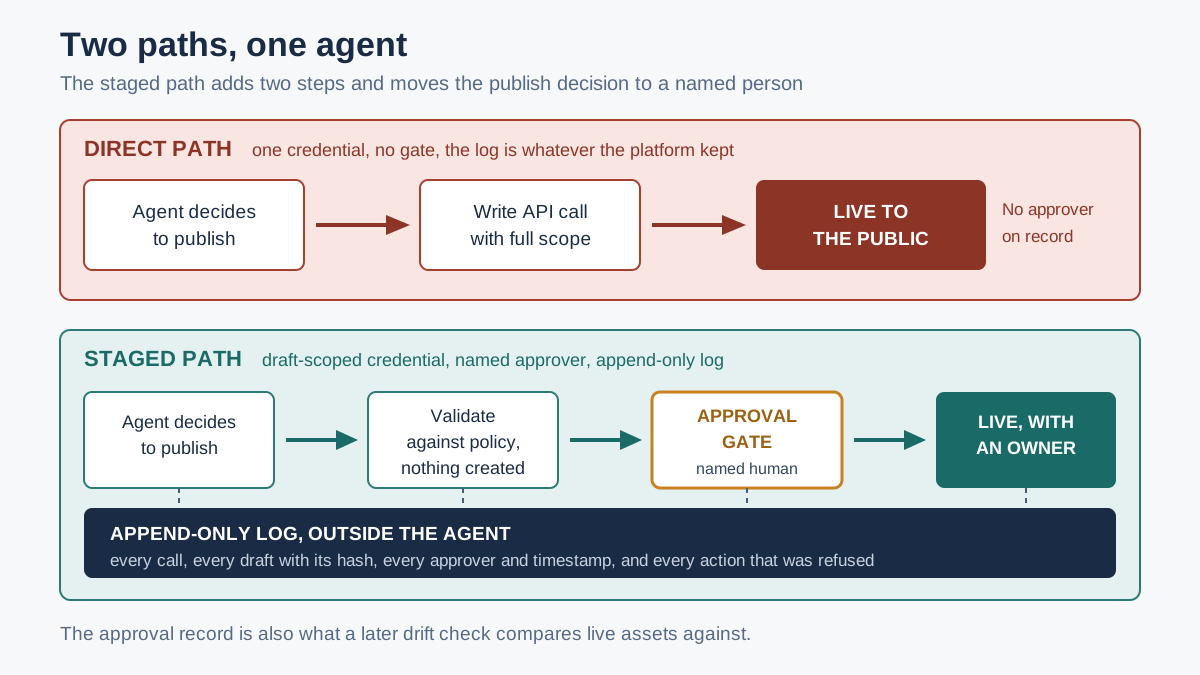
The staged path adds two steps and moves the publish decision to a named person. Both paths use the same agent.
Prerequisites before the first agent gets a credential
None of these prerequisites for AI agents for marketing is exotic, and none takes more than a day. All of them are painful to retrofit after an agent is live and someone is depending on its output.
- A named human owner per agent. A person, not "the growth team." The owner approves scope changes and is the one paged when the agent misbehaves. If nobody will accept the name, the agent is not ready.
- A dedicated credential in every system it touches. Never a human's key, never a shared key. This is the single control that makes an action log interpretable, and it is the one most often skipped because it takes twenty minutes per platform.
- A cap set in the platform before the first run.
spend_capon Meta. An account budget on Google. A recipient ceiling in the ESP, if yours has one. Draft-only status in the CMS. Where a platform offers no native cap, and several do not, the cap has to live in whatever sits between the agent and that platform. - An expiry date on every credential. Marketing pilots outlive their sponsors. An expiry date turns a forgotten agent into an expired agent rather than a permanent one with unclear ownership.
- A log destination the agent does not control. If the only record of what an agent did is inside the agent, you cannot investigate the agent. The log has to be append-only and elsewhere, and it has to capture refusals as well as actions — the reasoning we set out in our earlier work on audit trails for agent actions.
- A rehearsed reversal path, with a measured time. Not documented. Rehearsed. Someone revokes the credential, times it, and writes the number down. Ten minutes discovered on a Tuesday is fine. Ten minutes discovered during an incident is not.
Deploying your first three agents in blast-radius order
The ordering principle is simple and unpopular: deploy in ascending order of what the agent can break, not descending order of what it can save. Teams do the reverse because the highest-value agent is the most exciting one, and then spend the first quarter learning permission lessons on the surface where mistakes cost the most.
Agent one: reporting. Zero keys, week one. Cross-platform performance summaries on read-only credentials everywhere: Google Ads Read-only, HubSpot .read scopes, a Klaviyo Read-Only key. There is no cap to set because there is nothing to cap. What you are testing is not the agent, it is your own plumbing. Does every platform issue a dedicated credential? Does the log land somewhere you can query? Can you revoke all of it in under ten minutes? Answer those where a wrong answer costs a wrong number in a slide.
Agent two: drafting. Voice, staged, weeks two to six. Content, ad copy, or newsletter drafts, all landing in a draft state a human promotes. This is where you build the approval gate and discover how much review load the agent actually generates, a number nobody can predict and everybody underestimates. Track the approval rate. If humans approve 98% of drafts unchanged, the gate has become a rubber stamp and you should either raise the autonomy or admit the review is theatre. If they rewrite 60%, the agent is not ready for a wider brief.
Agent three: acting. List or Wallet, capped, week six onward. Now the agent sends or spends. Pick one key, not both. Set the platform cap first, run against a test account or a 5% audience slice for two weeks, and instrument the reversal path before the first real run. If it is Wallet, start with a campaign whose monthly ceiling you can afford to lose entirely, because the 30.4× multiplier means the ceiling is what you are risking, not the budget number.
The temptation is to skip to three. Resist it for a reason that has nothing to do with caution: the failures at steps one and two teach you what your logging cannot see, and you want that lesson where nothing is at stake.
Six mistakes that surface in the first ninety days
1. Running the agent on a person's credential. The agent uses the marketing ops manager's API key because it was already there. Now every log line is ambiguous, her offboarding breaks production, and the audit question "who did this" has two possible answers. Fix it before the first run; the cost is twenty minutes per platform.
2. Granting Standard Google Ads access because Read-only cannot do the job. Correct diagnosis, wrong conclusion. The gap between the two levels is real, but the fix is a validateOnly dry-run path plus a human on the mutate, not a permanent grant of budget-editing rights to an agent that only needed to write headlines.
3. Mistaking a campaign budget for a cap. The average daily budget is a pacing target. Google's own documentation puts the real ceiling at 2× daily and 30.4× monthly. A team that believes "we capped it at $200 a day" has actually authorized $6,080 a month per campaign, and any agent with Standard access can raise that figure.
4. Leaving spend_cap at its default. Meta's documentation is explicit that a value of 0 means no spending cap. Not setting it is a decision. It is the least deliberate decision in the whole deployment and it is the one that removes the only account-wide brake.
5. Approving the agent instead of the action. A sign-off in January that "marketing can use the content agent" is not an approval of the thing it publishes in June. The gate has to be on the publish event, tied to a named approver, with the approved artifact retained. Article 50's human-review carve-out is written in terms of editorial responsibility for content, not authorization of a tool.
6. Treating the pre-publish gate as the whole control. This is the one that only appears after the agent has been working well for a while, and it deserves its own section.
Drift: what the pre-publish gate does not catch
Every control above governs the moment an AI agent for marketing acts. The CPG brand lead's Hacker News post is about the weeks afterward, and it is the most useful field report on marketing agents we found while researching this piece. The poster ran agents across a real product launch for content generation and localization, asset routing between design, legal, and marketing, SKU variant handling, and post-launch updates when claims or packaging changed. What surprised the poster was not hallucination but drift: copy that slowly diverged from approved claims, and packaging variants that stayed technically consistent while violating internal brand rules. The one-line summary was "It was drift. The systems 'worked,' but..." (deliass, Ask HN, December 15, 2025).
The scale described: over 60 influencers and 500-plus assets globally lined up for a Christmas launch, all of which become obsolete on January 1 and need changing. The pattern that held up was to treat agentic automation as a continuous system: agents execute, outputs are monitored after publication, deviations from brand, regulatory, or launch constraints are flagged, and humans step in only when something breaks tolerance. The summary of the shift: this "feels closer to observability than approval workflows."
We think both are required, and the distinction is worth being precise about because it maps onto the three keys unevenly.
| Control | What it catches | Where it is blind |
|---|---|---|
| Pre-publish gate | A wrong action at the moment it is proposed | Anything that becomes wrong later: a claim that changes, a price that moves, a regulation that shifts |
| Post-publish monitoring | Drift between what is live and what is currently approved | Nothing at all, if the log does not record what was approved at the time |
| Both, tied together | Drift with an audit trail back to the approving human | Only what neither was configured to look at |
Drift is a live-asset problem that existed before agents. Agents make it acute because they raise the asset count faster than review scales. Five hundred assets maintained by humans drift at the speed humans update them; five hundred maintained by agents drift at the speed the agent runs, which is nightly.
The practical control is a reconciliation loop: a scheduled comparison between what is currently published and the currently approved source of truth for claims, prices, and brand rules, with an alert on divergence. It is not what agent vendors demo. It also depends on the pre-publish gate, which is what tells the reconciliation job what "approved" meant at the time. Neither control works alone.
Two caveats on that account. It is a single practitioner's public description of one launch, so it is a data point rather than a study. And the same post names a specific brand-compliance vendor twice, so it may carry a promotional motive; we cite the observed failure pattern, which is checkable against the mechanics above, rather than the tooling conclusion. It is the kind of field evidence this topic mostly lacks, which is why we lean on it at all.
Where LeapForce fits, and where it does not
LeapForce is not a marketing tool. We do not build a content agent, a bid manager, or an ESP, and if you are choosing between marketing agent products, nothing on our platform helps you pick one. What we build is the layer underneath: one controlled place where every AI tool, connector, model, and agent gets an owner, a scope, and an audit record, with dollar budgets IN DEV.
That maps onto this article's structural finding — that the marketing stack has five permission models, three cap mechanisms, and no single place to ask what one agent can reach. Access & Identity treats non-human identities as first-class, so a marketing agent has an owner, a scope, and an expiry the way a human account does, and offboarding it is one step rather than four consoles. Connectors is a registry IT vets once, with action-level scoping and human-in-the-loop gates for exactly the publish and send events this article says to gate. Credential brokering, so the agent never holds the raw key, is the vaulted-keys capability and it is IN DEV, not shipping today. Observability & Audit records what was refused, not only what ran, the log property the Voice key needs and platform-native logs rarely provide. Our gateway rollout model is deliberately sequenced for this: Observe first. Enforce second. Optimize third. You cannot write a sensible policy for a marketing agent before you can see what it is doing, and most teams try to.
Per our published honesty convention, some of this is live and some is not, and we label it rather than blur it. Gateway endpoints, tracing, and SSO are LIVE. Vaulted keys, inline DLP, and dollar budgets are IN DEV. Shadow-AI discovery and compliance evidence packs are ROADMAP. If your need today is an evidence pack for a marketing audit, we are not there yet, and you should build the reconciliation loop above yourself in the meantime.
Honest limits on this analysis
The platform documentation is a snapshot. Everything cited here was fetched on July 31, 2026. Ad platform access levels and budget mechanics change without much announcement. We read each page once, on one day; we did not check any page's revision history, so we cannot tell you which of these rules is long-standing and which is recent. Re-check the specific pages before you build a control on top of one.
The $9,120 figure is arithmetic, not an incident. It is 30.4 × ($500 − $200), using Google's published multiplier. It is what the platform permits, not something we watched happen. Your actual exposure depends on your campaign count and whether an account budget is set.
We have not run a marketing agent against a live brand's accounts. No first-hand deployment log sits behind this piece. The field evidence is one practitioner's public post and the vendor documentation, and both are named at the point they are used.
Two sources a reader would expect are missing. Gartner's CMO Spend Survey is widely quoted on martech utilization, and Gartner's site is protected in a way we could not get past without defeating a bot check, so we have excluded its figures rather than cite them second-hand. Reddit's marketing and PPC communities, where practitioner incident reports actually live, were also unreachable. Both absences skew this article toward vendor documentation and away from practitioner accounts, and you should read it with that in mind.
The three-key model is a sorting tool, not a risk score. It tells you which controls to look for. It does not tell you how much autonomy is right for your risk appetite, your regulator, or your brand. Those are judgment calls the framework organizes rather than answers.
Nothing here is legal advice. GDPR Article 5, EU AI Act Article 50, and FTC substantiation obligations are summarized from primary sources and linked. How they apply to your specific marketing operation is a question for your counsel.
Frequently asked questions
AI agents for marketing are systems that take a marketing goal, plan their own steps, and execute them by calling marketing tools through APIs using credentials they hold. The operational difference from a chatbot or a content generator is the credential: an agent has standing access to your CMS, CRM, email platform, or ad accounts, and can act inside them without a person clicking each step. That makes its permission scope, not its model quality, the property that determines what it can do wrong.
AI agents for marketing differ from marketing automation in one structural way. A rules-based automation executes a branch someone drew; it can only do what was wired in. An agent chooses its own sequence at runtime, so the set of actions it might take equals the set its credential allows. The practical consequence: with traditional automation you audit the flow definition before it runs, and with an agent you audit the action log afterward. That is why credential scope and platform caps matter more for agents than they ever did for workflow tools.
Yes, if you gave it a credential that can edit campaigns. In Google Ads, Standard access can "edit campaigns," and average daily budget is a campaign field. Google's published limits mean actual spend can reach 2× the daily budget on a given day and 30.4× monthly, so raising a budget from $200 to $500 a day moves the monthly ceiling from $6,080 to $15,200. The controls that stop this are a Google account budget or Meta's spend_cap, both set in advance. Google's account budget changes go through a review that typically takes under an hour, so it is a fence, not an emergency brake.
The narrowest scope that lets it do its stated job, in a credential of its own, with an expiry date. Concretely: read-only scopes wherever it only needs to look (crm.objects.contacts.read in HubSpot rather than .write); per-resource scopes rather than full-access keys in Klaviyo; a draft-only CMS role rather than a publishing role; and no ad account credential at all unless spending is its actual purpose. Write down what it may not reach as an explicit list. A scope grant is ambiguous about absences and a refusal list is not.
The EU AI Act's Article 50 requires providers to mark synthetic output as machine-readable and detectable, and requires deployers to disclose AI-generated text "published with the purpose of informing the public on matters of public interest." There is a carve-out where content has "undergone a process of human review or editorial control and where a natural or legal person holds editorial responsibility." So a named editorial owner plus a real review gate is one of the two compliant paths. Marketing copy is not automatically "matters of public interest," but the safe operational answer is to have the named owner and the gate regardless, because that also satisfies the substantiation question below. This is a summary of primary text, not legal advice.
The company that published it. The FTC's position, stated when it announced Operation AI Comply on September 25, 2024, is that "there is no AI exemption from the laws on the books." Advertising substantiation obligations do not change because a model drafted the sentence. Practically this means the claim-verification step has to sit between the agent and the publish action, held by a named person, and the evidence of that review has to be retained. That is the same control the EU AI Act's human-review path requires.
A read-only reporting agent, with no write access anywhere. It has almost no upside and that is the point: you are testing your own provisioning, logging, and revocation before anything is at stake. Move next to a drafting agent whose output lands in a draft state a human promotes, then to an acting agent that sends or spends, one key at a time, with the platform cap set first. Deploying in ascending blast-radius order means your permission lessons get learned where they cost a wrong number in a slide.
Withhold the write scope that authorizes sending, keep a human on the send action, and set a circuit breaker below Google's threshold. Google's bulk sender guidelines require senders of 5,000+ daily messages to keep spam rates in Postmaster Tools below 0.30%, which on a 50,000-recipient send is about 150 complaints. Pause the agent at a lower rate. 0.20% gives you margin, so the alarm precedes the harm. The reason this matters more than other agent mistakes is that reputation damage accrues to the sending domain and degrades every email the company sends, including transactional mail.
Setup is measured in hours, not budget: roughly twenty minutes per platform to mint a dedicated scoped credential, an hour to set caps and write the permission spec, and one rehearsal to time the reversal path. The recurring cost is review load, and that is the number teams underestimate. A drafting agent producing twenty pieces a week generates twenty approval decisions a week, and at a 98% approval rate you are paying for a gate that filters nothing. Track that rate from week one.
Only if you designed for it before deployment. The requirement is an append-only log outside the agent's control, capturing every API call with system, endpoint, record count and timestamp, every artifact created with a content hash, and every refused or blocked action — not only successes. GDPR Article 5 frames this as accountability: the controller must "be able to demonstrate compliance," which is an evidence obligation rather than an intent one. Platform-native logs typically record what ran and not what was declined, which is why the refusal record usually has to come from the layer between the agent and the platform.
Ready to Govern Your AI?
Talk to LeapForce — one controlled layer for every AI tool, connector, model, and agent.
Comments