
AI FOMO costs you nothing until you sign something. The price of waiting one quarter is usually four figures of forgone benefit; the price of signing the wrong enterprise AI contract is usually six, because the licence is the smallest line on the invoice. Before you decide, put both numbers on the same page.
Our position at LeapForce is that AI FOMO is not a character weakness. It is an arithmetic failure with a very specific shape: one side of the trade arrives with a number attached and the other side arrives with none. Vendors, boards and competitors supply the urgency figure. Nobody supplies the cost of being wrong, so it gets treated as zero. On a Hacker News thread in May 2026 about AI hype, a commenter posting as hilariously described sitting in a meeting where the top agenda item was securing an LLM component, showing that it could not be secured as specified, and then watching the security requirements get dropped rather than the project. Their summary of why: "The management is the team that wants it to go." That is what a missing number looks like from the inside.
The short answer: Write down the cost of waiting one quarter and the cost of a wrong signature in the same units, then buy only when the first exceeds the second. For most companies in 2026 it does not, because falling model prices cancel most of the wait while integration, unwind and governance debt make the mistake three to four times bigger than the licence.
Last updated: July 30, 2026.
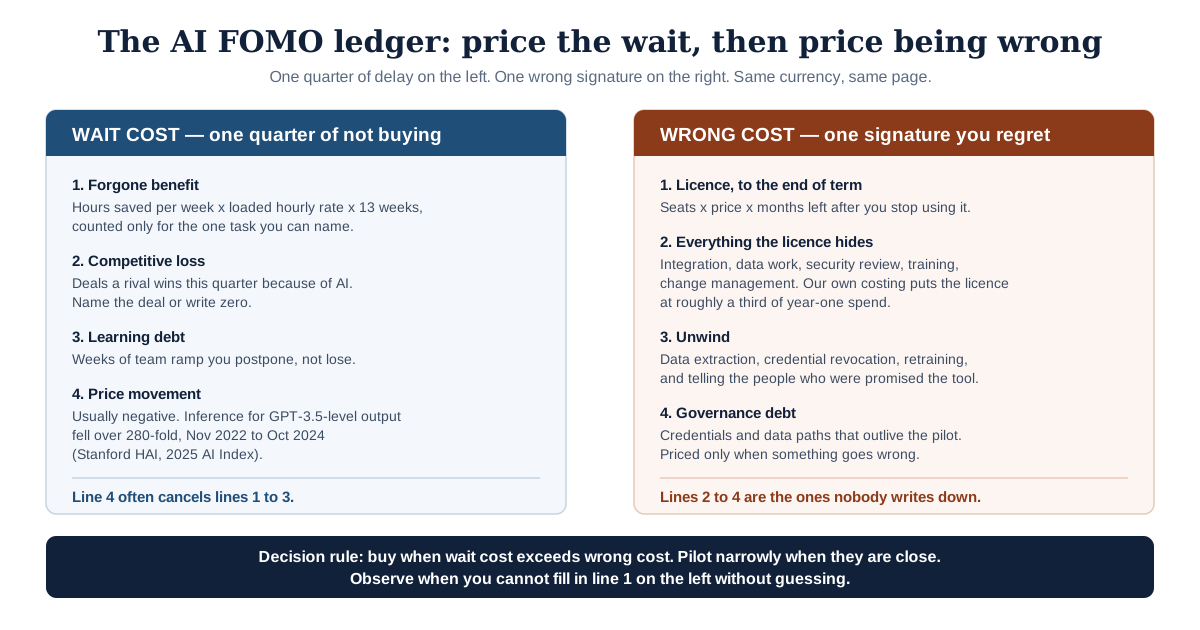
The Wait/Wrong Ledger. Both columns in the same currency, on the same page, before anyone signs.
AI FOMO is a pricing error, not a personality flaw
AI FOMO is the pressure to buy or deploy AI because of what other organisations appear to be doing, rather than because of a task you can name. It is a pricing error: the urgency side of the decision comes pre-quantified by vendors and press coverage, while the downside side arrives as a vague feeling, so the comparison is made between a number and a mood. Numbers beat moods every time, which is why the decision reliably tips toward buying.
Chris Willis, chief design officer and futurist at the data platform company Domo, described the same dynamic to The Register in May 2026, and put it more sharply than we would: what companies face, he argued, is "not an innovation problem but an impatience problem". His line on the mechanism is worth keeping: "Fear is not a durable strategy for innovating." He also named the behaviour that results, buying model access and pushing employees to consume as much of it as possible, which the piece calls tokenmaxxing, and noted that heavy token consumption can make individuals feel productive without moving the bottom line.
The reason this matters more in 2026 than it did in 2023 is that the cost of rushing into AI is now measurable rather than theoretical. S&P Global Market Intelligence, surveying more than 1,000 organisations across North America and Europe, found the share of companies abandoning most of their AI initiatives jumped to 42% in 2025 from 17% the year before, with the average organisation abandoning 46% of its proofs of concept before they reached production. That is not a story about AI being useless. It is a story about a lot of signatures that arrived before a use case did.
There is a second, less obvious tell. The industry has already invented a name for the correction. Writing in diginomica in October 2024, analyst Rebecca Wettemann described a shift from FOMO to FOMU, fear of messing up, as buyers moved from worrying about competitive disadvantage to worrying about reputational damage, lawsuits and lost customer trust. Both emotions are unpriced. Swapping one for the other does not improve a decision; it just changes which way the unpriced feeling pushes.
What follows is a framework we will call the Wait/Wrong Ledger. It has two columns, four lines each, and it is designed to be completed in one sitting by one person with access to a contract and a payroll figure. It does not tell you AI is bad. It tells you whether this purchase, at this price, this quarter, beats waiting a quarter.
Three numbers make everyone feel late, and they measure different things
The single most useful move against AI FOMO is to notice that the adoption statistics driving the urgency are measuring three different verbs. One counts organisations that touched AI anywhere. One counts organisations that put it into production. One counts organisations that got money out of it. They are quoted interchangeably, and the gap between them is where the panic lives.
| Verb being measured | Representative figure | Source |
|---|---|---|
| Uses AI in at least one function | 88% organisational adoption | Stanford HAI, 2026 AI Index |
| Has invested significantly in agentic AI | 19%, against 31% explicitly waiting or unsure | Gartner, June 2025 |
| Got measurable P&L impact from a pilot | ~5% of pilots | MIT NANDA, via Fortune |
Read left to right, the sequence is brutal and clarifying. Stanford HAI's 2026 AI Index puts organisational adoption at 88%, and reports that generative AI reached 53% population adoption within three years, faster than the personal computer or the internet. That is the number you feel in your inbox. Gartner's January 2025 poll of 3,412 webinar attendees found 19% had made significant investments in agentic AI, 42% conservative investments, 8% none, and 31% were taking a wait-and-see approach or were unsure. Nearly a third of the room, in other words, was already doing the thing that AI FOMO tells you nobody else is doing.
Then the third column. The MIT NANDA research group's The GenAI Divide: State of AI in Business 2025, as reported by Fortune, found roughly 95% of enterprise generative AI pilots produced no measurable P&L impact, drawing on 150 leader interviews, a survey of 350 employees and an analysis of 300 public deployments. The report's own explanation is not that the models are weak. It is a learning gap: generic tools do not adapt to a specific workflow, and organisations do not adapt the workflow to the tool.
Put the three together and the honest reading is that AI adoption is nearly universal, AI deployment is a minority sport, and AI returns are rare. If you are being told you are behind, the fair question is: behind on which verb? Being behind on the first is almost impossible in 2026. Being behind on the third is the normal condition, including for the companies whose press releases are making you anxious.
One more figure belongs here because it prices the urgency directly. Gartner predicts that over 40% of agentic AI projects will be cancelled by the end of 2027, citing escalating costs, unclear business value and inadequate risk controls. Senior Director Analyst Anushree Verma is direct about the cause: most such projects are "early stage experiments or proof of concepts that are mostly driven by hype and are often misapplied". Hype is named in the forecast. It is a costed input, not an editorial flourish.
How to price the wait: four lines, one sitting
The wait cost is what one quarter of not buying actually costs you, in money, counted only for things you can name. Four lines, and three of them are usually small. Do this before you read a single vendor deck, because a deck will change your inputs, and the whole point of a responsible AI adoption strategy is that the arithmetic precedes the pitch rather than following it.
Line 1: forgone benefit. Pick the single task you would hand to this tool first. Not a category. A task, with a name, a current owner and a frequency. Estimate hours saved per week, multiply by the loaded hourly rate of whoever does it, multiply by thirteen weeks. If you cannot name the task, the honest entry on this line is zero, and you have just learned the most important thing the exercise can tell you. Our earlier analysis on measuring AI workplace efficiency makes the case that this estimate is only worth anything if you already hold a pre-AI baseline for the same task; without one you are comparing a measurement to a memory.
Line 2: competitive loss. How many deals, renewals or hires will a rival win this quarter specifically because they have this capability and you do not? Name them. Not "we will look dated". Name the deal, the account, the RFP. In most companies this line is genuinely zero for a quarter, and writing the zero down is what breaks the spell. It is also where you should be most willing to be proven wrong: if your sales team can name two live deals where a competitor's AI feature was decisive, that is a real number and it belongs in the column.
If the honest answer is "we cannot know", say that rather than splitting the difference with a placeholder. An unknown line 2 is not a small line 2; it is a missing measurement, and the standard place to look for it is your existing win/loss review, where the reasons buyers gave for choosing someone else are already written down by someone who was in the room. If your win/loss notes have never mentioned an AI capability, that is evidence. If nobody runs win/loss reviews, then the FOMO you are feeling is being generated by press releases rather than by customers, which is worth knowing before you spend anything.
Line 3: learning debt. Your team will need weeks of ramp whenever you start. Waiting a quarter postpones that ramp; it does not delete it. Price it as the ramp cost multiplied by the probability that starting later makes the ramp harder, which, given how fast interfaces are converging, is usually a discount rather than a premium.
Line 4: price movement. This is the line that reverses the whole calculation, and it is the one almost no urgency argument accounts for. Stanford HAI's 2025 AI Index found that the inference cost for a system performing at the level of GPT-3.5 dropped more than 280-fold between November 2022 and October 2024, that hardware costs have declined roughly 30% annually, and that energy efficiency has improved about 40% each year. The same report noted open-weight models closing the gap with closed models from 8% to 1.7% on some benchmarks in a single year. We checked whether the 2026 edition revised these figures; it does not restate the inference-cost series, so the 2025 numbers and their explicit date range stand as the most recent published version.
Nothing else you buy behaves like this. When you delay a warehouse, a hire or an ERP migration, the price goes up. When you delay a model-dependent capability, the price of the capability tends to fall and the quality tends to rise. Line 4 is negative, and it is frequently large enough to cancel lines 1 through 3 outright.
One important qualification, because it is the first objection a burned buyer raises and it is correct. Token prices and seat prices are different markets. The 280-fold decline is a measurement of inference cost, not of what a vendor charges you per user per month, and per-seat enterprise assistant pricing has been conspicuously sticky while the underlying compute has collapsed. So line 4 should be filled in twice: negative and large if you are buying model access or building on an API, roughly flat if you are buying a fixed-price seat licence. If it is the latter, the anti-FOMO case does not disappear, but it has to be carried by the wrong column instead of by the price trend. The practical response is to negotiate term length rather than to wait for a discount that the market structure is not going to deliver.
That is the core of the case against AI FOMO, and it is worth stating in the form a CFO would use. A capability whose unit cost is falling faster than your cost of capital is not an asset you are late to buy. It is an asset that gets cheaper while you decide. The exception, and it is a real one, is any advantage that compounds: proprietary data you can only start accumulating once you deploy, or a workflow change that takes four quarters to bed in. Those belong on line 1 with a multi-quarter horizon, and they are the strongest honest argument for moving now.
How to price being wrong: the four lines nobody writes down
The wrong cost is what a signature you regret costs before you are free of it, and it is systematically underestimated because only the first of its four lines appears in the proposal. This is where the cost of rushing into AI actually sits. Not in the subscription, which is visible and negotiable, but in the three lines underneath it that nobody puts in a business case. Total it the same way: four lines, one sitting.
Line 1: licence to the end of term. Seats multiplied by price multiplied by the months remaining after the day people stop using the tool. Annual contracts with a twelve-month term signed in month one mean that a pilot abandoned in month four still bills for eight more. This is the only line most buyers price.
Line 2: everything the licence hides. Integration work, data preparation, security review, identity plumbing, training, change management and the internal time to run all of it. In our own costing of a 250-seat enterprise AI deployment, built from published vendor prices, the licence came to roughly a third of year-one cost. If your only budget line is the licence, you have budgeted about a third of the decision. That multiplier is also the reason the wrong cost usually beats the wait cost by an order of magnitude: line 1 of the wait column is a few thousand pounds of forgone benefit, while line 2 of the wrong column is two-thirds of a six-figure programme.
Line 3: unwind. Getting your data back out in a usable form. Revoking credentials the tool was given, including the ones handed out by teams who were not on the project. Retraining people on the process you just replaced and are now un-replacing. And the political cost of telling a department that the thing they were promised is being taken away, which is unbudgetable and is the single most common reason companies keep paying for tools they have stopped using.
Klarna is the reference case, and it is worth being precise about it because it is often misquoted. In February 2024 the company said an OpenAI-powered assistant was doing the work of 700 customer service agents. By May 2025 chief executive Sebastian Siemiatkowski had reversed course and was recruiting human agents again, telling Bloomberg the AI-first approach "wasn't the right path" and that the chatbots, while cheaper, produced lower quality work, as reported by Entrepreneur. Note what the reversal cost was not: it was not the licence. It was rehiring, retraining and reputational repair — line 3, in full.
Line 4: governance debt. This is the line that gets priced only when something goes wrong, and it is the reason a rushed deployment is more expensive than a slow one even when both are eventually cancelled. A tool bought under time pressure gets an exception on the identity review, a service account with more scope than it needs, and a data path nobody documented. Those artefacts outlive the pilot.
The 2026 IBM and Ponemon Cost of a Data Breach report put the global average breach cost at a record high, a 12% increase over the previous year, and framed its central warning in exactly these terms: racing to adopt agentic AI without strengthening security and governance for agents puts data, people and reputation at risk. The specific figures, as reported by Cybersecurity Dive from the study of 602 breached organisations across 17 industries and 16 countries between March 2025 and February 2026: the average breach reached about $5 million, the share of incidents involving shadow AI more than doubled year over year to 43%, more than two-thirds of organisations had no governance process limiting shadow AI, and 92% of organisations that suffered attacks on their AI models had failed to control access to those tools.
That last figure is the one to sit with. It is not a statement about model safety. It is a statement about access control, about who and what was allowed to touch the system — which is a decision made during procurement, under exactly the time pressure AI FOMO creates.
The four postures, compared
There are four honest responses to AI FOMO, and the reason this reads as a decision guide rather than a lecture is that three of them involve doing something. The posture you pick should follow from the two column totals, not from how the last board meeting felt.
| Posture | What you actually do | Typical quarter-one cost | Best for | Main risk |
|---|---|---|---|---|
| Buy now | Sign a production contract, roll out to a department | Full licence plus roughly 2x in non-licence cost | A named task with a measured baseline and a rival winning deals on it | Locking in tooling and prices that will look poor in two quarters |
| Pilot narrow | One team, one task, fixed end date, no production data | Low four figures plus internal time | A named task with no baseline yet | Pilot theatre: no success criteria, so it never ends |
| Observe | Route existing AI traffic through one measured path; buy no new capability | Near zero in licence, real in engineering time | Companies who cannot fill in line 1 without guessing | Mistaking measurement for progress and staying there |
| Wait | Do nothing new; revisit next quarter with the same ledger | Zero | Regulated processes with no reversible task to hand over | Shadow AI filling the vacuum unmeasured |
Buy now — verdict. Justified when line 1 of the wait column is a named task with an existing baseline, line 2 has an actual deal name in it, and your wrong cost is bounded by a contract you have read. Choose this if you can complete the sentence "if this fails in month four, we owe X and we recover Y" without opening a new tab.
Pilot narrow — verdict. The default for most organisations, and the one most often executed badly. A pilot with no end date, no success threshold and no baseline is not a pilot; it is a subscription with better branding. Choose this if you have a named task but no baseline, and set the exit criteria before the kickoff meeting rather than after. Our earlier analysis of why AI pilots stall on the way to production covers the four questions a pilot never has to answer and a production system always does.
Observe — verdict. Underrated, and the only posture that generates the missing number rather than guessing at it. Your people are already using AI; the question is whether you can see it. Choose this if line 1 of your wait column is currently a guess, because a quarter of observation converts it into a measurement and costs you no licence. We should be candid that we cannot give you a credible engineering-hours figure for this posture. It depends entirely on how many AI surfaces your organisation already has and how much identity plumbing exists, and we would rather leave the cell qualitative than publish a number we have not measured.
Wait — verdict. Legitimate, and increasingly defensible given the price trajectory, but only when paired with something. Naked waiting is how shadow AI grows: usage does not stop because procurement did, it just stops being visible. Choose this only if you are simultaneously running the observe posture, or if the process in question genuinely has no reversible task to delegate.
Notice what is missing from that table: a "buy the platform now and figure out the use case later" row. That posture exists in the wild and it is the one the cancellation statistics are describing.
A worked ledger: 250 seats, one quarter
Here is the framework filled in end to end, using a deliberately ordinary scenario: a 250-person services firm considering an AI assistant rollout at a published list price, under pressure from a board member who saw a competitor's announcement. This is AI FOMO in its most common form — not a strategy meeting, a forwarded link.
We have not run this deployment ourselves. The figures below are constructed from published prices and from our own earlier costing work, not from a customer engagement, and we would rather say so than dress an illustration up as a case study. Use the shape, not the totals.
Wait column, one quarter:
| Line | Input | Value |
|---|---|---|
| 1. Forgone benefit | 12 people x 2 hrs/week saved x $55 loaded rate x 13 weeks | $17,160 |
| 2. Competitive loss | No named deal identified by sales | $0 |
| 3. Learning debt | Ramp postponed, not lost | $0 |
| 4. Price movement | Capability cheaper next quarter on published trend | Negative |
| Wait cost | ~$17,000, trending down |
Wrong column, if the rollout is abandoned in month four of a twelve-month term:
| Line | Input | Value |
|---|---|---|
| 1. Licence still owed to term | 250 seats x $30/month x 8 remaining months | $60,000 |
| 2. Non-licence cost already incurred | Year-one non-licence is about 2x the $90,000 annual licence, so ~$180,000; assume 60% of it front-loaded by month four | ~$108,000 |
| 3. Unwind | Data extraction, credential revocation, retraining, communication | Unbudgeted |
| 4. Governance debt | Scoped-too-wide service accounts, undocumented data paths | Priced on incident |
| Wrong cost | Lines 1 and 2 only | ~$168,000 before unwind |
Two of those inputs are assumptions and should be labelled as such: the one-third licence share comes from our published costing, and the 60% front-loading is our estimate of how much integration, security review and training work lands before month four rather than a measured figure. Change either and the total moves, but not the shape.
The ratio is roughly ten to one, and it holds across a wide range of inputs because of the structure rather than the specific numbers. The wait cost is bounded by one quarter of one task. The wrong cost is bounded by a contract term and a cost multiplier. You would have to believe in a very large line 1 or a very real line 2 to flip it.
Two things change the answer immediately. If sales names two live deals lost on an AI capability, line 2 stops being zero and can dwarf everything else. And if the contract is monthly rather than annual, wrong-cost line 1 collapses from $60,000 to $7,500, which is precisely why contract term, not price, is the variable to negotiate hardest when you are buying under time pressure.
A practitioner's note on the harder half of this. On the same Hacker News thread, a commenter posting as JohnMakin described the current thinking as assuming that if money is being spent on tokens, the work must be worth it, and called tracking "token usage to measurable work outputs" one of the more difficult things they had worked on lately. That difficulty is real and it is the reason line 1 defeats most teams. It is also the reason the observe posture exists.
When moving now is actually right
The Wait/Wrong Ledger tilts toward patience for most companies, and a framework that never recommends acting is worthless, so here is the honest counterweight. There are four situations where the arithmetic genuinely favours moving this quarter, and if you are in one of them, waiting is the expensive choice.
The advantage compounds. If deploying now starts accumulating something you cannot buy later, such as labelled interaction data specific to your domain, a corrected knowledge base, a retrained team, then wait-cost line 1 is not one quarter of forgone benefit. It is one quarter of a compounding series, and it should be modelled over four quarters or more. Gartner's forecast that at least 15% of day-to-day work decisions will be made autonomously through agentic AI by 2028, up from 0% in 2024, is a forecast about accumulated organisational capability, not about buying software in 2028.
A named deal is on the line. Line 2 with an account name in it is the strongest buy signal in the whole framework, because it is the only input that is not an estimate. Treat one named, verifiable lost deal as worth more than any market-level adoption statistic.
The contract is genuinely reversible. Monthly terms, no data lock-in, no exclusivity, a documented export path. When wrong-cost line 1 is small and line 3 is short, the whole ledger loses its asymmetry and experimenting becomes cheap. This is a reason to negotiate for reversibility rather than for discount.
The shadow AI is already running. If your people are pasting work into personal accounts today, "waiting" is not a neutral state. You already have the exposure without the visibility. Our earlier analysis of why ungoverned AI takes hold inside most enterprises sets out the mechanism; the relevant point for this ledger is that in that condition the do-nothing option carries the wrong column's line 4 without any of the wait column's savings.
Notice that none of the four is "a competitor issued a press release" or "the board asked about our AI strategy". Those are prompts to run the ledger, not entries in it. The difference between AI FOMO and a responsible AI adoption strategy is not speed. Plenty of careful organisations move fast. It is whether the trigger was an external signal or an internal number.
Buy information before you buy capability
There is a version of this decision that most companies skip, and it is the one LeapForce is built around: buying visibility is cheaper than buying capability, and it produces the number that AI FOMO relies on you not having. Route the AI traffic your people already generate through one governed path, and within days you know which tools and models are actually being used, for what, and at what cost. That converts wait-cost line 1 from a guess into a measurement, which is the entire reason the framework stalls for most teams. Our gateway rollout model states the sequence plainly — observe first, enforce second, optimize third — and the first phase deliberately applies no rules at all: you point one team's traffic at the gateway in observe mode and collect the truth before writing any policy. We should be straightforward that this is a governance and deployment layer, not an AI assistant or a productivity tool, and it will not tell you whether a given vendor's product is any good; it tells you what your organisation is already doing, which is the input the decision needs and rarely has.
Where the Wait/Wrong Ledger breaks down
This framework has real limits, and it is more useful if we name them than if you discover them mid-quarter.
It assumes you can name a task. For organisations at the very start, the honest first step is not the ledger. It is a fortnight of writing down what people actually do. The ledger presumes a candidate task exists; if none does, the exercise correctly returns zero on both sides and tells you nothing.
Line 2 is easy to fake in both directions. A sales leader under pressure can produce a plausible lost deal, and a sceptical CFO can dismiss a real one. We have no clean method for validating competitive loss, and we would treat any framework claiming to have one with suspicion.
The price trajectory is an extrapolation. The 280-fold decline Stanford HAI measured covers November 2022 to October 2024. Compute scarcity, energy prices or consolidation could flatten or reverse it, and a published historical trend is not a guarantee about the next four quarters. If model prices stop falling, wait-cost line 4 goes to zero and the ledger tightens considerably.
It says nothing about which vendor. The ledger answers "now or later", not "which one". Enterprise AI vendor evaluation is a separate discipline with a separate method, and it matters here mainly because Gartner estimates only about 130 of the thousands of self-described agentic AI vendors are genuine, the rest engaged in what it calls agent washing, rebranding assistants, RPA and chatbots. Our AI vendor security assessment questions covers that ground.
Two sources a reader would expect are missing. We could not fetch McKinsey's State of AI survey or the US Census Bureau's Business Trends and Outlook Survey through any of our three retrieval routes; both are widely quoted on AI adoption rates and both are excluded here rather than cited second-hand. The Census figures in particular would have sharpened the adoption-versus-deployment section, because they measure all US firms rather than survey panels of large enterprises.
And one thing we did not do: we have not run this ledger against a real LeapForce customer deployment and published the result. The worked example above is constructed from published prices and our own prior costing analysis, not from an engagement. When we have a real one to show, it will be labelled as such.
Frequently asked questions
AI FOMO is the fear of missing out on artificial intelligence: pressure to buy, deploy or announce AI because of what competitors, vendors or boards appear to be doing, rather than because of a specific task you have identified. It is best understood as a pricing error rather than an emotion. The urgency side of the decision arrives with numbers attached: adoption statistics, competitor announcements, vendor deadlines — while the downside arrives as an unquantified feeling, so the comparison is structurally unfair. The fix is not willpower. It is putting a number on the other side.
Waiting is safe on price and unsafe on visibility. On price, the direction is unusually clear: Stanford HAI's 2025 AI Index found inference costs for GPT-3.5-level performance fell more than 280-fold between November 2022 and October 2024, with hardware costs down about 30% a year, so the capability you are anxious about gets cheaper while you decide. On visibility, waiting is not neutral, because your staff do not stop using AI when procurement does. The defensible version of waiting always runs alongside measurement of what is already happening.
Answer with the ledger rather than with a tool. Show the board the named candidate task, the measured or missing baseline, the quarterly forgone benefit, and the total cost of a wrong twelve-month signature including non-licence cost and unwind. Then state which of the four postures you are in and what would change it. This converts a status question into a capital-allocation question, which is the language a board already has good instincts in. It also protects you from the worst outcome, which is buying a platform to answer a question rather than to do a job.
Budget the licence at roughly one third of year-one cost. In our own costing of a 250-seat deployment built from published vendor prices, integration, data preparation, security review, training and change management together outweighed the subscription by about two to one. A first deployment budgeted at licence-only is not underfunded by a margin; it is underfunded by a multiple, and that gap is where most of the cost of rushing into AI actually lands: not in an expensive subscription, but in unplanned work that arrives after the money is committed and before anything is in production.
Long enough to cover a full cycle of the task, and no longer, with the exit criteria written before kickoff. The failure mode is not pilots that are too short. It is pilots with no defined end, which quietly become subscriptions. Set a fixed date, a numeric success threshold against a pre-AI baseline, and a named person who is allowed to call it off. S&P Global's finding that the average organisation abandoned 46% of proofs of concept before production suggests most pilots do end; the question is whether they end by decision or by exhaustion.
Enterprise AI vendor evaluation under time pressure comes down to four questions: what the product does without a model available, what identity it acts under inside your systems, what it can write to rather than only read, and what record it leaves of actions it refused. Gartner estimates only about 130 of the thousands of vendors marketing agentic AI are genuine, describing the rest as agent washing, meaning rebranding existing assistants, robotic process automation and chatbots. Under time pressure these questions get skipped, which is exactly when they are most valuable. Contract term and export path deserve the same scrutiny as price.
Yes, if waiting means doing nothing at all. IBM and Ponemon's 2026 Cost of a Data Breach study, as reported by Cybersecurity Dive, found the share of security incidents involving shadow AI more than doubled year over year to 43%, and that more than two-thirds of organisations had no governance process limiting it. Declining to buy does not decline the usage; it declines the visibility. This is why the observe posture, rather than the wait posture, is the honest default for a company that has decided not to purchase this quarter.
Because pilots are allowed to skip the questions production cannot skip: who owns this, what identity it runs under, what it may touch, and what happens when it fails. MIT NANDA's 2025 research attributes the roughly 95% no-return rate to a learning gap rather than model quality. Generic tools do not adapt to a specific workflow, and organisations rarely adapt the workflow to the tool. Gartner separately forecasts more than 40% of agentic AI projects will be cancelled by the end of 2027, citing escalating costs, unclear business value and inadequate risk controls.
Starting late is not the disadvantage it feels like, and it changes the build-versus-buy answer less than people expect. The MIT NANDA research, as reported by Fortune, found that purchasing AI tools from specialised vendors and building partnerships succeeded about 67% of the time, while internal builds succeeded only one-third as often. The more useful question for a late starter is reversibility: a bought tool on a monthly term with a documented export path is the cheapest possible way to be wrong, which matters more than time-to-first-deployment when you are still identifying the task.
Work the four wrong-cost lines in order, and expect line 3 to be the expensive one. Establish what remains payable to term, extract your data in a format you can actually use elsewhere, then revoke every credential the tool was issued, including any handed out informally by teams outside the project, which is where governance debt hides. Plan the internal communication before the cancellation, not after: the political cost of withdrawing a promised tool is the most common reason organisations keep paying for software they no longer use.
Yes, in four situations: when the advantage compounds through data or organisational learning you can only start accumulating by deploying, when sales can name a specific deal lost to a competitor's AI capability, when the contract is genuinely reversible so being wrong is cheap, and when ungoverned usage is already running and inaction carries the risk without the visibility. Outside those four, the pressure is usually a response to someone else's announcement rather than to your own arithmetic — and announcements are not a line item.
Ready to Govern Your AI?
Talk to LeapForce — one controlled layer for every AI tool, connector, model, and agent.
Comments