
Chatbot pricing in 2026 lands between $0.49 and $2.00 per unit of AI work: Intercom charges $0.99 per Fin outcome, Salesforce $2.00 per resolution or per conversation, Gorgias $1.50 per automated interaction past your quota, Tidio about $0.65 per Lyro conversation, Freshworks $0.49 per AI Agent session. Those numbers are not comparable, and the reason is not the price.
Our position at LeapForce is that in category-level chatbot pricing the decisive variable is definitional, not numeric. Every vendor above bills you per some noun: resolution, outcome, automated interaction, conversation, session. Every one of them wrote the definition of its own noun, publishes it on a page it controls and can edit, and counts against it in a system you cannot audit. Two products quoting the identical figure of $2.00 can differ by more than three times on the same workload, because one bills a customer who stopped replying and the other does not. A commenter on Hacker News put the mechanism plainly in June 2026, reading Intercom's own documentation during the Salesforce acquisition news: the product needs to "separate confirmed resolutions from assumed resolutions", and without that split, what you are buying is "a very soft resolution metric" (tcp_handshaker, Hacker News, 15 June 2026).
The short answer: Do not compare per-resolution prices. Compare cost per confirmed outcome, meaning the vendor's published rate divided by the share of conversations a real human actually confirmed as solved. Then make the vendor write its definition of the billable unit, with three worked examples, into the contract rather than into a help page it controls.
Last updated: July 31, 2026.
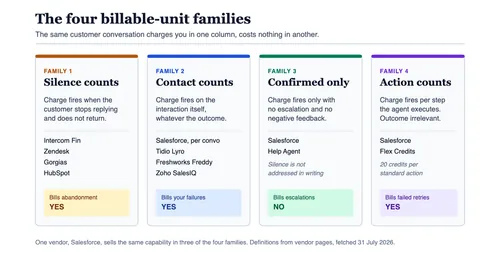
The four unit families. The same customer conversation produces a charge in one column, nothing in another, and a different charge in a third.
We have not run any of these vendors' invoices through a finance system ourselves, and nothing below is a first-hand billing experience. Every figure is arithmetic applied to prices and definitions the vendors published on their own sites, each fetched on July 31, 2026 and linked at the claim, so you can re-derive any line against your own volumes instead of taking our word for it.
Chatbot pricing in 2026: every number these vendors publish
Chatbot pricing has two layers in 2026: a seat or platform subscription, and a usage meter for the AI agent. The seat layer runs roughly $19 to $115 per agent per month among the vendors that still charge for seats. The AI layer runs $0.49 to $2.00 per unit. The unit differs at every vendor.
| Vendor | Subscription price (published) | AI unit | Published AI rate |
|---|---|---|---|
| Intercom (Fin) | Per seat, three plans; seat price shown only in an animated widget | Fin outcome | $0.99 per outcome |
| Zendesk | Suite Team $55, Suite Professional $115 per agent/month billed yearly | Automated resolution | Not published |
| Salesforce Agentforce | Agentforce User License $5/user/month; Agentforce 1 Editions from $550/user/month | Conversation, resolution, or Flex Credit action | $2.00 per conversation; $2.00 per Help Agent resolution; $500 per 100,000 Flex Credits |
| Gorgias | $40 / $77 / $471 / $1,227 per month by plan, each a combined helpdesk plus AI Agent figure (annual pricing on the upper three) | Automated interaction | $1.50 per automated interaction past quota |
| Freshworks (Freshdesk) | Growth $19, Pro $55, Enterprise $89 per agent/month billed annually | AI Agent session | $49 per 100 sessions after the first 500 |
| Tidio (Lyro) | Free $0, Starter $24.17, Growth from $49.17, Plus from $300 + usage | Lyro conversation | From $32.50 per 50 conversations |
| Zoho SalesIQ | Tiered plans with bundled quotas | Chat session | Bundled; extra sessions chargeable |
| Ada | Not published | Not published | Not published |
Seven of the eight rows were fetched July 31, 2026 from the vendors' own pricing pages: Intercom, Zendesk, Salesforce, Gorgias, Freshworks, Tidio and Zoho SalesIQ. The eighth records an absence: Ada's pricing page publishes no rates, and the Ada post cited later argues about pricing models without stating Ada's own.
Read that table as a buyer and the obvious move is to sort by the right-hand column. Freshworks at $0.49 looks like a quarter of the price of Salesforce at $2.00. That comparison is arithmetically valid and commercially meaningless, because a Freshworks session and a Salesforce resolution are not the same event. One is any interaction. The other is a completed, non-escalated, non-complained-about outcome. Two different products, sold in the same column.
Two details in that table are worth flagging before we go further. Intercom's seat prices render inside an animated number widget rather than static text, so we could read the $0.99 usage rate but not the per-seat figure; the pricing page itself states that "Intercom pricing has two components: Seats: You pay per teammate based on your plan (Essential, Advanced, Expert)" and "Usage: You pay for what you use (e.g. Fin outcomes, messaging channels)". And Zendesk, which arguably did more than anyone to make outcome pricing the category default, does not publish a price for its own outcome unit at all.
The billable unit is a word the vendor wrote
An AI chatbot bill in 2026 is a count multiplied by a rate, and chatbot pricing pages only ever show you the rate. The rate is published, negotiated, and easy to compare. The count is produced by the vendor's system applying the vendor's definition, and it is where essentially all of the commercial risk sits. If the definition moves 20%, your bill moves 20%, and no line item on the invoice will show you that anything moved.
This is not a fringe buyer concern. It is being said out loud inside the category. Writing in TechTarget on 2 July 2026, senior news writer Don Fluckinger described customer-service AI pricing as a shell game in which "vendors still control the definition of that subjective word, outcome". His reporting catalogues the spread: HubSpot's outcome pricing "kicks in if a customer doesn't escalate a case to a human in 72 hours"; Zendesk meters after a "72-hour quiet period"; Pegasystems "meters after a case is closed"; ServiceNow runs a hybrid of consumption and outcome tiers.
A vendor makes the same argument against its competitors. Ada, which sells into this market, published a piece on 18 July 2025 arguing that "The term 'resolution' isn't standardized", giving two live examples: "One vendor might define it as there being no customer response for 5 minutes. Another might consider any interaction that didn't escalate to a human agent as resolved." Ada's own conclusion about counting a customer who wandered off is worth quoting exactly, coming as it does from a supplier: that is "not a resolution. That's abandonment with a different label." Read Ada's post as competitive positioning, because it is arguing for the model Ada sells. The definitional observation stands on its own, and it matches what the vendors' own documentation says.
That is the whole argument of this article, and it has an unusual property for a pricing piece: the more precisely a vendor documents its definition, the better it looks here. The vendors quoted below are the ones that publish; the ones with no definition to quote are the ones that publish none.
The three questions a definition has to answer
Every billable-unit definition in this category answers, or dodges, the same three questions. When you read a vendor's help page, read it looking for these:
| Question | Why it decides your bill |
|---|---|
| Does silence bill? | The customer who asks a question, gets an answer, and never comes back is a large bucket in most support volumes, and it is 40% of the illustrative mix used later in this article. Whether that bucket bills is often the difference between two adjacent price quotes. |
| Does escalation bill? | If a conversation that reached a human still produces a charge, you are paying twice for the same ticket: the AI unit and the human's time. |
| What is the clock, and can it run backwards? | A 72-hour window means today's invoice is provisional for three days. Whether a reopened case reverses an earlier charge is almost never stated. |
Hold those three against any quote and the comparison stops being about dollars alone.
This is a billing argument, not a service-quality one
There is a well-travelled argument about the word "resolution" in customer support that says containment metrics measure avoided human contact rather than solved problems. That argument is about whether the customer was served. This article is about whether you were correctly charged. They are the same word and two different problems, and conflating them costs you either way.
We have written the service-quality version separately: deflection is not resolution sets out the four-number read a support leader needs to tell a working rollout from a hidden one, why a deflection rate can be improved by making humans harder to reach, and why the knowledge base sets the ceiling on answer quality. None of that is re-argued here.
The distinction matters practically because the two problems can point in opposite directions. A chatbot that abandons customers looks good on a containment dashboard and, under a silence-counts billing model, also generates revenue for the vendor. The service-quality fix and the billing fix are different clauses signed by different people: one is an operating metric owned by the support leader, the other is a contract definition owned by procurement. A support organisation can get the first exactly right and still be over-billed, because nothing in the CSAT split tells you what the vendor counted.
So read the deflection article to find out whether your customers are being helped, and read this one before you sign the order form.
The four unit families, and which vendor sits in each
Across the vendors that publish a definition, four families cover the whole category. Sort your shortlist into these before you look at a single price.
Family 1 — silence counts. A charge is triggered when the customer stops engaging and does not come back within a window. Intercom, Zendesk, Gorgias and, per TechTarget's reporting, HubSpot all sit here. It is one of the two largest families among the vendors here, and it is the one that bills the 40% silence bucket in the illustrative mix used later in this article.
Family 2 — contact counts. A charge is triggered by the interaction itself, regardless of outcome. Salesforce's per-conversation rate, Tidio's Lyro conversation, Freshworks' AI Agent session and Zoho SalesIQ's chat session sit here. Predictable, indifferent to quality, and it bills your failures.
Family 3 — confirmed outcome only. A charge is triggered only when the interaction ends without escalation and without negative feedback. Salesforce's Agentforce Help Agent pay-per-resolution model is the clearest published example.
Family 4 — action counts. A charge is triggered per step the agent executes, unconnected to whether the customer was helped at all. Salesforce Flex Credits, at 20 credits per Agentforce action, is the published instance.
Notice that Salesforce appears in three of the four families. That is not a criticism; it is the single most useful fact in this article. One vendor sells the same underlying capability on three meters, and which meter your order form names changes your bill by a multiple. If one vendor's own products span that range, the idea that a per-unit price is comparable across vendors does not survive contact.
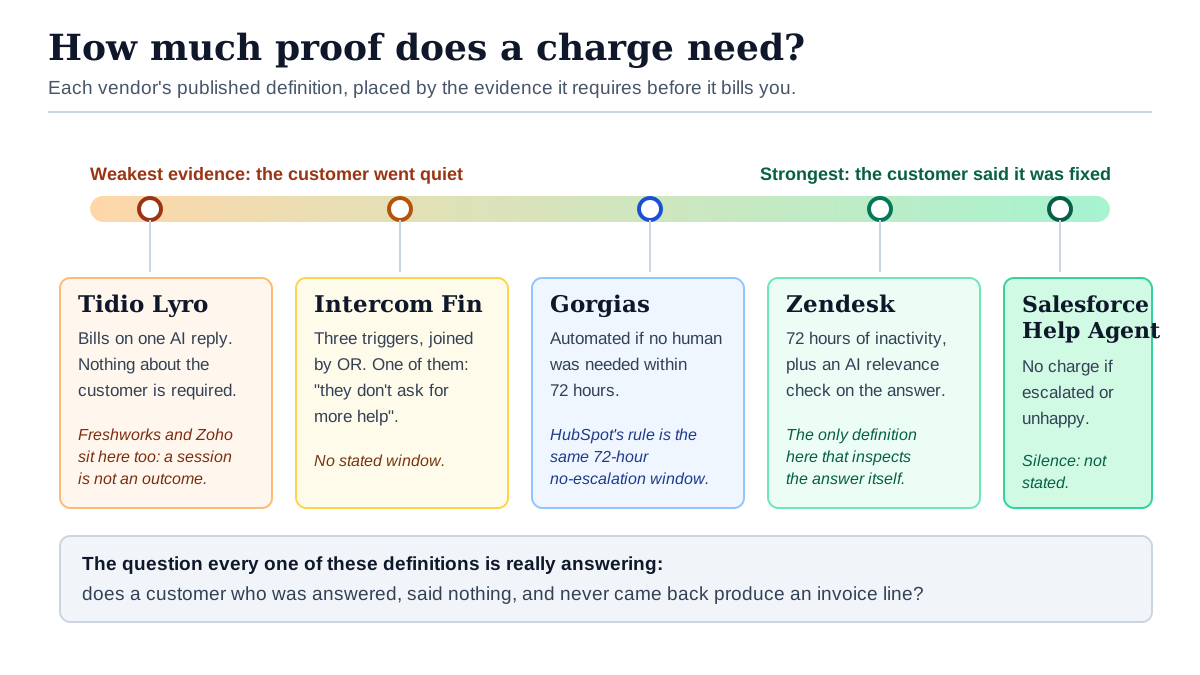
Where each published definition sits on the line from "the customer went quiet" to "the customer said it was fixed".
Vendor by vendor: the published rate and the published definition
Same four fields every time: the unit, the vendor's own definition of it, the published rate, and the one thing to put in your notes. All fetched July 31, 2026.
Intercom (Fin)
Billable unit: the Fin outcome. Vendor's definition, verbatim: "An outcome is counted when: A customer confirms their issue is resolved, or They don't ask for more help after Fin responds, or Fin completes a workflow (Procedure), including handoffs." The pricing page adds: "You're only charged once per conversation, even if multiple questions are answered." Published rate: $0.99 per outcome, on all three plans, plus per-seat subscription. Put in your notes: three separate triggers, joined by or, and only the first involves the customer saying anything. The second bills silence. The third can bill a conversation that ended up with a human, because a Procedure that includes a handoff still completed. Ask Intercom, in writing, what share of your outcomes would be counted under each of the three triggers. That ratio is your real price.
Zendesk
Billable unit: the automated resolution. Vendor's definition, verbatim: "An automated resolution is counted when a customer's issue is successfully resolved without live-agent intervention." Zendesk's help documentation adds the mechanism: "An automated resolution is counted after 72 hours of inactivity if AI evaluation has confirmed that the AI agent's response was relevant," where the qualifying last interaction is positive feedback, no feedback, an article click, or reaching a flow's final step. Counting is "per conversation rather than per user," and "A single user's visits over multiple channels, browsers, or devices will be considered separate interactions." Published rate: not published. The pricing page says only that "Zendesk AI agents are included in every Suite and Support plan, with pricing based on the successful outcomes they deliver." Put in your notes: Zendesk is the most transparent vendor in this article about what it counts and the least transparent about what it charges. The relevance check is a genuine safeguard. It is the only published definition here that puts a model in the way of counting a bad answer as a resolution. The multi-device clause cuts the other way: one person switching from phone to laptop can produce two billable interactions from one problem.
Salesforce Agentforce
Billable unit: three of them, and you pick. Vendor's definition, verbatim: for the Help Agent, Salesforce's announcement states: "With pay-per-resolution pricing, you are charged when Help Agent resolves an issue autonomously, start to finish. If the customer asks for a human or walks away unhappy, there is no charge." The same page adds: "If a customer gives negative feedback or asks for human escalation, there is no charge, and the agent passes complete customer context to the service team," and that "Both Data 360 and Agentforce are unmetered during the agent interaction." For Flex Credits, the pricing page states that "Agentforce actions are 20 Flex Credits, while Agentforce Voice actions are 30 Flex Credits." Published rate: $2.00 per conversation; $2.00 per Help Agent resolution; $500 per 100,000 Flex Credits, which puts a standard action at $0.10 and a voice action at $0.15; Agentforce User License $5 per user per month; Agentforce 1 Editions from $550 per user per month including 2.5 million Flex Credits per org per year. Pay-per-resolution availability is stated as July 2026. Put in your notes: the Help Agent definition is the most buyer-favourable published in this article. Escalation and negative feedback both suppress the charge, and the actions inside the conversation are unmetered. It also leaves the biggest hole: it does not say what happens to a customer who neither escalates nor complains and simply leaves. That single unstated case is worth thousands of dollars a month at moderate volume, and we work the arithmetic below rather than guess at the answer.
Gorgias
Billable unit: the automated interaction. Vendor's definition, verbatim: "An automated interaction occurs when a customer issue or request is fully handled by AI Agent or another automation feature including Flows, Order Management and Article Recommendations," and "An interaction is considered automated if the customer does not require the involvement of a human agent within 72 hours of the interaction" (Gorgias billing documentation). If the AI hands over to a human, you are charged "only a ticket fee". Published rate: plans at $40, $77, $471 and $1,227 per month, including 50, 300, 2,000 and 5,000 tickets and 30, 30, 190 and 530 automated interactions respectively. Past quota: $1.50 per automated interaction, and $0.40 or $0.36 per ticket depending on plan. Put in your notes: Gorgias's marketing line on the same page is "pay only when it resolves a conversation," but the metered noun in the documentation is an interaction that no human touched for 72 hours, which is not the same claim. It is also the clearest published example of double metering: the documentation states that one ticket can count toward both the helpdesk ticket meter and the automated-interaction meter. Budget both.
Freshworks (Freshdesk)
Billable unit: the AI Agent session. Vendor's definition, verbatim: "A session is a unique interaction between an end-user and an AI Agent. In Freddy AI Agent Studio, an Email AI Agent session is defined as a 72-hour window starting from the customer's first email" (Freshdesk pricing). Published rate: Growth $19, Pro $55, Enterprise $89 per agent per month billed annually, each with the first 500 sessions included; additional sessions at $49 per 100, or $0.49 each. Freddy AI Copilot is a separate $29 per agent per month. Put in your notes: this is the cheapest headline number in the category and the definition explains why. A session is an interaction, not an outcome. Every conversation the agent fails to help bills exactly the same as one it solves. That is not a trick. It is a legible, forecastable meter, and forecastability has real value. Just do not compare $0.49 with $0.99 as though they buy the same thing.
Tidio (Lyro)
Billable unit: the Lyro conversation. Vendor's definition, verbatim: "A Lyro conversation is a customer interaction initiated through any channel integrated with Tidio that has at least one reply from our AI Agent," and the pricing page clarifies that even if Lyro "replies a dozen times or more to solve the customer's problem... that still counts as a single conversation." Published rate: Free $0, Starter $24.17, Growth from $49.17, Plus from $300 per month plus usage, Premium by quote. Lyro sold standalone starts at $32.50 per month for 50 conversations, or $0.65 each. The published conversation ladder runs 50, 100, 150, 200, 300, 500, 750 and 1,000; above 1,000 is a custom plan. Put in your notes: the trigger is one AI reply, so a bot that answers and is immediately ignored bills identically to one that closes the case. Tidio is also the only vendor here that publishes a guarantee. The Premium tier advertises "Guaranteed 50% Lyro AI resolution rate" alongside "Pay-per-resolution billing." A contractual resolution-rate floor is genuinely unusual and worth asking about, but note that the guarantee and the pay-per-resolution billing appear on the tier that does not publish a price.
Zoho SalesIQ
Billable unit: the chat session. Vendor's definition, verbatim: "A chat session is the active period of engagement within a conversation, lasting from the moment your visitors initiate or resume a chat until they close the browser, log out, or go idle for the configured closure time" (Zoho SalesIQ pricing). Published rate: bundled quotas per plan, with operator chat sessions and bot chat sessions metered separately, and additional bot chat sessions sold as a paid add-on. Put in your notes: the phrase to underline is "or resume". The same customer coming back after the idle timeout starts a new billable session on the same problem, and the idle timeout is a setting. Confirm who can change that setting, and whether changing it changes your bill.
Ada, Sierra and Decagon
Billable unit: none of the three states its own billable unit on a public page. Ada publishes an argument comparing resolution-based and conversation-based models without saying which it bills on; Sierra markets outcome-based pricing publicly but publishes no unit definition; sierra.ai/pricing and decagon.ai/pricing both returned 404 when we checked on 31 July 2026. Published rate: none of the three publishes a rate. Ada's argument, though, is a useful one to bring to a negotiation with anybody: that resolution-based pricing suffers from a definitional problem serious enough that "That lack of transparency makes it difficult for enterprise teams evaluating AI for customer experience to compare vendors or accurately forecast long-term automation costs." Put in your notes: treat an unpublished rate as a data point about the sales process rather than the product. Your price becomes a function of your negotiation, your volume and your renewal date, with no public anchor. Ask for the definition document before you ask for the price. A vendor that will not put its unit definition in writing at the RFP stage will not put it in the contract either.
One workload, every published meter: what 10,000 conversations cost
Take one month of support volume and price it under every published meter in this article. The workload is 10,000 conversations that reach the AI agent. The mix below is our assumption, not a measurement. We have not observed any customer's real distribution, and yours is the number that matters. Substitute it and re-run the arithmetic; every rate used is published and linked above.
| Conversation outcome | Share | Count |
|---|---|---|
| Customer explicitly confirms the issue is solved | 30% | 3,000 |
| Customer stops replying and never returns | 40% | 4,000 |
| Conversation escalates to a human agent | 20% | 2,000 |
| Customer returns within 72 hours or gives negative feedback | 10% | 1,000 |
Now the bills. Each row applies the vendor's published rate to the count its own published definition would produce on this mix.
| Meter | Family | Billable count | Published rate | Monthly bill |
|---|---|---|---|---|
| Salesforce Flex Credits, 4 actions/conversation (assumed) | Action | 40,000 actions | $0.10/action | $4,000 |
| Freshworks AI Agent sessions | Contact | 9,500 after 500 included | $0.49 | $4,655 |
| Salesforce Help Agent, strict reading | Confirmed | 3,000 | $2.00 | $6,000 |
| Tidio Lyro conversations | Contact | 10,000 | $0.65 | $6,500 |
| Intercom Fin outcomes, triggers 1 and 2 | Silence | 7,000 | $0.99 | $6,930 |
| Gorgias Advanced, all meters | Silence | 7,000 automated + 5,000 excess tickets | $1.50 + $0.36 + $1,227 plan | $12,732 |
| Salesforce Help Agent, lenient reading | Confirmed | 7,000 | $2.00 | $14,000 |
| Salesforce per-conversation | Contact | 10,000 | $2.00 | $20,000 |
Five things fall out of that table, and none of them is visible from a price list.
The spread is five to one on identical work. The same 10,000 conversations produce $4,000 or $20,000 depending only on which noun the order form names. No difference in quality, staffing, channel or customer satisfaction is involved.
The biggest single line is an ambiguity inside one vendor's own documentation. Salesforce publishes that escalation and negative feedback are not billed. It does not publish what happens to a customer who does neither and simply leaves, which is the 4,000-conversation bucket. Read strictly, that bucket is free and the bill is $6,000. Read leniently, it is billable and the bill is $14,000. One unstated sentence is $8,000 a month, or $96,000 a year at this volume. We are not asserting which reading Salesforce applies; we are pointing at the exact sentence to make them write down before signing.
The cheapest headline is not the cheapest bill and the most expensive headline is not the most expensive bill. Freshworks' $0.49 produces $4,655. Salesforce's $2.00 produces $6,000 under one reading and $20,000 under another. A 3.3x range inside one vendor's catalogue.
Gorgias's number is high because it is honest about running two meters. Most of the other rows here quietly exclude the seat or platform subscription, which every one of those vendors also charges. Gorgias's row includes the plan fee and the ticket meter because Gorgias publishes both; add the equivalent layers to the other rows and the gap narrows. This is a caution about the table, not a criticism of the vendor: a fully-loaded comparison needs seats, add-ons and platform fees, which we cover below.
The action meter is the outlier and needs its own health warning. Four actions per conversation is our assumption, not a Salesforce figure. At eight actions the same row is $8,000, and a complex agent doing lookups across several systems could plausibly run higher. Action-based billing decouples the meter from the customer entirely: an agent that performs twelve retrievals and then fails costs more than one that answers correctly in two.
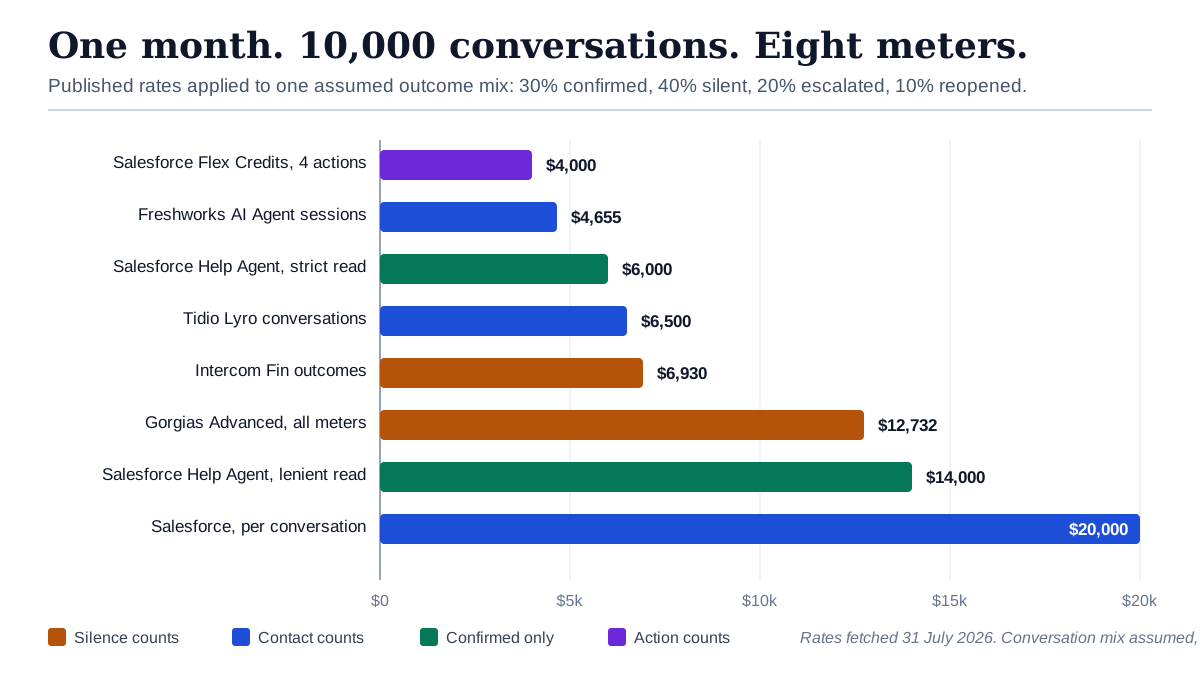
Same month of support volume, eight published meters, a five-to-one spread. Rates from vendor pricing pages, fetched 31 July 2026; conversation mix assumed.
Cost per confirmed outcome is the only comparable number
Divide the monthly bill by the number of conversations a human actually confirmed as solved. That single derived figure is the only one in this article that can be compared across vendors, because it is denominated in something none of them controls: your customers saying the problem went away.
| Meter | Sticker rate | Monthly bill | Cost per confirmed outcome | Multiple of sticker |
|---|---|---|---|---|
| Salesforce Flex Credits (assumed 4 actions) | $0.10/action | $4,000 | $1.33 | — |
| Freshworks AI Agent session | $0.49 | $4,655 | $1.55 | 3.2x |
| Salesforce Help Agent, strict | $2.00 | $6,000 | $2.00 | 1.0x |
| Tidio Lyro conversation | $0.65 | $6,500 | $2.17 | 3.3x |
| Intercom Fin outcome | $0.99 | $6,930 | $2.31 | 2.3x |
| Gorgias, all meters | $1.50 | $12,732 | $4.24 | — |
| Salesforce Help Agent, lenient | $2.00 | $14,000 | $4.67 | 2.3x |
| Salesforce per-conversation | $2.00 | $20,000 | $6.67 | 3.3x |
The pattern is the one that matters for procurement. The stricter the vendor's definition, the smaller the gap between its sticker price and its real price. Salesforce's Help Agent under the strict reading is the only row where the number on the price list is the number you pay per solved problem, and that is precisely because its published definition excludes escalation and negative feedback. The loosest definitions carry the largest multiples.
Two consequences follow, and they are the practical payoff of this whole piece.
First, a high sticker price with a tight definition can be cheaper than a low sticker price with a loose one. On this mix, $2.00 per confirmed resolution beats $0.99 per outcome and beats $0.49 per session. A procurement process that ranks vendors on the per-unit rate will systematically pick the wrong one, and will do so with a defensible-looking spreadsheet.
Second, the denominator is where your negotiating power sits. Every figure in the right-hand column moves with your confirmation rate, with one instructive exception. Lift explicit confirmations from 30% to 45% of volume, and every cost-per-confirmed-outcome in that table falls by roughly a third while the invoices barely change. Every one except the strict Salesforce reading, which is invariant at $2.00 by construction, because that bill is confirmations multiplied by the rate. A tight definition buys exactly that: the vendor cannot profit from your bad months, and you cannot profit from your good ones. It is also the same investment the service-quality argument recommends, arriving at the same place from the commercial direction, and the one time the two arguments agree.
A caveat on both tables: the Gorgias and Flex Credits rows carry a dash in the multiple column because they are not like-for-like. The Gorgias figure bundles a plan fee and a ticket meter; the Flex Credits figure prices actions, not conversations. Comparing their multiples to the others would be arithmetic without meaning.
What the vendors do not publish, and why that is a finding
Four of the vendors in this article publish a usage rate you can read without talking to a salesperson. The rest do not, and the pattern is informative rather than merely inconvenient.
| Vendor | Publishes the unit definition | Publishes the rate |
|---|---|---|
| Intercom | Yes, three explicit triggers | Yes, $0.99 |
| Zendesk | Yes, in detail, with the 72-hour rule and the LLM check | No |
| Salesforce | Yes for Help Agent and Flex Credits | Yes, $2.00 and $500/100k credits |
| Gorgias | Yes, with the 72-hour rule | Yes, $1.50 over quota |
| Freshworks | Yes, session and 72-hour email window | Yes, $49/100 |
| Tidio | Yes, one AI reply | Yes, from $32.50/50 |
| Zoho SalesIQ | Yes, idle-and-resume | Bundled only |
| Ada | Publishes an argument about definitions, not its own | No |
Nobody in this category publishes the number you actually want, which is the historical distribution of how their own billable units were triggered: what share of billed resolutions came from an explicit customer confirmation versus a timeout. That number exists in every one of these vendors' systems. None of them puts it on a public page. Ask for it in the RFP; the answer, including a refusal, tells you a great deal.
A source we could not verify. Gartner published a press release in January 2026 forecasting that generative-AI cost per resolution in customer service will exceed offshore human agent costs by 2030, and it is widely referenced in this debate. Gartner's site returned 403 to every fetch route available to us on 31 July 2026, so we have not read the release and we are not quoting its figures. The same applies to the FinOps Foundation's unit-economics material. If you need those numbers for a business case, go to the primary sources directly rather than relying on second-hand summaries, including ours.
Independent sourcing advisers are starting to publish on exactly this question. UpperEdge's Salesforce practice lead recorded an eighteen-minute breakdown of what "resolution" means under the pay-per-resolution model and where the risk sits for buyers:

The Unit Clause: seven lines to put in the contract
Everything above resolves into one procurement action: make the vendor define the billable unit in the agreement, not in a help-centre article. We call the resulting clause the Unit Clause, and it has seven lines. They are ordered by how much money each one has moved in the arithmetic above.
1. The definition lives in the contract. Reproduce the vendor's definition in the order form or an exhibit. A definition that lives only on a page the vendor controls is a definition it can revise on a Tuesday without telling you, and that is where every definition quoted in this article currently lives.
2. Three worked examples are attached as an exhibit. One confirmed resolution, one conversation where the customer went silent, one escalation to a human. Beside each, the invoice line it produces. This single artefact resolves more ambiguity than any amount of clause-drafting, because it forces the vendor to answer the silence question in writing rather than in a sentence with an or in it.
3. Silence is addressed by name. Does a customer who receives an answer and never replies produce a charge? If yes, after what window? A clause that does not use the word "silence" or an equivalent has not addressed the bucket that decides the bill.
4. Escalation is excluded, or priced. If a conversation that reached a human still bills as an automated unit, you are paying twice for one ticket. Either exclude it, or accept it knowingly and reduce the rate.
5. Reopening reverses the charge. If the same customer returns with the same issue inside an agreed window, the earlier charge is credited. Without this, a 72-hour timer means the vendor is paid for problems that came back on day four.
6. You get a per-unit usage export. A monthly file listing each billed unit and which definitional trigger fired it. You cannot audit a count you cannot see, and a vendor confident in its definition has no reason to withhold the log.
7. The definition cannot change mid-term without a price re-open. If the vendor amends what counts, you get the right to renegotiate the rate or terminate. This is the clause that turns the other six into something durable.
Nothing on that list is exotic. Every line is standard practice in metered-services contracting elsewhere, and what is new is only that the metered noun is now a judgement rather than a measurement. A kilowatt-hour and a gigabyte are defined by standards bodies. A resolution is defined by the party sending the invoice.
If you can only get one line, get line 2. A vendor that will attach three worked examples has effectively conceded lines 3 and 4, and a vendor that refuses has told you something important at no cost to you.
When to raise it, and what to do if you have already signed
Raise it at the RFP, when you are still one of several and the answer costs the vendor nothing. Get it into the order form before signature, because a definition agreed in an email during evaluation is not a definition you can enforce. And re-raise it at renewal, the point where you have the most room and the vendor most wants to keep the account.
If you are already mid-term, you cannot amend the definition unilaterally, but three of the seven lines are usually available without reopening the contract. Ask for the per-unit usage export as an operational request rather than a legal one; most vendors will provide it, and the ones that will not have told you something. Reconcile one month of it against your own ticket system and see whether the counts agree. And put the definition question on the renewal agenda now, with the reconciliation attached, rather than three weeks before the term ends. A single month of evidence that the count and your records disagree is worth more at a renewal negotiation than any argument made from a help-centre page.
The meters running beside the resolution meter
The resolution meter is rarely the only one. Budgeting from the per-unit rate alone understates most of these bills, and the additional layers are all published.
| Layer | Who charges it | Published figure |
|---|---|---|
| Per-agent seat subscription | Zendesk, Freshworks, Intercom | $55 and $115 per agent/month (Zendesk Suite Team and Professional, billed yearly); $19, $55, $89 per agent/month (Freshdesk); per-plan seat pricing at Intercom |
| Agent-assist copilot add-on | Zendesk, Freshworks | $50 per agent/month (Zendesk Copilot); $29 per agent/month (Freddy AI Copilot) |
| Ticket or conversation meter running alongside the AI meter | Gorgias | $0.40 or $0.36 per ticket past quota |
| Proactive and outbound messaging | Intercom | Proactive Support Plus $99/month including 500 messages |
| Voice actions at a premium to text | Salesforce | 30 Flex Credits per voice action versus 20 for standard |
| Per-user platform licence beneath the usage meter | Salesforce | Agentforce User License $5/user/month, which "Requires Flex Credits" |
Two of those deserve a note. Zendesk's Copilot add-on at $50 per agent per month sits on top of a $55 or $115 seat, which means agent assistance can cost close to as much as the seat it assists. And Salesforce's user licence is explicitly gated on Flex Credits, so the $5 line is a precondition for spending rather than a substitute for it.
There is also a cost that appears on no vendor's page: the internal work of checking the count. Somebody has to reconcile the usage export against the ticket system every month, and somebody has to run the dispute when the numbers disagree. Cost that work without a named owner and you have a governance gap rather than a budgeting one, the same gap we describe in our analysis of what enterprise AI actually costs beyond the licence.
When per-resolution billing is genuinely the better deal
This article is a warning about definitions in chatbot pricing, not an argument against outcome pricing. Outcome pricing is a real improvement over per-seat licensing for a support function, and there are cases where it is clearly the right structure.
When the definition is strict and published. A model that excludes escalation and negative feedback, like Salesforce's published Help Agent terms, genuinely aligns the vendor with you. If the agent does badly, the vendor is not paid. That is the promise outcome pricing makes, and some vendors keep it.
When your volume is spiky. Seat-based pricing makes you buy for the peak and pay for it in the trough. A usage meter of any family absorbs seasonality automatically, which for retail, travel and education support is worth a meaningful premium on the unit rate.
When you are early and small. Under a few hundred conversations a month the per-unit rate is noise against the platform fee, and the freedom to stop is worth more than the price per unit. Tidio's 50-conversation entry point and Freshworks' 500 included sessions exist for this case.
When you can move the denominator. If you have a maintained knowledge base and a support team that closes the loop with customers, your confirmation rate will be high, and outcome pricing rewards you for it. If your corpus is stale, a contact-counting meter is more honest about what you are buying, because you will be paying for the failures either way and at least you will see them.
When the vendor will attach the worked examples. This is the real test and it cuts across all the others. A vendor that will put three examples in an exhibit is selling a defined product. A vendor that will not is selling a discretionary count, and no rate is low enough to make that safe.
The case against is narrower than it looks, and it is not that outcome pricing is a trick. It is that an outcome-priced contract without a Unit Clause turns a procurement decision into a trust exercise, and trust is not a control.
Where LeapForce fits, and where it does not
LeapForce does not audit your chatbot vendor's invoice, and nothing in this article should be read as a product pitch for doing so. The Unit Clause is a contract you sign, not software you install.
What LeapForce does own is the layer underneath: when AI work moves from a personal subscription to a company system, someone has to be able to say what ran, who authorised it, what it touched and what it cost. Our observability and audit layer keeps a tamper-evident record of what agents actually did, including what was refused rather than only what succeeded, and our model routing sets budgets in dollars rather than tokens, hierarchically, with chargeback to the team that spent them. That is the same discipline this article asks of your chatbot vendor, applied to the AI you run yourself: a unit you define, a count you can see, and a bill you can attribute. Our rollout model is deliberately sequenced: observe first, enforce second, optimize third. A budget you cannot yet measure is a guess with a policy attached. The related pattern in workflow automation, where a dropdown inside a builder silently multiplies the invoice, is covered in our analysis of who sets your Zapier task multiplier.
Honest limits on this analysis
The conversation mix is assumed, not measured. The 30/40/20/10 split driving every bill in this article is our own illustrative distribution. We have not observed a real customer's outcome distribution, and a support organisation with a strong knowledge base and an explicit closing question will see a very different confirmation share. The arithmetic is the deliverable; the mix is a placeholder for yours.
Two readings of one vendor's terms are presented because the vendor has not resolved them. The strict and lenient Salesforce rows are both consistent with the published language. We do not know which one Salesforce bills. Treat the $8,000 gap as the size of the question, not as an accusation.
Chatbot pricing moves, and definitions move faster. Everything here was fetched on 31 July 2026. Every definition quoted lives on a page the vendor can edit without notice, which is the argument of the article and also a limitation of it. Re-check before you sign.
Enterprise rates are not public and are not modelled. Every vendor here discounts at volume, and several publish nothing. Nothing above predicts what you will be quoted.
Two recognisable sources are missing. Gartner and the FinOps Foundation both 403'd every fetch route available to us, so their material is excluded rather than paraphrased. A reader expecting an analyst forecast in a category-cost article should know it is absent by omission, not by oversight.
We have not run these products. No LeapForce first-hand usage of Intercom, Zendesk, Agentforce, Gorgias, Freshworks, Tidio, Zoho or Ada informs this piece. It is a documentation and arithmetic exercise, and the vendors' own words are quoted so you can check ours.
Frequently asked questions
Chatbot pricing comes in two layers. A platform or seat subscription of roughly $0 to $115 per agent per month, and an AI usage meter of $0.49 to $2.00 per unit. Published rates on 31 July 2026: Freshworks $0.49 per AI Agent session, Tidio about $0.65 per Lyro conversation, Intercom $0.99 per Fin outcome, Gorgias $1.50 per automated interaction past quota, Salesforce $2.00 per conversation or per Help Agent resolution. Zendesk and Ada do not publish AI rates.
It is the billable unit for an AI support agent, and the vendor decides. Zendesk defines it as an issue "successfully resolved without live-agent intervention", counted after 72 hours of inactivity with an AI relevance check. Gorgias counts an interaction as automated if no human was needed within 72 hours. Intercom counts an outcome when the customer confirms, when they do not ask for more help, or when a workflow completes. Three vendors, three different events, one word.
At several vendors, yes. Intercom's published definition counts an outcome when customers "don't ask for more help after Fin responds". Zendesk counts one after 72 hours of inactivity where the last interaction included no feedback, provided its AI evaluation confirms the response was relevant. Gorgias counts an interaction as automated when no human was required within 72 hours. Ada, arguing against the model, calls counting disengagement as success "abandonment with a different label". Ask this question first in any negotiation.
Not necessarily, and on our illustrative mix it is not. Applying each vendor's own definition to 10,000 conversations of which 3,000 are explicitly confirmed, $0.99 per Fin outcome works out to $2.31 per confirmed outcome, while $2.00 per Help Agent resolution under a strict reading works out to $2.00. The stricter the definition, the smaller the gap between the sticker and the real cost. Compare cost per confirmed outcome, never the sticker.
As of 31 July 2026: Intercom ($0.99 per Fin outcome), Salesforce ($2.00 per Help Agent resolution, $2.00 per conversation, $500 per 100,000 Flex Credits), Gorgias ($1.50 per automated interaction past quota), Freshworks ($49 per 100 sessions) and Tidio (from $32.50 per 50 conversations). Zendesk publishes its definition in detail but no rate. Ada, Sierra and Decagon publish neither. Treat "not public" as a finding about the sales process, not a gap in your research.
Seven lines, which we call the Unit Clause. The definition reproduced in the contract rather than referenced on a help page; three worked examples attached as an exhibit with the invoice line each produces; silence addressed by name with its window; escalations excluded or knowingly priced; reopened cases reversing the earlier charge; a monthly per-unit usage export naming which trigger fired; and no mid-term definition change without a price re-open. If you can only win one, win the worked examples.
Split your historical conversation volume into four buckets: explicitly confirmed solved, went silent, escalated to a human, and reopened or complained. Then apply each shortlisted vendor's published definition to those buckets to get a billable count, multiply by the rate, and divide by the confirmed bucket. That last number is your real unit cost. Do it for every vendor on the shortlist before you look at a discount schedule, because the discount is usually smaller than the definitional spread.
It is more predictable and less aligned. Per-conversation billing, as used by Salesforce's conversation rate, Tidio, Freshworks and Zoho SalesIQ, charges for every interaction whether or not the customer was helped, so you pay for the failures. The count is unambiguous, though, and you can forecast it from traffic alone. Per-resolution billing can be cheaper and better aligned when the definition is strict, and considerably worse when it is loose. The deciding factor is the definition, not the family.
It depends entirely on the vendor. Salesforce publishes that there is no charge if the customer asks for a human or gives negative feedback. Gorgias charges "only a ticket fee" when its AI hands over. Intercom's third published trigger counts an outcome when a workflow completes "including handoffs", which reads as though at least some handed-over conversations can bill. Get the answer in writing, because paying an AI unit and a human's time for one ticket is the most expensive failure mode in this category.
Unless your contract says otherwise, in practice yes. Every definition quoted in this article lives on a vendor-controlled page rather than in a standards document. That is why line 7 of the Unit Clause ties any change to a price re-open or termination right. It is also why line 1 matters: a definition reproduced in your contract is one the vendor has to come back to you to amend.
At low volume, chatbot pricing is dominated by the platform fee and the unit rate barely matters. Tidio's Free tier is $0 and its Starter plan is $24.17 per month, with Lyro sold standalone from $32.50 per month for 50 conversations. Freshdesk starts at $19 per agent per month with the first 500 AI sessions included, which is the largest included AI allowance published in this comparison. Below a few hundred conversations a month, choose on fit and exit cost rather than on per-unit price.
Under a strict definition, yes, and that is the point of the model: Salesforce publishes that a conversation ending in escalation or negative feedback is not charged. Under a loose definition the incentive inverts, because a customer who gives up and leaves can be counted as a success and billed. That inversion is why the silence question is the first one to ask, and it is where this billing argument touches the service-quality one we make in deflection is not resolution without duplicating it.
Ready to Govern Your AI?
Talk to LeapForce — one controlled layer for every AI tool, connector, model, and agent.
Comments