
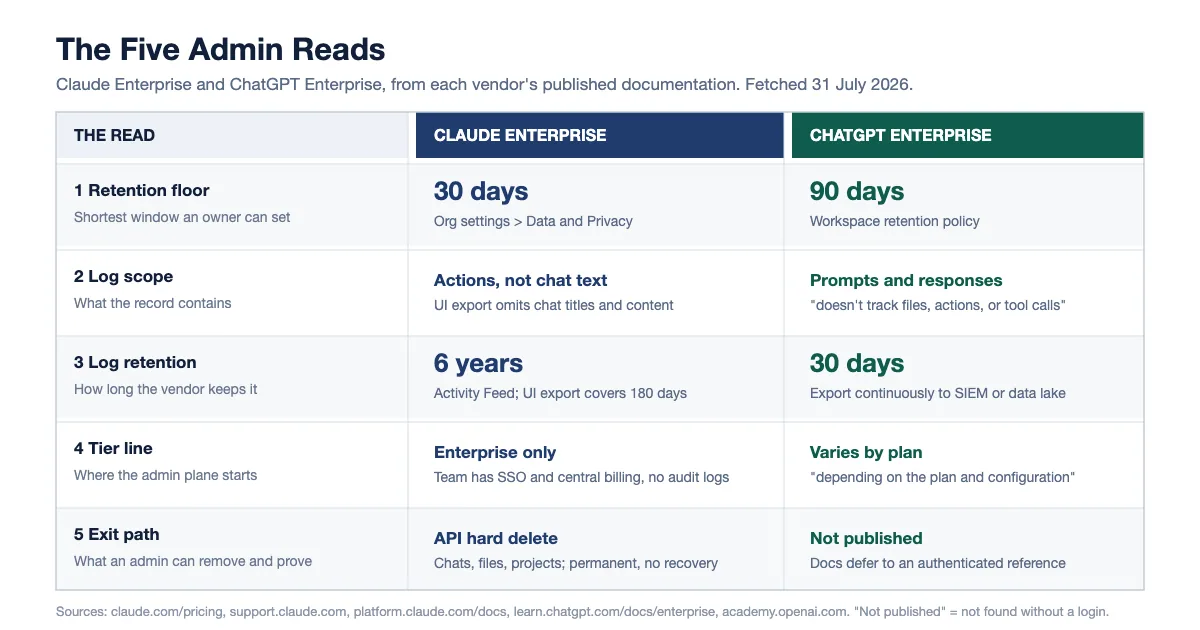
For an enterprise seat purchase, Claude vs ChatGPT comes down to five published admin numbers, not model quality. Claude Enterprise lets an owner set retention as low as 30 days; ChatGPT Enterprise's documented floor is 90. Claude's activity feed keeps six years of events; OpenAI's compliance logs keep 30 days. Neither logs everything.
Our position is narrow and deliberate: the seat product is an administrative purchase, and the Claude vs ChatGPT comparisons we read while researching this piece answer a different question — which model writes better prose or cleaner code. That question is genuinely contested and we are not going to pretend to settle it. The question a security reviewer has to sign off on is what the admin console gives them, and both vendors publish enough to answer it. Writing on Hacker News on 24 July 2026, a commenter posting as thewebguyd argued that a team-tier AI seat sets connector read/write permissions for the whole team rather than per user, and concluded that "the enterprise controls are sorely lacking first party" — a complaint about the console, not the model.
The short answer: Compare the admin plane, not the model — Claude Enterprise publishes a shorter retention floor (30 days vs 90), a far longer audit window (6 years vs 30 days) and self-service content export and deletion, while ChatGPT Enterprise logs the one thing Claude's UI audit export deliberately omits, the prompts and responses themselves.
Last updated: July 31, 2026.
Why the admin plane is the real comparison
The admin plane is the set of controls an administrator gets over a seat product: how long conversation data is kept, what is written to an audit record, who can read that record and for how long, how identity is provisioned and revoked, and what an owner can pull back or destroy when someone leaves. It is a different purchase from the API. When a company buys seats, it is buying a place where employees paste customer data, contract drafts and incident notes. The controls over that place are published, dated, and comparable in a way that model quality is not.
We will say plainly what this article does not do. It does not rank Claude and ChatGPT on output quality. We have not run evaluations, we do not publish a benchmark, and a ranking asserted without one is the exact thing that makes a comparison useless six weeks later when the next model ships. Capability claims move monthly. The retention floor an owner can set has to survive a three-year contract and an auditor.
That distinction matters more than it used to, because the seat product stopped being a chat box. Both vendors now ship connectors into corporate systems, agent surfaces that take multi-step actions, and code tooling that runs on developer machines. OpenAI's own ChatGPT Work admin FAQ tells administrators that "residency, retention, logging, and feature availability vary by plan, region, surface, and connected system, so confirm coverage for your configuration." That is a vendor telling you the answer is configuration-dependent, which is a fair warning, and also the reason a generic "which is better" verdict cannot be the output of a procurement review.
The framework we use below is deliberately small. We call it the Five Admin Reads: five questions, each with a published answer or a documented silence. Five is the number a security reviewer can actually run before a renewal date. Where a vendor does not publish an answer, the silence is the finding. We record it rather than inferring a number that would be corrected in the first call with the vendor's solutions engineer.
Two notes on method before the numbers. Every figure below was fetched from the vendor's own documentation on 31 July 2026 and is dated in the source table; both vendors flag their own documentation as current-state rather than fixed, so re-read the source before you rely on a number here. And we have not administered either console ourselves — this is a documentation read, not a first-hand deployment report, and we would rather say so than imply an operator's experience we do not have.
At a glance: the admin plane side by side
Here is the whole Claude vs ChatGPT admin comparison in one table. Every cell is a quote or a direct paraphrase of the vendor's published documentation, fetched 31 July 2026. "Not published" means we could not find the answer on a page reachable without a login, not that the capability is absent.
| Admin control | Claude Enterprise | ChatGPT Enterprise |
|---|---|---|
| Shortest retention an owner can set | 30 days, set in Organization settings > Data and Privacy | 90 days, per OpenAI's admin governance resource |
| Default retention if nothing is set | "retained indefinitely unless a custom retention period is set" | "chats are saved indefinitely to the user's account until they delete them" |
| Self-service audit log export | Yes, UI export covering the past 180 days | Not published as a UI export; export runs through the Compliance API |
| Audit/activity retention via API | 6 years, queryable within 1 minute of the event | 30 days on the Compliance Logs Platform |
| Does the log carry prompt and response text? | Not in the UI audit export; yes through separate Compliance API content endpoints | Yes — "user prompts and agent responses" |
| Does the log carry files, actions, tool calls? | Activity Feed records "every authentication, chat, file, project, administrative, and platform action" | "It doesn't track files, actions, or tool calls" |
| SSO | On the Team plan card; Enterprise inherits it as "all Team plan features, plus" | Listed among identity features, "depending on the plan and configuration" |
| SCIM provisioning | Enterprise only | Listed, with identity-group synchronisation, same plan caveat |
| Role-based access control | Enterprise ("fine grained permissioning") | Built-in Owner, Admin and Member roles, plus RBAC |
| Customer-managed encryption keys | Enterprise, opt-in, US regions only | Not published on the pages we could reach |
| IP allowlisting | Enterprise | Not published on the pages we could reach |
| Training on business content by default | No, on commercial plans | "OpenAI does not use business customer content from ChatGPT Enterprise and ChatGPT Business to train its models" |
| Hard delete of a specific chat by an admin | Yes, via Compliance API delete endpoints | Not published on the pages we could reach |
Two lines in that table do most of the work, and they point in opposite directions. Anthropic's UI audit export deliberately excludes conversation content; OpenAI's compliance logs are conversation content and explicitly exclude actions and tool calls. If your control objective is "reconstruct what the assistant did," neither log answers it on its own.
Read 1: the retention floor you can actually set
The shortest data retention policy an administrator can configure is 30 days on Claude Enterprise and 90 days on ChatGPT Enterprise, according to each vendor's published documentation. If your records policy says employee-generated working material is destroyed after 60 days, one of those two products can comply with a setting and one cannot.
Anthropic's help documentation on organization data retention controls states that "by default, data is retained indefinitely unless a custom retention period is set," that "the minimum retention period is 30 days, and each month is counted as 30 days," and that the control sits with the Primary Owner or an Owner under Organization settings. The clock is anchored per object: for chats it runs from the last message in the conversation, for projects from the last time the project was updated. Deletion "occurs at midnight UTC on the scheduled day," and "data past its retention period will be permanently deleted and cannot be recovered."
There is a detail in that documentation worth reading twice before anyone touches the setting. Shortening the window does not schedule a future cleanup — "any data that falls outside the new retention period will be deleted immediately upon saving." An owner who types 30 into that field on a workspace that has been running for a year destroys eleven months of work at the moment they click save. That is documented behaviour, not a bug, and it is the kind of thing that belongs in a change ticket with a second approver.
On the OpenAI side, the OpenAI Academy admin resource on data governance and compliance states that by default "chats are saved indefinitely to the user's account until they delete them," that Enterprise Owners can set a custom retention policy with "a minimum of 90 days," and that shorter retention can degrade the product experience because chat history is what makes prior conversations referenceable. That last point is honest and worth conceding: a short retention window is a real usability cost, not a free win.
One caveat on that 90-day figure, because it decides a procurement: we found it on one OpenAI-operated page. The ChatGPT Work admin FAQ confirms that retention is governed by "the ChatGPT workspace plan, administrative settings, and the capabilities in use" but does not restate the number, and OpenAI's help centre — where the number is most likely restated — returned 403 to every fetch we attempted. Treat 90 days as a single-sourced figure and confirm it in writing before it goes into a policy document.
The two defaults are functionally the same — indefinite until someone acts. The floors are not. Sixty days sits between the two floors, so any policy that lands there is reachable on one product and not the other. If your legal team has already written that number into a policy, this single row decides the procurement, and no amount of model quality changes it.
| Retention question | Claude Enterprise | ChatGPT Enterprise |
|---|---|---|
| Default | Indefinite until a policy is set | Indefinite until the user deletes |
| Shortest configurable window | 30 days | 90 days |
| Who can change it | Primary Owner or Owner | Enterprise Owner |
| Clock anchor | Last message (chats), last update (projects) | Not published on the pages we could reach |
| Effect of shortening the window | Out-of-window data deleted immediately on save | Not published on the pages we could reach |
| Recoverable after expiry | No | Not published on the pages we could reach |
Read 2: what each log actually records
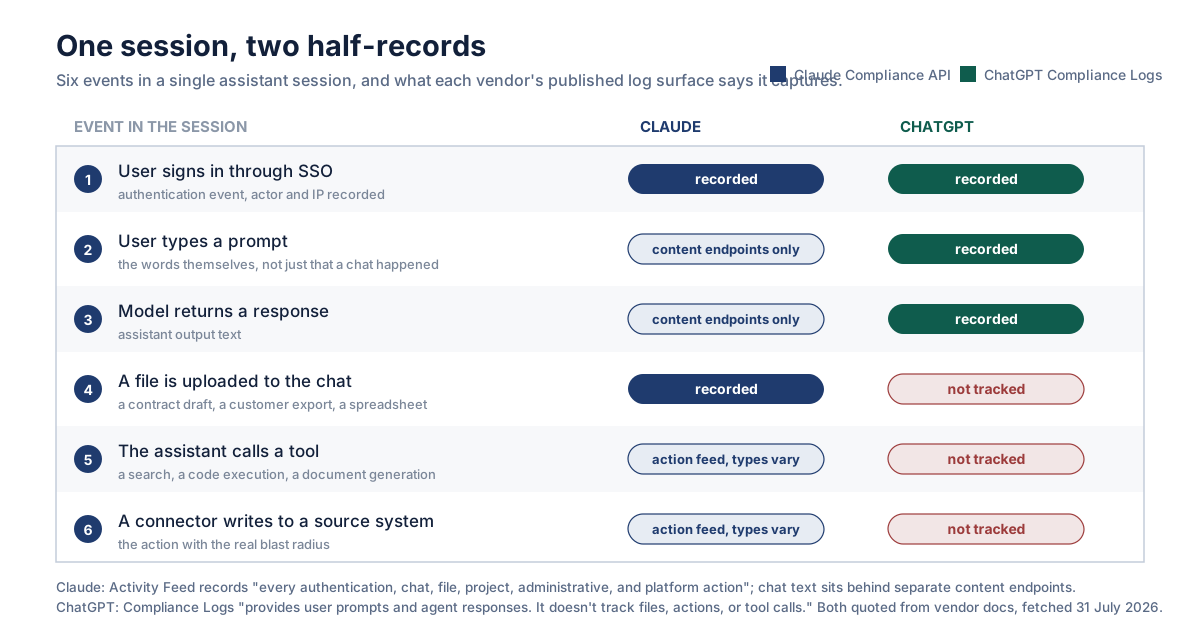
This is the read that changed how we framed the whole article, and it is the strongest reason to look at the admin plane rather than the model. The two vendors log opposite halves of the same session.
Anthropic's help centre article on accessing audit logs says plainly that "audit logs are available for Enterprise organizations only," that an Organization Owner or Primary Owner exports them from Organization settings > Data and Privacy, and that the export covers the past 180 days, and it lists the event types it carries — sign-in through SSO, Google and Apple, project creation and deletion, project visibility changes, user invitations and removals, and SSO configuration changes. It also says what is not in that export: chat and project titles and content are excluded, and only unique identifiers appear. Claude Enterprise audit logs, in their self-service export form, tell you who did what to the organisation. They do not tell you what anyone said.
OpenAI's ChatGPT Work admin FAQ answers the same question from the other end. Asked directly whether prompts, outputs, files, actions or tool calls are logged, it answers: "The Compliance Logs Platform provides user prompts and agent responses. It doesn't track files, actions, or tool calls." Elsewhere the same page says "the Compliance API covers all user messages and responses across Chat, Work, and Codex." So the OpenAI record is the conversation, and it is explicitly not the actions taken around the conversation.
Anthropic covers the action half through a second, separate surface. The Compliance API Activity Feed documentation states that the feed "records every authentication, chat, file, project, administrative, and platform action that occurs in your organization," that activities are "queryable within 1 minute of occurring," and that the feed "produces hundreds of distinct activity types." Each activity carries an actor union that distinguishes a signed-in user from an API key, an admin API key, an unauthenticated pre-sign-in event, an Anthropic operator, and — usefully for offboarding forensics — a scim_directory_sync_actor representing a change pushed by Okta, Microsoft Entra ID or a similar identity provider.
We did not enumerate the full activity-type list, which lives in Anthropic's API reference, so we are not going to claim the feed captures every tool call by name. What the documentation supports is narrower and still decisive: Anthropic publishes an event stream with named action types and a distinguished actor model, and OpenAI's public admin FAQ states that its compliance logs do not track actions or tool calls.
OpenAI is careful about this in its own words, and the caution is worth quoting because it is good advice regardless of vendor. The same FAQ tells administrators to "review the current schemas before promising coverage of particular prompts, files, approvals, actions, errors, or tool calls." Read that as written: do not promise your auditor coverage you have not confirmed against the live schema. That instruction applies to both products.
The practical consequence is a gap that does not appear on either feature matrix. If an agent surface reads a customer record from a connected CRM, drafts an email and posts to a channel, the question after the fact is not "what did the model say" but "what did it touch." On one product that question is answered by an action feed with no conversation content; on the other it is answered by a conversation record that does not track the actions. This is the same structural point we made in our earlier analysis of AI observability and audit trails: the record you need after an incident is rarely the record the product was designed to keep.
Read 3: how long the record survives
Audit retention differs by a factor of roughly seventy between these two products, and the shorter one comes with an explicit instruction to build a pipeline.
Anthropic's Compliance API Activity Feed documentation states that activities "are retained for 6 years." The self-service UI export is a different, shorter surface: it covers "the past 180 days," and the emailed download link is "active for 24 hours." OpenAI's ChatGPT Work admin FAQ states that "the Compliance Logs Platform retains data for 30 days" and instructs administrators to "export records continuously to an approved electronic discovery, data loss prevention, SIEM, or data-lake system when your organization requires longer retention."
That second sentence is not a footnote. It is a requirement passed to the buyer. Thirty days of vendor-side retention means the durable record is whatever your team builds and keeps running — a scheduled export. A landing zone. Monitoring on the exporter, and someone who notices when it stops. The cost of the seat is the licence; the cost of the record is an integration with an owner and an on-call rotation.
Log retention is one of the few areas here with genuinely authoritative outside guidance to lean on. NIST's SP 800-92 Rev. 1 (Initial Public Draft), Cybersecurity Log Management Planning Guide, published 11 October 2023, frames log management as a planning exercise that includes "ensuring that records are stored for the required period of time." That is exactly the obligation a 30-day vendor window transfers to you. The framing in NIST's AI Risk Management Framework, released as AI RMF 1.0 on 26 January 2023 and organised around the Govern, Map, Measure and Manage functions, puts the same duty under Govern: the organisation deploying the system owns the accountability structures, not the model provider.
| Record | Window | Where it lives |
|---|---|---|
| Claude Compliance API Activity Feed | 6 years | Anthropic, queried by API |
| Claude UI audit log export | 180 days | Anthropic, exported to an emailed link valid 24 hours |
| ChatGPT Compliance Logs Platform | 30 days | OpenAI, exported continuously to your own system |
| Either vendor, beyond the above | As long as you keep it | Your SIEM, data lake or eDiscovery store |
One practical read of the table: if your organisation cannot commit to running an export pipeline, the vendor with the longer native window is the safer buy, because the record still exists when someone finally asks for it eleven months later. If you already run a SIEM with mature ingestion, the difference narrows sharply and other rows should decide.
Read 4: the tier line, and what the cheaper seat leaves out
Both vendors gate the admin plane behind the top tier. That matters because the tier a department can buy on a card and the tier that carries the audit controls are not the same tier, on either product.
On the Claude side the line is published and easy to read. Fetched from claude.com/pricing on 31 July 2026, the Team plan is listed at $20 per seat per month billed annually ($25 monthly) for a standard seat and $100 per seat per month annually ($125 monthly) for a premium seat, "for teams of 2 to 150." The Team plan card lists "central billing and administration," "single sign-on (SSO)," "admin controls for remote and local connectors," "enterprise search across your organization" and "enterprise deployment for the Claude desktop app." The Enterprise card opens with "all Team plan features, plus" — and that "plus" list is the admin plane: spend limits set by admins, "role-based access with fine grained permissioning," SCIM, audit logs, "compliance API for observability and monitoring," custom data retention controls, network-level access control, IP allowlisting, and a HIPAA-ready offering. Anthropic's own help centre confirms the gate from the other direction: "audit logs are available for Enterprise organizations only."
Commenting on Hacker News on 27 May 2026, a reader working through the same pricing page reached the identical conclusion after an edit to their own post: that the "enterprise" feature matrix carries the audit and compliance controls while the Team plan is otherwise the better value for a business. That is the honest shape of it. Team is a good seat. It is not a governed seat.
We are not putting a ChatGPT seat price next to those figures, and the reason is the same one that runs through this whole article: OpenAI's pricing pages returned 403 to every automated fetch we attempted on 31 July 2026, and we do not quote a number we could not read at its source. Get it from the vendor. The structural point below does not depend on it.
OpenAI publishes the same structure with less numeric detail on the pages we could reach. The ChatGPT Work admin FAQ describes identity features that "can include SSO, domain verification, SCIM provisioning, user lifecycle management, and identity-group synchronization" but qualifies them with "depending on the plan and configuration." It notes that "eligible Enterprise and Edu admins can set monthly per-user limits" while "Business follows a separate credit and spend-control model." And on privacy commitments it names ChatGPT Enterprise specifically: "no training on business data by default, encryption in transit and at rest, workspace-level access controls, and supported audit logging."
The word "supported" is doing quiet work in that sentence, and the same page adds that "coverage for data residency, inference residency, FedRAMP, HIPAA, or a Business Associate Agreement isn't universal." Both statements are appropriate hedges from a vendor whose product surface changes weekly. They are also, from the buyer's side, an instruction: get the specific coverage for your specific configuration in writing before signing, because the marketing page and the contract are not the same document.
The tier line has a second-order effect worth pricing separately from the seat difference. When the governed tier is expensive and the ungoverned tier is a card swipe, teams buy the ungoverned tier and IT finds out later. That is the mechanism behind shadow AI inside companies that already pay for an approved tool. Price the governed tier for the whole population, not just for the security team's pilot, and compare that against what a discovery-and-remediation exercise costs you.
Read 5: the exit path, from deprovisioning to hard delete
The exit path is three separate mechanisms, and the first one is the only one that produces a visible change in the product. Revoking access is not the same as removing data, and removing data is not the same as being able to prove it was removed.
Start with identity. OpenAI's admin FAQ is unusually direct about the failure mode: "for SCIM-managed users, remove access at the identity provider; otherwise, a later synchronization can provision the user again." That is the classic offboarding bug written down by the vendor. Remove the seat in the product, and the next directory sync quietly puts it back. The groups and provisioning documentation adds the second half of the boundary: "SCIM provisions workspace membership and group assignments. It doesn't grant permissions in GitHub, Google Drive, Slack, or another connected system." Cutting the assistant seat does not cut what the assistant's connectors were authorised to reach.
Then data. On Claude Enterprise, a departing user's conversations fall under the organisation's configured data retention policy, which is the same setting from Read 1 — chats are deleted a set number of days after their last message, permanently, at midnight UTC. On ChatGPT, the admin FAQ states that retention and deletion "are governed by the ChatGPT workspace plan, administrative settings, and the capabilities in use," which is a pointer rather than a number, and it routes the reader to the help centre for the specific behaviour.
Then targeted removal, which is where the two products diverge most sharply on the pages we could read. Anthropic's Compliance API content documentation exposes hard-delete endpoints for chats, files, project documents and entire projects, available "only to Claude Enterprise organizations," gated behind a delete:compliance_user_data scope that is granted separately from the read scope. The documentation is blunt about the consequences: "Every successful delete is permanent and immediate. There is no recovery window." It also distinguishes soft from hard deletion in a way that matters for an investigation. A chat a user deleted in the app "remains visible through the Compliance API with deleted_at populated," while a hard-deleted chat is not retrievable at all. So an administrator can see that a user tried to remove something, which is often the more interesting fact.
The same endpoints are described as supporting "eDiscovery (electronic discovery) exports, data loss prevention (DLP) enforcement, and account-deletion responses," and there is an operational trap documented for anyone scripting it: a project cannot be deleted while chats remain attached, and the API returns a 409 conflict until you detach or delete them first.
We did not find an equivalent published admin-triggered hard-delete endpoint for individual ChatGPT conversations on the pages we could reach. That is a gap in our reading, not a proven absence — OpenAI's public docs repeatedly defer to an authenticated Admin API reference, and we could not open it. It is exactly the question to put on the vendor call.
A workable exit test, and one you can run in a trial workspace before the contract is signed: create a conversation with a distinctive marker string, attach a file, invoke a connector, then deprovision the user at the identity provider. Twenty-four hours later, ask four questions. Is the seat still gone after a directory sync? Does the audit record show who removed them, and when? Can you retrieve the conversation and the file? Can you destroy them and evidence the destruction? Any product where you can answer all four has an exit path. The fourth is the one to plan time for, because evidencing a deletion is a separate capability from performing one, and on the pages we could read, only one of the two vendors documents an endpoint for it.
The CMEK trade-off: your key, minus your audit export
This is the finding we did not expect, and it is the single best argument for reading the admin documentation rather than the feature matrix.
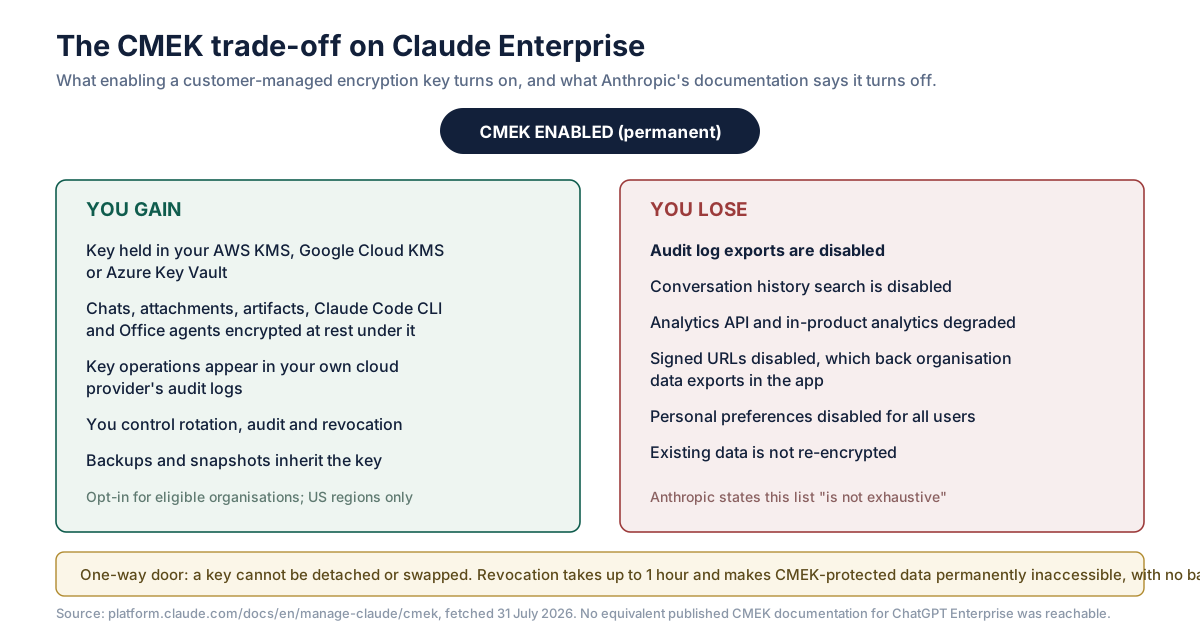
Anthropic offers customer-managed encryption keys on Claude Enterprise: you provision a key in AWS KMS, Google Cloud KMS or Azure Key Vault, and Anthropic uses it to encrypt workspace data at rest. On paper that is the strongest data control on either product. The CMEK documentation then lists what stops working when it is enabled, and the list includes the thing a compliance team probably bought the tier for: "audit log exports are disabled."
The rest of the list is substantial. Conversation history search is disabled, because titles are encrypted and searching by title or content returns nothing. Search across large numbers of files is slower. "The Analytics API and in-product analytics are degraded," with some usage views incomplete. Signed URLs for temporary file exchanges are disabled, and those signed URLs are what back organisation data exports in the app. Personal preferences are switched off for every user in a CMEK-protected organisation. Anthropic states explicitly that the list "is not exhaustive."
The commitment is also one-way. "Enabling CMEK is permanent," the documentation says. A key cannot be detached or swapped once attached; switching to a different key requires a new workspace and a data migration. "CMEK only protects data written after the key is enabled" — existing chats, files and sessions stay under Anthropic-managed keys and are not re-encrypted. Revocation takes up to an hour to propagate because of a cache TTL, and "revoking or disabling the key makes all CMEK-protected data in that workspace permanently inaccessible, with no backout path." The feature is currently available in US regions only, and the KMS itself bills separately from your seats.
None of that makes CMEK a bad control. It makes it a control with a cost that is not on the pricing page, and the cost is paid in observability. An organisation that enables CMEK to satisfy one clause of a data-protection requirement can find it has broken the audit-export capability it relies on for a different clause. On the Claude Platform side, Anthropic addresses the same tension the other way round. Activity feed, audit logs and telemetry are deliberately not encrypted under your key, the documentation says, "so customers can maintain compliance even if a key is revoked."
We could not find published CMEK documentation for ChatGPT Enterprise on any page we were able to fetch. Third-party write-ups describe it as available; we are not citing them, because a control this consequential should be read from the vendor, and "not published where we could read it" is the honest state of our evidence.
Connectors, DLP and the actions nobody inspects for you
Neither vendor, on the documentation we could reach, offers native inline data-loss-prevention inspection of prompts as an admin toggle. Both instead give you an export path and expect DLP to happen in your own stack. That is a defensible design, and it is also a budget line that appears nowhere on Anthropic's pricing page; OpenAI's we could not read.
OpenAI's position is stated as an instruction: export compliance records continuously "to an approved electronic discovery, data loss prevention, SIEM, or data-lake system." Anthropic's compliance content endpoints are described as supporting "data loss prevention (DLP) enforcement." Again: enforcement you perform, using content the API hands you. In both cases the vendor's contribution is the feed. The inspection, the policy, the blocking and the alerting are yours.
Where both vendors do offer real, native control is connector scope. OpenAI's apps and connectors documentation describes enabling "reviewed connectors" and assigning access by workspace role, and for connectors that support action control, allowing "read-only actions or an approved custom set, including how the workspace handles newly added actions." That last clause is the one to read carefully: a connector that gains new actions in a vendor update is a permission change you did not approve, and the workspace's default handling of newly added actions decides whether that lands silently. The same documentation separates plugin availability, bundled skills, connector access, connector actions, source authorisation and runtime permissions into distinct control surfaces, and says admins govern plugin availability, connector access, connector actions and permissions, provider authorisation and runtime policy "independently." Independent switches mean more than one place a permission can be left open, which is a runbook problem as much as a product one.
OpenAI's managed configuration documentation draws the boundary between policy and access in a sentence worth borrowing for your own runbook: managed configuration "doesn't grant ChatGPT workspace access, assign seats, or replace workspace role-based access control (RBAC)." Runtime policy and identity are separate systems, and a control in one does not compensate for a gap in the other.
For a practitioner walkthrough of how connector and data-access changes land in a real ChatGPT Enterprise tenant, the data-security vendor Varonis published a session on the 2025 changes to connectors and data access. It is vendor content and should be read as such, but it is specific about the admin surfaces rather than the model:

The through-line across all of this is the one we keep arriving at: the connector, not the model, is where the blast radius lives. Reviewing an assistant's model card tells you nothing about which systems it can write to. Reviewing the connector matrix tells you almost everything, which is why it belongs in the same review as the questions worth asking in an AI vendor security assessment.
Choose Claude Enterprise if, choose ChatGPT Enterprise if
Here is the Claude vs ChatGPT decision, stated as commitments rather than considerations. Each branch traces to a published fact above.
Choose Claude Enterprise if your records policy needs a retention window shorter than 90 days; if you need a long native audit window and cannot commit to running a continuous export pipeline; if an administrator must be able to hard-delete a specific conversation, file or project on request and evidence it; if you want customer-managed encryption keys under a US-region deployment and have read the disabled-feature list; or if soft-delete visibility — seeing that a user tried to remove something — is part of your investigation model.
Choose ChatGPT Enterprise if the record you need is the conversation itself rather than the action trail; if you already run a SIEM or eDiscovery store with mature ingestion, which turns the 30-day window from a liability into a non-issue; if identity-group synchronisation and RBAC assigned by group is how your organisation manages every other tool; or if the connector surface you need is one OpenAI has reviewed and yours is a Microsoft-shaped estate where that ecosystem alignment carries real integration weight.
Neither product clears the bar if your requirement is an inline policy engine that inspects and blocks a prompt before it reaches a model, or a single audit record that carries both the conversation and the actions taken around it. On the documentation we read, that record does not exist as a vendor feature on either side. It is assembled, by you, from two feeds, or it is bought at a different layer.
When the incumbent still wins. If your organisation already runs a tenant-native assistant embedded in the productivity suite it has governed for a decade, the honest comparison is not Claude against ChatGPT. It is either of them against a tool whose identity model, retention policy and audit trail your team has already operationalised. The commenter quoted at the top of this article closed on a version of that trade-off, crediting Microsoft with investment in agent governance and identity while being blunt about the assistant itself. Migrating governance is expensive and rarely shows up in the seat-price comparison.
And the "use both" answer deserves scrutiny. Running two seat products doubles the admin plane: two retention policies, two audit surfaces with different scopes and windows, two connector matrices, two offboarding paths that must both be exercised. There can be good task-fit reasons to do it anyway. Just cost it as two governance programmes rather than one, because that is what it is.
Where this comparison is uncertain
This Claude vs ChatGPT comparison is a documentation read performed on one day, and several things about it are worth flagging before anyone acts on it.
We have not administered either console. Every number above comes from vendor documentation fetched on 31 July 2026, not from operating a tenant. A published minimum and a minimum that behaves as documented under load are not automatically the same thing, and we cannot speak to the second.
Our access to OpenAI's own documentation was uneven. openai.com, help.openai.com, chatgpt.com and trust.openai.com all returned HTTP 403 to our automated fetches on 31 July 2026, and the browser fallback we normally use for those hosts was unavailable during this run. Everything we cite for ChatGPT therefore comes from OpenAI-operated properties that did respond — learn.chatgpt.com and academy.openai.com. Several of those pages explicitly defer to the help centre or to an authenticated Admin API reference for the current schema, retention and permission details. So a number of "not published on the pages we could reach" entries in our tables would very likely be answered by a logged-in reviewer. Treat them as open questions for the vendor call, not as absences.
That asymmetry cuts a second way, and it is a legitimate procurement observation rather than a criticism: Anthropic publishes retention minimums, audit-log scope, the 180-day export window, the six-year activity retention and the full CMEK disabled-feature list on pages an anonymous reader can open. On the pages we could reach, OpenAI's corresponding detail is behind a login. Neither approach is wrong. But a security reviewer who wants to read the controls before the first sales call will get further with one than the other, and that is a real difference in how the two products can be evaluated.
Every figure here is a snapshot of a settings page, and both vendors say so in their own documentation. OpenAI tells administrators to "review the current schemas" and, on its roles and workspace permissions page, to use the help centre "for the current permission list." Anthropic tells integrators to "build forward-compatible handlers" so an integration "keeps working when new activity types ship," says CMEK is "currently available in US regions only," and states that its list of features CMEK disables "is not exhaustive." Re-fetch every figure against the source links before you put it in a decision memo, and note the date you did it.
We deliberately did not rank the models. For some readers output quality genuinely is the deciding factor. This article does not help those readers, and they should be reading a benchmark with a published methodology and a date, not a comparison post.
Finally, where any of this touches a legal obligation — a retention duty, a records-management requirement, a regulated-industry rule, a data-transfer question — the reading above is not legal advice and is not a substitute for counsel. The published numbers are facts you can hand to a lawyer. What they require of you is their call, not ours.
The layer that sits above both seat products
There is a version of this comparison that ends by picking a winner, and a more useful version that notices the shape of the problem. Both vendors give you a good admin plane for their own seat, and neither gives you one for your organisation's AI as a whole. The retention policy governs Claude conversations or ChatGPT conversations; it does not govern the assistant embedded in the CRM, the model called from a data pipeline, or the agent a team built last quarter. The audit surface is per-product. So is offboarding.
That is the gap LeapForce builds for: one controlled layer across every AI tool, connector, model and agent, so that identity, policy, cost and audit are answered once rather than per vendor. Our own rollout model for the gateway is deliberately sequenced — observe first, enforce second, optimize third — because turning on enforcement before you can see what people are actually using is how governance programmes lose the room. LeapForce does not replace a Claude or ChatGPT seat and does not change either vendor's retention floor; those remain exactly what their documentation says. What it changes is whether you have to read two admin consoles, in two schemas, to answer one question from an auditor. If you want the mechanics of that layer, our earlier writing on what an AI gateway is and what it governs covers the API side, and the observability and audit and access and identity platform pages cover the rest.
One note on scope, since this article is about seats: swapping the model behind an API is a different exercise with different gates, and we have written that up separately as a four-gate migration. Nothing in this comparison is about the API layer.
Frequently asked questions
Neither, as a general claim, and any Claude vs ChatGPT article that answers that question without naming a benchmark and a date is guessing. On the admin plane, which is what an enterprise purchase actually turns on, they differ in specific and published ways: Claude Enterprise offers a 30-day retention floor against ChatGPT Enterprise's documented 90, a six-year activity feed against a 30-day compliance log, and admin-triggered hard deletion of individual conversations. ChatGPT Enterprise logs the prompts and responses themselves, which Claude's UI audit export deliberately excludes. Pick on which of those your control objectives need.
According to OpenAI's ChatGPT Work admin FAQ, the Compliance Logs Platform "provides user prompts and agent responses," and the Compliance API "covers all user messages and responses across Chat, Work, and Codex." So conversation content is available to the workspace through that surface. Separately, the same documentation says the compliance logs do not track files, actions or tool calls. On Claude Enterprise the split runs the other way: the UI audit log export excludes chat titles and content, but the Compliance API's content endpoints let an Enterprise organisation retrieve chats, messages, files and artifacts. On both products, assume a workspace administrator can reach what you type.
Thirty days on Claude Enterprise, per Anthropic's help documentation, which states that "the minimum retention period is 30 days" and that data past its retention period "will be permanently deleted and cannot be recovered." Ninety days on ChatGPT Enterprise, per OpenAI's Academy admin resource on data governance. Both default to indefinite retention if nobody sets a policy. On Claude, note that shortening the window deletes out-of-window data immediately when you save, not on a future schedule. Treat that setting as a destructive change with an approver.
No. Claude Enterprise audit logs are exactly that. Anthropic's help centre states that "audit logs are available for Enterprise organizations only," and the pricing page lists audit logs, SCIM, role-based access with fine-grained permissioning, the Compliance API, custom data retention controls and IP allowlisting under Enterprise as additions to the Team feature set. Team does include single sign-on, central billing and administration, and admin controls for remote and local connectors. If a department bought Team seats and your security review assumes an audit trail exists, check the plan before the review, not after.
It depends entirely on the surface, and the spread is wide. Anthropic's Compliance API Activity Feed retains activities for six years and makes them queryable within a minute of the event; its self-service UI export covers the past 180 days, delivered as a download link valid for 24 hours. OpenAI's Compliance Logs Platform retains data for 30 days, with the documentation instructing administrators to export continuously to an eDiscovery, DLP, SIEM or data-lake system for anything longer. NIST's Cybersecurity Log Management Planning Guide frames that obligation generally as ensuring records are stored for the required period. On a 30-day vendor window, that means you own the pipeline.
OpenAI answers this directly and negatively for its compliance logs: "It doesn't track files, actions, or tool calls." Anthropic's Compliance API Activity Feed is documented as recording "every authentication, chat, file, project, administrative, and platform action" across "hundreds of distinct activity types," though we did not enumerate that type list and are not claiming per-tool-call coverage by name. OpenAI's own advice applies to both vendors: review the current schemas before promising an auditor coverage of particular prompts, files, approvals, actions, errors or tool calls.
Removing the seat does not remove the data. On Claude Enterprise, a leaver's chats age out under the organisation's configured retention policy, deleted permanently at midnight UTC once the window since the last message expires. On ChatGPT, OpenAI states that retention and deletion are governed by the workspace plan and administrative settings, and points to the help centre for specifics. The provisioning failure to test explicitly is the one OpenAI documents: for SCIM-managed users, remove access at the identity provider, "otherwise, a later synchronization can provision the user again." Run that test in a trial workspace before you sign.
Some organisations resolve Claude vs ChatGPT by running both, and there are reasonable task-fit arguments for it. Budget it honestly, though: two seat products means two retention policies with different floors, two audit surfaces with different scopes and retention windows, two connector matrices to review, and two offboarding paths that both have to be exercised on every leaver. That is two governance programmes, not one licence line. If the second product is being added for a capability rather than a control, check whether a single product plus a governed routing layer gets you there for less administrative surface.
Five questions, in this order, and insist on a documentation link rather than a sales answer for each. What is the shortest retention period an owner can configure, and what happens to existing data when we shorten it? What exactly is in the audit record — conversation content, administrative events, file operations, tool calls? How long does the vendor retain that record natively, and what must we export? Which of these controls are gated to the top plan? And what can an administrator delete on request, how permanently, and how do we evidence it? Those five map directly onto the reads in this article.
It makes the data-at-rest story stronger and costs you observability, so read the disabled list before you commit. Anthropic's CMEK documentation states that on Claude Enterprise, enabling it disables audit log exports, disables conversation history search, degrades the Analytics API and in-product analytics, and disables the signed URLs that back organisation data exports. Enabling is permanent, the key cannot be detached or swapped, existing data is not re-encrypted, and revoking the key makes CMEK-protected data "permanently inaccessible, with no backout path." It is currently US-regions-only. We could not find equivalent published CMEK documentation for ChatGPT Enterprise on any page we were able to fetch.
Ready to Govern Your AI?
Talk to LeapForce — one controlled layer for every AI tool, connector, model, and agent.
Comments