
Choosing between CrewAI vs AutoGen in 2026 is no longer a symmetric decision: CrewAI shipped release 1.15.9 on 30 July 2026, while AutoGen has been in declared maintenance mode since 2025 and its last Python release, python-v0.7.5, landed on 30 September 2025. If you are starting today, CrewAI is the live framework of the two, and AutoGen's own maintainers point new users at Microsoft Agent Framework instead.
That is the availability answer. The more useful answer, and the one this article exists to give, is about control shape. CrewAI's roles-and-tasks structure and AutoGen's conversational message-passing are usually written up as developer ergonomics. One feels like a team, the other feels like a chat room. They are not ergonomics. They decide where a human approval gate can physically sit, whether a failed run can be replayed from the point it broke, what an audit record can even contain, and whether permissions can be narrowed per agent or only per process. A framework you cannot instrument is a framework you cannot govern later, and by then the code is written.
A CrewAI user filing issue #6347 on 26 June 2026 put the risk in one line. After upgrading to 1.15.0, submitting feedback on a task with human_input=True raised an AttributeError. "The same task YAML and crew code, no changes on our side," they wrote. The report traces it to the default Agent.executor_class silently changing from CrewAgentExecutor to AgentExecutor, which was missing three protocol methods the human-feedback path calls. The crew still ran. The approval gate is what stopped working. CrewAI closed the issue on 7 July 2026, eleven days later.
The short answer: Pick CrewAI if you want a maintained framework whose declared task boundaries give you an obvious place to put an approval gate and a replay point; pick AutoGen only to maintain something already built on it, because Microsoft has moved its enforcement primitives — pausable workflows and checkpointing — into Agent Framework and says so in its own migration guide.
Last updated: July 31, 2026.
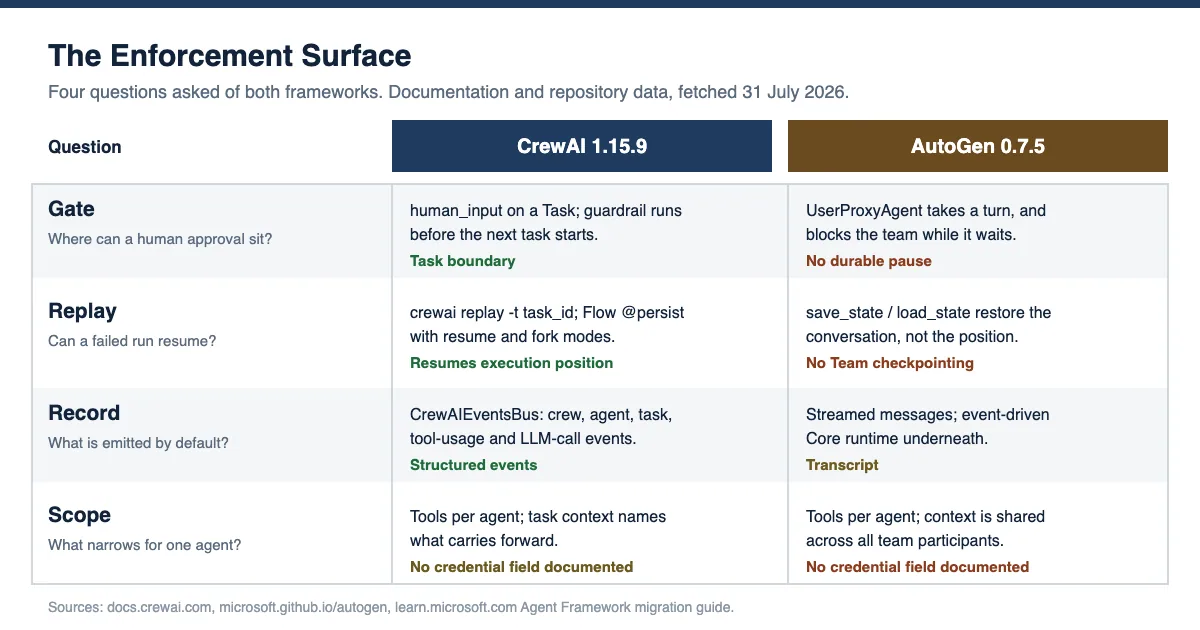
The Enforcement Surface: the same four questions asked of both frameworks, with what each answers natively and what it leaves to you.
A note on what this article is and is not. We have not run either framework in production, so nothing below is a first-hand performance claim. Everything here comes from each project's published documentation, its public repository metadata, and Microsoft's own migration guide, all fetched on 31 July 2026, with the source page named for every quotation. Where the evidence stops, we say so rather than filling the gap.
This piece is also deliberately narrow. The general design problem of what authority crosses each hand-off between agents is covered in our earlier analysis of the multi-agent handoff contract, and we are not re-arguing it here. This article assumes you already accept that the hand-offs need governing and asks a different question: given these two specific frameworks in the state they are in today, which one lets you actually do it?
Project health first: one of these two stopped shipping
Before any feature comparison, the maintenance question decides most of this. The AutoGen repository README carries a caution banner stating that "AutoGen is now in maintenance mode. It will not receive new features or enhancements and is community managed going forward," and directs new users to Microsoft Agent Framework. CrewAI, by contrast, published twelve releases in July 2026 alone, eight of them stable. Framework health is a governance fact, not a popularity contest: an unmaintained dependency means your team inherits the duty to patch it.
Here is the state of both projects, read directly from the GitHub and PyPI APIs on 31 July 2026.
| Signal | CrewAI | AutoGen |
|---|---|---|
| Repository | crewAIInc/crewAI | microsoft/autogen |
| Declared status | Active | Maintenance mode (README caution banner) |
| Latest release | 1.15.9, 30 July 2026 | python-v0.7.5, 30 September 2025 |
| Latest PyPI package | crewai 1.15.9, 30 July 2026 | autogen-agentchat 0.7.5, 30 September 2025 |
| Last push to any branch | 31 July 2026 | 15 April 2026 |
Most recent commit title on main | (continuous) | "Update maintenance mode banner in readme", 6 April 2026 |
| Stars | 56,424 | 60,126 |
| Forks | 8,025 | 9,060 |
| Open issues | 725 | 979 |
| Successor named by maintainers | None | Microsoft Agent Framework |
Release tags and package dates come from the GitHub Releases and PyPI APIs; star, fork and issue counts are live figures read the same day and will have moved by the time you read this. The dates are the durable part.
Two things in that table are worth sitting with.
The first is that the star count still favours AutoGen. Sixty thousand stars accumulated over three years is a measure of how many people once found the project interesting, not of whether it shipped anything this year. Any comparison that ranks these two on GitHub stars is ranking them on 2024. This is the same trap the frozen-vendor problem creates elsewhere in the agent tooling market: the artefacts of popularity outlive the maintenance.
The second is that the gap between AutoGen's last release and today is ten months. Even a project in honest maintenance mode normally cuts patch releases; the last tagged Python release predates the maintenance-mode banner itself. Community members have adapted. At least three 2026 items in the repository are explicitly framed as bug fixes "in keeping with the project's maintenance-mode scope" rather than feature requests. The practical reading is that a security fix in AutoGen is now something you may have to carry yourself, or fork.
Nothing in that makes AutoGen's design wrong. Conversational multi-agent orchestration was a genuinely influential idea and Microsoft's successor framework is built on it. It does mean that the question "CrewAI vs AutoGen" has quietly become "CrewAI vs a frozen reference implementation of an idea that moved house."
CrewAI vs AutoGen at a glance
The table below is the whole comparison compressed. Every row is sourced in the sections that follow; nothing here is an impression.
| Dimension | CrewAI | AutoGen |
|---|---|---|
| Core primitive | Agents with a role, goal and backstory, executing declared Tasks | Agents exchanging messages inside a Team |
| Execution model | Process.sequential (default) or Process.hierarchical | Group chat: round-robin, model-selected speaker, or handoff |
| Who decides what runs next | The declared task order, or a manager LLM in hierarchical mode | The team pattern; in SelectorGroupChat, a model picks the speaker |
| Native approval gate | human_input=True on a Task; guardrail validates output before the next task | UserProxyAgent as a participant; blocks the run while waiting |
| Pause and resume | @persist on Flows, with resume and fork modes; crewai replay -t <task_id> | save_state / load_state on agents and teams |
| Built-in checkpointing | Flow-level state persistence | None at Team level, per Microsoft's migration guide |
| Native event stream | CrewAIEventsBus with crew, agent, task, tool and LLM events | Streamed messages and, at the Core layer, an event-driven runtime |
| Per-agent tool assignment | Yes, tools on each Agent | Yes, tools passed to each agent |
| Per-agent context isolation | Task-scoped, with context naming which prior outputs carry forward | Shared: messages are broadcast to all participants |
| Per-agent identity or credentials | Not in the documented attribute set | Not in the documented attribute set |
| Licence and price | Open source; framework free | Open source; framework free |
| Maintenance status | Active, 1.15.9 on 30 July 2026 | Maintenance mode; last release 30 September 2025 |
| Named successor | None | Microsoft Agent Framework |
The last three rows of that table are the ones a procurement reviewer will read first, and the middle rows are the ones that decide what you can promise them.
The Enforcement Surface: four questions to ask any agent framework
Most framework comparisons score orchestration power, and orchestration power is the least scarce thing in this market. What is scarce is the ability to answer four questions after the system is live and somebody senior asks them. We call that set the Enforcement Surface, and it is the rubric used for the rest of this article.
| Question | What it really asks | Why it is hard to add later |
|---|---|---|
| Gate | Where can a human approval physically sit, and can it sit before the first irreversible external effect? | Gates added after the fact end up validating outcomes rather than preventing them |
| Replay | Can a run be resumed or re-executed from a known point, without repeating the side effects? | Requires the framework to have serialised state at a boundary you chose |
| Record | What does the framework emit about a run without you writing instrumentation? | Retro-fitted logging captures what the developer thought to log, not what the auditor asks for |
| Scope | What can be narrowed for one agent and not another: tools, context, credentials? | Scope narrowing has to be expressible in the framework's own model of an agent |
The Enforcement Surface is deliberately not a security checklist. It is a set of questions about what a framework's shape makes expressible. A control that is expressible is one you can implement badly and then improve. A control that is not expressible in the framework has to be built outside it, by you, in a component that framework upgrades will keep breaking.
This is also where the difference from a hand-off contract matters. A hand-off contract asks what authority crosses one edge between two agents. The Enforcement Surface asks what the framework itself will let you assert about any edge. You need both, and only one of them is a procurement question.
CrewAI: the role-based crew
The CrewAI crews documentation defines a crew as "a collaborative group of agents working together to achieve a set of tasks." The agent attributes reference declares each agent with three fields: role ("Defines the agent's function and expertise within the crew"), goal ("The individual objective that guides the agent's decision-making") and backstory. Work is declared separately as Tasks. The structure is a project plan, not a conversation.
Best for: teams whose mental model is a workflow with named steps, and who want the sequence of work visible in code rather than emergent at run time.
Key features. Two processes are documented. Process.sequential "executes tasks sequentially, ensuring tasks are completed in an orderly progression," with the output of each task becoming context for the next, and the context parameter on Task letting you name explicitly which prior outputs carry forward. Process.hierarchical "organizes tasks in a managerial hierarchy, where tasks are delegated and executed based on a structured chain of command," and requires that "a manager language model (manager_llm) or a custom manager agent (manager_agent) must be specified in the crew," per the CrewAI process documentation. Tasks carry human_input, guardrail, callback and output_file. Agents carry tools, allow_delegation (default False), max_iter (default 20), max_rpm, max_execution_time and step_callback. Above crews, CrewAI Flows add @start, @listen, @router and @persist decorators for explicitly coded control flow.
Pros. The unit of work is declared, so there is a named boundary between steps, and every enforcement question below turns out to be answered at a boundary. Per-task human review is a documented flag rather than a pattern you invent. Guardrails run before the next task starts, not after the run. The event bus emits tool-level and LLM-level events without custom instrumentation. Flows give you an explicit, non-model-decided control graph when you want one, and @persist gives that graph durable state.
Cons. Hierarchical mode moves the delegation decision into a language model, which makes it flexible and non-deterministic in the same stroke: two runs of the same crew can allocate work differently, so delegation is something you log rather than something you configure. The role, goal and backstory fields are prompt content, not policy. An agent whose backstory says it only handles refunds under fifty dollars is a suggestion, not a limit. And the release cadence that keeps the project healthy also moves fast enough to break things, which is exactly what issue #6347 documents: a default executor class changed between 1.14.3 and 1.15.0 and took the human-approval path down with it.
Pricing. The framework is open source and free; you pay for model calls. CrewAI also sells a hosted platform, whose economics we costed separately in our analysis of what CrewAI's free tier actually costs to run. Nothing in this article depends on that pricing.
Bottom line. CrewAI gives you the boundaries. It does not give you authority, identity or a policy engine, and its own docs do not claim to.
AutoGen: the conversational team
AutoGen's README describes it as "a framework for creating multi-agent AI applications that can act autonomously or work alongside humans," and the AutoGen documentation home describes its AgentChat layer as "a programming framework for building conversational single and multi-agent applications." The primitive is the message. Agents are participants; work happens because they talk.
Best for: research settings and exploratory problems where the sequence of steps genuinely should not be fixed in advance, and for teams already maintaining an AutoGen codebase.
Key features. In the AutoGen teams tutorial, a Team is "a group of agents that work together to achieve a common goal." RoundRobinGroupChat has "participants taking turns in a round-robin fashion" where "all agents share the same context and take turns responding." SelectorGroupChat is the interesting one: the selector group chat page describes it as one where "a generative model (e.g., an LLM) selects the next speaker based on the shared context, enabling dynamic, context-aware collaboration," and every response is broadcast to all participants. Termination conditions stop the run when a criterion is met. Human feedback comes through a UserProxyAgent participant. save_state and load_state exist on both agents and teams, and the separate Managing State page notes that "when we call save_state on a team, it saves the state of all the agents in the team."
Pros. The conversational model is genuinely more expressive for open-ended problems: you do not have to know the task graph in advance. The Core layer is an event-driven runtime, which is a good foundation for observability. State serialisation exists, and the Managing State page documents it as a plain dictionary that "can be serialized to a file or written to a database." And AutoGen's own tutorial gives better advice than most vendor documentation does about its own product: "start with a single agent for simpler tasks, and transition to a multi-agent team when a single agent proves inadequate."
Cons. Maintenance mode is the dominant one. Beneath it, the shared-context model is a scope problem by construction. If every message is broadcast to every participant, you cannot use the team structure to control what an agent sees. And Microsoft's own migration guide is unusually direct about two gaps we care about most, which are covered in the Gate and Replay sections below.
Pricing. Open source and free; you pay model and hosting costs. There is no paid AutoGen tier to evaluate.
Bottom line. AutoGen is a well-designed reference implementation of an idea whose maintained version now lives somewhere else. If you are starting today, its own maintainers would rather you did not start here.
Gate: where a human approval can physically sit
The single most consequential difference between these two frameworks is where a human can be inserted, and whether the run survives the wait. CrewAI's gate is a flag on a declared boundary. AutoGen's gate is a turn in a conversation that blocks the whole team while it waits.
CrewAI's human_input is documented in the task attributes reference as controlling "whether the task should have a human review the final answer of the agent." That places the gate at the end of a task, before the next task consumes its output. Its sibling, guardrail, is a "function to validate task output before proceeding to next task." Both are boundary controls: they sit between step N and step N+1.
AutoGen's route is UserProxyAgent, and the human-in-the-loop tutorial is candid about the cost. "When UserProxyAgent is called during a run, it blocks the execution of the team until the user provides feedback or errors out," and the docs recommend using it "only for short interactions that require immediate feedback from the user, such as asking for approval or disapproval with a button click." For anything longer, they steer you to the second mode: feedback between runs, via the input to the next call to run().
Microsoft's AutoGen to Agent Framework migration guide states the structural version of the same thing: "AutoGen's Team abstraction runs continuously once started and doesn't provide built-in mechanisms to pause execution for human input. Any human-in-the-loop functionality requires custom implementations outside the framework."
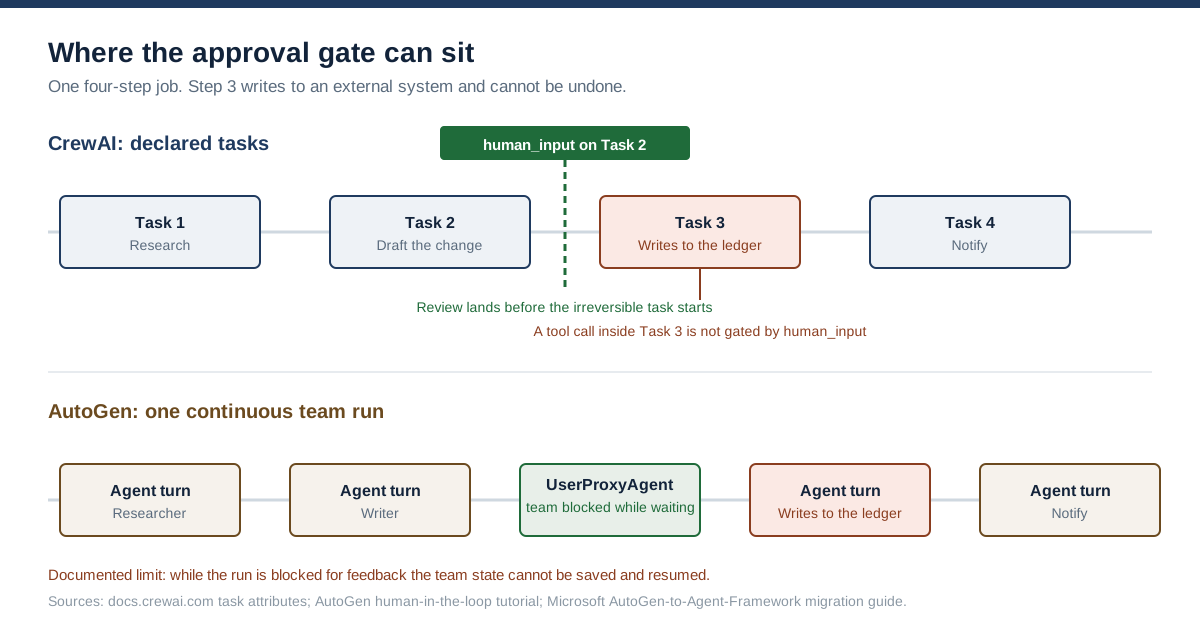
The same four-step job in both frameworks. The gate position is not a preference; it is what the execution model allows.
Here is why the placement matters more than the mechanism. An approval that arrives after an agent has already sent the email, posted the refund or written to the ledger is a notification, not a control. The useful gate sits immediately before the first irreversible external effect. In CrewAI, if the irreversible action is the final act of a task, human_input lands in roughly the right place. If the irreversible action is a tool call inside a task, where the agent decides mid-reasoning to call the refund API, then neither human_input nor guardrail is positioned to stop it, because both operate on task output. That is a real limit and it is the reason a tool-level policy point matters regardless of framework.
In AutoGen, a UserProxyAgent turn can sit anywhere in the conversation you can steer the speaker selection to put it, which sounds more flexible and is, for short interactions. But the blocking behaviour is a production problem: the team is held open for the duration, and while it is blocked the team state is not in a shape that can be saved and resumed. A gate that only works when the approver is at their desk is a gate that will be routed around at 6pm on a Friday.
| Gate property | CrewAI | AutoGen |
|---|---|---|
| Declared mechanism | human_input=True on a Task | UserProxyAgent participant |
| Where it lands | Task boundary, on the final answer | Wherever the speaker selection places its turn |
| Blocks the run while waiting | Task-level wait | Yes, blocks the whole team |
| Survives a pause and resume | Flow-level @persist covers the surrounding flow | Not while blocked |
| Can gate an individual tool call | Not through human_input | Not natively |
| Framework-native "before the write" gate | Only if the write is the task's last act | No |
This is also the section where a real bug matters more than a feature list. Issue #6347 is a reminder that the gate is code like any other code: it was silently disabled by a default change, it crashed loudly rather than failing open, and it took eleven days to close. Loud failure is the good outcome. The bad version of that bug is one where the approval is skipped and the run continues.
If you want a walkthrough of pause-and-resume approval patterns in the successor framework rather than a written description, Microsoft Reactor recorded a full session on exactly this.

Replay: can you resume the run that failed?
Replay is the question nobody asks in evaluation and everybody asks at 2am. A multi-agent run fails on step four of six. Can you resume from step four, or do you re-run the whole thing and repeat every side effect the first three steps already committed?
CrewAI answers this at two levels. At the crew level, the CrewAI CLI offers crewai replay, documented as "replay the crew execution from a specific task," taking a --task_id, together with crewai log-tasks-outputs to "retrieve your latest crew.kickoff() task outputs." Because tasks are declared units with stored outputs, a task ID is a meaningful resume point. At the flow level, @persist "enables automatic state persistence in CrewAI Flows, allowing you to maintain flow state across restarts or different workflow executions," per the CrewAI Flows documentation, with two distinct hydration modes: resume, which loads the latest snapshot for a supplied UUID and continues writing under the same flow_uuid, and fork, which hydrates a new run from a snapshot and assigns a fresh state ID.
The resume-versus-fork distinction is more governance-relevant than it looks. Resume extends one history; fork creates a branch with its own identity. If you need to show an auditor a single continuous record of what happened to a particular case, you want resume, and you want to know which one your operators reached for.
AutoGen answers at the state level. save_state and load_state work on agents and on teams, saving the message thread and the agents' contexts, and the state is a dictionary that can be serialised to a file or a database. That is enough to restore a conversation. What it is not is a checkpoint of execution position, and Microsoft's migration guide says so directly: "AutoGen's Team abstraction does not provide built-in checkpointing capabilities. Any persistence or recovery mechanisms must be implemented externally, often requiring complex state management and serialization logic."
| Replay property | CrewAI | AutoGen |
|---|---|---|
| Resume unit | Task ID, or Flow state UUID | Serialised conversation state |
| Restores execution position | Yes, from a task | Restores the conversation, not the position |
| Framework-level checkpoint store | Flow persistence | None documented at Team level |
| Fork a run from a snapshot | Yes, restore_from_state_id | You would build it |
| Documented CLI for replay | crewai replay -t <task_id> | None |
A caveat that applies to both, and to every framework in this category: replay restores state, not the outside world. If step three sent an email, resuming from step four is correct and resuming from step three sends a second email. Neither framework tracks the reversibility of an action, because neither framework knows what your tools do. Idempotency remains your design problem, and it is the reason the gate belongs before the write rather than after it.
Record: what each framework emits without you writing it
An audit trail assembled after an incident is a reconstruction. What matters is what the framework emits by default, because that is what exists on the day you did not know you would need it.
CrewAI ships an event bus. The documentation describes "an event bus architecture to emit events throughout the execution lifecycle," built on a singleton CrewAIEventsBus, a BaseEvent class and a BaseEventListener you subclass. The published event catalogue covers crew lifecycle (CrewKickoffStartedEvent, CrewKickoffCompletedEvent, CrewKickoffFailedEvent), agents (AgentExecutionStartedEvent, AgentExecutionCompletedEvent, AgentExecutionErrorEvent), tasks (TaskStartedEvent, TaskCompletedEvent, TaskFailedEvent), tool usage (ToolUsageStartedEvent, ToolUsageFinishedEvent, ToolUsageErrorEvent, ToolSelectionErrorEvent) and LLM calls (LLMCallStartedEvent, LLMCallCompletedEvent, LLMCallFailedEvent). The event listener documentation lists logging and monitoring, analytics, debugging, integration with external systems and custom behaviour as the intended uses.
The tool-usage and failure events are the valuable ones. A record that says a tool was selected, started, and errored is the beginning of an answer to "what did this agent try to do." A record of only the final output is not.
The same AutoGen documentation home describes the Core layer as "an event-driven programming framework for building scalable multi-agent AI systems," and AgentChat streams messages as a run proceeds, which gives you a transcript. A transcript is genuinely useful evidence, and the closest thing either framework has to a native narrative of a run. But it is a record of what was said, not a structured record of what was attempted against which system.
That distinction is what the standards bodies are pointing at. The NIST AI Risk Management Framework, released on 26 January 2023, is explicit that the artefacts have to exist and be assigned: MEASURE 2.8 requires that "risks associated with transparency and accountability — as identified in the MAP function — are examined and documented," and GOVERN 2.1 that "roles and responsibilities and lines of communication related to mapping, measuring, and managing AI risks are documented and are clear to individuals and teams throughout the organization." MANAGE 4.1 goes further and asks for mechanisms including "appeal and override", which is the gate question again, arriving from the compliance side. Neither CrewAI nor AutoGen has an opinion about roles and responsibilities, because neither is that kind of software. What they can do is emit the raw material.
| Record property | CrewAI | AutoGen |
|---|---|---|
| Structured event stream | CrewAIEventsBus, documented event classes | Event-driven Core runtime; AgentChat streams messages |
| Tool-call start, finish and error events | Yes, named event types | Not a documented equivalent catalogue |
| LLM call events | Yes | Streamed model output |
| Failure events as first-class | Crew, agent, task and tool failure events | Errors surface in the transcript |
| Attach an external sink without patching | Subclass BaseEventListener | Consume the message stream |
| Records what was refused | No | No |
That last row is not a criticism of either project; it is the honest ceiling of a library. A framework can tell you what its agents did. It cannot tell you what they were prevented from doing, because it never saw the request that a policy layer above it rejected. Any evidence pack that needs to show controls working rather than merely present has to be assembled somewhere the refusals are visible, which is a point we have argued at length in our earlier analysis of AI observability and audit trails.
Scope: what can be narrowed per agent
Scope is where both frameworks are weakest and where the difference between them is nonetheless real.
Start with what they share. Both let you attach tools per agent. In CrewAI, the agent attributes reference documents tools as the agent's "capabilities or functions available to the agent," defaulting to an empty list. In AutoGen, tools are passed to the agent that may use them. So in both, agent A can hold the read-only lookup tool and agent B the write tool. That is genuine action scoping and it is the most valuable control either framework gives you for free.
Now the difference. CrewAI's execution model is task-scoped: a task has a description, an expected output, and a context attribute naming "other tasks whose outputs will be used as context for this task." You decide what carries forward. AutoGen's team model broadcasts: in RoundRobinGroupChat "all agents share the same context," and in SelectorGroupChat a response is distributed to every team member. That is a deliberate design choice. Shared context is what makes model-driven speaker selection work, and it means the team structure cannot be used to keep information away from a participant. If one agent handles a record containing customer PII, every agent in that group chat has seen it.
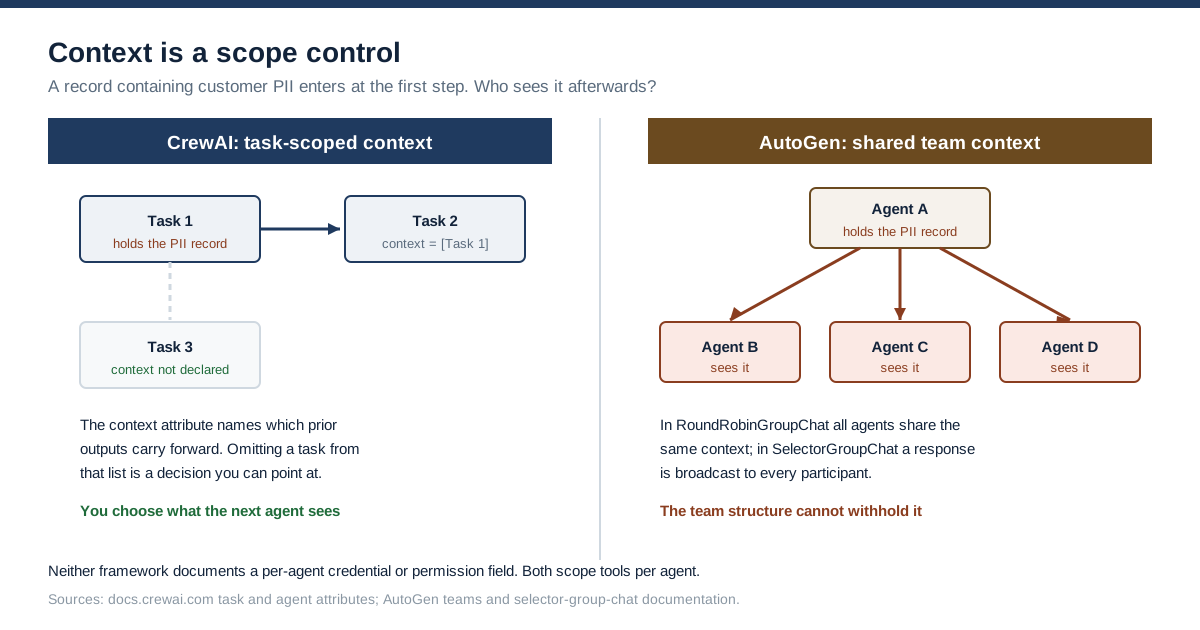
Context is a scope control. One of these two models lets you decide what the next agent sees; the other decides for you.
And now the limit that applies to both, which no feature table in this genre states plainly: neither framework's documented attribute set contains a per-agent identity, credential or permission field. We went through CrewAI's Agent and Task attribute tables and AutoGen's agent documentation looking for one. There is allow_delegation, max_iter, max_rpm and max_execution_time — resource limits, not authority limits. An agent's authority in both frameworks is whatever credential the process it runs in happens to hold.
That is the correct scope for a library and the wrong place for the problem to end. The OWASP Gen AI Security Project published its Top 10 for Agentic Applications on 9 December 2025, describing it as "a globally peer-reviewed framework that identifies the most critical security risks facing autonomous and agentic AI systems", which is the level at which this problem is now being treated, and it is a level above any orchestration library. Giving every agent in a crew an owner, a scope and an expiry is a layer below the framework, and we have written about what that identity model requires in our earlier analysis of non-human identity.
| Scope property | CrewAI | AutoGen |
|---|---|---|
| Per-agent tool set | Yes | Yes |
| Control what the next agent sees | Yes, task context | No, context is shared across the team |
| Per-agent credential | Not documented | Not documented |
| Per-agent permission policy | Not documented | Not documented |
| Resource limits per agent | max_iter, max_rpm, max_execution_time | Iteration limits, termination conditions |
| Delegation opt-in | allow_delegation, default False | Handoff patterns |
The one row worth arguing about is delegation. CrewAI defaults allow_delegation to False, which means an agent cannot hand work to a peer unless you switch it on. That default is a quietly good governance decision: it makes the peer-to-peer edges opt-in rather than emergent.
The option the question omits: Microsoft Agent Framework
Comparing CrewAI to AutoGen in 2026 without naming Microsoft Agent Framework would be writing about the wrong pair. AutoGen's own README says new users "should start with Microsoft Agent Framework" and existing users are "encouraged to migrate." Its repository cut a Python 1.13.0 release on 30 July 2026 and a .NET 1.16.0 release the same week.
We are not scoring it as a third contender — that would need its own evaluation, and its .NET and Python surfaces differ. But it is directly relevant here because Microsoft chose to close exactly the two Enforcement Surface gaps this article has been describing, and documented them as reasons to move.
On gates, the migration guide introduces "the concept of request and response, which allows workflows to pause execution and wait for external input before continuing," notes that "this capability is not present in AutoGen's Team abstraction," and shows a typed ApprovalRequest payload as the example. On replay, it describes checkpointing through a FileCheckpointStorage and a checkpoint_storage parameter, capturing executor state, shared state, pending message queues and "current execution progress and next steps."
The wider architectural change is a move away from conversation as the primitive. Describing its Workflow against AutoGen's experimental GraphFlow, the guide draws the line at control flow versus data flow, and summarises the new model this way: "Workflow routes typed messages along edges. Nodes (executors) can be agents, pure functions, or sub-workflows," with request and response letting a workflow pause for external input and checkpointing persisting progress. Typed edges and a durable pause are, precisely, the two things a conversation between agents does not give you.
The honest reading for a buyer: the industry's most-starred conversational multi-agent framework was retired by its own vendor in favour of a graph-shaped one with a built-in approval pause and a checkpoint store. That is a strong signal about which control shape survives contact with production, and it did not come from us.
Choose CrewAI if, choose AutoGen if, choose neither if
Choose CrewAI if your work decomposes into named steps you can write down before you run it; you need a human review at step boundaries and want it as a documented flag rather than a pattern you maintain; you want a replay point that means something operationally; you want tool-level events on a bus without writing instrumentation; and you are prepared to pin your version and read the changelog, because a fast-moving project moves.
Choose AutoGen if you already run it in production and the cost of migrating exceeds the cost of carrying an unmaintained dependency for now, with a written plan for the day a CVE lands in a transitive dependency and nobody upstream is cutting a release. Also choose it if you are doing research where the open-ended conversational model is the object of study rather than the delivery mechanism.
Choose neither if your problem is one agent with good tools. AutoGen's own documentation gives the best version of this advice: "start with a single agent for simpler tasks, and transition to a multi-agent team when a single agent proves inadequate. Ensure that you have optimized your single agent with the appropriate tools and instructions before moving to a team-based approach." The peer-reviewed evidence points the same way. The Berkeley-led study Why Do Multi-Agent LLM Systems Fail? reports that despite enthusiasm for multi-agent systems, "their performance gains on popular benchmarks are often minimal," and builds a taxonomy from 1,600-plus annotated traces across seven popular frameworks: 14 distinct failure modes in three categories, namely system design issues, inter-agent misalignment and task verification, derived from 150 traces with an inter-annotator agreement of kappa 0.88.
Read that taxonomy again with the Enforcement Surface in mind. Two of its three categories, inter-agent misalignment and task verification, are failures of hand-off and of checking. Those are the exact things a gate and a record exist to catch. Multi-agent systems do not mostly fail because the models are not smart enough. They fail at the seams.
And choose a different question if what you actually need is one governed place where every agent, model and connector is subject to the same policy. That is not a framework choice, and picking a framework will not produce it.
Where the older framework still wins
Three things AutoGen does that CrewAI's structure genuinely does not, stated plainly because a comparison that finds one side better on every axis is not a comparison.
Open-ended problems. When you cannot write the task graph in advance, because the shape of the work depends on what the first agent finds, a conversation is the honest representation and a declared task list is a fiction you will keep editing. CrewAI's answer is hierarchical mode, which puts a manager LLM in charge of allocation, and that trades one non-determinism for another.
A single shared transcript. Everything every agent said, in order, in one artefact. For debugging a reasoning failure this is often more useful than structured events, because the failure is usually in what was said, not in which function was called. CrewAI's event bus gives you better structure and a less readable story.
Lineage. The migration guide states that Agent Framework is "developed by the core AutoGen and Semantic Kernel teams at Microsoft," and describes its Workflow as inspired by AutoGen's experimental GraphFlow. An AutoGen codebase is not a dead end; it is one migration away from a supported framework built by the same people, with a published concept mapping. A CrewAI codebase has no equivalent escape hatch, because there is nothing it is a predecessor to.
Where this analysis is uncertain
Four limits worth stating before you act on any of this.
We have not run either framework in production. Every claim above is traceable to published documentation, repository metadata or Microsoft's migration guide, fetched on 31 July 2026, with the source page named at each quotation. Documentation describes intent; production reveals behaviour, and issue #6347 is a concrete example of the two diverging inside one minor version.
Absence in documentation is not absence in the code. When we say the documented attribute set contains no per-agent credential field, that is a statement about the docs. Both projects are open source and either may expose something at the code level that the reference pages do not describe. Read the source before you conclude a control is impossible.
Fast-moving projects date fast. CrewAI published twelve releases in July 2026, eight of them stable. Any specific attribute, default or CLI flag named here should be checked against the version you are pinning. The structural argument, that declared boundaries give you enforcement points and conversations do not, is more durable than any individual API.
There is no independent head-to-head benchmark of these two frameworks under a governance rubric. We looked. The closest rigorous work is MAST, which is deliberately framework-agnostic. The user-sentiment roundups that dominate this SERP are unattributed, undated and version-free, so we excluded them rather than presenting them as evidence. That is a real gap in the public record, and if it matters to your decision, the way to close it is a two-week spike on your own workload rather than another article.
What neither framework gives you, and who has to
Neither CrewAI nor AutoGen ships identity, policy or spend control, and neither claims to. That is the correct scope for an orchestration library. The gap does not disappear because it is out of scope. Somebody has to own the layer where an agent is a named thing with an owner, a scope and an expiry; where the credential an agent uses is brokered rather than borrowed from whoever deployed it; where the approval gate sits in front of the tool call rather than after the task; and where the record includes what was refused, not only what ran.
That layer is what LeapForce builds: one controlled place in front of every AI tool, connector, model and agent, so the framework question stops being a governance question. Our rollout model for it is Observe first. Enforce second. Optimize third. You cannot write a sensible policy for traffic you have never measured, and teams that start at enforcement write rules that block work nobody was doing. Being honest about status, per our published convention: gateway endpoints, tracing and SSO in front of AI surfaces are live today; vaulted credentials, inline data-loss prevention and dollar budgets are in development; shadow-AI discovery and compliance evidence packs are on the roadmap. LeapForce does not replace CrewAI or AutoGen and has no opinion about which you pick. You still write the crew or the team: the approval gates and policy checks in Workflows and the identity model in Access and Identity sit around whatever you built.
Frequently asked questions
Not deprecated, but in declared maintenance mode. The microsoft/autogen README states that "AutoGen is now in maintenance mode. It will not receive new features or enhancements and is community managed going forward," and directs new users to Microsoft Agent Framework. The last tagged Python release, python-v0.7.5, was published on 30 September 2025, and the most recent commit on the default branch as of 31 July 2026 dates from 6 April 2026. The package still installs and still works. What has stopped is the flow of fixes, which for a governed deployment is a supply-chain question: you are now the maintainer of last resort.
For a new production system in 2026, yes, on two grounds that do not depend on taste. It is actively maintained, with 1.15.9 shipped on 30 July 2026, and its declared task boundaries give you named places to put an approval gate, a validation guardrail and a replay point. AutoGen's conversational model has no equivalent boundary, and Microsoft's own migration guide states that its Team abstraction "doesn't provide built-in mechanisms to pause execution for human input" and "does not provide built-in checkpointing capabilities." Neither framework gives you identity or policy, so "better" here means a better foundation, not a sufficient one.
CrewAI, for asynchronous approvals; AutoGen, marginally, for immediate interactive ones. CrewAI's human_input=True puts a documented review step at a task boundary and guardrail validates output "before proceeding to next task." AutoGen's UserProxyAgent can take a turn anywhere in the conversation, but its own documentation warns that it "blocks the execution of the team until the user provides feedback or errors out" and recommends it "only for short interactions." Neither gates an individual tool call natively, so if the irreversible action happens mid-task, both need a policy point outside the framework.
You can scope tools per agent in both, and that is worth doing. Give the reader agent the read tool and nothing else. What you cannot do in either, based on the documented attribute sets, is give an agent its own identity, its own credential or its own permission policy. Alongside tools, CrewAI's Agent attributes cover allow_delegation, max_iter, max_rpm and max_execution_time — resource limits, not authority limits. In practice every agent inherits whatever credential the host process holds, which means the blast radius of any one agent is the blast radius of the whole deployment unless something outside the framework narrows it.
Both frameworks are open source and free to use; your bill is model tokens, tool calls and hosting. The cost that surprises teams is not the licence, it is the fan-out: one user request in a multi-agent system becomes many billed model calls, and unless a budget identifier travels with the work you cannot tell which agent is expensive. CrewAI additionally sells a hosted platform, which we costed separately. Budget for the observability and policy layer as a line item too, because as this article argues, neither framework includes it.
Plan it, do not panic. A working AutoGen deployment does not break because the repository went quiet, and Microsoft publishes an AutoGen to Agent Framework migration guide with a concept-by-concept mapping. The trigger to act is a security advisory in AutoGen or one of its dependencies with no upstream fix, so the sensible interim step is to know today who on your team would produce that patch. If you are already rewriting the human-approval or persistence paths by hand, the migration arithmetic changes, because those are the two things the successor provides natively.
Often not. AutoGen's own tutorial advises starting "with a single agent for simpler tasks" and moving to a team only "when a single agent proves inadequate." The research points the same way: Why Do Multi-Agent LLM Systems Fail? observes that performance gains on popular benchmarks "are often minimal" and classifies 14 failure modes across three categories, two of which, inter-agent misalignment and task verification, only exist because there is more than one agent. A single agent with well-scoped tools has fewer seams, and every seam is something you have to govern.
From CrewAI, a structured event stream: crew, agent, task, tool-usage and LLM-call events, including failures, emitted through CrewAIEventsBus and consumable by subclassing BaseEventListener. From AutoGen, a conversation transcript plus whatever the event-driven Core layer exposes. Neither produces an evidence pack on its own, and neither records what was refused, because a refusal happens in a policy layer the framework never sees. Where the obligation is to demonstrate that a control worked, the framework supplies raw material and not the artefact. NIST's AI RMF asks under MEASURE 2.8 that transparency and accountability risks be "examined and documented"; an event stream is an input to that, not a discharge of it.
Run the Enforcement Surface against it in one sitting. Take a real job with an irreversible step and answer four questions in code, not in the docs: where can a human approval sit before that step (Gate); can you kill the process at step four and resume without repeating step three's side effects (Replay); what lands in your log store without you writing instrumentation (Record); can agent A be denied something agent B has (Scope). A framework that answers three of four is workable. One that answers Gate with "you would build that outside the framework" is telling you what your real project is.
This is the question frameworks cannot answer and the one that decides whether an agent is a company asset or somebody's script. Neither CrewAI nor AutoGen models an owner, so ownership lives in your deployment records or nowhere. The practical minimum before anything reaches production: a named human accountable for each agent, an explicit list of what it may touch, an expiry date that forces a re-review, and an offboarding path that removes its access when its owner leaves. NIST's GOVERN 2.1 asks for exactly this at the organisational level: roles and responsibilities that "are documented and are clear to individuals and teams throughout the organization." None of it is a framework feature, which is precisely why it gets skipped.
Ready to Govern Your AI?
Talk to LeapForce — one controlled layer for every AI tool, connector, model, and agent.
Comments