
If you are shopping Flowise alternatives because you need an audit trail, the shortlist is shorter than the roundups suggest. Of the five leading open-source agent canvases, only Dify's free self-hosted build records who changed a flow, keeps published versions, and stamps each run with the version that produced it. The rest either charge for that record or do not keep it.
That is a different ranking from the one you will find elsewhere, and it is deliberate. Flowise alternatives lists tend to rank on node count, model support and ease of use, and where they name governance as a reason teams leave, it arrives as an adjective in the introduction rather than a column in the comparison table. We went the other way. We read the licence files, the database schemas and the documented API surfaces of all five projects, and ranked them on one question: six months from now, when someone asks what this flow did and who changed it, can you answer? On an n8n community thread from June 2023, a user named Yoann asked for exactly this — visibility into "which user edited a workflow at what time" — noting it was "mainly for security reason". The thread has no replies. n8n has since shipped the feature, at a price.
The short answer: Rank open-source agent canvases on the five records they keep (change, run, refusal, version, and which of those survive a free self-hosted install) and Dify leads on the free build, n8n and Activepieces lead overall but sell the audit layer separately, Flowise stores an execution log with no author column, and Langflow's free build ships audit machinery with no policy to feed it.
Last updated: July 31, 2026.
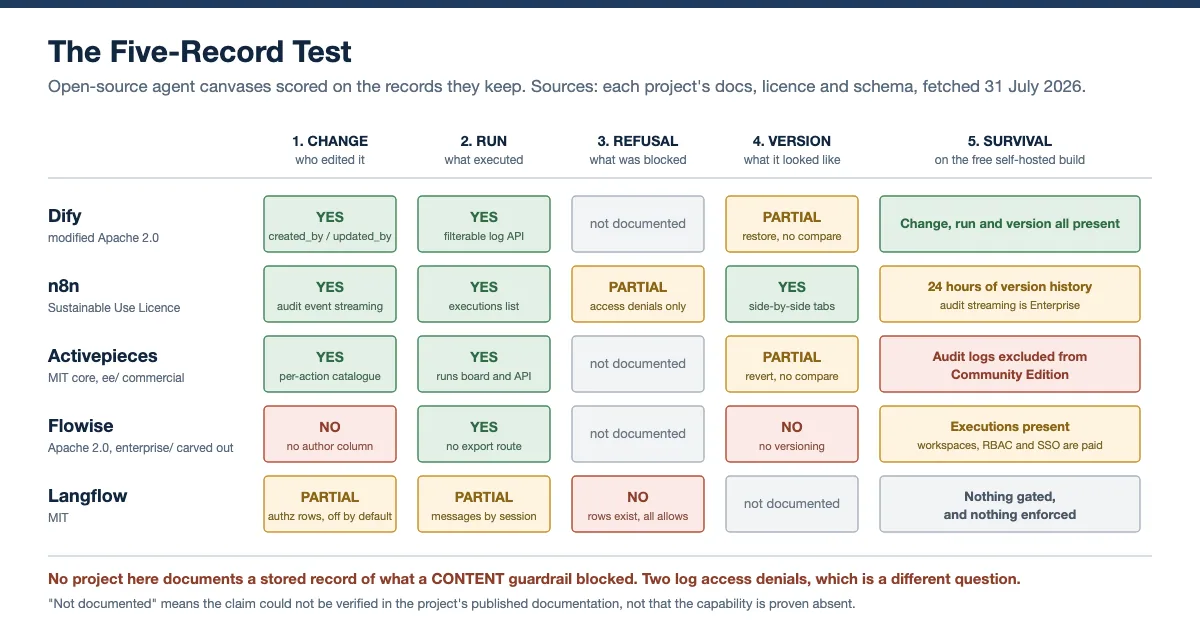
The Five-Record Test
Before ranking Flowise alternatives, define what you are ranking them on. Auditability is not one feature. It is five separate records, and a tool can keep any subset of them. Naming them separately is what makes a comparison possible, because the marketing word "audit log" covers at least three of the five and sometimes none. We call this the Five-Record Test, and it is the rubric every section below is scored against.
Record 1 — the change record. Who edited this flow, and when. Not "when was it last saved" but "which named identity made which change". The distinction matters because a last-modified timestamp is overwritten by the next save, so it can only ever tell you about the most recent edit.
Record 2 — the run record. What executed, with what inputs, producing what output. And, critically, can you get it out of the tool into the system where your evidence lives.
Record 3 — the refusal record. What the system declined to do. A guardrail that blocks a prompt and leaves no trace is a control you cannot prove you had. This is the record buyers discover last and need most, because a regulator's question is rarely "what did it do" and often "how do you know it did not".
Record 4 — the version record. What the flow looked like at the moment a given run executed, and whether you can put two versions side by side and see the difference.
Record 5 — survival. Which of the four above are still there on the free, self-hosted build you actually deploy. This is the record that reorders the whole ranking, because three of the five projects gate at least one of the first four behind a paid licence, and a fourth ships the audit machinery with nothing behind it to enforce. No gate lifts when you host it yourself.
The fifth record is where most evaluations go wrong. Teams choose an open-source canvas partly for control, install it, and discover that the governance layer was never in the box. Activepieces states this on its own pricing page with unusual bluntness: self-hosting "decides where Activepieces runs, not what it can do."
At a Glance: Five Canvases, Five Records
Here are the Flowise alternatives worth shortlisting, scored on all five records. Every cell is drawn from the project's own documentation, licence file or source code, fetched July 31, 2026. "Free build" means the no-cost self-hosted edition.
| Change record | Run record | Refusal record | Version record | On the free build | |
|---|---|---|---|---|---|
| Dify | Yes — created_by and updated_by on the workflow row | Yes — REST log API, filterable by account and date | Not documented | Yes — published versions, restore, no compare | Change, run and version records all present |
| n8n | Yes — audit events via log streaming | Yes — executions list with filters | Access denials only, not content blocks | Yes — versions plus a side-by-side view | 24 hours of version history; audit streaming absent |
| Activepieces | Yes — a documented per-action event catalogue | Yes — runs dashboard and API | Not documented | Yes — revert to a previous version | Audit logs excluded from Community Edition |
| Flowise | No author column on the flow record | Yes — executions table, filterable, no export route | Not documented | No versioning in the product | Executions present; anything named audit is paid |
| Langflow | Partial — an authorization audit row per decision, off by default, pruned after 90 days by default | Messages by session ID | Access decisions only, and they are all allows | Not documented | Nothing gated, and nothing enforced |
Two patterns fall out of that table immediately. The first is the refusal column: not one of the five documents a stored record of what its content guardrails blocked, and the two projects that do log refusals log a different kind — access-control denials, not policy blocks on a prompt. The second is that the two projects with the richest audit features, n8n and Activepieces, are also the two whose free editions withhold them.
How We Ranked These, and What We Did Not Do
This is an evaluation guide built from primary sources, not a hands-on bake-off. Most roundups blur that distinction; this one will not. We have not run these five tools against a production workload, and nothing below reports a benchmark, a timing or a personal build. A roundup that says "we tested these" rarely publishes the artefacts that would let you check — no build, no versions, no workload, no run logs, no timings — and a test you cannot inspect tells you about onboarding rather than about what survives a compliance review eighteen months later.
What we did instead is reproducible in an afternoon, and you should redo it for any tool we have not covered. For each project we read three things:
- The licence file, to establish which parts of the codebase you are permitted to run in production without a subscription.
- The database schema, because a feature that has no column cannot exist. If the table storing a flow has no field for the user who last edited it, no future release note changes that today.
- The documented API and admin surface, to establish whether a record that exists in the database is reachable by an operator or an auditor.
Reading the schema is the step that separates this from a feature-matrix exercise, and it is cheap. The Flowise flow entity, for instance, is a single file you can read in a browser in about thirty seconds:
curl -sL https://raw.githubusercontent.com/FlowiseAI/Flowise/main/packages/server/src/database/entities/ChatFlow.tsDo the equivalent for any tool on your shortlist before a demo call, and you will arrive with a question the sales engineer has to answer from the product rather than the roadmap. Where a project publishes no answer at all, we have written "not documented" rather than "does not exist" — absence of documentation is what we can verify, and it is itself a procurement finding, because an undocumented control is one you cannot cite in an evidence pack.
Dify: The Only Free Build That Joins a Run to Its Version
Best for: teams who need an attributable change history and a queryable run log without buying an enterprise tier first.
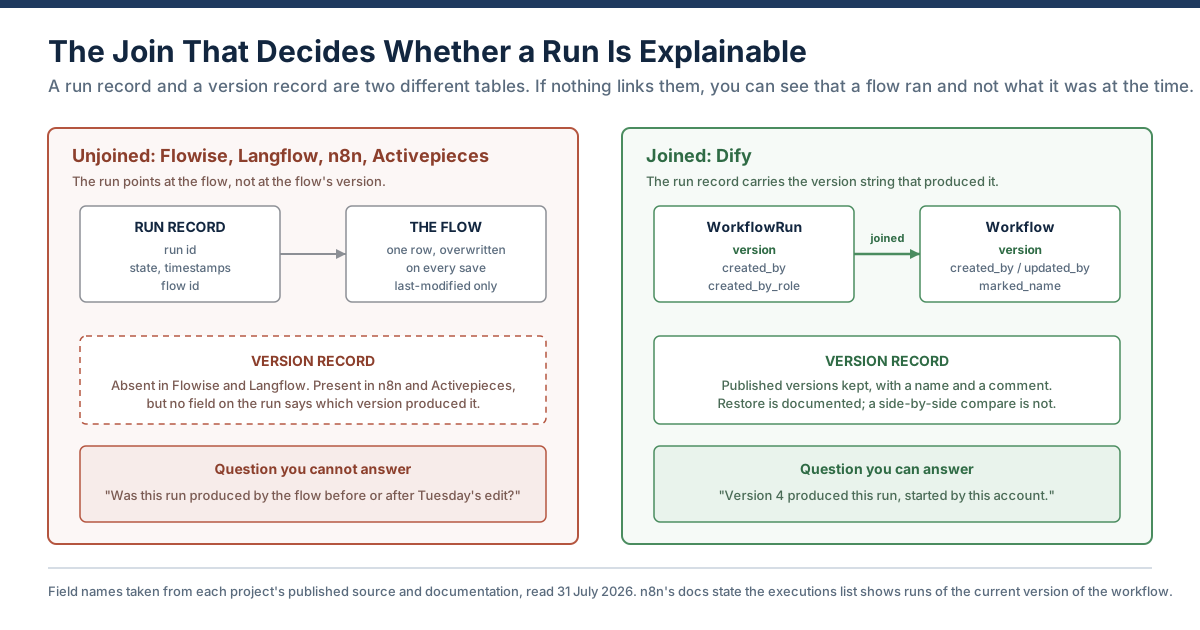
Dify is the surprise of this comparison, and the reason is a single field that does not appear in its own feature marketing. Its workflow model carries created_by and updated_by user references alongside the timestamps, so the row itself knows which account last changed it. More importantly, its run record carries a version field and a created_by_role that distinguishes an internal account from an end_user. That means a Dify run can be tied to the exact published version of the flow that produced it, and to the class of identity that started it. No other project in this comparison joins those two records in its free build, and that join is the difference between "this flow ran on the third of March" and "this specific version of this flow ran on the third of March, started by this account".
The run log is reachable, not just stored. Dify documents a /workflows/logs endpoint that accepts keyword, status, page, limit, created_at__before, created_at__after and created_by_account as filters and returns JSON — which is a usable export path even though no CSV button is documented. On self-hosted installs, the docs state that logs are retained indefinitely by default, with scheduled cleanup available through environment variables. Indefinite retention is the right default for evidence and the wrong default for a database you have to back up, so plan for the cleanup window rather than discovering it.
Version control is real but partial. The version control documentation describes a Current Draft, a Latest Version and Previous Versions, with publish and restore. Restoring "replaces your current draft completely", so it is a rollback, not a merge. There is no documented way to compare two versions side by side — the schema supports it, with marked_name and marked_comment fields on each version, but the product does not surface a diff.
Pros: attributable change history in the free build; run records stamped with the workflow version; a filterable logs API; named and commented versions; a very active repo (release 1.16.1 on July 28, 2026, twelve stable releases in the six months to July 31, 2026, with commits landing daily).
Cons: no diff view; no audit-log product surface, so the attribution lives in the schema and the API rather than in a screen an auditor can be shown; single sign-on is Enterprise-only per the pricing page; and the licence is not plain Apache.
Licence, stated once: Dify ships a modified Apache 2.0 that forbids operating a multi-tenant environment without written authorisation and forbids removing the console branding. It also reserves the right for "the producer" to "adjust the open-source agreement to be more strict or relaxed as deemed necessary" — a clause worth showing your counsel before you standardise on it. Our earlier analysis of where the Flowise licence boundary sits covers how to cost this class of restriction; this article treats it only as an input to the survival record.
Pricing, for reference: Sandbox free, Professional $590 per workspace per year, Team $1,590 per workspace per year, Community free, Enterprise quoted.
Bottom line: if the audit question is the reason you are leaving Flowise and you do not have budget approved, Dify is the only one of these five whose free build answers the change, run and version questions at once.
n8n: The Deepest Record in the Field, Sold Separately
Best for: teams with budget who want the most complete change history available in this category and can buy the tier that unlocks it.
n8n has the answer to Yoann's 2023 request. Its workflow history creates a new version on every save, on every restore, and on every pull from a Git repository, and it is the only product here that documents a comparison workflow at all: "Open version in new tab: open a second tab displaying the selected version. Use this to compare versions." That is eyeballing two browser tabs rather than a structural diff, and calling it a compare feature is generous — but it is more than the other four offer.
The pricing of that history is the story. The docs are explicit: full workflow history is Enterprise Cloud and Enterprise Self-hosted, five days is Cloud Pro, and "Versions from the last 24 hours are available for all users." On a free self-hosted n8n, your change record has a one-day memory. Naming a version to protect it from automatic pruning is itself a Pro and Enterprise feature, so the free build cannot even pin the version it cares about. Log streaming, which carries the audit event categories covering workflow changes, credential operations and API key management, is "available on all Enterprise plans."
There is a structural gap worth flagging regardless of tier. n8n's own documentation separates the two records and warns you not to confuse them: with the executions list "you can see previous runs of the current version of the workflow." Runs belong to the workflow, not to the version. Edit a flow and the executions that preceded the edit are still listed against it, with nothing in the execution record marking which version produced them. Deletion compounds this: "When you delete a workflow, n8n deletes its execution history as well." A single delete removes the evidence and the thing the evidence was about.
Retention is configurable and the defaults are short. EXECUTIONS_DATA_PRUNE is on by default, EXECUTIONS_DATA_MAX_AGE defaults to 336 hours, which is fourteen days, and EXECUTIONS_DATA_PRUNE_MAX_COUNT caps the table at 10,000 executions. Workflow history has its own knob, N8N_WORKFLOW_HISTORY_PRUNE_TIME, which defaults to -1 for indefinite retention. Two different records, two different retention regimes, two different defaults; if you set one and assume the other followed, you will find out during an incident.
Pros: the most complete version history in the category; named versions; JSON download per version; audit event streaming to an external system, which is the right architecture for evidence; near-daily releases.
Cons: every governance feature is a paid tier, self-hosted or not; 24 hours of history on the free build; runs are not joined to versions; deleting a workflow deletes its execution history; and the Sustainable Use Licence limits you to "your own internal business purposes or for non-commercial or personal use", with .ee. files requiring an Enterprise licence outright.
Pricing: Starter €20/month, Pro €50/month, Business €667/month, Enterprise quoted. Self-hosting starts at the Business tier. Our earlier costing of the n8n governance cliff works the economics; here the point is narrower, that the cliff and the audit record are the same cliff.
Bottom line: n8n is the right answer if the audit record is a budgeted requirement rather than a hope. It is the wrong answer if your plan was to self-host the free edition and get governance thrown in.
Activepieces: The Clearest Event Model, Behind the Highest Gate
Best for: teams who want audit events streamed into a SIEM and are buying an enterprise tier anyway.
Activepieces has the best-specified audit model of the five, and it is not close. Its documentation states that the platform "records an audit event for every meaningful action" and that each event "captures what happened, who did it, when, and the project or platform it belongs to." Those four attributes are the definition of a usable audit record, written down by the vendor. It then publishes a per-event catalogue — flow created, flow updated, flow deleted, flow run started, flow run finished, user signed in, connection saved, signing key created — each with its own documentation page, and points at the event schema in the repository as the source of truth. You can filter the table by action, user, project or date range, and stream every event to a webhook, which is how audit data should reach a SIEM rather than being screenshotted out of an admin panel.
The gate is the highest in this comparison. Audit logs sit in the Ultimate tier, which is quote-only, alongside SCIM provisioning, custom roles, secret managers and Git Sync. The Community Edition is generous on capacity — the pricing page describes it as free forever with no cap on runs, users or flows — and explicit about the exclusion: the whole team and admin layer, "SSO, user roles, audit logs, secret managers, branding, and Git Sync", sits outside it. And the sentence quoted earlier is the clearest statement of the survival problem any of these five vendors publishes: self-hosting "decides where Activepieces runs, not what it can do."
Versioning exists. You can return to a previous version and edit it as a draft without disturbing the published one. No comparison or diff view is documented.
Pros: the clearest documented definition of an audit event in the category; a published event catalogue; webhook streaming; a genuinely uncapped free tier for runs and users; MIT core with the enterprise code cleanly separated into packages/ee.
Cons: audit logs are Ultimate-tier only; no diff view; the free build has no roles, so it has nobody to attribute a change to; smaller project than the others by open issue count, which cuts both ways.
Pricing: Free $0, Plus $16/month billed yearly, Team $166/month billed yearly, Ultimate quoted. Team adds SSO and standard roles; Ultimate adds the audit layer.
Bottom line: the model you would design if you were designing one, priced where only funded teams reach it.
Flowise: An Execution Log With No Author Column
Best for: staying put, if your governance requirement is satisfied by knowing what ran rather than who changed it.
Start with the incumbent honestly, because a Flowise alternatives list is read by people who may not need to move at all. Flowise ships a real execution record in the open-source build: an Execution entity with a state, an agentflow reference and a session ID, and a controller that accepts filters for state, date range and pagination. That is a working run record, and it is not paywalled.
Then read the flow entity. The ChatFlow table, the row that is your flow, has columns for name, flow data, deployment status, API config, analytics config, speech settings, category, type, MCP server config, webhook secret, workspace ID, createdDate and updatedDate. There is no column for the user who created it and none for the user who last changed it. A last-modified timestamp is overwritten on every save, so the strongest statement Flowise's own data model can make about a change is that one happened, at some point, most recently. Who made it is not recorded, and no configuration setting adds a column.
The word "audit" does appear in the codebase, and what it points at is instructive. The enterprise audit route exposes exactly one endpoint, fetchLoginActivity, gated behind a loginActivity:view permission. It is a login and logout log, not a change log — and it sits inside packages/server/src/enterprise, the directory the root licence file carves out from Apache 2.0. The commercial licence governing that directory permits production use only if you "have a valid FlowiseAI Inc Enterprise Edition subscription". The docs confirm the gating in one line each: "Workspaces are only available for Cloud and Enterprise plans" and "SSO is only available for Enterprise plan."
There is no flow versioning. An open pull request from August 2025 proposes adding it, its author noting that users "frequently modify ChatFlows and Assistants during development and testing, but currently have no way to" track or roll back changes. It remains open. Until it lands, exporting flow JSON into your own Git repository is the only version record available, and that is a discipline you enforce rather than a control the product provides.
One more gap: the executions routes expose read, update and delete, and no export endpoint. You can see the run history in the product; getting it out is an API-scraping exercise.
Pros: a genuine, filterable execution log in the open-source build; an active repo (release 3.1.4 on July 29, 2026, six releases in six months, commits landing most weeks, not archived); documented integrations with external tracing backends; a clean Apache 2.0 core outside the enterprise directory.
Cons: no change attribution at the schema level; no versioning; no export route on executions; workspaces, RBAC and SSO all gated; and the only "audit" feature is a login log.
Bottom line: Flowise's execution record is better than its reputation and its change record is worse than its marketing. If you need to know what ran, it is adequate. If you need to know who changed it, the answer is not in the database.
Langflow: Permissive Licence, Unenforced Policy, Five KEV Entries
Best for: rapid prototyping by a small technical team on an isolated network, where the only identity is the person at the keyboard.
Langflow is the most permissively licensed project here — plain MIT, no enterprise directory, nothing withheld. What it withholds is not the point; what it enforces is.
Langflow does document an authorization layer, and this is the correction we most want to flag, because our first pass missed it and it changes the verdict in an interesting direction. The authorization documentation describes "a pluggable authorization layer for role-based access control (RBAC) over flows, projects, deployments, files, variables, and knowledge bases", and an LANGFLOW_AUTHZ_AUDIT_ENABLED flag, documented default false, that you set to "review the audit log to understand what decisions would be made before enforcement is on". Switch it on and Langflow writes "an audit log row for every authorization decision and share-administration action", readable at /api/v1/authz/audit and filterable by user, resource, action and a result of allow, deny or owner_override. Those rows are kept for LANGFLOW_AUTHZ_AUDIT_RETENTION_DAYS, which defaults to 90, with a sweep every LANGFLOW_AUTHZ_AUDIT_CLEANUP_INTERVAL seconds, default 86400. So there is an audit capability, it is in the open-source build, and it is off until somebody turns it on.
Read the rest of that same page, though. "The authorization infrastructure is present in all Langflow deployments, but the open-source build registers a pass-through service that always allows every action for every authenticated user." And, flatly: "Langflow OSS does not include a registered authorization plugin." Setting the enforcement flag without a plugin "does not restrict access": "Route guards still run and audit rows can still be written, but no policy is applied."
That is a genuinely unusual position, and it is worth stating precisely rather than scoring as a simple no. Free Langflow can write an audit row for every authorization decision, and in free Langflow every authorization decision is an allow. You get the ledger without the policy. It is honest engineering — the docs tell you exactly this, in plain language, which is more than some vendors manage — and it is also a control you cannot cite, because a log in which nothing is ever denied evidences nothing.
The rest of the record is thin. The run record is a messages table keyed by session ID, retrievable at /api/v1/monitor/messages; richer tracing is delegated to external tools, and the docs list integrations with Arize, Grafana and Loki, Langfuse, LangSmith, LangWatch, Openlayer, Opik and Traceloop. Flow export produces a JSON file per flow. We found no documented flow version history and no comparison view.
There is a configuration detail that changes the change record entirely. Langflow documents LANGFLOW_AUTO_LOGIN, and when it is enabled the editor "automatically signs in all users as the configured superuser". On an install left in that state, every action is attributable to one account, which is the same as being attributable to nobody. That is a default worth checking before you ask what your audit log contains.
Now the part the buyer questions miss. Of eleven pages we checked that rank for "flowise alternatives" or "best open source AI agent builder" on 31 July 2026, four carried a real FAQ block: lindy.ai, voiceflow.com, firecrawl.dev and ayautomate.com. Their questions cover pricing, ease of use, beginner-friendliness, head-to-head matchups and production readiness. Across all four, no question asks about audit trails, change history or compliance. The URLs are there so you can check that in a minute rather than take our word for it.
Here is one thing those FAQs skip. Langflow has five entries in CISA's Known Exploited Vulnerabilities catalogue, four of them added in 2026. KEV is a materially stronger signal than an advisory count, because inclusion means the flaw has been observed exploited in the wild, not merely reported. The rows below come from CISA's published catalogue, read from its machine-readable feed at catalogue version 2026.07.29:
| CVE | Added to KEV | Weakness | Note |
|---|---|---|---|
| CVE-2025-3248 | 2025-05-05 | Missing authentication | Ransomware campaign use recorded as "Known" |
| CVE-2026-33017 | 2026-03-25 | Code injection | Public flows buildable without authentication |
| CVE-2025-34291 | 2026-05-21 | Origin validation error | Permissive CORS plus SameSite=None refresh cookie |
| CVE-2026-55255 | 2026-07-07 | Authorization bypass | Run another user's flow by supplying their flow ID |
| CVE-2026-0770 | 2026-07-21 | Untrusted functionality inclusion | Remote code execution; due date 2026-07-24 |
The first of those, CVE-2025-3248, is scored 9.8 critical by NVD and affects versions prior to 1.3.0, where "a remote and unauthenticated attacker can send crafted HTTP requests to execute arbitrary code."
The fourth one is why this belongs in an article about auditability rather than in a security post. CVE-2026-55255, an insecure direct object reference in the /api/v1/responses endpoint fixed in 1.9.1, let an authenticated attacker "execute any flow belonging to another user by specifying the victim's flow ID". Consider what would have told you it happened. Not an alert — a run record attributing each execution to an identity, checked against a policy that could have said no. Sit that beside the authorization documentation quoted above, and the point is about what would have caught it: a vulnerability whose whole mechanism was one authenticated user acting as another, in a product whose free build ships no policy layer that could have denied the request.
Be precise about what that does and does not say. Langflow plainly does scope flows to owners — an insecure direct object reference is a missing ownership check on one endpoint, and the existence of a fix in 1.9.1 is itself evidence that the ownership model exists and that this endpoint bypassed it. We are not claiming the pass-through authorization service caused the flaw, and nothing in either source says so. The point is narrower and it is about detection rather than cause. A policy layer is a second place where a request like that can be stopped and, more to the point here, recorded as stopped. When the enforcement layer allows everything by design, the audit rows it writes cannot tell you that anything unusual was permitted.
None of this makes Langflow a bad project. It ships fast: eighteen stable releases in the six months to July 31, 2026, and the fixes for these issues shipped. A fast-moving repository with an active disclosure programme surfaces more findings than a dormant one. It does mean that if you run Langflow on anything reachable, patching is an operational commitment with a clock on it, and CISA's due dates for two of these were three days after the catalogue entry.
Pros: MIT with nothing gated; the fastest release cadence of the five; a large ecosystem; a documented guardrails component covering PII, credentials, jailbreak, offensive content, malicious code and prompt injection; and unusually candid documentation about what the open-source build does not enforce.
Cons: the free build's authorization service allows every action for every authenticated user, so its audit rows record no refusals; no documented flow version history; run record is session-scoped messages; an auto-login default that can collapse all identities into one; and the KEV record above, which is the heaviest patching obligation in this comparison.
Bottom line: excellent for building, weakest of the five for proving. The audit machinery is present and the policy it would audit is not. Treat an internet-reachable Langflow as a patch subscription.
The Refusal Record: Access Denials Yes, Content Blocks No
Here is the finding that surprised us most, and the one we most expected to be wrong. We were partly wrong, and the correction is worth more than the original claim, so here is the corrected version: across all five projects, we found no documentation stating that a request blocked by a content guardrail is written to a queryable record.
The qualifier "content guardrail" is doing real work, because two of the five do record a different class of refusal. n8n's audit event list includes "Execution data reveal failed", "User login failed", "Token exchange failed" and "Token exchange embed login failed" — those are access-control denials, they are streamable to an external system, and they are exactly the kind of refusal a security team wants. Langflow's authorization layer writes audit rows for authorization decisions, though as set out above the free build's decisions are all allows. Neither of those is a record of a prompt that a moderation rule stopped.
The two answer different questions. "Who was denied access" is a security question, reasonably well served here. "What did the model decline to process, and how often" is a control-effectiveness question, and none of the five answers it from stored data.
The guardrails themselves exist and some are good. Langflow's Guardrails component validates against PII, tokens and passwords, jailbreak attempts, offensive content, malicious code and prompt injection, and on failure "the input is blocked and sent through the Fail output with a justification explaining why it failed" — the docs also warn, creditably, that it "can produce false positives or miss some violations". Flowise ships moderation nodes that check input against a deny list or OpenAI's policies before it reaches the model. Dify offers a moderation API extension that returns a preset response such as "Your content violates our usage policy."
In every case the refusal is routed, not recorded. A justification that travels down a Fail branch is available to the flow at runtime and gone afterwards unless the flow author deliberately writes it somewhere. Flowise's execution state enumeration — INPROGRESS, FINISHED, ERROR, TERMINATED, TIMEOUT, STOPPED — has six values and none of them means "refused by policy", so a blocked run is indistinguishable from a crashed one in the run list. Activepieces' published event catalogue is lifecycle events: created, updated, deleted, started, finished, signed in. Nothing named for a denial.
Why this matters more than it sounds: the number a control review asks for is usually the denominator. "How many prompts containing customer data did your masking rule catch last quarter" is a question about refusals, and none of these tools answers it from stored data. You can build the record yourself — route every Fail branch to a logging step and never let anyone remove it — but that is a convention held in place by reviewers, not a control held in place by the platform. This is the specific gap our platform's observability and audit layer is built to close, by recording what was refused alongside what ran; our earlier write-up on proving agent actions sets out why a refusal record has to be produced by the enforcement point rather than by the flow.
We invited correction on this claim while drafting and got it, which is why the section is narrower than it started. If any of these five persists content-guardrail refusals and documents it somewhere we still have not looked, that is a finding worth more than the ranking, and we would rather publish it than be right.
The Inversion: Permissive Licences Come With Thinner Records
Line the five up by how permissive the licence is and by how much audit capability survives on the free build, and the two lines run in opposite directions.
Langflow is plain MIT and enforces the least: the audit table is there, the policy that would fill it is not. Flowise is Apache 2.0 with a carved-out enterprise directory, and what sits in that directory is the identity and workspace machinery. Dify is a modified Apache licence with commercial restrictions, and it ships the most attribution for free. n8n's Sustainable Use Licence and Activepieces' MIT-plus-enterprise split both put the full audit layer behind a subscription.
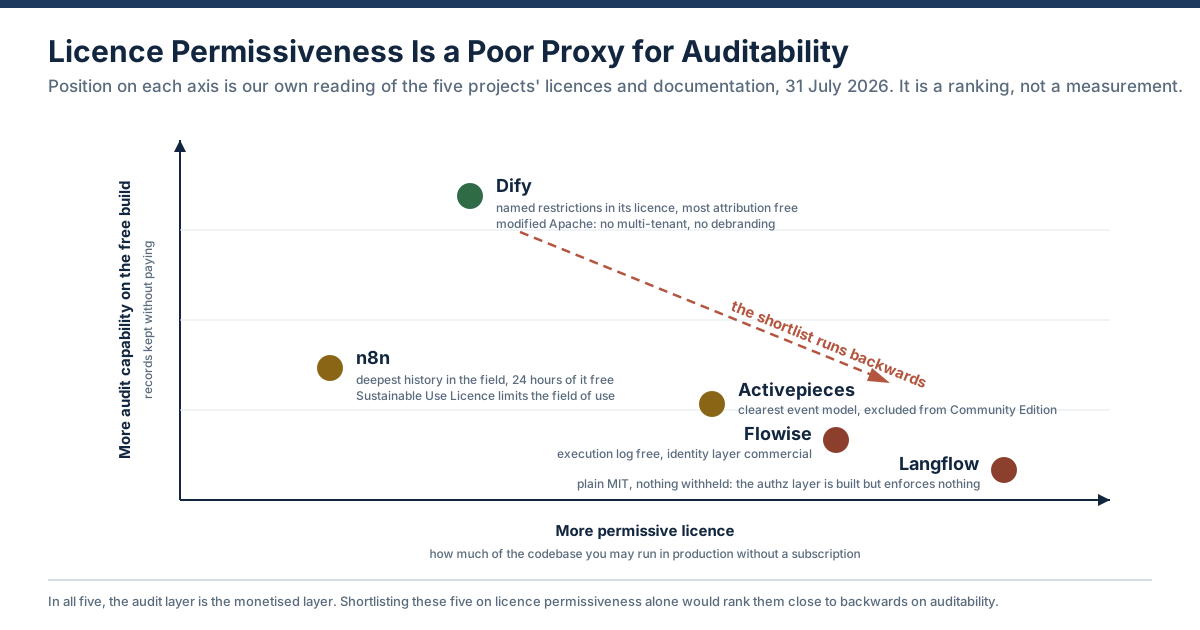
The mechanism is not mysterious and it is not a conspiracy. Audit features are what enterprises pay for, so a project that intends to monetise builds them and gates them, while a project that has not yet monetised has not built them. The practical consequence for a buyer is that "how open is the licence" and "how auditable is the tool" are close to independent variables, and the first is a bad proxy for the second. A team that shortlisted on licence permissiveness alone would rank these five almost exactly backwards on the thing they said they cared about.
There is a second-order effect worth naming. Because the audit layer is the monetised layer, it is also the layer most likely to move between editions in a future release. Dify's licence reserves the right to make the agreement stricter; n8n's .ee. convention makes it a filename change to move a feature behind the Enterprise licence. Neither is misconduct, and both are reasons to write the specific features you depend on into a contract rather than assuming the current edition boundary is permanent.
Our analysis of Langflow's per-run economics costs the other half of this: what you pay a third-party tracing vendor to buy back the observability an open canvas does not ship. Read together, the two articles describe the same trade from opposite ends — this one asks what the record contains, that one asks what the record costs.
Choose This One If: A Decision Path
The question "what is the best Flowise alternative" has no single answer because the blocker differs. Run this against your own blocker rather than against a feature grid.
Choose Dify if your requirement is attributable change history and a queryable run log, and you have not got budget approved. It is the only free build here that attributes a flow edit to a named account on the flow record itself and stamps each run with the version that produced it. Accept that you will show an auditor an API response rather than a screen.
Choose n8n if the audit record is a funded requirement and you want the deepest version history available. Budget for Business or Enterprise from the start — the free tier's 24-hour history is a prototype feature, not a governance one — and write your own join between runs and versions, because the product does not provide it.
Choose Activepieces if you are buying an enterprise tier regardless and you want audit events streaming into a SIEM. Its event model is the best specified of the five. Do not choose it expecting the Community Edition to carry any of that.
Stay on Flowise if your control requirement is satisfied by an execution log and your change control lives in Git already. Moving costs you a rebuild and buys you attribution you may not need.
Choose Langflow if you are prototyping with a small technical team, the deployment is not internet-reachable, and you have someone whose job includes tracking CISA advisories. Do not choose it as the system of record for anything.
Choose none of them if the honest answer is that your requirement is not a builder at all but a control plane in front of whichever builder you already run. That branch is the next section.
When Flowise Still Wins, and When Not to Move at All
A roundup has a structural bias toward concluding in a migration, because a migration is what the article is for. We think that bias is worth resisting, and there are three specific cases where the incumbent wins.
Your objection was hosting, not governance. If you went looking for Flowise alternatives because of upgrade burden or scaling, note that every project on this list is a service someone on your team runs, patches and backs up. Swapping one self-hosted canvas for another moves the maintenance rather than removing it, and our comparison of SaaS against your own cloud sets out why that decision is a sequence rather than a binary.
Your flows are already in Git. If flow JSON is exported and committed on every change, you already have a change record with attribution, a version record and a diff — a better diff than any of these five products offers, since it is a real one. What Git does not give you is a run record joined to a commit, and that gap is worth closing with a convention: stamp the flow's Git commit hash into a field the run record carries, such as a named version label or a custom data field the executions list can filter on.
The record you need is at the edge, not on the canvas. If the question is what data left the building, which model saw it and which credential was used, no builder answers that, because the builder is not where those decisions get made. That record belongs at the gateway.
The cost of migrating is also frequently understated. You are rebuilding flows in a different node vocabulary, re-establishing credentials, re-testing every integration and losing whatever run history the old tool held — and, per n8n's documentation, in at least one case deleting the workflow deletes the history with it. Do that for a governance requirement you have not written down and you will arrive with the same gap in a new tool.
The Option Nobody Ranks: Keep the Canvas, Govern the Edge
The framing every list of Flowise alternatives shares is that the answer to a governance gap is a different builder. There is a third option that the seven-alternatives format cannot express, because it is not on the list: keep the canvas your team already knows and put the record-keeping somewhere the canvas cannot lose it.
The reason this works is structural. Every flow in every one of these five tools eventually makes an outbound call: to a model, to a connector, to a customer system. That call is the enforcement point. A layer that sits there sees which identity initiated the call, which model it went to, what was masked or blocked before it left, and what it cost, and it keeps that record whether or not the builder above it kept anything. That is what LeapForce builds: one controlled layer for every AI tool, connector, model and agent, with non-human identities carrying an owner, a scope and an expiry, and an audit record that includes what was refused. Our rollout method is deliberately ordered — observe first, enforce second, optimize third — because a policy written before you can see what your flows actually do is a guess.
What this does not do is give you a diff of two Flowise flows or restore last Tuesday's version. Version control of the canvas is the canvas's job, and if that is your blocker, the ranking above is the relevant answer rather than this section.
Where This Analysis Is Uncertain
Four limits, stated plainly.
We did not run these tools. Every claim above comes from a licence file, a schema, a documentation page or a public vulnerability record, each fetched July 31, 2026. Nothing here reports observed behaviour, and a product can behave better than its documentation describes. Where we wrote "not documented", read it as exactly that.
Undocumented features may exist. Dify's attribution lives in the schema with no documented admin screen, which is the clearest example of a real capability that a docs-only reading nearly missed. There may be others we did miss, in either direction.
We could not verify Flowise's published pricing tiers. The pricing page resolves to an authenticated application shell rather than a public plan table under every fetch we attempted, so no Flowise prices appear above — only the documented Cloud and Enterprise gating. That is a gap in this comparison and we would rather name it than fill it with a number from a secondary source. Reddit, Glassdoor-style aggregators and vendor-comparison directories were not used as sources of fact about these five products anywhere in this article. The four competitor pages linked earlier are objects of study, not evidence.
Advisory counts are a bad health metric and we deliberately avoided them. Every one of these five projects has published security advisories, and the totals are confounded: a mature disclosure programme produces more advisories than an inattentive one, so raw counts would penalise the projects doing the right thing. We used CISA's KEV catalogue instead, because it records exploitation observed in the wild rather than reports received. n8n has one KEV entry, added 2026-03-11; Flowise, Dify and Activepieces have none as of catalogue version 2026.07.29. That is a narrower claim than "more secure", and it is the only one the data supports.
Finally, edition boundaries move. Every gating statement above is true of the documentation as published today and is the kind of thing a vendor can change in a minor release. If any of it is load-bearing for you, it belongs in a contract.
Frequently asked questions
Flowise's core is Apache 2.0 and free to self-host, but the licence carves out packages/server/src/enterprise under a commercial licence permitting production use only with a valid Enterprise subscription. Workspaces, role-based access control and SSO all live behind that boundary, per the project's own documentation. So the free build gives you a working execution log and no identity layer — which means "free" and "auditable" are separate questions, and the answer to the second is no.
Rank Flowise alternatives by the record they keep and the answer splits in two. If the audit record must exist on a free self-hosted build, choose Dify, because its workflow rows carry created_by and updated_by and its run records carry the version that produced them. If you have budget, n8n or Activepieces, both of which have deeper audit tooling sold as a paid tier. The deciding question is not which product is better overall but whether your evidence requirement is funded — that single fact reorders this list.
Flowise on runs, Langflow on paper, neither in practice. Flowise ships a dedicated execution entity with filterable state and date ranges in the open-source build, while Langflow's native run record is a messages table keyed by session ID. On change attribution, Flowise's flow row has no author column at all, while Langflow can attribute a flow write to a user in its authorization audit log — if you switched that log on, since it is off by default and prunes after 90 days unless you change the retention setting. What Langflow's rows cannot show you is a refusal, because its open-source build "always allows every action for every authenticated user". Langflow's licence is more permissive and its release cadence faster; Flowise's stored run record is more complete. Langflow also carries five CISA KEV entries against Flowise's none.
Partly, and it is the best available workaround for Flowise and Langflow, neither of which documents flow versioning in the product. Committing exported flow JSON gives you a change record with a real author, a version record and a genuine diff — better than any diff these products offer. What it cannot give you is the join between a run and the version that produced it, because the run history lives in the tool and the version lives in Git. Close that by writing the commit hash into a field the run record carries.
No, and the assumption is expensive when it goes unchecked. Activepieces states it directly on its pricing page: self-hosting "decides where Activepieces runs, not what it can do." n8n's full workflow history and log streaming require Enterprise tiers whether hosted by them or by you. Flowise's workspaces and SSO are Cloud and Enterprise only. Self-hosting relocates the software; it does not unlock the licence.
They differ enough to matter. n8n prunes by default at 336 hours, fourteen days, and caps the executions table at 10,000 rows, both adjustable by environment variable, while its workflow history defaults to indefinite retention. Dify's self-hosted docs state logs are retained indefinitely by default with optional scheduled cleanup. Flowise documents no retention policy we could find. Check the default before you rely on a record still being there next quarter.
Not on its own. Tracing answers what a run did and what it cost; an audit log answers who changed the system and what it refused. They are different records with different retention needs — 30 days is enough to debug and nowhere near enough to answer a compliance question about last quarter. Our costing of Langflow's per-run economics works through what buying that layer back actually costs.
Production-ready is the wrong test to apply to Flowise alternatives; ask instead which of the Five Records you need and which edition provides them. All five are actively maintained, all five ship releases regularly, and none of them is archived. The enterprise gap is rarely reliability — it is that the identity, attribution and evidence layers are either absent or in a tier you have not bought. Decide the record requirement first and the edition follows from it.
Five questions, one per record. Does the row storing my flow have a column for the user who last changed it? Can I export run history without scraping the API? Is a policy refusal stored, and can I count refusals for a date range? Can I see the difference between two versions, and can I tell which version produced a given run? And which of those four remain available on the edition I am actually deploying? Ask for the answers in writing, since edition boundaries move between releases.
Ready to Govern Your AI?
Talk to LeapForce — one controlled layer for every AI tool, connector, model, and agent.
Comments