
Invoice data extraction is the process of turning an invoice — a PDF, a scan, a photo, an email attachment — into named fields a finance system can act on: supplier, invoice number, dates, tax amounts, totals, bank details, and the line items. Modern services return 30 to 50 such fields, each with its own confidence score. Almost none of those scores should be your control.
Our position, and the reason this article exists: a confidence score tells you whether the model read the page correctly. It tells you nothing about whether the page is correct. Those are different failures with different consequences, and treating one number as the gate for both is why invoice automation projects pass their pilot and then quietly pay a fraudulent bank account. The sharpest statement of the problem we found came from a practitioner posting as order-matters on Hacker News in July 2026, who works in invoice analytics and described invoices where the stated line items do not add up to the stated total: item 1 - $500, item 2 $500. total: $1300. Nothing was misread. The document itself is wrong, and it is wrong on purpose, because, as that commenter went on to argue, invoices are written on the assumption that a reasonable human already following the conversation will read them.
The short answer: Do not gate invoice data extraction on a model confidence score. Classify every field by what you can independently check it against — arithmetic, a record you already hold, an external register, or nothing at all — and let confidence govern only the last category, which on a typical invoice is a small minority of the fields and never includes the bank account.
Last updated: July 30, 2026.
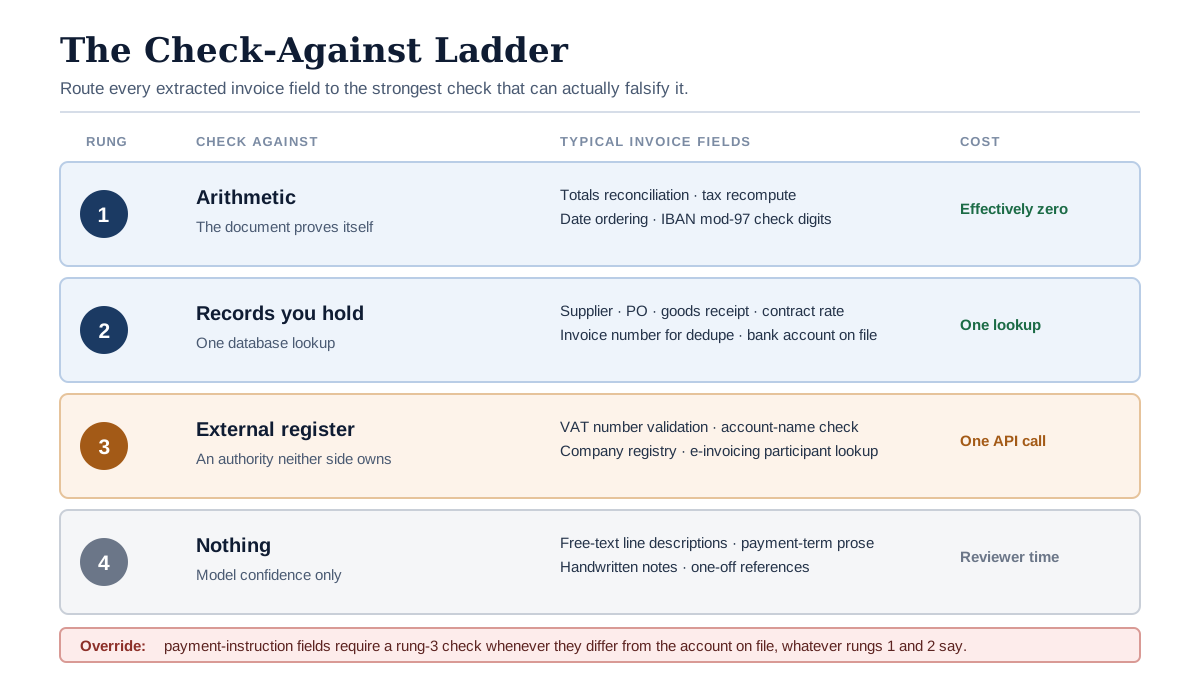
The Check-Against Ladder: every extracted field routes to the strongest independent check it can reach, and confidence governs only the fields that reach none.
What Invoice Data Extraction Actually Returns
Invoice data extraction returns a structured object, not a page of text. Microsoft's prebuilt invoice model in Azure AI Document Intelligence, whose published schema is a fair representative of the category, defines roughly 35 top-level fields plus nine line-item sub-fields, and Microsoft's product documentation says the model supports invoices in 27 languages.
Reading that schema is the fastest way to understand why a single accuracy number is meaningless. The fields are not of one kind. InvoiceDate is a date. InvoiceTotal is a currency amount. VendorTaxId is a registered identifier that exists in a government database. PaymentDetails.*.IBAN and PaymentDetails.*.SWIFT are payment instructions. Items.*.Description is free text a human wrote. PurchaseOrder is a foreign key into your own system.
Six field types, six different ways of being wrong, six different costs when they are wrong. A wrong ServiceEndDate produces a mildly confusing report. A wrong PaymentDetails.*.IBAN produces a payment to a stranger.
| Field group in the schema | Example fields | What "wrong" costs you |
|---|---|---|
| Identity | VendorName, VendorTaxId, CustomerId | Wrong supplier record, wrong tax treatment |
| Reference | InvoiceId, PurchaseOrder, CustomerId | Duplicate payment, unmatched receipt |
| Money | SubTotal, TotalTax, InvoiceTotal, AmountDue | Overpayment, understated liability |
| Dates | InvoiceDate, DueDate, ServiceStartDate | Missed discount, wrong period, late fee |
| Payment instruction | PaymentDetails.*.IBAN, .SWIFT, .BankAccountNumber | Funds sent to a fraudulent account |
| Descriptive | Items.*.Description, PaymentTerm | Bad analytics, weak audit narrative |
Every serious extraction service also returns a per-field confidence score alongside each value. That score is genuinely useful, and we will come back to where it belongs. What it is not is a general-purpose gate.
The Accuracy Number That Does Not Exist
Vendors quote invoice data extraction accuracy as a single percentage. There is no defensible way to compute one. Accuracy depends on which fields you count, whether a partially correct field counts, whether the document was born digital or photographed, and whether the invoice was in your training distribution. The strongest public evidence for how hard this task is comes from an open academic benchmark, and its numbers are nowhere near the marketing figures.
DocILE, introduced in an ICDAR 2023 paper, is the largest public benchmark for extraction from semi-structured business documents. It carries 6,700 annotated documents, 100,000 synthetic ones and close to a million unlabeled ones, with annotations across 55 field classes. It splits the problem into two tasks that map directly onto the two halves of an invoice: Key Information Localization and Extraction (KILE) for header-style fields, and Line Item Recognition (LIR) for the table.
The baseline results published with the dataset are worth reading before you accept any accuracy claim.
| DocILE baseline (test set) | Best reported score | Metric |
|---|---|---|
| KILE, header-style fields | 0.539 | Average Precision |
| KILE, header-style fields | 0.664 | F1 |
| LIR, line items | 0.698 | F1 |
| LIR, weakest table-detection variant | 0.594 | F1 |
Read those honestly and they cut both ways. These are research baselines from 2023 on a deliberately hard, unseen-layout benchmark, using models trained only on the provided data. A commercial service tuned to your fifty recurring suppliers, on born-digital PDFs, will do considerably better on your mail than any of these numbers suggest, and competition entrants have since beaten these baselines — though on the line-item track the published results note that only one method managed it, and second place went unawarded. Do not read 0.539 as "invoice extraction software is 54% accurate."
Read it instead as the shape of the problem. The task is not solved in the general case. Difficulty is not uniform across fields. And the number that a vendor quotes to you was measured on a document population, with a field weighting and a partial-credit rule, that they chose and you cannot inspect. Our earlier analysis of why accuracy is not the gate in intelligent document processing makes the broader version of this case across document types; this article narrows it to the invoice, where the field-by-field consequences are unusually sharp.
Why Confidence Is the Wrong Control for Most of an Invoice
The confidence score attached to every invoice data extraction result answers one question: how sure is the model that the characters it emitted are the characters on the page. It is a statement about reading, not about truth. Three of the four ways an invoice field ends up wrong in your ledger are invisible to it, and one of the three is the expensive one.
Consider the four failure modes separately.
The model misread the page. The document is correct, the extraction is wrong. This is the only failure a confidence score is designed to catch, and modern models catch it reasonably well on clean input.
The model read a correct page and picked the wrong field. Two totals appear, one being the previous balance carried forward; the model returns the wrong one with high confidence because it read both perfectly. Confidence is high. The value is wrong.
The page itself is internally inconsistent. This is the Hacker News case above: the line items say $1,000, the total says $1,300, and there is a real charge sitting in a note at the bottom of the page or in a separate agreement. The extraction is faithful. The document does not reconcile.
The page is correct, legible, faithfully extracted, and fraudulent. Someone intercepted the email, changed the bank account, and re-sent a clean PDF. Every character is crisp. Confidence approaches 1.0. The money leaves.
That last mode is not hypothetical, and it is not rare. The FBI's Internet Crime Complaint Center recorded business email compromise as one of the top five cyber-enabled fraud types by reported loss in its 2025 Annual Report, at $3,046,598,558 for the year. Invoice redirection is a core BEC pattern, and the technique works precisely because the fraudulent document is a good document. A clean, well-typeset, machine-readable invoice with a substituted IBAN is the ideal input for a system whose only control is legibility.
So the control has to be independence. Not "how sure is the model," but "what else in the world agrees with this value." That is what the ladder below organises.
The Check-Against Ladder
The Check-Against Ladder is our name for an invoice data extraction routing rule that takes about an afternoon to apply and replaces the single-threshold design most accounts payable teams start with. It has four rungs, ordered by how cheap and how deterministic the check is, and one rule that governs the whole thing.
The rule: route every extracted field to the strongest check that can actually falsify it. Confidence governs only the fields that reach no rung at all.
| Rung | What you check the field against | Cost per check | Catches |
|---|---|---|---|
| 1 | Arithmetic within the document | Effectively zero | Misreads of numeric and structured fields, documents that do not reconcile |
| 2 | A record you already hold | One database lookup | Wrong supplier, duplicates, off-contract pricing, unmatched receipts |
| 3 | An external register | One API call, sometimes a fee | Deregistered suppliers, substituted payment details, impersonation |
| 4 | Nothing | Model confidence only | Reading errors on free text, and only those |
Two things about this ordering are worth stating plainly, because they are where the rule earns its keep.
First, the rungs are not exclusive. A field that can be checked at rung 1 and rung 2 gets checked at both. The InvoiceTotal reconciles arithmetically against the line items and matches against the purchase order. Cheap checks are cheap; run all of them. The payback argument for the extra engineering is not a better accuracy figure. It is a smaller queue. Every field a deterministic check can clear is a field that stops generating review work, and review labour is where the running cost of invoice processing automation actually sits.
Second, and this is the part that changes system design: money-movement fields require a rung-3 check regardless of how well they score at rungs 1 and 2. An IBAN can pass its own check digits, match nothing in your vendor master because the supplier is new, and be entirely fraudulent. Arithmetic proves the string was not corrupted. It says nothing about whose account it is.
Rung 1: What the Invoice Proves About Itself
Rung 1 is arithmetic, and it is startlingly powerful for something free. A well-formed invoice is a small system of equations, and several of its fields carry check digits by design. If you implement nothing else from this article, implement rung 1 first: it costs one function, adds no measurable latency, and catches the great majority of the numeric misreads that confidence thresholds are usually deployed to catch.
Four checks belong here.
Totals reconciliation. Sum of line amounts, plus tax, minus discount, should equal InvoiceTotal; InvoiceTotal minus PreviousUnpaidBalance adjustments should equal AmountDue. This is a two-line check that catches a misread digit in any line amount, because a single wrong digit almost never leaves a sum intact.
Tax recomputation. For each entry in the tax detail array, Amount should equal the taxable base times Rate within a rounding tolerance you set explicitly. This catches misread rates and misread tax amounts independently of the totals check.
Date sanity. InvoiceDate must not be in the future. DueDate must not precede InvoiceDate. ServiceStartDate must not follow ServiceEndDate. A surprising share of extraction errors are date-format confusions between day-first and month-first conventions, and the ordering constraints catch a meaningful fraction of them for free.
Check-digit validation on structured identifiers. This is the underused one. An IBAN carries two check digits computed under the mod-97-10 system from ISO/IEC 7064, whose published abstract states that its check character systems detect "all single substitution errors" and "all or nearly all single (local) transposition errors." The IBAN structure itself is specified in ISO 13616-1:2020.
We ran that claim rather than repeating it. Taking the widely published example IBAN GB82 WEST 1234 5698 7654 32, we generated every possible single-digit substitution and every adjacent-digit transposition and validated each against mod-97:
Mutation type applied to GB82WEST12345698765432 | Cases tested | Rejected by mod-97 |
|---|---|---|
| Single-digit substitution | 144 | 144 (100%) |
| Adjacent-digit transposition | 14 | 14 (100%) |
Every corrupted variant failed. That is exactly what the standard promises, and it means an OCR misread of an IBAN is a solved problem that requires no model, no threshold and no reviewer. If your invoice data extraction pipeline routes low-confidence IBANs to a human queue, you are paying a person to do arithmetic.
The important limit, stated now so it is not mistaken later: this catches corruption, not substitution. A fraudster does not corrupt an IBAN. They supply a different, perfectly valid one. Mod-97 will happily pass it. That is a rung-3 problem.
Rung 2: Records You Already Hold
Rung 2 checks the extracted value against data your organisation already owns, and it is the rung most invoice data extraction projects under-build because it requires touching systems the extraction vendor does not control. It is also where the highest-value catches live, because the majority of an invoice is a claim about a relationship you already have documented somewhere.
Five checks belong here.
Supplier identity against the vendor master. VendorName and VendorTaxId should resolve to exactly one record. Fuzzy-matching to the nearest supplier is where systems quietly go wrong; a name that matches two records or none is an exception, not a best guess.
Invoice number against payment history. InvoiceId combined with the supplier is your duplicate-payment control. Duplicates are not primarily an extraction problem, but extraction is where you get the key that makes the check possible. Match on the normalised pair, not the raw string, because suppliers reissue the same invoice with a different prefix.
Purchase order and receipt matching. PurchaseOrder gives you the classic three-way match: the invoice against the order against the goods receipt. A PO number that does not exist in your system is an unambiguous exception, and no confidence score is required to know that.
Contract pricing. Items.*.UnitPrice against the agreed rate card. This is the check that finds the errors nobody reports, because a supplier billing an old rate produces a perfectly legible, perfectly extractable, perfectly wrong invoice.
Bank details against the account already on file. If the IBAN matches the one you have paid for two years, the risk is close to zero and the invoice can proceed. If it does not match, you have a change event, and a change event is a rung-3 problem no matter how confident the model is.
That last split is worth stating as its own rule, because it converts a hard problem into an easy one: for existing suppliers, payment-detail verification is a diff, not a lookup. You are not asking "is this a valid account." You are asking "did this change." The answer is free, and it catches more real risk than any other check in the pipeline. A practitioner building document workflow automation for logistics clients made the same point on Hacker News in March 2026, noting that OCR is roughly 70% of the effort while matching to master data and reconciliation logic is where teams underestimate the work.
Rung 3: Registers Outside Your Four Walls
Rung 3 checks a field against an authority neither you nor the supplier controls. It costs an API call and sometimes a fee, and it is the only rung that can address the failure mode confidence scores are blind to: a correct-looking document containing a substituted or impersonated value. Three registers matter for invoices, and one of them is free and public.
VAT number validation. The European Commission operates VIES, which validates an EU VAT number and returns the registered trader name. It is a genuine external authority, and it is directly callable.
We ran it on 2026-07-30 against a public Irish VAT registration to confirm both directions of the check. The valid number returned "isValid": true together with the registered name GOOGLE IRELAND LIMITED and its Dublin address. Changing the final character to produce 6388047X returned "isValid": false with no name. The endpoint used was the VIES REST service, in the form .../vies/rest-api/ms/{country}/vat/{number}.
That two-line result is more useful than it looks. The register does not merely say yes or no; it hands back a name you can diff against the VendorName your extractor returned. A supplier whose VAT number is valid but whose registered name does not resemble the name on the invoice is a specific, actionable exception that no confidence score would ever surface.
Account-name verification for payment details. Several jurisdictions now operate account-name checking before payment, the UK's Confirmation of Payee being the best-known. We were not able to retrieve Pay.UK's own service pages through any of our three fetch methods, so we describe the mechanism without attributing specific coverage figures to them, and readers should treat scheme details as something to confirm with their own bank. The design point stands regardless: for a first-time supplier or a changed account, the control is a name check performed by the payment rails, not a confidence threshold performed by the extractor.
Company registry and e-invoicing directory lookups. Company registration numbers resolve against national registries. For suppliers exchanging structured invoices, participant directories confirm that the identifier on the document belongs to a registered participant. Both are lower-frequency checks than VAT validation, and both are worth wiring for new-supplier onboarding rather than for every invoice.
| Rung-3 check | Authority | When to run it |
|---|---|---|
| VAT number validation | EU VIES service | Supplier onboarding, then periodically |
| Account-name verification | Payment scheme or bank | New supplier, or any bank-detail change |
| Company registry lookup | National business registry | Supplier onboarding |
| E-invoicing participant lookup | Network directory | Before enabling structured exchange |
The economic argument for rung 3 is straightforward. These checks are expensive per call relative to rungs 1 and 2, and they are also the only checks that address a loss category the FBI measured in billions. Run them on the events that matter, meaning a new supplier, changed bank details or an unusually large amount, rather than on every invoice. The cost then stays trivial.
Rung 4: The Fields With Nothing Behind Them
Rung 4 is where model confidence finally becomes the right control, and it is a smaller set of fields than most pipelines assume. These are the fields with no arithmetic relationship, no matching record and no external register: free-text line descriptions, payment-term prose, delivery notes, one-off references, handwritten annotations. There is nothing to check them against, so how well the model read them is genuinely the best available signal.
Two design consequences follow.
The first is that a confidence threshold on these fields should be set from your review capacity, not from a target accuracy. If you can review 40 invoices a day and 200 arrive, your floor is whatever value routes about 20% of documents to a human. That is an operations decision dressed as a model decision, and we worked through how to derive it in our earlier piece on setting the confidence floor before choosing a document parser.
The second consequence matters more. Because rung-4 fields have no independent check, they should almost never be allowed to block a payment on their own. A low-confidence line description on an invoice whose totals reconcile, whose PO matches, whose supplier is known and whose bank account is unchanged is a data-quality issue, not a payment risk. Route it to a cleanup queue that runs weekly. Do not hold the payment.
Getting this backwards is the most common design error we see described in the field: teams set a global confidence floor, the floor fires most often on the descriptive fields because free text is genuinely the hardest thing to read, and the exception queue fills up with items that carry no financial risk at all. Meanwhile the fraudulent invoice with the crisp substituted IBAN sails through with a high score, because it is a perfectly legible document. The queue is busy and the control is absent.
Prerequisites Before You Build the Map
Building an invoice data extraction field map takes an afternoon, but only if four things are already in place. Attempting it without them produces a map you cannot implement, which is worse than no map because it looks like progress. Confirm all four before you start.
A list of the fields your extractor actually returns. Not the marketing page. The schema. Every major service publishes one, and the field names in it are the rows of your map.
Read access to the systems that hold your reference data. Vendor master, open purchase orders, goods receipts, payment history, contract rate cards. Rung 2 is unbuildable without these, and "we will add matching later" is how pipelines ship with only rungs 1 and 4.
A named owner for the exception queue. Not a team. A person, with an agreed daily capacity in invoices. Every threshold you set later is derived from that number.
A written statement of what the system may commit without a human. Amount ceilings, supplier categories, whether a changed bank account may ever auto-commit. If nobody has written this down, the extraction pipeline will invent it by accident.
If you are missing the third or fourth item, stop and get them. They are cheap to obtain and they determine every number in the map.
How to Build Your Field Map in One Afternoon
This is the procedure. It produces a single table that becomes the specification for your validation layer, your exception routing and your audit record. To be precise about what the afternoon buys you: it produces the specification, not the running system. Writing the map is fast because it is a design exercise; wiring rung-2 lookups into an ERP you do not control is the part measured in weeks. Work through it in order, because each step depends on the one before.
Step 1. Pull the schema and list every field. Copy the field names from your extractor's published schema into the first column of a table. Include line-item sub-fields as their own rows. Expect 35 to 50 rows.
Step 2. Delete the fields you do not use. Most organisations act on 12 to 20 invoice fields. If nothing downstream reads ServiceAddressRecipient, it does not belong in the map, it does not need a check, and it should not generate exceptions. This step usually halves the table.
Step 3. Assign a consequence to each surviving field. In one short phrase: what happens downstream if this value is wrong. "Pays the wrong account." "Books to the wrong period." "Nothing, it is reference only." Be blunt. The phrase drives everything after it.
Step 4. Assign the highest rung each field can reach. Ask the question literally: what could falsify this value? If arithmetic can, mark rung 1. If a record you hold can, mark rung 2. If an outside register can, mark rung 3. If nothing can, mark rung 4. Fields commonly reach two or three rungs; record all of them.
Step 5. Write the actual check for each rung you marked. As an expression, not a paragraph. sum(items.amount) + totalTax - totalDiscount == invoiceTotal. vendorTaxId ∈ vendorMaster. iban == vendorMaster.iban. If you cannot write the expression, you have not specified the check.
Step 6. Decide the routing for each failure. Three outcomes only: block the payment, queue for review, or log and continue. Assign one per check. Resist inventing a fourth.
Step 7. Set thresholds only for the rung-4 rows. Divide your daily review capacity by daily invoice volume to get the fraction you can afford to review, then set the confidence floor that produces roughly that fraction. Every other row is governed by a check, not a number.
Step 8. Run it against last month's invoices before it touches anything. Score in shadow mode, then read the exceptions it would have raised. This is the step that reveals whether your tolerance on the totals check is too tight and whether your vendor master is dirtier than anyone admitted.
Expect that last one to be the finding. The most common outcome of a first shadow run is not a tuned threshold but a data-cleanup backlog: duplicate supplier records, stale bank details, POs closed in one system and open in another. That is uncomfortable, and it is also the honest answer to a fair objection. A rung-2 check against a dirty vendor master will fire more often than the confidence threshold it replaces, and it will keep firing until the master is fixed. The exceptions are not noise. They are a pre-existing control gap that the old design was hiding, and the sequencing that works is clean the reference data first, then go live, rather than loosening the check to make the queue look manageable.
One Invoice, Every Field Mapped
Below is a complete worked field map for a single invoice, assembled from the procedure above. The invoice is a constructed illustration, not a customer document: a services invoice from an existing EU supplier, three line items, VAT applied, paid by bank transfer against an open purchase order. The values are chosen to be typical, and the reason for including it is the shape of the completed table rather than the specific figures.
| Field | Extracted value | Consequence if wrong | Rungs reached | The check | On failure |
|---|---|---|---|---|---|
VendorName | Northbay Systems BV | Wrong supplier record | 2, 3 | Resolves to one vendor-master record; name matches VIES registered name | Queue |
VendorTaxId | NL812345678B01 | Wrong tax treatment | 2, 3 | Matches vendor master; VIES returns valid | Queue |
InvoiceId | NBS-2026-04417 | Duplicate payment | 2 | Supplier + number not already paid | Block |
PurchaseOrder | PO-88213 | Unmatched, over-budget spend | 2 | PO exists, open, same supplier | Block |
InvoiceDate | 2026-07-06 | Wrong period | 1 | Not in future; within 180 days | Queue |
DueDate | 2026-08-05 | Missed terms | 1, 2 | After invoice date; matches contract terms | Log |
SubTotal | 24,000.00 EUR | Overpayment | 1 | Equals sum of line amounts | Block |
TaxDetails.*.Rate | 21% | Wrong VAT recovery | 1, 2 | Valid rate for supplier country; base × rate = amount | Queue |
TotalTax | 5,040.00 EUR | Wrong VAT recovery | 1 | Equals 21% of subtotal within 0.02 | Block |
InvoiceTotal | 29,040.00 EUR | Overpayment | 1, 2 | Subtotal + tax; within PO remaining balance | Block |
AmountDue | 29,040.00 EUR | Overpayment | 1 | Equals total minus prior payments | Block |
PaymentDetails.*.IBAN | NL91ABNA0417164300 | Funds to a stranger | 1, 2, 3 | mod-97 valid; identical to account on file; if changed, account-name check | Block |
PaymentDetails.*.SWIFT | ABNANL2A | Failed or misrouted payment | 1, 2 | Valid BIC format; consistent with IBAN country and bank on file | Queue |
Items.*.Description | "Managed detection, July 2026" | Weak audit narrative | 4 | Confidence ≥ floor | Log |
Items.*.Quantity | 1, 1, 40 | Overpayment | 1 | Quantity × unit price = line amount | Block |
Items.*.UnitPrice | 12,000.00 / 8,000.00 / 100.00 | Off-contract pricing | 1, 2 | Line arithmetic; matches contract rate card | Queue |
Items.*.Amount | 12,000 / 8,000 / 4,000 | Overpayment | 1 | Sums to subtotal | Block |
PaymentTerm | "Net 30" | Cash-flow noise | 2, 4 | Matches contract terms; else confidence ≥ floor | Log |
Count the rows. Eighteen fields, and exactly one of them, the free-text line description, is governed by a confidence score alone. One more, PaymentTerm, falls back to confidence when the contract lookup is unavailable. The other sixteen are governed by checks that either succeed or fail deterministically.
That ratio is the entire argument of this article expressed as a table. A pipeline built the usual way would have applied one threshold to all eighteen rows, would have queued the descriptive fields most often, and would have had nothing at all to say about the IBAN.
Line Items: Why the Table Breaks
Line-item extraction fails more often than header extraction, which is why invoice data extraction benchmarks such as DocILE score the two tasks separately. The failure is structural rather than optical: header fields are a flat set of labelled values, while a line-item table is a grid whose row boundaries, column boundaries and continuation rules must all be inferred correctly before any individual cell means anything.
Four specific things break tables.
Rows that wrap. A long description flows onto a second visual line. Is that a new item with missing values, or a continuation? Get it wrong and your row count, and therefore your totals check, is wrong.
Tables that span pages. Headers repeat, subtotals appear mid-table, and the last row of page one may be the first row of page two.
Merged and implicit cells. A quantity that applies to three rows appears once. A discount is expressed as a row rather than a column.
Charges that are not rows at all. This is the case our problem-card practitioner described: charges sitting in a note at the bottom of the page, or arising from a separate agreement, that appear in the total but nowhere in the table.
The practical response is not a better model. It is to stop treating the line-item table as an authority and start treating it as a claim to be reconciled. Two rules do most of the work.
First, the totals reconciliation is the line-item accuracy test. If the extracted rows sum to the extracted subtotal, your row segmentation was almost certainly right. If they do not, something in the grid was misread or something is charged outside the grid, and either way the invoice needs a human. You do not need per-cell confidence to know this; you need one comparison.
Second, decide in advance what an unreconciled invoice means. It is not automatically an error. On some supplier relationships it is normal, and the right answer is a standing rule for that supplier rather than a daily exception. Treating "does not reconcile" as always-an-error is how a legitimate supplier ends up generating a manual review every single month.
For a longer treatment of what to do with the queue these rules create, and what it costs, see our analysis of pricing the exception queue in invoice automation.
When the Invoice Is Not a Document At All
The most reliable invoice data extraction is the extraction you never perform. A structured electronic invoice arrives as machine-readable data with defined semantics, so there is no reading step, no confidence score and no rung 4. This is not speculative: the European Union has legislated the transition, and the dates are fixed.
EN 16931 defines the European semantic data model for electronic invoicing. According to the European Commission's eInvoicing documentation, the standard specifies the core business terms of an electronic invoice as a semantic data model and maps them into two XML syntaxes, UBL 2.1 and the UN/CEFACT Cross Industry Invoice. Each business term carries a defined meaning and cardinality, which is what makes automated processing possible without inference.
On top of that, the VAT in the Digital Age package. Per the European Commission's ViDA page, Council Directive (EU) 2025/516 was adopted on 11 March 2025 and entered into force on 14 April 2025. From that date, per the same page, Member States may introduce mandatory e-invoicing under specific conditions. Digital reporting requirements for cross-border business-to-business transactions apply from 1 July 2030, with domestic systems to be aligned by 1 January 2035. The Commission's own estimate is a reduction in VAT fraud of up to €11 billion a year and administrative savings of over €4.1 billion a year across ten years.
| Milestone | Date | What changes for extraction |
|---|---|---|
| ViDA entry into force | 14 April 2025 | Member States may introduce mandatory e-invoicing under specific conditions |
| Cross-border DRR applies | 1 July 2030 | Intra-EU B2B invoices become structured by law |
| Domestic alignment deadline | 1 January 2035 | Remaining national systems converge |
What this means for a system you are designing in 2026 is concrete. A share of your invoice volume will migrate from documents to data, supplier by supplier, over the next decade. Design the validation layer so it sits after the format boundary rather than inside the extractor. Rungs 1, 2 and 3 apply identically to a structured invoice and a scanned one. A UBL invoice can still fail totals reconciliation, still name a supplier who is not in your master, and still carry a substituted IBAN. Only rung 4 disappears.
Teams that build validation inside their extraction vendor's platform will rebuild it when the structured invoices arrive. Teams that build it as a separate layer will simply feed it a second input.
Common Mistakes in Invoice Data Extraction
These are the recurring design errors in invoice processing automation, in rough order of how much they cost. Each one is a direct consequence of treating extraction as a reading problem rather than a verification problem.
Applying one confidence threshold to every field. The threshold that is right for a free-text description is far too loose for a bank account and far too tight for an invoice date that arithmetic already validates. One number cannot serve eighteen fields with six different consequence profiles.
Sending low-confidence fields to review instead of running the free check. A low-confidence IBAN does not need a human. It needs a mod-97 validation, which we measured above as catching 100% of single-digit corruptions on a published example IBAN. Paying a reviewer to do this is a pure cost with no risk reduction.
Reviewing extraction rather than reviewing the exception. A reviewer shown "this field scored 0.71, please confirm" will confirm it, because the value looks right on the page. A reviewer shown "this supplier's bank account changed since the last payment" will investigate. The unit of review should be the business event, never the field score.
Auto-committing a changed bank account because the model was confident. Stated this bluntly it sounds like nobody would do it. It happens whenever payment details are governed by the same global threshold as everything else, which is the default configuration of most pipelines.
Building the validation layer inside the extraction vendor. It looks efficient. It couples your controls to a format and a supplier, and it is the reason the e-invoicing transition above will be an expensive rebuild for some teams and a configuration change for others.
Measuring the pilot on documents you selected. A pilot run on fifty clean PDFs from your top suppliers measures the easy half of your mail. Include the photographed ones, the ones with handwriting, the ones from the supplier who reissues with a new prefix, and the one that does not add up.
Never re-running the map. Suppliers change formats, your ERP gains fields, thresholds drift out of line with review capacity. A field map read once a year takes an hour and prevents most of the slow decay.
Where This Approach Falls Short
We would rather state the limits than have a reader discover them in production. This method is a routing discipline for invoice data extraction, not a guarantee, and there are four places where it is genuinely weak.
It does not help where you hold no reference data. A first invoice from a brand-new supplier, with no PO, no contract and no payment history, reaches rung 2 on almost nothing. The ladder collapses to rungs 1 and 3 plus human judgement. New-supplier onboarding is a separate control problem, and it is the one this approach helps least with.
Rung 3 coverage is uneven by geography. VAT validation is genuinely good in the EU. Account-name verification exists in some payment schemes and not others. A supplier base spread across many jurisdictions will find rung 3 available for some and absent for others, and we do not have a general answer for the gaps.
The benchmark evidence is imperfect. We cited DocILE because it is public, reproducible and the best available, but its baselines are from 2023 and it does not measure the commercial systems most readers will actually buy. Vendors do not publish comparable per-field numbers, and we could not find an independent 2026 evaluation of commercial invoice extraction accuracy that we would be willing to cite. Treat the DocILE figures as an indication of task difficulty, not as a measurement of any product.
We have not run this end to end. We verified the mechanics we could verify directly: the mod-97 behaviour, computed here; the VIES responses, called live on 2026-07-30. We have not deployed this exact field map across a production accounts payable function and measured the change in exception volume, and we are not going to imply otherwise. The reasoning is derived from published standards, published benchmarks and practitioner accounts, and it should be tested against a month of your own invoices in shadow mode before you trust it.
One more honest exclusion. Several of the invoice-automation benchmark figures a reader might expect here, such as touchless rates, cost per invoice and exception percentages, circulate widely but trace back to vendor blog posts rather than to accessible primary research. We have left them out rather than launder them through a citation. The ones we could source are in our earlier cost analysis.
Governing the Extraction After It Works
Once invoice data extraction is running unattended, the open questions stop being about reading and start being about authority. What identity does the pipeline use inside the ERP, what is it permitted to commit without a human, what record proves what it did, and what happens to that authority when the person who built it leaves. That last question is a segregation-of-duties question in disguise, because an approver of record who is a service account nobody owns is not an approver at all — we set out the owner, scope and expiry model for that in our earlier piece on non-human identity for AI agents. Those are the questions LeapForce is built for: one controlled layer for every AI tool, connector, model and agent, with non-human identities treated as first-class so an extraction agent has an owner, a scope and an expiry the same way an employee account does, and observability and audit that records what was refused as well as what ran. Our rollout model for that layer is deliberately staged — observe first, enforce second, optimize third — because a control you switch on before you can see the traffic is a control you will switch off again within a week. LeapForce does not extract invoices and does not replace your document AI vendor; the field map above stays yours to build.
Frequently asked questions
No. Optical character recognition converts pixels to characters. Invoice data extraction takes those characters, plus the document's layout, and decides which of them constitute the invoice number, the supplier, the tax amount and each line item. OCR gives you text; extraction gives you named fields with types. Modern services do both in one call, which is why the terms get conflated, but they fail differently: OCR fails on image quality, extraction fails on unfamiliar layouts and ambiguous labels.
There is no single honest number, because accuracy depends on which fields you count and which documents you test. The best public evidence is the DocILE benchmark, where the published baselines reached 0.539 Average Precision on header-field extraction and 0.698 F1 on line items on a hard unseen-layout test set. Commercial systems tuned to your recurring suppliers on clean PDFs will do better than that. The point is that invoice extraction accuracy varies enormously by field and by document, so a single vendor percentage cannot be checked and should not be used to design controls.
Set it from your review capacity, not from a target accuracy, and set it only for fields that no other check can falsify. Divide the number of invoices your named reviewer can genuinely handle per day by your daily volume; that fraction is what your floor should route to review. Then apply the floor only to free-text and unmatched fields. Totals, dates, tax, identifiers and bank details should be governed by arithmetic and matching, which are deterministic and cost nothing per check.
Payment instruction fields, whenever they differ from what you already hold. A bank account that matches the one you have paid for two years carries almost no risk. A changed or first-seen account is a distinct event that needs verification against something outside the document, because the failure mode there is a legible, high-confidence, fraudulent value. The FBI's Internet Crime Complaint Center recorded business email compromise losses of $3,046,598,558 in its 2025 Annual Report, and invoice redirection is a core pattern within it.
For EU suppliers, the European Commission's VIES service validates a VAT number and returns the registered trader name. Calling it on 2026-07-30, a valid Irish registration returned isValid: true with the registered name and address; a single altered character returned isValid: false with no name. The returned name is the valuable part, because you can compare it with the supplier name your extractor produced. Run it at onboarding and periodically thereafter rather than on every invoice.
Partly, and unevenly. Handwritten annotations, faint thermal prints and photographs taken at an angle are where extraction accuracy degrades most, and they are also where a confidence score is doing its most useful work, because there is no independent check on a handwritten note. The practical mitigation is upstream: ask suppliers to send PDFs rather than photographs, and treat image quality as a supplier-onboarding requirement rather than a modelling problem.
Because a table is a structure, not a list of values. Before any individual cell can be read correctly, the system must infer row boundaries, column boundaries, wrapped rows, page continuations and merged cells. The DocILE benchmark separates line-item recognition from header extraction for this reason. The practical control is not a better model but a reconciliation: if the extracted rows sum to the extracted subtotal, the segmentation was almost certainly correct.
Per-page extraction pricing from the major cloud services is published on their own pricing pages and changes often enough that any figure quoted here would be stale within a quarter, so check the current page for your chosen service and region. The more useful budgeting insight is that extraction is rarely the dominant cost of invoice processing automation; review labour on the exception queue usually is, which is why the routing rules in this article matter more to the total than the per-page rate does.
Buy the extraction, build the validation. The reading problem is commoditised, competitive and improving quickly, and reproducing it internally means maintaining models against a moving target. The validation layer is the opposite: it depends on your vendor master, your purchase orders, your contract rates and your approval policy, none of which a vendor can see. That split also survives the shift to structured e-invoicing, because the validation layer keeps working when the extraction step disappears.
For part of your volume, eventually, yes. Under Council Directive (EU) 2025/516, digital reporting requirements for cross-border intra-EU business-to-business transactions apply from 1 July 2030, with domestic systems aligned by 1 January 2035. Structured invoices arrive as data with defined semantics, so there is no reading step. What does not disappear is verification: a structured invoice can still fail totals reconciliation, still name an unknown supplier and still carry a substituted bank account. Build validation as a layer outside the extractor and it survives the transition.
Enough to reconstruct the decision without the original reviewer. For each committed field: the value, the source document identifier and page location, the model and version that produced it, the confidence score, which checks ran, what each returned, who or what approved it, and when. The location reference is the one teams skip and later need, because an auditor asking why you paid a given amount wants to see the place on the page it came from.
The field map itself is an afternoon once the prerequisites are in place. Wiring rung-2 lookups into a vendor master and purchase-order system is the long pole and depends entirely on how accessible those systems are. Run the whole thing in shadow mode against a month of historical invoices before it touches a payment; that pass is what tells you whether your reconciliation tolerance is too tight and how dirty your supplier data actually is.
Ready to Govern Your AI?
Talk to LeapForce — one controlled layer for every AI tool, connector, model, and agent.
Comments