
The quote-to-cash process is the chain that runs from the moment a seller configures a price to the moment that money lands in the bank and is recognised as revenue. Seven stages, three departments, usually four or five systems. It is one process only in the sense that a relay race is one race.
Our position is narrower than the usual advice, and it is the reason we wrote this rather than another stage-by-stage tour. The unit you have to govern in quote-to-cash is not the stage and not the system. It is the price. Every figure you invoice was set by somebody or something, under some authority, at some moment, and the whole chain is healthy exactly to the degree that you can walk any invoiced number backwards to the approval that permitted it. On Hacker News, a practitioner describing why deal data goes missing put the failure in eleven words: "price discount or variation are only really included in the quotes" (laurentb) — not in the CRM, not in the ledger, not anywhere a finance team looks six months later. That is the defect this article is about, and adding an AI agent to any stage makes it sharper, not softer.
The short answer: Treat quote-to-cash as a chain of custody for a price — if you cannot walk one invoice line back to the recorded approval that set it without asking a human, the process is broken no matter how fast it runs.
Last updated: July 30, 2026.
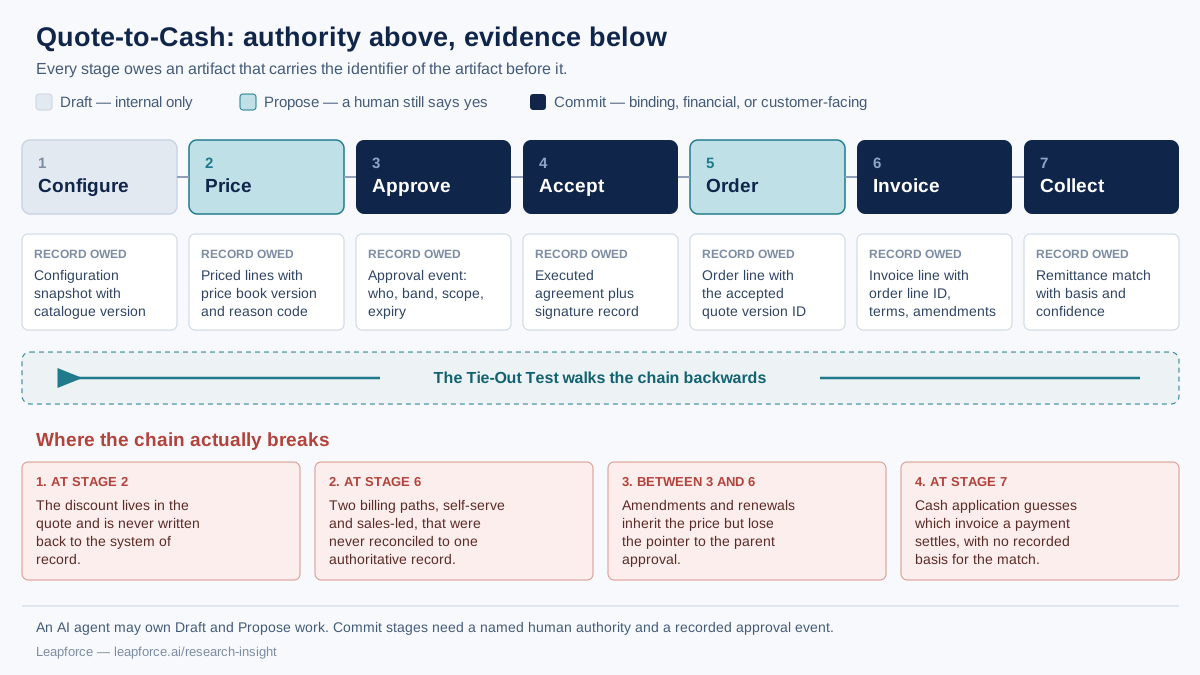
The quote-to-cash chain, drawn as authority above and evidence below rather than as a left-to-right pipeline.
One disclosure before the substance: we have not run a controlled quote-to-cash implementation of our own and are not going to pretend otherwise. Everything below is built from published standards, fetched vendor pricing, practitioner accounts we link to directly, and the governance patterns we build into our own platform. Where a number would have to come from a test we did not run, you will find a blank and a reason instead of a figure.
Quote-to-Cash, Defined by the Record It Leaves
The quote-to-cash process covers every step between a priced offer and recognised revenue: configure and price, approve, propose, accept, order, invoice, collect, apply cash, and recognise. Most definitions stop there. The more useful definition adds a second clause. Quote-to-cash is also the sequence of records that has to survive the transaction, because those records are what an auditor, a disputing customer, and next year's renewal all read.
That second clause is not decoration. Public-company audit standards describe internal control over financial reporting in terms of transaction flow, and the wording is precise. Those standards bind auditors of US-listed issuers, not every company — but the design logic they encode is the same logic a private company's own controller, insurer or acquirer will apply, so it is the most concrete public statement available of what "a governed revenue process" means. Auditors are directed to "understand the flow of transactions related to the relevant assertions, including how these transactions are initiated, authorized, processed, and recorded," according to the PCAOB's Auditing Standard 2201. Four verbs. Every stage in the chain performs at least one of them on a number that ends up in revenue. If a stage performs one and leaves no trace, the control does not exist. It just feels like it does.
The reason this framing beats the usual stage list is that stage lists implicitly treat all seven steps as equally worth automating. They are not. A stage that only processes an already-authorised number is cheap to automate and cheap to get wrong. A stage that authorises a number is the one that decides whether the company is owed $23,616 or $28,800, and it is the one that most automation projects quietly hand to whoever is fastest.
The vocabulary, in the order finance actually uses it
Revenue operations teams use several overlapping names for adjacent parts of this chain, and conflating them is the first source of confusion in any vendor conversation.
| Term | What it covers | Where it starts | Where it ends |
|---|---|---|---|
| Quote-to-cash (QTC) | Configure, price, quote, approve, contract, order, invoice, collect, recognise | The priced offer | Cash applied and revenue recognised |
| Order-to-cash (O2C) | Order capture, fulfilment, invoicing, collections, cash application | The accepted order | Cash applied |
| CPQ (configure, price, quote) | Product configuration, pricing rules, discount approval, quote document | Product selection | Quote issued |
| Contract lifecycle management (CLM) | Drafting, redlining, signature, obligations, renewal | Agreed terms | Contract expiry or renewal |
| Revenue recognition | Allocating and recognising revenue against performance obligations | The executed contract | Period close |
Quote-to-cash is the superset. The order-to-cash process is its back half. CPQ software is one tool inside its front half. The reason the chain feels harder than the sum of those parts is that ownership changes hands twice inside it, sales to finance at the order boundary and finance to accounting at the recognition boundary. Each handover is a chance for the price to lose its paperwork.
What the Quote-to-Cash Process Is Not
It is not the sales process, it is not a piece of software, and it is not a reporting problem. Those three misreadings send teams to the wrong fix, and each has a tell.
Not the sales process. The sales process ends when the customer says yes. Quote-to-cash is only halfway through at that point, and the second half is where the money is either collected or written off. A team that treats quote-to-cash as a sales concern will staff it with sellers and measure it with win rates, and will be surprised when days sales outstanding drifts.
Not a piece of software. A configure-price-quote tool does not give you a quote-to-cash process any more than a payroll system gives you an HR function. It gives you a place to record part of one. We looked at this from the adjacent angle in our earlier analysis of ranking sales automation candidates by reversal cost: the tool question comes last, after you have decided which actions may be taken without a human, and it is the cheapest of the decisions involved.
Not a reporting problem. Dashboards on cycle time are the most common output of a quote-to-cash improvement project and the least useful. Cycle time tells you the relay was fast. It does not tell you the baton was the same baton at the finish as at the start.
There is a fourth thing it is not, and it matters more in 2026 than it did in 2020: quote-to-cash is not a workflow you can safely wrap in an AI agent because the steps look clerical. Several steps are clerical. The two or three that are not sit in the middle, look identical from the outside, and carry the entire legal and financial weight of the chain.
The Seven Stages and the Record Each One Owes
Here is the quote-to-cash chain as we think it should be drawn: not as a pipeline with arrows, but as a table of decisions, each with a named authority and a named artifact. The middle two columns are the ones nobody fills in, and they are the ones that decide whether the process is governable.
| # | Stage | The decision made here | Who may commit it | The record it owes |
|---|---|---|---|---|
| 1 | Configure | Which products, quantities, terms and entitlements the customer gets | Seller, inside the published catalogue | Configuration snapshot with catalogue version and effective date |
| 2 | Price | The list price and the discount applied to each line | Seller within band; deal desk or director above band | Priced quote lines with the price book version and the discount reason code |
| 3 | Approve | Whether an off-band price may be issued at all | Named approver per authority matrix | Approval event: who, what percentage, which lines, when, on what grounds |
| 4 | Propose and accept | Whether the customer is bound to these terms | Customer signatory plus internal signatory | Executed agreement with an audit certificate and the exact quote version attached |
| 5 | Order | Which entitlements are provisioned and from when | Order management, on the executed agreement only | Order record linked to the accepted quote version, with a service start date |
| 6 | Invoice | What the customer is legally asked to pay, and when | Billing, on the order only | Invoice linked to the order line, showing terms, tax treatment and the amendment history |
| 7 | Collect, apply, recognise | Which cash settles which invoice, and when revenue is earned | Treasury and accounting, under policy | Remittance match, cash application entry, revenue schedule tied to performance obligations |
Read the right-hand column downwards and you have the tie-out chain: configuration snapshot, priced lines, approval event, executed agreement, order, invoice, remittance. Seven artifacts. If any one of them exists only in an inbox, a slide deck, or a sales rep's memory, the chain has a hole at exactly that point, and everything downstream of it is unverifiable rather than merely undocumented.
Notice how few of these are hard. The difficulty is not producing any one artifact; every system in the stack produces something. The difficulty is that each artifact has to carry a pointer to the one before it, and pointers are the first thing an integration drops.
The Tie-Out Test: A One-Afternoon Diagnostic
We call the diagnostic the Tie-Out Test, and the whole thing runs in an afternoon with a laptop and read access. Pick one invoice line and walk it backwards to the authority that set its price, recording how many humans you had to ask. Do that for ten invoice lines and you have a defensible picture of whether the chain is governed or merely busy.
Here is the procedure. Do not delegate it to the team that owns the process; the point is to see what a stranger can reconstruct.
Step 1: sample deliberately, not randomly. Ten invoice lines from the last full quarter: three standard new-business deals, three renewals, two mid-term amendments, one multi-year, one that went through a non-standard discount. Amendments and non-standard discounts are where the chain breaks, so they must be over-represented.
Step 2: start at the invoice, never at the quote. Starting at the quote is the mistake that makes every process look healthy, because you follow the path that was designed rather than the path that happened. Open the invoice line. Write down the amount.
Step 3: walk backwards one hop at a time, timing each hop. Invoice line to order line. Order line to accepted quote version. Accepted quote version to signature record. Signature record to approval event. Approval event to the discount band in the authority matrix. Five hops. For each, record: did the pointer exist in the system, or did you have to search, ask a person, or infer it?
Step 4: score each line on a three-value scale. Tied means all five hops resolved from system records alone. Traceable means you got there but had to search across systems or read a document. Orphaned means at least one hop required asking a human what happened, or the answer no longer exists.
Step 5: report the two numbers that matter. The tie-out rate is the percentage of sampled lines scored Tied. The evidence time is the median minutes to complete one line. The second number is usually the one that changes minds. A finance leader who is comfortable with a 60% tie-out rate stops being comfortable when a single line takes forty minutes to reconstruct and the auditor wants forty of them.
| Tie-out rate | What it means | What to do next |
|---|---|---|
| Below 40% | The chain is reconstructed by memory, not by record | Stop all automation work; fix pointers first |
| 40–70% | Standard deals tie out, exceptions do not | Instrument amendments and off-band approvals before anything else |
| 70–90% | Chain is sound; gaps are in one system boundary | Find the boundary, usually quote-to-order or order-to-invoice |
| Above 90% | Governable | Automation can now proceed stage by stage |
The test is deliberately cheap, and that is its argument. Nothing else in a quote-to-cash improvement programme gives you a defensible number for under a day of effort, and every vendor conversation you have afterwards is different because you can say which hop is broken instead of saying the process feels slow.
Four Places the Chain Actually Breaks
Across practitioner accounts, audit guidance and the structure of the tooling itself, the same four fractures recur. None of them is a speed problem. All four are pointer problems.
Drift point one: the discount lives in the quote, not in the system of record
This is the failure our problem card names. Discounts and variations get captured in the quoting layer and never make it back into the CRM, because most companies adopt a CRM years before they adopt anything resembling configure-price-quote tooling, and the quote layer arrives as a bolt-on. The practical consequence is that the CRM opportunity record — the thing every forecast, every renewal motion and every account review reads — carries a number that was never the number.
The tell is easy to check: pull ten closed-won opportunities and compare the opportunity amount to the sum of the accepted quote lines. If they differ on more than one or two, the CRM is a narrative, not a record.
Drift point two: two billing paths that were never reconciled
Product-led companies acquire a self-serve billing path first and a sales-led path second, and the two rarely converge. A founder building in this space described the outcome plainly: it "creates 2 different systems: self-serve and sales-driven billings" (AnhTho_FR), which is bad for the customer experience and worse for the internal process. The same customer can hold two subscriptions with different price books, different proration rules and different renewal dates, and no single record says which one is authoritative.
This one is expensive because it is invisible until an upgrade, a downgrade or an acquisition forces the two records to be compared. Then someone spends a quarter reconciling by hand.
It has a master-data twin that is worth naming separately, because it defeats otherwise sound pointer work. If the CRM account, the billing customer and the legal entity on the contract are three records with no shared identifier, every pointer you build downstream is anchored to a different notion of "the customer". Before instrumenting anything else, confirm that one identifier survives all three systems. Where it does not, that reconciliation is prerequisite work, not a later phase.
Drift point three: amendments lose their parent approval
A mid-term change, whether that is five extra seats, a co-termination or a downgrade, gets treated as a small transaction and processed accordingly. The amendment gets its own record and no pointer to the approval that governed the original discount, so the new seats are sold at the discounted rate without anyone re-checking whether that discount was ever authorised at that level, or whether it was authorised only for the original quantity.
This is the single most common orphaned hop in the Tie-Out Test, and it is why the sample must over-represent amendments.
Drift point four: cash application guesses
Payment arrives without a clean remittance advice. Somebody, or some rule, decides which invoices it settles. That decision changes the ageing profile, the dunning behaviour and, in edge cases, revenue timing. It is very often made with no recorded rationale at all. Automating it is genuinely attractive. Automating it without recording the basis for each match converts a slow manual judgement into a fast undocumented one.
We treated the mirror-image of this problem — the inbound, accounts-payable side, where the economics live in the exception queue rather than the scan — in our analysis of what invoice automation actually costs. The accounts-receivable side of quote-to-cash has the same shape: the happy path is cheap and the exception is where the money and the risk sit.
What Auditors Already Require of an Automated Chain
Before deciding what an AI agent may do in this chain, it is worth knowing what the audit profession already expects of any automated control. The answer is more specific than most technology teams assume, and one clause in particular reframes the entire AI question.
Audit standards treat automation as a risk reducer, but conditionally. An automated control "would generally be expected to be lower risk if relevant information technology general controls are effective," according to AS 2201. Read the condition, not the conclusion. Automation lowers control risk only when the controls around the automation, meaning change management, access and operations, hold. An agent that anyone can reconfigure, whose prompt is edited without review, running under a shared credential, is not a lower-risk control. It is a higher-risk one wearing the costume of a lower-risk one.
Three further requirements from the same standard bear directly on quote-to-cash design:
- Authorisation is a named stage. Transactions must be initiated, authorised, processed and recorded, and the auditor tests the flow across all four. A quote-to-cash design that has no distinct authorisation artifact has not simplified the process; it has deleted a control.
- Segregation of duties may be substituted, not skipped. The standard acknowledges that smaller companies have fewer "opportunities to segregate duties" and must implement alternative controls, whose effectiveness the auditor then evaluates. If one agent both prices and invoices, you owe an alternative control and a written argument for it.
- Unusual transactions get extra scrutiny. Controls over transactions "outside the normal course of business", meaning unusual in timing, size or nature, are called out specifically. Off-band discounts, backdated service starts and quarter-end amendments are precisely that category, and they are precisely what teams most want to speed up.
None of this is AI-specific, which is the point. The governance bar for an agent in this chain is not a new bar invented for AI. It is the existing bar for financial controls, applied to a new kind of actor that happens to be very fast and very confident.
Which Quote-to-Cash Stages an AI Agent May Own
Sort every quote-to-cash task into three authority classes and the automation question stops being contentious. The classes are Draft, Propose and Commit, and the line that matters sits between the second and the third.
- Draft. The agent produces something no one outside the company will ever see unless a human forwards it. Zero external exposure. Reversal cost near zero.
- Propose. The agent produces something that will be acted on by a human who can still say no, and the human's approval is recorded separately. Reversal cost is the reviewer's time.
- Commit. The agent's action is externally visible, legally meaningful, or changes a financial record. Reversal requires contacting the customer, issuing a credit note, or adjusting the ledger.
| Quote-to-cash task | Class | Why | Governance required |
|---|---|---|---|
| Summarise the call and extract requirements | Draft | Internal note, no external effect | Retention policy only |
| Assemble a configuration from the catalogue | Draft | Nothing is priced or sent | Catalogue read access, versioned |
| Apply list pricing from the price book | Propose | Deterministic, but feeds a customer-facing number | Price book version recorded on the quote |
| Recommend a discount within band | Propose | Human sends it; the band is the control | Band check enforced outside the model |
| Approve an off-band discount | Commit | This is the authorisation artifact itself | Never an agent. Named human, recorded event |
| Send the quote to the customer | Commit | Externally visible price commitment | Human send, or agent send with pre-send policy check and log |
| Generate the contract from an approved template | Propose | Draft until countersigned | Template version pinned; no free-text terms |
| Countersign | Commit | Binds the company | Named signatory, never delegated to software |
| Create the order from the executed agreement | Propose | Internal, reversible before invoicing | Pointer to the accepted quote version mandatory |
| Issue the invoice | Commit | Legal demand for payment; starts the payment clock | Agent may assemble; release requires policy check plus recorded authority |
| Send a dunning notice | Commit | Customer-facing, relationship-affecting | Policy-gated, with an escalation ladder and a suppression list |
| Apply cash to invoices | Commit | Changes the ledger and the ageing | Agent may propose the match with a confidence score; low-confidence goes to a queue |
| Draft the revenue schedule | Propose | Accounting reviews and posts | Never posts to the general ledger directly |
The reason to sort by class rather than by stage is that the same stage contains tasks of different classes. "Quoting" is not one thing: assembling a configuration is a Draft task and sending the resulting quote is a Commit. Teams that automate at stage granularity end up automating a Commit because it happened to sit next to a Draft.
There is empirical reason to be conservative about the Commit column. In TheAgentCompany benchmark, which puts language-model agents inside a simulated company and asks them to do real professional work, the strongest agent tested completed 30% of tasks autonomously, with the authors noting that longer-horizon tasks remained out of reach. That figure is from a research setting rather than your ledger, and the benchmark's own leaderboard will have moved since the paper's September 2025 revision. But the shape of the finding is the useful part: short clerical tasks go well, long multi-system tasks with a consequential end state do not, and this chain is the second kind.
Pricing Authority Is a Policy Object, Not a Prompt
The discount authority matrix is the most important artifact in the entire quote-to-cash chain and the one most often kept in a slide. Write it down as data, enforce it outside the model, and half the governance problem disappears.
A minimal matrix has four columns and lives somewhere a system can read it:
| Discount band | Who may approve | Evidence required | Expiry |
|---|---|---|---|
| 0–10% | Seller, self-serve | Reason code from a fixed list | Quote validity period |
| 10–20% | Sales manager | Reason code plus competitive note | 14 days |
| 20–30% | Sales director or deal desk | Written justification plus margin impact | 7 days |
| Above 30% | CFO or equivalent | Board-visible; margin and precedent analysis | 7 days, single use |
Three design rules make this enforceable rather than aspirational.
Rule one: the band check runs outside the model. If an agent proposes a discount, the check that the discount is inside the proposer's authority must execute in policy code that the agent cannot argue with. A model that has been asked to respect a limit is not a control; it is a preference. This is the same principle as putting the approval gate in the workflow rather than in the instructions, which we worked through in detail in our analysis of when a human approval gate is actually a control.
Rule two: approvals expire and are single-use by scope. An approval for 22% on 40 seats is not an approval for 22% on 60 seats three months later. Attach quantity and term to the approval event, and require re-approval when either changes materially. This one change closes drift point three on its own.
Rule three: the reason code is mandatory and enumerated. Free-text discount reasons are unanalysable, so nobody analyses them, so the company never learns which discounts bought anything. A fixed list of eight or ten codes turns the discount log into the single best dataset revenue operations will ever own.
The corollary is worth stating plainly, because it is where AI pricing pitches usually founder: an agent may be extremely good at recommending a price and must still never be the authority for one. Authorisation is an assertion about who is accountable, and accountability does not attach to a model. It attaches to a person, or to a named non-human identity with a named human owner. That distinction is one we have written about at length in the context of giving AI agents an owner, a scope and an expiry.
Worked Example: A Forty-Seat Renewal, Tied Out End to End
Abstractions collapse fast against a real transaction, so here is one quote-to-cash deal end to end, assembled with arithmetic you can check. This is an illustrative deal built to demonstrate the artifacts, not a customer of ours.
The deal. A forty-seat renewal of a subscription listed at $60 per seat per month, sold on an annual term with payment up front, plus a mid-term addition of five seats on day 90, co-terminated with the parent contract.
The numbers.
| Line | Calculation | Amount |
|---|---|---|
| Annual list value, 40 seats | 40 × $60 × 12 | $28,800 |
| Discount applied | 18% | −$5,184 |
| Net unit price after discount | $60 × 0.82 | $49.20 per seat per month |
| Renewal invoice, 40 seats, 12 months | 40 × $49.20 × 12 | $23,616 |
| Amendment, 5 seats, 9 months remaining | 5 × $49.20 × 9 | $2,214 |
| Total contract value | $23,616 + $2,214 | $25,830 |
The authority path. The 18% discount falls in the 10–20% band, so a sales manager approves it. Not the seller, and not the director. The amendment inherits the $49.20 unit price, which means the amendment also inherits the approval, which means the approval record must be attached to the amendment or the amendment is orphaned. That single pointer is the difference between a clean file and a finding.
The tie-out record. This is the artifact the whole article argues for. One row per hop, generated from system records, retrievable for any invoice line in under two minutes.
| Hop | Artifact | Key fields |
|---|---|---|
| 1 | Invoice line | Invoice number, line ID, $23,616, terms Net 45, issue date, order line ID |
| 2 | Order line | Order ID, service start date, quote version ID, 40 seats at $49.20 |
| 3 | Accepted quote version | Quote ID and version, price book version, per-line discount 18%, reason code COMPETITIVE-RENEWAL |
| 4 | Signature record | Envelope ID, signer identities, timestamps, certificate of completion, quote version hash |
| 5 | Approval event | Approver identity, band 10–20%, scope 40 seats for 12 months, granted date, expiry |
| 6 | Authority matrix version | Matrix version in force on the approval date, band definitions, named approver role |
| 7 | Amendment link | Amendment ID, parent approval event ID, 5 seats at $49.20, $2,214, co-termination date |
Seven rows. Every field comes from a system that already exists in a normal stack. The work is not producing them. It is making each row carry the identifier of the row above it, and refusing to let a stage complete when that identifier is missing.
Where an agent could safely sit in this deal. It could assemble the renewal configuration from the expiring entitlements, draft the quote at list, compute the amendment proration, prepare the tie-out record itself, and flag that the amendment lacked a parent approval pointer. That last one is the highest-value automation in the whole example and nobody sells it, because it is a control rather than a time-saver. What the agent could not do: approve the 18%, countersign, release either invoice without a policy check, or decide unilaterally that a payment of $23,616 settled this invoice rather than another one for a similar amount.
What the Quote-to-Cash Stack Costs to Instrument
Published list prices for the main quote-to-cash layers, all fetched on 30 July 2026. These are list, before discounting, and the point of the table is the shape of the spend rather than a shopping list.
| Layer | Named example | List price, fetched 30 July 2026 |
|---|---|---|
| CRM, system of record | Salesforce Sales Cloud Enterprise | $175 per user per month, billed annually (Starter Suite $25, Pro Suite $100, Unlimited $350) |
| Configure, price, quote and order | Salesforce Revenue Cloud, Growth and Advanced editions | $150 and $200 per user per month; a paid add-on, not part of Sales Cloud |
| Signature and agreement record | DocuSign eSignature Standard and Business Pro | $30 and $45 per user per month; Personal $11 per month; 100 envelope sends per user per year on both business tiers |
| Subscription billing and invoicing | Stripe Billing | 0.7% of billing volume pay-as-you-go; annual plans from $620 per month up to $100,000 monthly billing volume, then 0.67% |
| Payment acceptance | Stripe card processing, same page | 2.9% + 30¢ per successful card charge |
A worked figure for an eight-seller team, at list, so the arithmetic is visible:
| Component | Calculation | Annual, at list |
|---|---|---|
| Sales Cloud Enterprise, 8 users | 8 × $175 × 12 | $16,800 |
| Revenue Cloud Growth, 8 users | 8 × $150 × 12 | $14,400 |
| DocuSign Business Pro, 8 users | 8 × $45 × 12 | $4,320 |
| Stripe Billing on $500,000 annual billing volume, pay-as-you-go | $500,000 × 0.7% | $3,500 |
| Software subtotal | $39,020 |
That is roughly $4,878 per seller per year at list, before implementation. Whether it is good or bad depends entirely on a number we cannot supply for you, and we are not going to invent one: there is no honest industry payback figure for quote-to-cash automation, because the benefit is dominated by your own dispute rate, discount leakage and audit effort. Compute your own instead, from two figures the Tie-Out Test gives you free: evidence time multiplied by the number of lines your auditor samples, and band breach rate multiplied by average deal value and gross margin. Both are defensible in a board pack because you measured them.
Card processing is excluded because business-to-business subscriptions of this size are usually settled by bank transfer rather than card; include it and the figure moves by an order of magnitude more than every licence combined. Implementation, integration and the internal time to build the pointers between systems are also excluded. We have no defensible multiplier to offer for them, and the honest thing to say is that they are the part of the budget that varies most between companies and least between vendors.
Two honest observations about this table.
First, note that the quoting layer costs about as much as the CRM underneath it, and it is an add-on to a licence you already hold. That is the actual economic argument behind the "is enterprise configure-price-quote software overkill for a small team" question, and it is an argument about seat maths rather than about complexity. Eight sellers is $14,400 a year for the quoting layer alone; the same eight sellers could tie out their chain with a spreadsheet-backed authority matrix and disciplined pointers for the cost of nobody's licence.
Second, and cutting the other way: the reason the enterprise suite is expensive is that it enforces the pointers by construction. A modular stack is cheaper in licences and more expensive in discipline, because every pointer between the layers is now yours to build and yours to keep working through every integration change. Neither is free. The Tie-Out Test is the way to find out which cost you are currently paying without knowing it.
We deliberately have not written this section as a vendor comparison. Ranking configure-price-quote products against each other is a different job with a different method, and doing it honestly needs per-product hands-on evaluation we have not performed.
The Cash End: Terms, Dunning, and What Software May Not Decide
The last third of the quote-to-cash chain is where automation is most tempting and most regulated. Payment terms are not purely a commercial choice in Europe, and automated collection actions are customer-facing regardless of who or what triggered them.
Under Directive 2011/7/EU on combating late payment in commercial transactions, as summarised by the European Commission, enterprises have to pay invoices within 60 days "unless they expressly agree otherwise and provided it is not grossly unfair"; public authorities are held to 30 days, or 60 in very exceptional circumstances. The directive also provides an automatic entitlement to interest on late payment, a minimum of €40 as compensation for recovery costs, and statutory interest of at least 8% above the European Central Bank's reference rate. Those are directive-level floors transposed into national law by each member state, and the Commission notes that countries may maintain or introduce provisions more favourable to the creditor, so check the implementation in the jurisdictions you actually invoice from rather than coding the directive itself into a billing rule.
Three consequences for anyone automating the cash end:
Terms are a compliance field, not a free-text field. If your quoting layer lets a seller type any payment term into a quote, a system is generating a legally significant number with no validation. The terms field belongs in the authority matrix alongside the discount bands, with the same approval logic.
Interest and recovery costs are entitlements you may be silently waiving. Whether to invoke them is a commercial decision, but it should be a recorded one. An automated dunning ladder that never mentions statutory interest has made that decision on the company's behalf, permanently, at scale.
Dunning is a Commit action. An automated reminder to a customer who is in an active dispute, or who is mid-renewal, is a relationship event. The suppression list — accounts in dispute, accounts in negotiation, accounts with an open credit note — is the control, and it has to be readable by whatever sends the notices. A fully automated ladder without one converts a collections improvement into an account escalation, reliably, at the worst possible moment in the renewal cycle.
Cash application deserves a separate note. It is the single best candidate for machine assistance in the whole chain, because matching remittances to invoices is genuinely a pattern-recognition task at which software beats people. It is also the place where an unrecorded decision does the most damage, because a wrong match makes both the settled invoice and the unsettled one wrong. The rule we would apply: the matcher may propose with a confidence score, may auto-apply above a threshold the finance team sets and reviews monthly, and must write the basis for every match, meaning matched fields, amount tolerance and confidence, into the record. Auto-application without a recorded basis is not automation, it is deletion of evidence.
For a fuller treatment of what a defensible action record looks like when software rather than a person took the action, see our earlier work on audit trails that prove what an agent actually did.
Six Numbers That Show the Chain Is Governed
Cycle-time dashboards dominate quote-to-cash reporting and tell you almost nothing about control. These six are harder to game and each one maps to a specific failure above.
| Metric | Definition | Why it matters | A reasonable first target |
|---|---|---|---|
| Tie-out rate | Percentage of sampled invoice lines whose price traces to a recorded approval with no human asked | The headline control measure | Above 90% within two quarters |
| Evidence time | Median minutes to assemble the full chain for one invoice line | What an audit actually costs you | Under 10 minutes |
| Band breach rate | Percentage of issued quotes carrying a discount above the sender's authority | Measures whether the matrix is enforced or decorative | Below 1% |
| Quote-to-invoice variance | Count of invoice lines whose amount differs from the accepted quote line | Catches drift points one and three | Zero, investigated individually |
| Orphaned amendments | Mid-term changes with no pointer to a parent approval | The most common broken hop | Zero |
| Agent refusal count | Number of agent actions blocked by policy in the period | A zero here almost always means the policy is not wired, not that behaviour is perfect | Non-zero and reviewed |
That last metric deserves the emphasis. A governance layer that has never refused anything has not been tested. Refusals are the evidence the control exists, which is why our own platform records what was refused and not only what ran, a design choice described on the observability and audit page rather than an aspiration.
A Ninety-Day Sequence to Get the Chain Tied Out
Ordering matters more than speed here, and the ordering is the same one we use for governing model traffic: observe first, enforce second, optimise third. That sequence is our published rollout model for the AI gateway, and it transfers to quote-to-cash for the same reason it works there — enforcing rules on a process you have not yet measured produces confident rules about the wrong things.
Days 1–30, observe. Run the Tie-Out Test on ten lines. Write down the authority matrix as it is actually practised, not as policy states it, and note every place the two disagree. Inventory which system owns each of the seven artifacts, and which pointers exist. Produce one number, the tie-out rate, and one list: the broken hops, ranked by frequency.
Days 31–60, enforce. Fix pointers before you fix speed. Make the accepted quote version ID a required field on the order, and the order line ID required on the invoice line. Make the approval event carry quantity, term and expiry. Make the amendment refuse to complete without a parent approval pointer. Move the authority matrix out of the slide and into a table a system can read, and enforce the band check in policy code. Nothing here is an AI project, and that is deliberate. None of it works better if a model is involved.
Two implementation details decide whether this survives its first quarter-end. Enforce required fields at stage completion, not at record creation, or you will break every inbound integration that legitimately writes a partial record. The order may exist without a quote version pointer, but it may not be marked complete without one. And treat every rule deactivation as a change-managed event with a logged owner, reason and expiry. A validation rule that a systems administrator can silently switch off at 4pm on the last day of the quarter is not a control; it is a suggestion with extra steps. The number of times it was switched off belongs on the same report as the band breach rate.
Days 61–90, optimise. Now automate, in Draft-then-Propose order. Configuration assembly, proration maths, tie-out record generation, remittance matching with confidence scores. Leave every Commit action requiring a named human authority until the tie-out rate has held above 90% for a full close cycle. Then, and only then, consider moving a single low-value Commit, say a standard-terms renewal quote under a fixed threshold, behind an automated policy check, and measure the refusal count.
On ownership: this is a revenue operations programme with a named finance sponsor, not an IT project and not a sales project. The single-owner test is whether one person can both mandate a required field in the CRM and change the discount authority matrix. If nobody can do both, the programme has no owner yet and the first ninety days will produce a document rather than a control.
The reason this sequence is slower than the vendor version and faster than the alternative is that it front-loads the only work that cannot be redone cheaply. Pointers built during an automation project get built to serve the automation. Pointers built first serve everything afterwards, including the automation you have not chosen yet.
Common Mistakes When Automating Quote-to-Cash
Six patterns show up repeatedly, and all six are cheaper to avoid than to unwind.
Automating at stage granularity. "Automate quoting" bundles Draft tasks with a Commit. Decompose to task level and the scary part usually turns out to be one action, not one stage.
Treating the model's confidence as an authorisation. A high-confidence recommendation is still a recommendation. The authority to bind the company is a separate object with a separate record, and no amount of model quality creates it.
One shared credential for the whole chain. An agent that holds the same identity across the CRM, the quoting layer and the billing system has silently collapsed segregation of duties. Each agent needs its own identity, scoped per system, with an owner and an expiry.
Skipping the amendment path. Every implementation demo shows a new deal. Almost every real defect lives in amendments, renewals and co-terminations. Build the amendment path first and the new-deal path is a simplification of it.
Optimising cycle time as the goal. Faster is the by-product of governed. Chasing speed directly produces exactly one reliable outcome: approvals get routed around.
Letting the agent write terms. Free-text contract language generated at speed is the highest-liability output in this entire process, and it is also the easiest thing to ask a model for. Pin templates, allow variable substitution, forbid generated clauses. If a deal needs a bespoke clause, it needs legal, and legal is not a latency problem.
Where LeapForce Fits
We do not sell configure-price-quote software, billing software, or a quote-to-cash suite, and nothing in this article is an argument for replacing yours. What we build is the layer underneath the agents you point at a process like this one: one governed endpoint for every model call, identity and scope for every non-human actor, a curated connector registry so an agent reaches the billing system through an action-scoped credential rather than an admin key, human approval gates inside workflows, and an action audit that records what was refused as well as what ran. Applied to the chain above, that means the band check, the Commit gate, the per-agent identity and the tie-out evidence are enforced in one place instead of reimplemented in four. Per our published convention, the build status of each capability — live, in development, or roadmap — is disclosed openly rather than blurred, so ask which is which before you plan around any of it.
Where This Analysis Is Still Uncertain
Four limits, stated plainly.
We have not run the Tie-Out Test at scale, and we do not have benchmark data for it. The thresholds in the scoring table are reasoned from how the artifacts are structured and from audit expectations, not derived from a sample of companies. Treat 90% as a design target rather than an industry norm, and if your own sample tells you something different, believe your sample.
Reddit was unreachable during research and practitioner voices skew technical. Cloudflare blocked our access to Reddit at every tier of our fetch ladder, so both linked practitioner voices come from Hacker News. That population skews toward founders and engineers building revenue tooling, not toward the controllers and revenue-operations managers who own the process day to day. The observations they describe are structural and we think they generalise, but the sourcing is narrower than we would like and you should read it as such.
The agent-capability evidence is from a simulated company, not from finance systems. The 30% autonomous completion figure we cite is a research benchmark on a synthetic workplace, its most recent revision is from September 2025, and agent capability has been moving quickly. It supports the claim that long multi-system tasks remain hard; it does not tell you how a specific agent will perform against your ledger.
Pricing is list pricing on one day. Every figure in the cost table was fetched on 30 July 2026 from the vendor's own page, and enterprise pricing is negotiated. Multi-year commitments, seat volumes and bundling move these numbers materially. Use them for the shape of the spend, not for a budget line. We also found third-party sources quoting Salesforce Sales Cloud Enterprise at $165 per user per month while the live page said $175, a small illustration of why secondary pricing summaries are worth re-checking at source.
Frequently asked questions
The quote-to-cash process is the end-to-end chain from configuring and pricing an offer through approval, proposal, acceptance, order, invoice, collection and revenue recognition. It spans sales, finance and accounting, and typically touches four or five systems. Its defining property is not speed but continuity of record: each stage produces an artifact that should point back to the one before it, so that any invoiced amount can be traced to the approval that authorised it.
The order-to-cash process is the back half of quote-to-cash. It starts at the accepted order and covers fulfilment, invoicing, collections and cash application. Quote-to-cash starts earlier, at configuration and pricing, and therefore includes the discount and approval stages where the price is actually decided. If your improvement programme is scoped as order-to-cash, it cannot fix pricing drift, because the price was already set before the scope begins.
CPQ stands for configure, price, quote. CPQ software handles product configuration, pricing rules, discount approval routing and quote document generation, the front half of the quote-to-cash process only. It does not cover invoicing, collections or revenue recognition. Buying CPQ software gives you a place to record part of the chain; it does not by itself give you the pointers between that part and the billing system downstream.
There is no defensible universal benchmark, and anyone quoting one without naming a sample and an industry is guessing. Cycle length is dominated by your payment terms, which are a policy choice, and by approval routing, which is a design choice. A more useful pair of targets: evidence time under ten minutes per invoice line, and zero amendments lacking a parent approval. Optimise those and the cycle shortens as a consequence.
At pointer boundaries rather than inside stages. The four recurring fractures are discounts captured in the quoting layer but never written back to the CRM, two unreconciled billing paths in product-led companies, amendments that lose their link to the parent approval, and cash application decisions made with no recorded basis. Run the Tie-Out Test on ten invoice lines with amendments over-represented and you will find yours in an afternoon.
Small companies need the artifacts, not necessarily the software. Eight sellers on Salesforce Sales Cloud Enterprise plus Revenue Cloud Growth is roughly $31,200 a year at the list prices we fetched on 30 July 2026, before signature and billing layers. A team selling standardised packages with a short discount ladder can hold a readable authority matrix, versioned quote documents and a required quote-version field on the order without buying an enterprise suite. What they cannot skip is the discipline, because a modular stack moves the cost of the pointers from the licence to the team.
Usually yes, and it is the right first move. Most quote-to-cash defects are missing identifiers between systems you already own, not missing capability inside them. Making the accepted quote version ID mandatory on the order, the order line ID mandatory on the invoice line, and the parent approval ID mandatory on amendments closes three of the four common fractures without a migration. Do that before evaluating replacements, because it also tells you which system is genuinely the constraint.
Assistive on the Draft and Propose tasks, and firmly excluded from authorisation. Agents are well suited to assembling configurations, computing prorations, drafting quotes at list, generating tie-out records, and proposing remittance matches with confidence scores. They should not approve off-band discounts, countersign, release invoices without a policy check, or apply cash without recording the basis. The line is not about capability; it is about accountability, which attaches to a person or to a named non-human identity with a named human owner.
For most business-to-business quoting and billing, the high-risk classification does not apply — but there is one exception worth checking. Annex III of the EU AI Act lists systems used "to evaluate the creditworthiness of natural persons or establish their credit score" as high-risk, with a carve-out for fraud detection. If your credit-check step scores sole traders or individuals rather than only incorporated entities, that step may fall in scope, and Article 14 then requires that the system be designed so it can be effectively overseen by natural persons. Confirm your own classification with counsel; this is a pointer, not advice.
The same evidence as when a person issued it, plus proof that the surrounding controls held. Audit standards direct auditors to understand how transactions are "initiated, authorized, processed, and recorded," and treat an automated control as lower risk only when the relevant information technology general controls are effective, according to AS 2201. In practice that means the seven-row tie-out record for a sample of lines, plus change management over the automation, access control over its credentials, and evidence that the discount band check ran and could refuse.
It is the quote-to-cash problem, expressed organisationally. The two ownership handovers in the chain, sales to finance at the order boundary and finance to accounting at recognition, are exactly where pointers get dropped, and a communication gap guarantees nobody owns the join. The practical fix is not a meeting cadence; it is making the join a required field. When the order cannot be created without the accepted quote version, the two teams are forced into contact by the system rather than by goodwill.
Budget in three separable envelopes and gate each on the one before it. Envelope one is the diagnostic, which costs an afternoon of a senior analyst's time and produces the tie-out rate. Envelope two is pointer remediation: configuration and integration work in systems you already own, sized from the specific broken hops the diagnostic found. Envelope three is licences and agent work, and it should not be approved until envelope two has held a tie-out rate above 90% across a full close cycle. Most cost overruns in this area come from buying envelope three first and discovering envelope two afterwards.
Ready to Govern Your AI?
Talk to LeapForce — one controlled layer for every AI tool, connector, model, and agent.
Comments