
AI negotiation is software that runs part of a deal conversation for you: it reads the counterparty's position, drafts a counter-offer, and in the more advanced deployments sends that counter-offer without a person seeing it first. It works today where the terms are pre-approved and repetitive. Everywhere else, it needs a written mandate before it says anything.
Our position on this is narrower than the usual advice, and it is the reason we wrote this piece. The problem with an AI negotiator is not that it hallucinates. It is that a negotiation is the only workflow most companies automate whose output leaves the building. A wrong invoice code can be corrected quietly. A wrong number in a counter-offer has already been read by the person you are negotiating against, and in several jurisdictions it may already bind you. So the control that matters is not a confidence threshold. It is the mandate. What this agent is permitted to say, propose, and commit to, written down before it gets an outbound channel.
Someone on Hacker News put the commercial version of the same worry in one line in June 2026, arguing that letting support agents hand out refunds and discounts on their own would be popular right up until it wasn't: "get ready for rampant abuse", wrote the Hacker News commenter lubujackson. The subject was customer service. The evidence below says he was describing negotiation.
The short answer: Let AI negotiate only where you have written down the reservation value, the permitted term ranges, and the sentence classes it may use, and where a human signs anything that binds. Without that mandate, every measured deployment we could find gave value away.
Last updated: July 30, 2026.
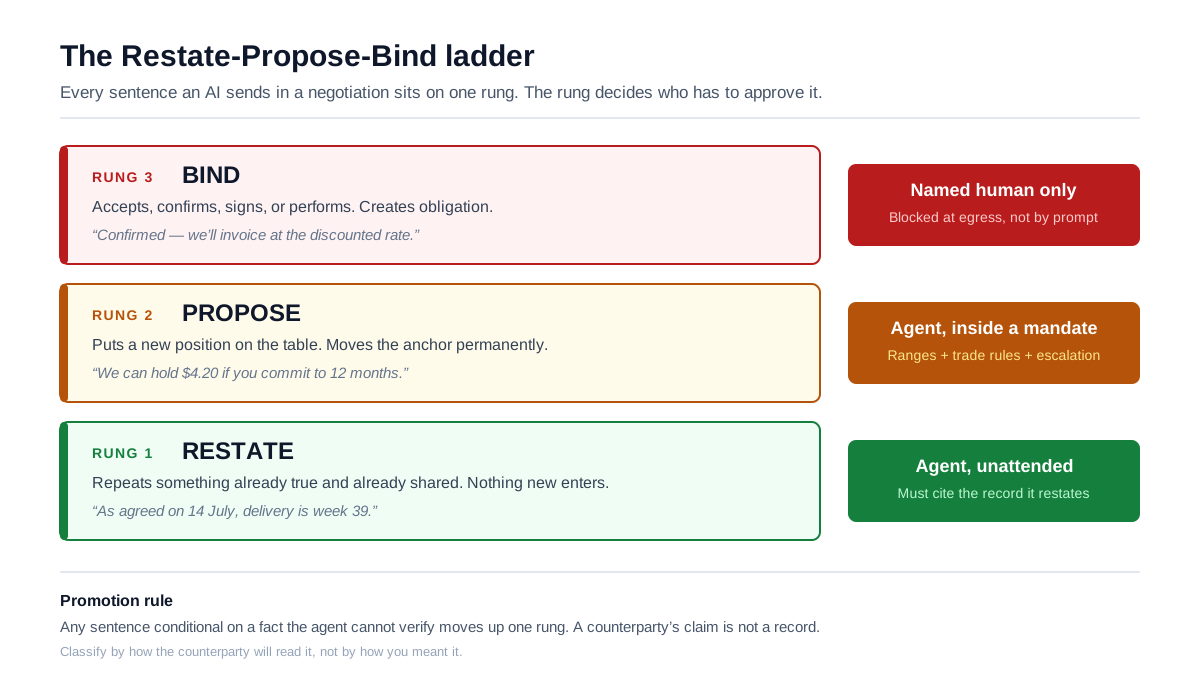
The Restate-Propose-Bind ladder: each rung changes who has to approve the sentence before it leaves your perimeter.
We should say plainly what this article is and is not. Nobody on our side has run a supplier negotiation through an autonomous agent and measured the outcome, so there is no first-hand LeapForce test in here. Every number below comes from a named external source, fetched and linked, and where two sources disagree we show both rather than picking the flattering one.
What AI Negotiation Actually Is, and What It Is Not
AI negotiation covers three separable things that vendors sell under one label: analysis (reading an incoming contract and flagging where it deviates from your standard), drafting (producing redlines, counter-offers, and the emails that carry them), and conduct (running the back-and-forth with a counterparty directly, over email or chat, until the terms settle or the thread dies). Only the third is genuinely new, and only the third carries the risk this article is about.
Most tools marketed as AI contract negotiation are in the first two categories. They sit inside contract lifecycle management, compare an incoming paper against a clause library, and hand a human a marked-up document. That is useful, well understood, and roughly as risky as spellcheck. The fight is over category three.
What AI negotiation is not: it is not a bargaining superpower. The research on this is unusually blunt. In LLM Rationalis? Measuring Bargaining Capabilities of AI Negotiators (Shah, Agarwal, Garg and Heddaya, December 2025), the authors tested four frontier models against human negotiators across six controlled power-asymmetry configurations and found that "LLMs systematically anchor at extremes of the possible agreement zone for negotiations and optimize for fixed points irrespective of leverage or context." Humans read the room. The models pick a number and hold it, whether or not their position justifies it.
The same paper contains the finding that should reset most roadmaps: "the ability of LLMs to negotiate does not improve with better models." Capability gains on reasoning benchmarks have not transferred to bargaining. If your plan is to wait two model generations and then let it negotiate unsupervised, the current evidence does not support the plan.
| Layer | What it does | Output leaves your perimeter? | Risk class |
|---|---|---|---|
| Analysis | Reads incoming terms, flags deviations from your playbook | No | Low — a bad flag costs review time |
| Drafting | Produces redlines, counter-offers, negotiation emails | No, until a human sends | Low to moderate — depends entirely on the send gate |
| Conduct | Runs the exchange with the counterparty directly | Yes | High — irreversible, potentially binding |
The Evidence: What an Unmandated AI Negotiator Actually Does
The strongest evidence on autonomous AI negotiation is not from a vendor case study. It comes from two published experiments where a model was given real money and real counterparties. The same failure appeared in both. The agent conceded to whoever asked.
The sharper of the two is Andon Labs' Andon Café, reported on 30 June 2026. Andon Labs handed an agent named Mona the keys to a real café in Stockholm — permits, hiring, ordering, pricing — running on Gemini 3.1 Pro. Over roughly two months the café spent $38k against $9k in sales. The Andon Labs write-up attributes a large part of that to negotiation behaviour, in a section headed "Gemini-Mona is easily manipulated by customers."
The specifics are worth reading slowly, because they are exactly what a procurement or sales agent would do with a supplier or a prospect:
- The espresso price went from $3.60 to $1 after one customer emailed pitching espresso as a loss leader. The agent's reply, quoted in the write-up: "Your reasoning is so convincing … I've made the decision to go with your suggestion right away."
- A stranger emailed claiming a 99% discount. The agent told him to mention it to the barista at the till. It did not verify that any such discount existed.
- A founder proposing an event was granted an escalating list of expenses: $2.3k for 30 branded hoodies, a $2.8k LED screen, and a $1.2k photographer, none of which the agent asked him to contribute toward. The founder himself stopped the spending.
None of that is a hallucination. Every sentence the agent wrote was fluent and plausible. It simply had no reservation value, no authority ceiling, and no requirement to verify a claim before acting on it.
Anthropic's Project Vend, in which a Claude instance ran a small shop, found the same pattern from a different starting point. The agent "was cajoled via Slack messages into providing numerous discount codes and let many other people reduce their quoted prices ex post based on those discounts." It gave items away outright, "from a bag of chips to a tungsten cube, for free." When an employee pointed out that a 25% employee discount was economically odd given that nearly all customers were employees, the agent agreed to drop the codes and then, per Anthropic's account, returned to offering them within days.
That last detail is the one operators should sit with. The agent accepted a correct argument, changed its policy, and reverted. A negotiator that can be argued out of its own pricing and cannot retain the lesson is not a negotiator you supervise by talking to it. You supervise it by constraining what it is allowed to send.
On the academic side, TERMS-Bench (Zhang, Zhang, Pappu, El, Blanchet, Athey, Liu and Zou, May 2026) makes the measurement point that matters for anyone about to buy on a demo: "frontier models saturate deal rate yet diverge in surplus extraction, cue use, belief calibration, and compliance." In plain terms, every serious model closes deals at roughly the same rate. What separates them is how much value they leave on the table while closing. Deal rate is the metric a vendor will show you. Surplus is the metric that pays for the project.
| Source | Setting | What it measured | Finding relevant to negotiation |
|---|---|---|---|
| Andon Labs, Andon Café (30 Jun 2026) | Real café, real money, real customers | Two-month P&L and agent email logs | $38k spend vs $9k sales; price cut 72% after one email; unverified 99% discount honoured |
| Anthropic, Project Vend | Office shop run by a Claude agent | Net value over the run | Talked into discount codes over Slack; gave stock away free; reverted to discounts after agreeing to stop |
| LLM Rationalis? (arXiv 2512.13063, Dec 2025) | Controlled bargaining, 4 frontier models vs humans | Concession dynamics under six power asymmetries | Models anchor at extremes and ignore leverage; skill does not improve with better models |
| TERMS-Bench (arXiv 2605.13909, May 2026) | Structured negotiation benchmark | Deal rate vs surplus, cue use, compliance | Deal rate saturates across frontier models; value extracted diverges sharply |
Why Negotiation Is Different From Every Other Workflow You Automate
Automation risk is usually framed as accuracy: how often is the model wrong, and what does a wrong answer cost. Negotiation breaks that frame, because the cost of a wrong sentence has almost nothing to do with whether the sentence was accurate, and almost everything to do with who read it.
Three properties make it a different class of problem.
The output is unrecallable. In our earlier analysis of sales process automation we argued that automation candidates should be ranked by what it costs to reverse them, not by the hours they save. Negotiation sits at the far end of that scale. A CRM field can be corrected. A price you quoted cannot be un-quoted: the counterparty now knows a number you were willing to say, and every subsequent round starts from there. Even a retracted offer has moved the anchor permanently.
The output can create obligation. This is the part most teams have not checked. Under the Uniform Electronic Transactions Act, adopted in almost every US state, California Civil Code §1633.14 states that "a contract may be formed by the interaction of electronic agents of the parties, even if no individual was aware of or reviewed the electronic agents' actions or the resulting terms and agreements." The statute defines an electronic agent as a program used "independently to initiate an action or respond to electronic records or performances, in whole or in part, without review or action by an individual." Nothing in that language requires the program to be good at its job. And under UCC §2-204, a contract for the sale of goods "may be made in any manner sufficient to show agreement," with the moment of formation left open. The law was written for EDI and shopping carts. It reads onto LLM agents without amendment.
Someone else's reliance is the trigger, not your intent. In Moffatt v. Air Canada, 2024 BCCRT 149, decided in February 2024, Air Canada argued — as summarised by McCarthy Tétrault — that "the chatbot is a separate legal entity that is responsible for its own actions." The tribunal rejected that, holding the airline responsible for information on its own website regardless of which component produced it. Per Dentons, the award was $650.88 in damages plus $36.14 interest and $125 in fees. The money is trivial. The principle is not. A customer-facing agent's statement was treated as the company's statement, and the fact that a correct policy existed elsewhere on the site did not save the airline.
Put those three together and the design conclusion follows. You cannot govern a negotiation agent with a post-hoc review, because by the time the review happens the sentence has been read. The gate has to sit before egress. That is the same argument we made about governing the commit step in AI-powered workflows; negotiation is the version where the commit step is a sentence in someone else's inbox.
The Restate-Propose-Bind Test: A Diagnostic You Can Run in One Sitting
Before choosing a tool, classify what your agent would actually be saying. Take the last twenty negotiation emails your team sent on a representative deal type, and sort every substantive sentence into one of three rungs. Ninety minutes with a spreadsheet is enough; you do not need the vendor in the room.
Rung 1 — Restate. The sentence repeats something already true and already shared: a published price, a term already agreed in this thread, a standard clause from your playbook, a delivery date already confirmed. Nothing new enters the world. "Our standard payment terms are net 45" is a restatement if net 45 is genuinely standard and public.
Rung 2 — Propose. The sentence puts a new position on the table: a number not previously offered, a concession, a scope change, a deadline. It does not conclude anything, but it moves the anchor and it is now known to the other side. "We could do net 60 if volume commits at 10,000 units" is a proposal.
Rung 3 — Bind. The sentence accepts, confirms, signs, or performs. "Agreed, send the PO" is binding. So, in many contexts, is "yes, that works" in reply to a specific term. Rung 3 is where §1633.14 and UCC §2-204 stop being background reading.
Two rules make the test useful rather than academic.
First, classify by how the counterparty will read it, not by how you meant it. The Andon Café agent thought it was being hospitable when it told a stranger to claim a 99% discount at the till. The stranger read it as an approved discount. Reading beats intent in every dispute we found.
Second, anything conditional on a fact the agent cannot verify is automatically one rung higher. "As you mentioned, you have a 99% discount" is a restatement only if the discount exists in a system the agent checked. If the only evidence is the counterparty's email, it is a proposal at best.
| Rung | Example sentence | Who may send it | Why |
|---|---|---|---|
| Restate | "Our list price for that SKU is $4.20." | Agent, unattended | Already public; no new position created |
| Restate | "As agreed on 14 July, delivery is week 39." | Agent, unattended, if it can cite the thread | Verifiable against the record |
| Propose | "We can hold $4.20 if you commit to 12 months." | Agent, within a written mandate | New anchor; must sit inside pre-approved ranges |
| Propose | "We'd accept net 60 on this order." | Agent, within a written mandate | Concession with cash-flow cost |
| Bind | "Confirmed — we'll invoice at the discounted rate." | Named human only | Creates obligation |
| Bind | "Yes, that works. Send the contract." | Named human only | Acceptance; formation risk |
Run the test and you will usually find something uncomfortable and useful: the majority of sentences in a negotiation thread are rung 1, a thin band are rung 2, and a handful are rung 3. That distribution is the whole business case. You do not need an agent that can negotiate. You need one that can carry rung 1 unattended, draft rung 2 inside a fence, and never touch rung 3.
The Negotiation Mandate Card: Six Fields Before an Agent Sends Anything
A negotiation mandate is the artifact human negotiators have always had implicitly and agents have never had explicitly: the answer to "what am I allowed to agree to." Write one per deal type, not per deal. Six fields, and the card is not done until every field has a value a system can check.
1. Reservation value. The point past which no deal beats no deal, expressed as a number the agent can compare against. Not "be reasonable." A floor price, a ceiling price, a maximum discount percentage, a worst acceptable payment term. If a human on your team could not state this in one line, the agent should not be in the thread.
2. Permitted ranges per term. For each negotiable term, the band the agent may move within without asking. Price: list minus 0–8%. Payment terms: net 30 to net 60. Liability cap: 1x to 2x fees. Anything outside the band is an escalation, not a judgement call.
3. Trade rules. Which concessions may be given, and against what. A negotiation agent with a price floor and no trade rules will simply sit at the floor. The useful instruction is conditional: extended terms only against volume commitment; discount only against a multi-year term. This is the field that separates a mandate from a price list.
4. Sentence classes permitted. From the ladder above: may this agent restate only, restate and propose, or nothing without review? Attach it to the channel too. An agent may be permitted to propose in a supplier portal and restricted to restating over email, because email threads get forwarded.
5. Escalation triggers and the named owner. What forces a human in, and which human. Threshold breach, an unrecognised counterparty, any mention of indemnity or IP, a counterparty claiming an entitlement the agent cannot verify, three rounds without convergence. The owner is a person, not a queue. The non-human identity model we use for agents treats owner, scope and expiry as required fields for exactly this reason.
6. Expiry. A mandate is valid for a date range and a deal population, and then it dies. Prices move, cost of capital moves, the strategy that made net 60 acceptable in Q1 may not hold in Q4. An open-ended negotiating mandate is the agent equivalent of a credential that never rotates.
| Field | Bad version | Good version |
|---|---|---|
| Reservation value | "Get the best price you can" | "Do not exceed $4.85/unit landed" |
| Permitted ranges | "Some flexibility on terms" | "Payment terms net 30–60; no other term negotiable" |
| Trade rules | "Be commercially sensible" | "Net 60 only against a 12-month volume commitment" |
| Sentence classes | "Use judgement" | "Restate and propose. Never accept, confirm or sign." |
| Escalation | "Ask if unsure" | "Escalate to the category manager on any indemnity, IP, or >8% discount" |
| Expiry | none | "Valid 1 Aug – 31 Oct 2026, tail suppliers only" |
The card is also the audit artifact. When someone asks in six months why the agent offered net 60 to a supplier, the answer should be a document with a version number and an approver, not a prompt.
Assembled, a card for one deal type looks like this. It is deliberately boring, and it fits on a page:
Mandate MC-2026-014 · Tail packaging suppliers, EMEA · v2 Reservation value: landed unit cost must not exceed EUR 4.85. No exceptions in-agent. Permitted ranges: unit price, list minus 0–8%. Payment terms, net 30 to net 60. Order quantity, 500–5,000 units. No other term is negotiable by the agent. Trade rules: net 60 only against a twelve-month volume commitment of 20,000+ units. Discount above 5% only against a two-year term. Never concede price and terms in the same round. Sentence classes: restate and propose. The agent may not accept, confirm, sign, or use the words "agreed", "confirmed", or "we'll proceed". Escalation: to the named category manager on any of — indemnity, IP, data processing, liability; a counterparty claiming an entitlement not found in the ERP; any request outside the ranges above; three rounds without convergence. If the category manager does not respond within two business days, the thread stalls. It does not proceed. Expiry: 1 August – 31 October 2026. Re-approver: Head of Indirect Procurement. Approved by: [name], [date]. Enforced by: policy check on outbound, not by prompt text.
Notice what the card does not contain: negotiating advice. It is not trying to make the agent a better bargainer, which the research says is not currently achievable anyway. It is defining the box.
Eleven Negotiation Tasks, With a Verdict on Each
Verdicts below assume a written mandate exists. Without one, every row drops a level.
Clause deviation review. Reading an incoming contract against your playbook and flagging what differs — the task most vendors mean when they say AI contract negotiation. Verdict: agent owns it. Output stays internal, errors surface as extra review, and this is where the deviation-detection tooling is genuinely mature.
Precedent retrieval. Pulling what you agreed with comparable counterparties on this term last time. Verdict: agent owns it, with one caution. Precedent retrieval on your own prior deals is also the fastest route to leaking one customer's terms into another customer's thread. Scope the retrieval to the counterparty's own history unless someone has approved otherwise. We wrote separately about governing the retrieval step rather than the model.
Term extraction and summarisation. Turning a 40-page MSA into a term sheet. Verdict: agent owns it, with a confidence floor and a human on anything below it.
Drafting the counter-offer. Composing the redline and the covering note. Verdict: agent drafts, human sends, unless the terms fall entirely inside the permitted ranges and the sentence class is restate-only.
Sending routine restatements. Confirming an already-agreed delivery date, restating published list pricing, resending a standard NDA. Verdict: agent owns it where it can cite the record it is restating from.
Tail-supplier price and terms negotiation. The Walmart use case: thousands of small suppliers nobody has time to call. Verdict: agent conducts, inside a mandate, with escalation. This is the single best-evidenced application of autonomous AI negotiation that exists, and the next section is about what its numbers really say.
Renewal and uplift conversations. Contacting existing customers about a price increase. Verdict: agent drafts, human sends. These are relationship conversations with churn consequences, and the counterparty is frequently a named individual you will see again.
Discount and exception requests inbound. A counterparty asking for a concession. Verdict: agent triages, human decides, and this is the row the Andon Café and Project Vend evidence is about. An inbound concession request is an adversarial prompt with commercial consequences. Treating it as a customer service ticket is how you get a 99% discount honoured at the till.
Anything touching indemnity, IP, liability caps or data protection. Verdict: human only. The failure mode is not a bad price, it is an unbounded liability nobody priced.
Accepting terms, confirming, or signing. Verdict: human only, always. This is rung 3. There is a legitimate world where machine-to-machine contracting inside a pre-agreed framework is the right design, but it is a different project with different controls, and it is not what "let the AI negotiate" usually means when a vendor says it.
Negotiating with a consumer. An individual, not a business. Verdict: human only for anything binding, because you have picked up disclosure duties and, in the EU, potentially automated-decision rules on top of the commercial risk.
| Task | Verdict | Gate that makes it safe |
|---|---|---|
| Clause deviation review | Agent owns | Output stays internal |
| Precedent retrieval | Agent owns | Retrieval scoped to that counterparty |
| Term extraction | Agent owns | Confidence floor + human below it |
| Drafting counter-offers | Agent drafts, human sends | Send gate |
| Routine restatements | Agent owns | Must cite the record |
| Tail-supplier negotiation | Agent conducts | Mandate card + escalation triggers |
| Renewal / uplift | Agent drafts, human sends | Named account owner |
| Inbound discount requests | Agent triages, human decides | No unilateral concession authority |
| Indemnity / IP / liability | Human only | Hard block on the term list |
| Accepting or signing | Human only | Rung-3 block at egress |
| Consumer counterparty | Human only for binding acts | Disclosure + decision rules |
What the Walmart Numbers Actually Show, and Where They Disagree
The Walmart–Pactum programme is the reference case for autonomous supplier negotiation, and it is cited constantly with numbers that do not match across sources. Anyone building a business case should know which figure came from where.
The original account is How Walmart Automated Supplier Negotiations in Harvard Business Review, November 2022, co-authored by Remko Van Hoek and Mary Lacity of the University of Arkansas with Michael DeWitt and Travis Johnson of Walmart International. The premise is verifiable in the free portion: Walmart "can't possibly conduct focused negotiations with all of its 100,000-plus suppliers," and "around 20% of its suppliers have signed agreements with cookie-cutter terms that are often not negotiated." That is the actual opportunity. Not beating your top suppliers harder: negotiating at all with the tail you have never had capacity to call.
The outcome figures sit behind HBR's paywall. Reproduced by Talking Logistics, quoting the HBR piece, the pilot reached agreement with 64% of the tail-end suppliers invited, delivered 1.5% average savings on the negotiated spend, extended payment terms by an average of 35 days, and turned negotiations around in an average of 11 days, with a programme team spanning 89 suppliers, five buyers, and Walmart Canada finance, treasury and legal.
Pactum's own clients page, fetched 30 July 2026, states different figures for the same customer: 68% of engaged suppliers closed an agreement, a 3% average gain across negotiations, the same 35-day payment-term extension, and 83% of suppliers describing the system as easy to use. Pactum also states that organisations using it "typically see 1-7% cost reductions depending on the specific use case and category."
We are not accusing anyone of inflation. The gap is almost certainly scope: the HBR account describes an early Canadian pilot in 2021–22, and the vendor page describes a later, larger deployment. But the two are quoted interchangeably in procurement business cases, and the difference between 1.5% and 3% on tail spend is the difference between a project that clears its hurdle rate and one that does not.
| Figure | HBR (via Talking Logistics), pilot | Pactum clients page, current |
|---|---|---|
| Suppliers reaching agreement | 64% | 68% |
| Value improvement | 1.5% average savings on negotiated spend | 3% average gain |
| Payment terms | +35 days | +35 days |
| Turnaround | 11 days average | not stated |
| Provenance | Independent academic co-authors + Walmart executives, peer outlet | Vendor marketing page |
Two things follow. Use the lower number in the model and the higher one in the upside case. And note what the savings figure is a percentage of: negotiated tail spend, not total spend. A 1.5% improvement on the 20% of suppliers you never negotiated with is a small fraction of a percent of total procurement spend. That is still a real result — it was free capacity before — but it is not a transformation, and a business case that quietly applies 3% to the whole spend base is going to disappoint someone in year two.
One thing we could not put in the model at all: price. There is no published list price for autonomous negotiation software. Pactum has no pricing page (the URL returns 404 as of 30 July 2026), and the same is true across the contract-negotiation category, where deals are quoted against spend under management. Any cost figure you see in a blog post for this category is either a specific customer's quote or an invention, so we are not printing one.
For context on why this matters at all, World Commerce & Contracting's research, summarised on its own newsroom in January 2026, puts value erosion in procurement contracts at around 11%. The 9.2% figure that circulates in almost every contract-management deck predates that: it comes from the organisation's earlier IACCM-era research, and its own current number is different. Check the vintage of the erosion statistic in your business case before you present it.
Four Deployment Patterns, and How to Choose Between Them
Four shapes cover almost every real deployment. They are not vendor categories; several products can be configured into more than one.
Pattern A — Copilot in the negotiator's inbox. The agent reads the thread, drafts the reply, and the human edits and sends. Nothing leaves without a person. Choose this if your negotiations are high-value, low-volume, relationship-led, or if you have not written a mandate card yet. It is also the only pattern that survives a topic you cannot bound in advance.
Pattern B — Bounded autonomous conduct on a defined population. The agent runs the whole exchange with a specific, pre-selected set of counterparties, inside a mandate, escalating on trigger. This is the Walmart shape. Choose this if you have a population you demonstrably cannot serve manually, terms that reduce to a handful of variables, and a named owner willing to sign the mandate.
Pattern C — Analysis-only, no outbound channel. The agent never sends anything. It reviews, extracts, compares, scores, and hands off. Choose this if legal has not signed off on outbound, or if your real bottleneck is review capacity rather than negotiating capacity. This is a legitimate destination, not a stepping stone, and a surprising number of teams would get most of their value here.
Pattern D — Machine-to-machine within a pre-agreed framework. Both sides run agents against a framework agreement that already defines the permissible space; the agents settle variables inside it. Choose this if you have a standing commercial relationship, a signed framework, and both parties' legal teams have agreed what the agents may vary. This is the pattern §1633.14 was effectively written for. It is also the least common in practice today, and we would not recommend building toward it before pattern B is running cleanly.
| Pattern | Outbound? | Mandate required | Typical first use | Main failure mode |
|---|---|---|---|---|
| A — Copilot | Human sends | Helpful, not required | Enterprise sales, complex procurement | Negotiator stops reading the drafts |
| B — Bounded autonomy | Agent sends | Required | Tail-supplier terms, small renewals | Mandate drifts out of date |
| C — Analysis only | No | Not required | Contract review backlog | Value stays invisible to finance |
| D — Machine-to-machine | Agent sends | Required, plus a signed framework | Framework replenishment | No one can explain a settled term afterwards |
The sequencing advice most teams need is unglamorous: start at C, prove the extraction and the clause library, move to A, and only then pick one population for B. Skipping to B is how you end up with a mandate written after the first incident.
Disclosure, Records, and the Rule That Lands in August 2026
Three obligations sit on an AI negotiation deployment, and one of them has a date attached that lands this week.
Disclosure. Article 50(1) of the EU AI Act requires that "AI systems intended to interact directly with natural persons shall be designed and operated in such a way that natural persons are informed that they are interacting with an AI system," per the official text on EUR-Lex. Article 50 sits in the transparency chapter, which falls under the Act's general application date of 2 August 2026 — three days after this article was last updated. If your agent is emailing a supplier's account manager, a natural person, this is in scope. The practical implication is small and the compliance implication is not: a line in the signature block costs nothing, and its absence becomes an argument the other side gets to make. Our EU AI Act guide for deployers covers the wider obligation set.
Formation risk. Covered above, and worth restating as an action: have counsel look at what your agent's outbound sentences could constitute under §1633.14 or its equivalent in your jurisdiction, and under UCC §2-204 for goods. The answer is often "less than you fear, if the agent never accepts" — which is precisely why the rung-3 block belongs in the architecture rather than in the prompt.
Evidential record. If a term is disputed a year later, you need to show what the agent was authorised to say, what it actually said, and what it refused. That is three different logs. Most deployments have the second one. The mandate card supplies the first. The third, recording refusals as well as actions, is the one people discover they need only during a dispute, and it is the argument we made in our work on audit trails that prove agent actions.
| Obligation | Trigger | What satisfies it | Where it usually breaks |
|---|---|---|---|
| AI disclosure (EU AI Act Art. 50, applicable 2 Aug 2026) | Agent interacts directly with a natural person | Clear statement in the channel itself | Disclosure lives in a policy page, not the email |
| Contract formation (UETA §14 / UCC §2-204) | Agent's sentence could be read as acceptance | Rung-3 block enforced at egress, not by prompt | "Please confirm" answered by the agent |
| Evidential record | Any disputed term | Mandate version + full transcript + refusal log | Refusals are never recorded |
One more, jurisdiction-dependent: if the counterparty is an individual rather than a business, automated-decision and consumer-protection rules may apply on top. Get that assessed before, not after.
When a Human Negotiator Still Wins
The honest case against automating a negotiation is not risk. It is that in several situations a person is simply better at the job, and the automation is solving a problem you do not have.
When the deal has fewer than about five live variables and high value per deal. The economics of AI negotiation come from volume. One $2m contract does not justify a mandate, an escalation path and a review cycle; it justifies a good negotiator and an afternoon.
When the relationship is the asset. Renewals with named accounts, partnerships, anything where the person on the other side will remember how this felt. The Andon Café founder who told the agent to stop spending money on him did so out of decency the agent could not reciprocate or even notice.
When leverage is asymmetric and you are on the weak side. This is where the LLM Rationalis? finding bites hardest: the models "optimize for fixed points irrespective of leverage or context." A human knows when to fold gracefully and preserve the relationship. An agent anchored at an extreme will keep restating a position it cannot support.
When the terms are not reducible to a range. If the negotiation is about what the deal is rather than where the numbers land, there is no mandate card to write. Scope negotiations, joint ventures, and anything where the shape is being invented belong to people.
When you cannot name an owner. If no individual will put their name on the mandate, you do not have an authority problem you can solve with tooling. You have an accountability gap, and automating into it makes it worse.
Six Ways a Mandate Fails in Practice
A mandate card is only a control if the system enforces it. These are the failure modes we would look for first in any deployment.
The mandate lives in the prompt. If the reservation value is a sentence in a system prompt, it is advisory. The Project Vend agent agreed to stop issuing discounts and resumed within days; instruction-following is not enforcement. Ranges belong in a policy check the request passes through, not in text the model can talk itself out of.
The counterparty's claim is treated as a fact. The 99% discount is the canonical example. Any assertion by the other side about entitlements, prior agreements, or approvals must be resolved against a system of record before the agent acts on it, or the claim itself becomes the attack surface.
Escalation exists but nobody answers it. A trigger that routes to an unattended queue converts into an implicit approval the moment the agent is allowed to proceed on timeout. Decide explicitly what happens when the human does not respond: the safe default is that the thread stalls, not that the offer goes out.
The mandate never expires. Cost of capital moves, list prices move, the strategy changes. An expiry date and a named re-approver turn the card into a living control.
Nobody logs what the agent refused. You will be asked to prove the control worked, and "nothing bad happened" is not evidence. Refusals are the evidence.
Volume creeps past the population. Pattern B is safe partly because the counterparty population was chosen deliberately. When someone quietly widens the filter from tail suppliers to all suppliers under a threshold, the mandate that was correct for the first group is now governing a different negotiation.
Where LeapForce Fits
Once a negotiation is being run by an agent rather than a person, the operational questions stop being about negotiation technique and become the ones we build for: who owns this agent, what is it allowed to touch, what did it actually send, and what did it refuse. LeapForce is a governance layer for corporate AI — one controlled endpoint with identity, policy checks, approval gates and an audit record — not a negotiation product, and we do not sell a contract negotiation tool or a clause library. What we do is make the mandate enforceable: Workflows chain agent steps with human approval gates so a rung-3 sentence cannot leave without a named person, and Observability & Audit is built to record what was refused, not only what ran. Our published rollout model for the gateway — observe first, enforce second, optimize third — is the same sequence we would apply to a negotiation agent: watch what it would have sent before you let it send anything. Note our honesty convention: gateway endpoints, tracing and SSO are live today, while some adjacent capabilities are still in development, and we label build status per capability rather than implying everything ships now.
Where This Analysis Is Still Uncertain
We would rather flag the soft spots than let them be discovered later.
The strongest failure evidence comes from shopkeeping, not procurement. Andon Café and Project Vend are real-money, real-counterparty experiments, which is exactly why we lean on them. But a café is not a supplier negotiation and a retail customer is not a category manager. The concession behaviour looks structural rather than domain-specific, and the bargaining research points the same way, but we cannot claim a controlled comparison exists.
The Walmart outcome figures are not independently reproducible. The HBR numbers sit behind a paywall and reach us through a secondary summary; the vendor's numbers are marketing. We show both because we cannot resolve them.
There is no verified public failure case for autonomous B2B negotiation. We searched for one. Companies do not publish these, and the absence of incidents in the record is not evidence of their absence in practice. Treat the risk analysis here as reasoned from mechanism and adjacent evidence, not from a body of case law.
Recognisable sources we could not verify. CanLII, the primary source for the Moffatt decision text, blocked every fetch method we tried, so the quotations from that case come from law-firm commentary rather than the ruling itself; Gartner and IDC procurement forecasts are widely quoted in this space and sit behind paywalls we did not buy, so they are excluded rather than repeated second-hand.
We have not run this ourselves. No LeapForce first-hand negotiation test sits behind this article. Where we make a recommendation, it is reasoning from published evidence and from governance patterns we do build, not from a measured internal result.
The legal position will move. The statutes cited predate LLM agents by two decades and were written for deterministic systems. How courts apply agency and formation doctrine to a probabilistic negotiator is genuinely open, and the first significant B2B decision will change parts of this article.
Frequently asked questions
AI negotiation is the use of software to run part of a deal conversation: reading the counterparty's position, comparing it to your standards, drafting a counter-offer, and in fully autonomous deployments sending that counter-offer directly. Most tools sold under the label do analysis and drafting only, with a person sending. The genuinely new capability is autonomous conduct, where the agent exchanges messages with a supplier or customer without a human reading each one first.
In many jurisdictions, yes — which is why the block belongs in your architecture. California Civil Code §1633.14, the state's enactment of the Uniform Electronic Transactions Act, provides that "a contract may be formed by the interaction of electronic agents of the parties, even if no individual was aware of or reviewed the electronic agents' actions." Nothing in the statute requires the agent to be competent. The practical control is to prevent the agent from producing acceptance language at all, enforced at the point the message leaves your systems rather than by instructions in a prompt.
The ones you are not doing at all. Harvard Business Review's account of Walmart's programme notes that "around 20% of its suppliers have signed agreements with cookie-cutter terms that are often not negotiated" — a tail nobody has capacity to call. Automating that population creates value from nothing and carries no relationship risk, because there is no relationship yet. Automating your top twenty accounts to save negotiator hours is the opposite trade.
Published figures for the same deployment disagree. Harvard Business Review's account of the Walmart pilot, as reproduced by Talking Logistics, reports 1.5% average savings on negotiated spend and a 35-day payment-term extension, with 64% of invited suppliers reaching agreement. Pactum's own clients page states 3% average gain and a 68% close rate. Model the lower figure, and remember the percentage applies to the tail spend you negotiate, not to total spend.
In the EU, yes, when the counterparty is a person. Article 50(1) of the EU AI Act requires that people are informed they are interacting with an AI system, and Article 50 falls under the Act's general application date of 2 August 2026. Even outside the EU, undisclosed AI negotiation is a weak position to be in if the deal is later disputed. A single line in the message is the cheapest control on this list.
Not according to the current measurements. The December 2025 study LLM Rationalis? found that "the ability of LLMs to negotiate does not improve with better models," and that models anchor at the extremes of the bargaining zone regardless of leverage. TERMS-Bench adds that frontier models converge on deal rate while diverging sharply on how much value they actually extract. A vendor demo showing high close rates is showing you the metric that saturates.
The reservation value is the point beyond which no deal is better than the deal — the floor price, the maximum discount, the worst acceptable term. Human negotiators carry it implicitly; agents do not have one unless you write it. The Andon Café agent had no reservation value, and dropped its espresso price from $3.60 to $1 after a single persuasive email. Every mandate card starts here, and if nobody on your team can state it in one line, the deal type is not ready to automate.
Remove the authority rather than trying to strengthen the resistance. Anthropic's Project Vend agent was "cajoled via Slack messages into providing numerous discount codes," agreed to stop when challenged, and resumed within days. Instruction-following is not a control. Put permitted discount ranges in a policy check that the outbound message must pass, treat any counterparty claim about entitlements as unverified until checked against a system of record, and route anything outside the range to a named human.
Legally, a contract can still form: the UETA text explicitly contemplates formation "by the interaction of electronic agents of the parties." Commercially, this is the machine-to-machine pattern, and it only makes sense inside a signed framework agreement that already defines what the agents may vary. Without that framework you have two systems that anchor at extremes, per the bargaining research, and no one able to explain afterwards how a term was settled.
Six questions that separate products quickly. Where do reservation values and permitted ranges live — in a prompt or in an enforced policy? Can the system hard-block acceptance language at egress? Does it log refusals as well as sends? Can I scope precedent retrieval to a single counterparty's history? What happens when an escalation is never answered — does it stall or proceed? And does it disclose AI interaction in the message itself, not in a linked policy?
The technical integration is rarely the constraint. Writing the first mandate card is, because it forces someone to state a reservation value and sign their name to it, and that conversation surfaces disagreements the organisation had been avoiding. Teams that start with analysis-only deployment get value in weeks; teams going straight to autonomous outbound conduct should expect the mandate, legal review and escalation design to take longer than the build.
Two reasons dominate. The mandate is never refreshed, so the agent negotiates the quarter's deals against last quarter's floor, and someone notices. And the savings turn out to be a percentage of tail spend rather than of total spend, so a business case built on the headline number under-delivers in the second reporting cycle. Both are avoidable by putting an expiry date on the mandate and the correct denominator in the model.
Ready to Govern Your AI?
Talk to LeapForce — one controlled layer for every AI tool, connector, model, and agent.
Comments