
AI sales enablement is the internal answer layer: an assistant that tells a rep what the product does, what they can promise, and what the price is today. It is not a customer-facing system, which is exactly why it gets governed loosely. Then the rep repeats the answer to a buyer in their own words, and an internal answer becomes an external representation with nothing recording where it came from.
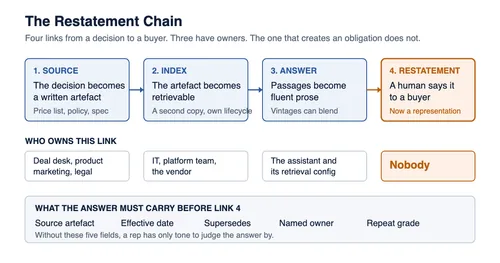
That last handover is our position. The whole industry governs the retrieval and stops there. The chain does not stop there: source, index, answer, and then a human mouth, and the only link that creates an obligation is the one nobody instruments. An answer that is wrong inside a chat window costs nothing. The same answer, restated on a call, is the company's word.
The problem is being described plainly by people using these systems. On 8 July 2025, the writer Robin Sloan, working on his own Shopify store, asked Shopify's documentation bot how to detect a Shopify Collective order inside an email notification, got working-looking Liquid back, and found the tag it checked for is not on the order yet at that moment. His verdict on the pattern: a freestyling doc bot "undermines the effort and care" of the people who write accurate documentation. He could place test orders and find out. A rep on a call cannot.
The short answer: Treat every answer your internal AI gives a rep as a draft external representation, and make it carry five things before a human repeats it — the source artefact, the date the fact became true, what it superseded, the named owner who can confirm it, and a grade saying whether the rep may repeat it, must attribute it, must verify it first, or must never say it out loud.
Last updated: July 31, 2026.
AI Sales Enablement, Defined by Who Ends Up Saying It
AI sales enablement is the set of tools that put company knowledge in front of a rep at the moment they need it: search across the content library, an assistant that answers questions in chat, call summaries, objection handling, recommended collateral. The definition that matters for a governance review is narrower. AI sales enablement is the point where your company starts producing internal answers that a human will restate to a customer without editing.
Read the usual coverage of this category and you get a stage map: prospecting, qualification, discovery, proposal, close, renewal. Useful for buying software. Poor for deciding what the assistant may say, because two answers delivered in the same chat window, in the same minute, differ enormously in what happens when they are wrong. "Here is the integration list" is a retrieval question. "Can I tell them we support SAML?" is a representation question wearing the same clothes.
What AI sales enablement is not. It is not a customer-facing agent. That is a different governance problem, and we have written separately about the four kinds of sentence an AI sales agent must never send without a named human owner. It is not a CRM hygiene system. It is not, despite how it is sold, a content problem: better collateral does not fix an answer layer that will confidently synthesise across three documents of different vintages. And it is not the same thing as governing retrieval, which we treat at length in our earlier analysis of knowledge management governance. Retrieval governance decides what the system may read. This article starts one step later, at what the human may repeat.
Three terms are used consistently below.
| Term | Meaning here |
|---|---|
| Internal answer | Anything the assistant tells an employee, in chat, in a sidebar, or inside a drafted email |
| External representation | A statement a buyer receives and could reasonably rely on, regardless of who typed it |
| Repeat grade | The label attached to an internal answer saying what a human may do with it in front of a customer |
The Restatement Chain: Four Links, One Uncontrolled Handover
The restatement chain is the path a fact takes from the person who decided it to the buyer who hears it, and it has four links. A pricing change is approved and lives in a spreadsheet or a deal desk policy. That artefact is indexed. The assistant retrieves it and composes an answer. A rep reads the answer and says something close to it on a call. Each link has a different owner, a different failure mode, and, in most companies, a different tool.
The first three links are well tooled. Content operations owns the artefact. IT or the platform team owns the connector and the index. The vendor owns the model and the retrieval. Ask who owns link four and the honest answer is usually "the rep", which is another way of saying nobody, because the rep has no way to tell a fresh fact from a stale one. The answer arrives in the same font either way.
This is where AI sales enablement differs from the automation problems next to it. We have argued that pipeline automation should be ranked by how expensive a bad write is to reverse; an enablement answer writes nothing at all, which is why it reads as low risk. Its blast radius is delayed. It arrives when a rep, weeks later, tells a procurement lead something that was true in April.
| Link | What moves | Who usually owns it | Failure mode |
|---|---|---|---|
| 1. Source | The decision becomes an artefact | Deal desk, product marketing, legal | The decision is made in a meeting and never written down |
| 2. Index | The artefact becomes retrievable | IT, platform, the enablement vendor | The old version stays retrievable next to the new one |
| 3. Answer | Retrieved passages become prose | The assistant | Two vintages are blended into one fluent paragraph |
| 4. Restatement | Prose becomes a human's spoken claim | Nobody | The rep repeats it with no date, no source, and full confidence |
Link two carries a specific trap worth naming. Indexing creates a second copy of the artefact, and the second copy has its own lifecycle — we have written about the second-copy problem in workplace search. For enablement the consequence is blunt: deleting the old price list from the drive does not delete it from the index, and the assistant will keep quoting it until something explicitly retires it there too.
The Research on What a Confident Answer Does to the Person Holding It
The strongest evidence that link four is the dangerous one does not come from sales. It comes from a July 2026 study by Chiara Marcoccia, Walter Quattrociocchi and Valerio Capraro, AI advice suppresses people's willingness to say "I don't know", across five experiments with 3,132 participants, four of them preregistered. The researchers engineered questions so the AI advice would be wrong, which separates the use of AI from the quality of it. Merely having access to the assistant, the paper reports, "nearly eliminated participants' willingness to suspend judgment", and it held whether the advice was requested or simply displayed on screen.
The consequences are the part that should worry an enablement leader. Participants answered more questions, were correct "about a third as often as when AI was unavailable", and their confidence "nearly doubled". Paying people for accuracy and penalising errors helped, but the paper is explicit that judgment was still suspended far less often than when no assistant was present.
Map that onto a rep. Before the assistant existed, the rep who did not know whether the current contract allows a 30-day termination for convenience said "let me check with legal". That sentence is the single most valuable safety behaviour in enterprise selling, and it is free. The research finding is that an available assistant is enough to suppress it, whether or not the assistant is right. This is why an accuracy target is the wrong goal for AI sales enablement. You are not trying to make the assistant right often enough. You are trying to keep the "let me check" reflex alive in a person who now has something fluent to read.
A developer in the Hacker News thread on Sloan's post put the gap between a colleague and an assistant in one line, saying that a human "will tell you 'I am not sure, and will have to ask engineering'" while the models are biased toward producing an answer. That is girvo, commenting in July 2025. It is an unsystematic observation from one thread, but it names the exact behaviour the controlled study measured a year later, and it names it from inside the workflow.
Where Superseded Truth Actually Lives
Our knowledge management governance analysis makes the case for enforcing staleness as a corpus-level policy. This section is about something narrower and more awkward: which of the clocks involved has a name written against it. Superseded truth does not sit in one bad document. It sits in the gap between four clocks that no single team reads, and the size of that gap is the real exposure number here. The fact changes on a Tuesday. The artefact is rewritten some days later. The connector recrawls on its own schedule. The obsolete artefact is retired from the index whenever somebody remembers. Between the first clock and the last, the assistant can answer with a straight face using something that stopped being true weeks ago.
| Clock | Event | Typically owned by |
|---|---|---|
| t0 | The fact changes and takes effect | Deal desk, product, legal |
| t1 | The source artefact is updated | Product marketing, enablement |
| t2 | The index reflects the update | IT, connector schedule, vendor |
| t3 | The superseded artefact stops being retrievable | Unassigned in most organisations |
We are not going to publish lag figures for those four clocks, because we have not measured them across a population of companies and we did not find a source that publishes them. The point stands without a number: t3 is the one with no owner, and t3 is the clock that decides whether the old price is still available to be quoted.
What makes this harder than ordinary staleness is what happens when both versions are retrievable at once. That is a studied weakness of retrieval systems, not a hypothesis. Jie Ouyang and colleagues built HoH, a benchmark for the impact of outdated information on retrieval-augmented generation, and report that outdated content in a knowledge base "substantially reduces response accuracy by distracting models from correct information" and "can mislead models into generating potentially harmful outputs, even when current information is available". Read that last clause twice. Having the new price sheet in the index is not sufficient; the old one being there too is the problem.
A second study puts a number on how hard the mixed case is. In Retrieval-Augmented Generation with Conflicting Evidence, Han Wang, Archiki Prasad, Elias Stengel-Eskin and Mohit Bansal built RAMDocs, a dataset that deliberately mixes ambiguity, misinformation and noise in the retrieved set, and report that it "poses a challenge for existing RAG baselines", with Llama3.3-70B-Instruct reaching only a 32.60 exact-match score. Their multi-agent debate method improves on strong baselines by up to 15.80 points absolute on suppressing misinformation, which is real progress and also an admission of how much room there was.
Read that as an enablement fact rather than a machine-learning one. If April's price sheet and July's price sheet are both in the index, the model is not reliably going to pick July. It is going to produce a fluent paragraph, and the rep is going to repeat it.
There is one number the sales enablement field quotes more than any other, and we are deliberately not using it. The claim that 60 to 70 per cent of B2B marketing content goes unused is generally traced to a 2013 Forrester and SiriusDecisions presentation, and it is still requoted in 2026 vendor content as though it described this year. The Forrester post the trail leads to, Summit 2013 Highlights, returned 404 when we requested it on 31 July 2026, so the figure appears nowhere in this article. A thirteen-year-old percentage about content usage tells you nothing about whether your assistant is quoting a superseded price, which is the question actually in front of you.
What Three Vendors' Own Pages Say About Expiry
We read five public pages covering three widely used knowledge and enablement products on 31 July 2026: three help-centre pages, one product page and one vendor blog post. We were looking for one thing. Does the product treat content expiry or verification as a first-class object, and does anything on the page say that status travels into an AI-generated answer? Every vendor has the first half in some form, though not identically. The second half varies, and the best case is more interesting than the worst.
| Page | Expiry primitive documented at the content layer | What the page says about the answer layer |
|---|---|---|
| Guru, help centre | Verification, "Guru's system for marking content as trusted and current", with Verified, Unverified and None states | States it directly: "You'll see these verification badges throughout Guru: in search results, in AI-generated answers, on Cards, and next to source documents", and Knowledge Agents can be configured "to use only verified sources" |
| Guru, product page | Subject-matter-expert verification workflow, presented as the reason to trust answers | The trust claim is made at the card level |
| Glean, help centre | A verified result "appears with a green badge after a result title", showing who verified it and when, with reverification reminders | Describes search results and document workflows; verification inside generated answers is not addressed on this page |
| Glean, AI Answers | Not the subject of the page | Says each response "includes specific references and citations"; verification status, freshness and effective dates are not mentioned |
| Highspot, vendor blog | Publishers "can set review windows at upload, attach ownership to every item, and let the platform retire aging pages"; automated "review routes, expiry dates, archive rules" | Does not address whether AI-generated recommendations or answers carry expiry or verification status |
Guru's page is the one that matters, and it undercuts the lazy version of this argument: verification state does reach the answer in at least one shipping product, and it is documented. So the gap is not "nobody passes anything through". The gap is narrower and worth naming precisely. A verification badge is a binary trust mark. It says a human reviewed this at some point. It does not say when the fact became true, what it replaced, who to ask, or whether the rep may repeat it to a buyer. Guru's own page makes the stakes plain in a sentence we would put on an enablement team's wall: "When AI gets inaccurate information, it confidently distributes that misinformation at scale."
The same page also carries the most useful figure we found in this audit. Guru states that "manual verification processes typically reach only 8-12% of organizational content, leaving the rest to slowly become outdated". That is a vendor's own number about a problem the vendor sells into, so weight it accordingly. It still names the right constraint. Verification does not fail because the feature is missing. It fails because the coverage is thin, and thin coverage plus a binary badge means most answers arrive with no signal at all.
Two things follow for a buyer. First, the primitives you need are shipping features, not a research programme — verification intervals, expiry dates, ownership, review windows all exist today. Second, the last mile is still yours: turning a review badge into an effective date, a supersession pointer and a repeat grade at the moment a human decides whether to say it out loud. That belongs on your AI sales enablement software checklist as a demo request rather than a questionnaire item. Ask the vendor to show you an answer to a question whose underlying fact changed last month, not a feature list.
Recognisable-source note: we could not retrieve the primary Forrester page behind the most-quoted content-usage figure, and we did not have access to non-public enterprise-tier documentation for any of these products. Both exclusions are stated rather than hidden, and this audit is five public pages read on one day. It is a snapshot, not a survey.
The Four Repeat Grades, With a Verdict on Each
Every internal answer gets exactly one of four grades, and the grade is about what a human may do with it, not about how confident the model is. Model confidence is not a governance signal; the study above is precisely a demonstration that confidence and correctness come apart. The grade is a property of the underlying fact: how fast it changes, whether it is already public, and whether restating it creates an obligation.
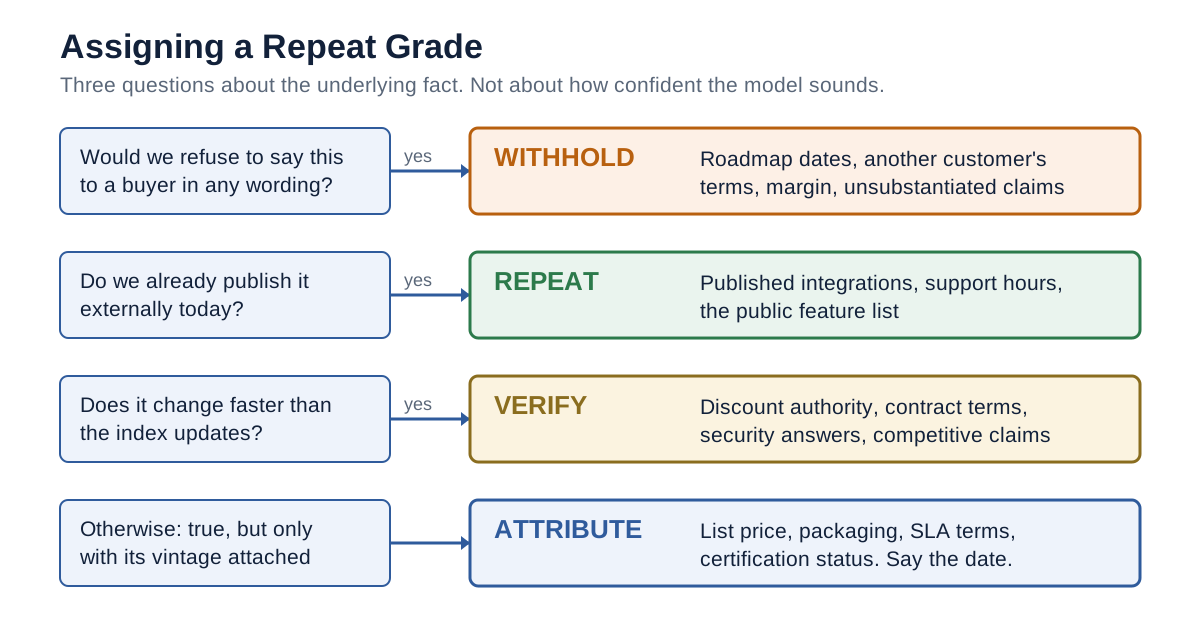
Repeat. The answer restates something the company already publishes externally and could be looked up by the buyer independently: documented integrations, published support hours, the public feature list, case studies already on the website. Verdict: let it go. The rep may say it in their own words with no ceremony. Most of what an assistant is asked lands here, which is why the whole system feels safe until it isn't.
Attribute. True internally, safe to share, but meaningless without its vintage. Anything version-scoped or time-scoped: current list price, current packaging, the SLA under the standard agreement, certification status. Verdict: shareable, but the rep must carry the date. "As of our July price list" is a full sentence and it is the difference between a quote and a promise.
Verify. The answer may well be right, but the fact changes faster than the chain updates, or the question is one where being wrong is expensive. Discount authority, security questionnaire responses, contract terms, anything about a named account. Verdict: the rep confirms with a named owner before it leaves the building. This is the grade that reinstates "let me check with legal" as a system behaviour rather than a personal virtue.
Withhold. The answer exists internally, the assistant will happily produce it, and it must not be restated to a buyer in any form: unreleased roadmap dates, another customer's terms, internal margin, win/loss commentary on a competitor, any capability claim the company cannot substantiate. Verdict: the assistant should decline or mark it, and the rep should treat a Withhold answer as information for their own understanding only. Note the overlap: Withhold answers about price, terms, timing and capability are the same four classes that must never leave an AI sales agent unapproved. That is not a coincidence. It is the same liability arriving through a human instead of an API.
| Grade | Test | What the rep does | Where the answer's date matters |
|---|---|---|---|
| Repeat | Already published externally | Says it freely | Not critical |
| Attribute | True but version-scoped | Says it with its effective date | Critical |
| Verify | Changes fast, or expensive to get wrong | Confirms with a named owner first | Critical |
| Withhold | Not for a buyer, in any wording | Uses it internally only | Irrelevant; it is never repeated |
The grades are cheap to assign because they attach to categories of fact, not to individual answers. You do not label a million answers. You label pricing, roadmap, security, contractual terms, competitive claims, and public marketing. Six to ten classes, and the assistant inherits the grade from the source it retrieved.
Ten Question Shapes, Graded
The ten rows below are written by us as illustrations, not harvested from a real query log, and they are here because working through a list of this shape is the fastest way to see that AI sales enablement use cases split cleanly along the repeat axis and not at all along the sales-stage axis. Notice that rows one and eight sit in the same stage and get opposite grades.
| # | The question a rep types | Grade | Why |
|---|---|---|---|
| 1 | "Do we integrate with Workday?" | Repeat | Published integration list; the buyer can check it themselves |
| 2 | "What's the list price for the mid tier?" | Attribute | True today, changes on a schedule; useless without its effective date |
| 3 | "Can I offer 20% for a two-year term?" | Verify | Discount authority is a policy, not a fact, and it is account-specific |
| 4 | "Are we SOC 2 Type II?" | Attribute | Certification has a scope and an expiry that the answer must carry |
| 5 | "When does the new reporting module ship?" | Withhold | Unreleased timing is the classic commitment a buyer will hold you to |
| 6 | "What did we agree with Acme on data residency?" | Withhold | Another customer's terms, regardless of how it is phrased |
| 7 | "How do we compare to their audit logging?" | Verify | Competitive claims need substantiation the assistant does not have |
| 8 | "What's our published support window?" | Repeat | Already on the website in the buyer's own language |
| 9 | "Does the platform mask PII before it hits the model?" | Verify | A capability claim; build status may differ from the marketing page |
| 10 | "What's the standard termination-for-convenience clause?" | Verify | Contractual, and the standard paper may have changed since the wiki did |
Two observations from working through a list like this. Question nine is the one that catches people, because the honest answer for many vendors is "partly", and an assistant trained on marketing pages will answer "yes". Any company that publishes per-capability build status — as we do on the LeapForce site, where capabilities carry a live, in-development or roadmap label — has to make sure the assistant retrieves the status and not just the headline.
And question six is where the enablement assistant differs most sharply from a search box. Search would have returned the Acme contract and the rep would have known they were reading a contract. An answer strips that framing. The buyer's name is gone, the document type is gone, and what remains is a fluent sentence about data residency that sounds like a general policy.
Versioning What Is True Today
The fix for the restatement chain is not a better model. It is making five facts travel with the answer, so the human at link four has something to act on other than tone. We call the display object the repeat card, and it sits in the answer, not in an audit log.
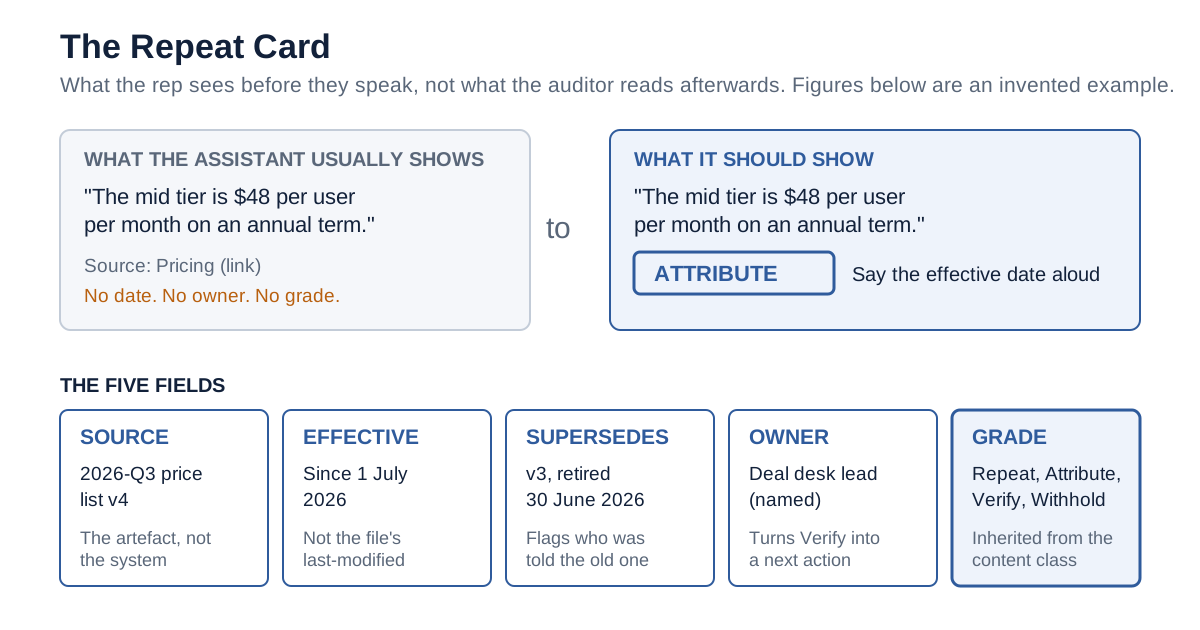
| Field | What it holds | Why the rep needs it |
|---|---|---|
| Source | The specific artefact, named and linked, not the system it lives in | "From the price list" is not a source; "2026-Q3 price list v4" is |
| Effective date | When the fact became true, not when the file was last touched | A file edited yesterday can carry a fact from March |
| Supersedes | What this replaced, if anything, and when the old one stopped applying | Tells the rep whether they have said the old thing to this buyer already |
| Owner | The named human or role who can confirm or change it | Turns "Verify" from an instruction into a next action |
| Repeat grade | One of the four grades above | The only field that tells the rep what to do in the next thirty seconds |
This is deliberately different from an audit record. Our knowledge management governance analysis argues for recording the retrieval event so you can reconstruct later what the system read. That is a compliance artefact, read after something goes wrong, by an investigator. The repeat card is a decision artefact, read before anything goes wrong, by a rep with a buyer waiting. Both are worth having. Only one of them changes what gets said on the call.
The supersedes field is the one teams skip and the one that pays. A rep who learns that the discount policy changed on 1 July does not just need the new policy. They need to know that they quoted the old one to two accounts in June, which is a retraction conversation, not a lookup. An enablement system that cannot answer "what did this replace, and when" leaves every past restatement unreviewable.
Where does the grade come from? Not from the model. It comes from the source, assigned once per class of content, the same way an expiry interval is assigned once per card. If the retrieved passage came from the price list, the answer is Attribute. If it came from the roadmap space, the answer is Withhold. If it came from the public website corpus, the answer is Repeat. Content-layer classification is boring, durable, and does not depend on the model getting anything right. That is the entire point.
The Supersession Sweep: A Diagnostic You Can Run in One Sitting
Here is a ninety-minute exercise that tells you whether your enablement stack has a supersession problem, and it needs no vendor involvement. We have not run this against a customer corpus and do not report results from one; what we did run, and report above, is the five-page vendor audit. This is the procedure we would use, written so you can run it before you believe us.
- Get the change list. Ask revenue operations, product marketing and deal desk for every change in the last ninety days that a rep might state to a buyer. Price, packaging, discount authority, SLA terms, support hours, security posture, certifications, integration availability, contract standard terms, launch dates. Aim for ten. Record the date each one took effect.
- Write the question, not the query. For each change, write the sentence a rep would actually type into the assistant — informal, incomplete, the way people type when a buyer is waiting. "can we still do the 3 year discount" beats "What is the current multi-year discount policy?"
- Ask each question in a fresh session. No follow-ups, no clarifications, no leading. One question per session, so nothing carries over.
- Record five things per answer. Was the answer current, superseded, or a refusal? Which artefact did it cite? What is that artefact's actual effective date? Did the answer show a date anywhere? Would a rep reading this know to check?
- Score the sweep on the last column, not the first. Accuracy is the number everyone reaches for and it is the least useful. The number that predicts a bad quarter is how many superseded answers arrived with no visible date, because those are the ones a rep repeats without hesitating.
- Do the retirement check. For every change, search the index directly for the superseded artefact. If it is still retrievable, you have found an unowned t3, and it will keep producing wrong answers no matter how good the model gets.
| Sweep output | What it means | What to do first |
|---|---|---|
| Superseded answers with a visible date | The chain works; the rep can catch it | Lowest priority |
| Current answers with no visible date | Right today, unverifiable tomorrow | Add the effective date to the answer |
| Superseded answers with no visible date | The failure mode this article is about | Retire the old artefact from the index; assign t3 |
| Confident refusals | The system knows its limits | Verify the refusal is for the right reason |
Run this twice: once before you change anything, once ninety days later. The delta is the honest measure of whether this governance is working, and it is the only measurement in this space we would trust from a vendor demo, because it is the only one that cannot be staged.
When the Rep Is the One on the Record
An internal answer stops being internal the moment a person repeats it, and the company's exposure at that point is ordinary sales exposure: what a representative said, what a buyer relied on, and what was substantiated. That is well-trodden law, and it did not change because an assistant drafted the sentence.
What is genuinely unsettled is narrower, and we are not going to resolve it here. Whether an internal answer, restated by a human employee, is treated any differently from a note that employee wrote themselves is a question we are not in a position to settle, and we have not found it settled anywhere we looked. Treat it as open, and put it to your own counsel rather than taking a reading from a blog. Where AI-specific obligations clearly do bite is on disclosure and on customer-facing automation, which is a different surface from the internal answer layer, and which we cover separately in the AI for sales analysis. Nothing in this article is legal advice.
The operational consequence is the same whichever way counsel calls it. If the rep is on the record, the rep needs the date and the grade before they speak, not the transcript afterwards. Governance frameworks agree on the shape even where they say nothing about sales specifically: the NIST AI Risk Management Framework organises the work into four functions: Govern, Map, Measure and Manage. Mapping context before you rely on an output is the part a repeat card implements, shrunk to the size of a chat reply.
One more thing belongs in the record and is almost never captured. When the assistant declines — a Withhold, a genuine "I don't know" — that refusal is evidence of a working control, and most stacks log only what was answered. An audit trail that records only successful answers cannot demonstrate the system ever stopped anyone. Recording refusals alongside actions is a design choice we build for in our own observability and audit layer, and it is worth asking any vendor whether their logs contain them.
What This Costs, and What It Does Not Buy
We are not going to publish a dollar figure for governing an enablement answer layer, because the honest answer depends on corpus size and how many classes of content you have, and any number we invented would be worse than none. What we can do is name every line item, so a finance partner can cost it against your own numbers.
| Cost line | What drives it | Frequency |
|---|---|---|
| Classifying content into repeat grades | Number of content classes, not number of documents | Once, then on new class creation |
| Assigning owners per class | Organisational, not technical | Once, then on reorganisation |
| Setting and honouring verification intervals | Number of artefacts and how fast each class changes | Continuous, per interval |
| Retiring superseded artefacts from the index | Connector behaviour, deletion propagation | Per change event |
| Surfacing grade and date in the answer surface | Vendor capability or in-house integration work | Once, plus maintenance |
| Running the supersession sweep | Ten questions, two people | Quarterly |
What this does not buy is worth stating plainly, because enablement software is sold on benefits that this discipline does not deliver. It does not make the model more accurate. It does not reduce the time a rep spends looking for content, and might add seconds. It does not increase content usage. It will not show up in a ramp-time metric. What it changes is a single, specific thing: the proportion of externally-repeated statements that were current and attributable when they were said. If your enablement business case cannot survive that being the headline benefit, be honest that you are buying productivity and governing it separately, rather than pretending the two are the same purchase.
Six Ways the Grades Break in the First Quarter
- Grades are assigned per answer instead of per content class. Somebody builds a classifier that grades each generated answer. It drifts, it disagrees with itself, and nobody trusts it by week six. Grade the source, inherit to the answer.
- The effective date is taken from file metadata. Last-modified is not effective-from. A price list re-saved after a typo fix looks fresh and carries a stale number. The date has to be a field somebody fills in, not one the filesystem supplies.
- Nobody owns retirement. Every other clock gets an owner in the kickoff meeting and t3 does not, because deleting things feels risky. Six months later the index holds four price lists and the model picks one.
- Verify becomes a formality. The grade shows up, the rep clicks through it, and it degrades into a cookie banner. Verify has to route to a named person with a response-time expectation, or it is decoration.
- The pilot corpus is the clean corpus. Teams pilot on the wiki that product marketing just rebuilt, get excellent results, and roll out across a decade of drive folders. Pilot on your worst corpus, not your best.
- Refusals are treated as failures. A dashboard that counts "unanswered questions" as a defect will get the refusals tuned away, and refusals are the control. Count them as a positive and review them for whether the reason was right.
When a Human Enablement Team Still Wins
There are conditions where adding an answer layer makes things worse and a person is the correct system. If your product changes weekly and nothing is written down until after it ships, the assistant will answer from whatever was written last, which is by definition the previous version; fix the writing cadence before adding retrieval. If a small team of reps sells one product with a stable price book, the marginal value of an assistant over a good wiki is small, and the marginal risk is not. If your content lives predominantly in call recordings and Slack rather than documents, an enablement assistant is going to index opinion as though it were policy.
And there is the case where an experienced enablement manager beats every system available: the question that requires knowing which of two contradictory internal positions is the one the company is currently defending. That is not retrievable. It lives in the head of whoever sat in the meeting, and the correct answer to it is a person's name.
Where LeapForce Fits
The pattern in this article is not specific to sales. Any internal AI surface that a human repeats externally — support, partner enablement, recruiting — has the same uncontrolled fourth link. LeapForce builds the layer under it: one governed endpoint for every model and tool, identity and scope for both humans and agents, and an audit surface that records what was refused rather than only what ran. Our rollout model for the gateway is "Observe first. Enforce second. Optimize third.", and it applies directly here. Observe which classes of question reps actually ask before you decide which ones to gate, because a grading scheme designed in a meeting will gate the wrong things.
We do not sell a sales content library, we do not write your collateral, and we are not the system that assigns your repeat grades. That classification is your product marketing team's work and it should be. What we provide is the control and evidence layer around whatever answer surface you choose, and per-capability build status is published honestly on our platform pages rather than implied.
Where This Analysis Is Still Uncertain
Several things in this article are positions, not findings, and it is worth being precise about which.
The four-grade scheme is our synthesis. We have not tested it against a rep population and cannot tell you whether four grades is the right number; it might be three in a simple product line and six where regulated claims are involved. The failure mode we would watch for is grade inflation, where everything drifts to Verify and the reflex dies the way it does with any over-triggered control.
The vendor audit covers three products across five public pages, read on one day. It is a snapshot and vendors ship changes weekly. If a product does surface verification state inside its answers and the documentation does not say so, our table understates it, which is precisely why the recommendation is to demand a demo rather than trust a table, including ours.
We have not measured supersession lag in a real corpus. Benchmarks do exist for the effect of outdated information on retrieval, HoH among them, and they are the reason we can say the mixed-vintage case is genuinely hard rather than merely plausible. What we did not find is a published measurement of how long the gap between t0 and t3 actually runs inside real companies. That gap is the most useful research anyone in this field could do, and until somebody does it, every claim about how stale enablement answers are in practice, including any implicit one here, is an argument rather than a measurement.
The legal position on restated internal answers is left open above on purpose. We would rather hand an unresolved question to your counsel than resolve it badly for you.
Finally, the strongest evidence we cite about the human link is from a general-knowledge experiment, not a sales floor. Marcoccia and colleagues used film trivia because it let them guarantee the AI was wrong. Whether the same suppression of "I don't know" holds when the person is a trained professional answering inside their own domain, with a customer relationship at stake, is an open question, and it could plausibly go either way.
Frequently asked questions
AI sales enablement is the internal answer layer for a sales team: software that retrieves company knowledge and composes an answer to a rep's question about the product, the price, the terms or the competition. The governance-relevant definition is narrower than the marketing one. It is the point where your company produces sentences that a human will repeat to a customer without editing them.
Four links. A fact is decided and written into an artefact; the artefact is indexed by a connector; the assistant retrieves passages and composes an answer; a rep restates the answer to a buyer. The first three links have owners and tooling in most companies. The fourth usually does not, which is why the practical work of how AI sales enablement works safely is mostly about attaching a source, an effective date, what it superseded, an owner and a repeat grade to the answer before a human acts on it.
No, and the research points the other way. It changes what the rep is accountable for. A July 2026 study by Marcoccia, Quattrociocchi and Capraro found that access to AI advice nearly eliminated participants' willingness to suspend judgment, while their confidence nearly doubled and accuracy fell. The rep is still the person on the record; the assistant has made it harder for them to notice when they should not be.
Five things that are not usually on one. Does an answer show the effective date of the fact, not the file's last-modified date? Does verification or expiry state travel from the content into the generated answer? Can the system record what it refused, not only what it answered? Can a superseded artefact be retired from the index in one action? And can you export the answer log with citations for review? Ask for a live demonstration of each rather than a questionnaire response.
Retire the old artefact from the index, not just from the drive. Deleting the source file often leaves the indexed copy in place, and when both vintages are retrievable the model does not reliably prefer the newer one — Wang and colleagues' RAMDocs work found conflicting retrieved evidence hard for strong baselines. Assign an owner to index retirement specifically, then verify it by searching the index directly for the superseded document after each change.
Operationally, the answer has to be assigned before it happens: the owner of the content class the answer came from owns its accuracy, and the rep owns whether they repeated a Verify-graded answer without checking. Legally, the position is ordinary representative liability and we could not find published enforcement that treats an AI-drafted internal answer differently from a human-written note. Put that question to your own counsel; nothing here is legal advice.
Measure the delta, not the level. Run the supersession sweep described above before you change anything and again ninety days later, and track one figure: the count of superseded answers that arrived with no visible date. Everything else in the ROI conversation, ramp time and content usage and seller productivity, belongs to the productivity business case for AI sales enablement, and mixing the two produces a number nobody believes.
Buy if your content already lives in systems the platform connects to and you need verification, expiry and ownership as shipping features rather than a project. Those primitives are documented in products like Guru, Glean and Highspot today. Build if the gap you actually have is the last mile, showing grade and date inside the answer surface your reps already use, because that integration is usually small and no purchase removes the need to classify your own content.
The classification itself is short, because grades attach to content classes rather than documents — most companies have six to ten classes and a working session can assign them. The long pole is ownership and retirement: naming a person per class, agreeing verification intervals, and building the step that pulls superseded artefacts out of the index. Plan for the sweep to be repeatable within a quarter rather than for everything to be graded in a week.
Overlapping but not the same. Retrieval governance decides what the system is allowed to read, how permissions are enforced and what is recorded about each retrieval, which we cover in our knowledge management governance analysis. This article starts after the answer exists and concerns what a human is allowed to repeat from it. You can have exemplary retrieval governance and still have reps quoting April's price, because nothing in the retrieval layer speaks to the person.
Ready to Govern Your AI?
Talk to LeapForce — one controlled layer for every AI tool, connector, model, and agent.
Comments