
Customer onboarding automation works when you split the flow into two kinds of step: the ones that tell a new customer something, and the ones that grant them something. Automate the telling end to end. Put every grant behind a verification level you have written down in advance.
Our position is that most onboarding automation projects are scoped on the wrong half. Teams spend months on welcome sequences, in-app tours and milestone nudges — the telling — and leave the granting to a mix of manual tickets and quiet scripts nobody owns. The telling is where the visible work is. The granting is where the money, the data and the liability are. On Hacker News, a commenter posting as jedwhite, describing work on a media SaaS product whose customers ranged from solo publishers to global media companies, summed the outcome up in four words: "We never solved onboarding." What broke was not the emails. It was that every account was different in what it needed to be given, and no automation ever covered that part.
The short answer: Automate every step that only sends information; require a named verification tier, a named owner and a tested reversal path before any automated step creates an account, a permission, a data-sharing link or a billing obligation.
Last updated: July 30, 2026.
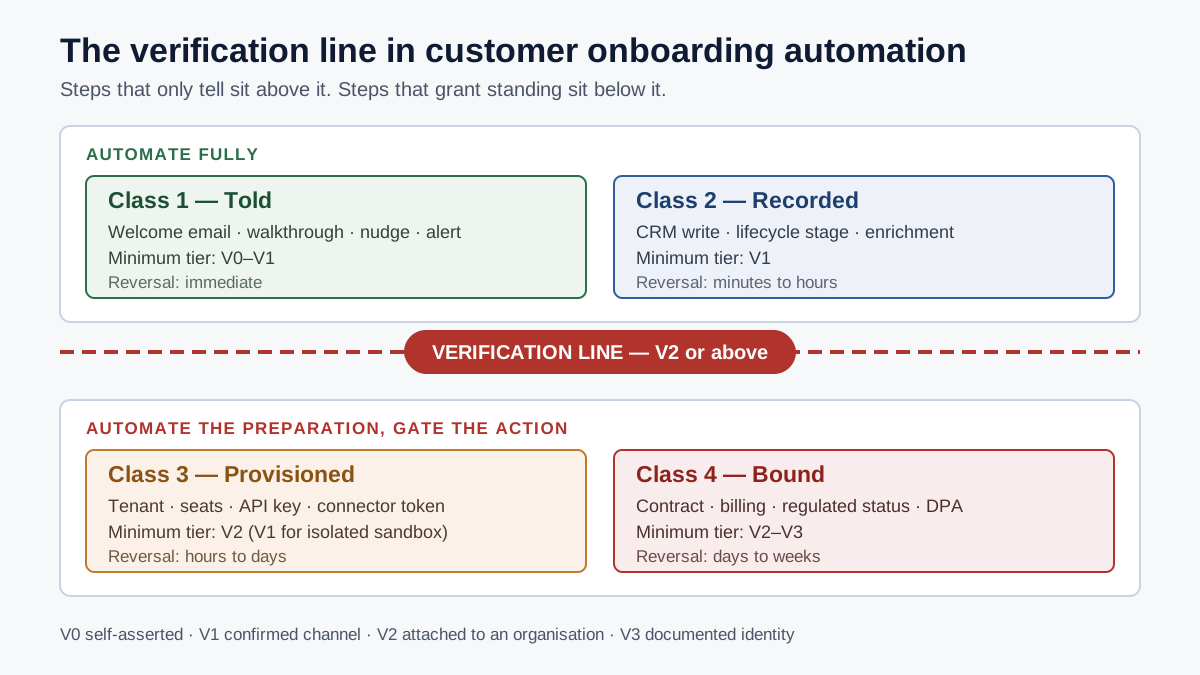
The verification line separates steps that only send information from steps that create standing.
One disclosure before we start. We have not run a controlled onboarding experiment for this article and we do not report a measured activation lift from any customer of ours. Everything numeric below is either cited to a named external source or presented as a structure for you to fill with your own numbers.
What Customer Onboarding Automation Actually Automates
Customer onboarding automation is the practice of replacing manual steps between "someone signed up" and "someone is using the product for its intended purpose" with software that fires on events. In practice, that covers two very different populations of step: messages, which cost almost nothing to get wrong, and grants, which create a standing relationship the company has to honour, secure and eventually unwind.
The usual inventory of an automated onboarding flow looks like this: a welcome email, a verification link, an in-app walkthrough, a drip sequence keyed to inactivity, a chatbot that answers setup questions, an alert to a customer success manager when a milestone is hit, and a celebration message when the customer reaches the activation event. Every item on that list is a message. It is the most-written-about part of the topic and the easiest part to build.
Underneath sits the part nobody photographs for a landing page. A tenant gets created. A workspace URL gets reserved. The signup's email domain gets mapped to an organisation record so the next twelve people from that domain join automatically. An API key gets minted. A connector to the customer's Google Workspace or Salesforce gets authorised, with a token stored somewhere. A CRM record is written that the sales forecast will later depend on. A billing subscription starts. A data processing relationship begins. Each of those is a grant, and each of them is far harder to reverse than an email.
The distinction matters because the failure modes are not comparable. A welcome email sent to the wrong person is embarrassing. A workspace provisioned for a domain the signer-up does not actually work at is an access-control incident. Sorting your onboarding steps by which of the two they are is the whole method in this article, and it is a sorting exercise you can finish in an afternoon.
Onboarding, activation, and implementation are three different things
Teams use these interchangeably and then argue about scope. Keeping them apart makes the automation boundary obvious.
| Term | What it means | Who owns it | What automation does well here |
|---|---|---|---|
| Onboarding | Everything from signup to the customer being able to use the product | Product plus customer success | Sequencing, reminders, provisioning, status visibility |
| Activation | The single event that proves the customer got value at least once | Product | Detecting it, and detecting its absence |
| Implementation | Configuration, data migration and integration work for larger accounts | Services or solutions engineering | Task tracking and handoffs, rarely the work itself |
An automated customer onboarding flow that cannot say which of these three it is trying to compress will optimise the wrong thing. In the Hacker News thread above, a practitioner going through several concurrent onboardings named the real friction as "necessary documents spread all over the place", plus customer-side project managers who did not understand the questions being asked (quercusa, Hacker News). That is an implementation problem. No welcome-email sequence touches it.
Why Onboarding Is The One Process Where The Counterparty Is A Stranger
Onboarding is unusual among automated business processes because at the moment the automation fires, the company knows almost nothing true about the person it is acting for. Every other automated workflow, whether support, billing, renewals or internal approvals, operates on a counterparty with history. Onboarding operates on a self-asserted claim typed into a form seconds ago.
The identity community has a precise vocabulary for how little that claim is worth. NIST's digital identity guidelines set out identity assurance levels, and the gap between the bottom and the middle is instructive. In NIST Special Publication 800-63A, dated August 26, 2025, IAL1 means the proofing process "supports the real-world existence of the claimed identity and provides some assurance that the applicant is associated with that identity", while IAL2 "requires collecting additional evidence and more rigorous processes for validating evidence and verifying identities, including enhanced processes to confirm that the applicant is the rightful owner of the presented evidence". Almost every self-serve SaaS signup sits below IAL1. An email round-trip proves control of a mailbox. It does not prove employment, authority, or that a human is involved at all.
That last point is not hypothetical any more. Cloudflare's 2025 Year in Review reported that as of December 2, 2025, human traffic generated 47% of HTML requests across its network, and non-AI bots generated 44%. Under half of the requests hitting a public web surface came from people. Your signup form is a public web surface.
So the honest statement of the problem is this: customer onboarding automation is a system that takes irreversible actions on behalf of an entity whose identity has been checked to a level nobody has written down. Fix the writing-down, and most of the scary parts become ordinary engineering.
The four things an unverified signup can cost you
- Access. A workspace, a shared tenant, or auto-join by email domain hands a stranger a seat inside a boundary you drew for customers.
- Data. Onboarding forms are where over-collection happens, because every team adds a field. GDPR's data minimisation principle requires personal data to be "adequate, relevant and limited to what is necessary in relation to the purposes for which they are processed" (Article 5(1)(c) GDPR).
- Money. Trials that provision compute, seats that bill, and usage-based connectors that run the moment they are authorised.
- Cleanup. Everything granted has to be revoked later, and revocation is the step teams build last, if at all.
Prerequisites: Five Things To Have Before You Automate A Single Step
Most guides to how to automate customer onboarding start with tool selection. Start here instead. Before writing any onboarding automation, five artifacts need to exist. None of them is software. All five are cheap, and every one of them is something we have seen missing from projects that later stalled, which is the pattern our earlier analysis of why AI pilots stall on the way to production describes in a different setting.
- A written activation definition. One sentence, in the present tense, naming an event in your telemetry. "The customer has connected one data source and run one report." If three people in the room write different sentences, stop and settle that first. The sequencing, the nudges and the success metrics all hang off it.
- A full inventory of automated steps, including the ones you do not own. Marketing automation, the product's own lifecycle emails, the CRM's workflow rules, the billing system's dunning, the support tool's triggers, and any personal scripts. On Hacker News, one commenter described writing provisioning scripts for around ten SaaS applications and eventually "spent more time writing script for the tool rather than for the actual product" (dmundhra). Those scripts are part of your onboarding flow whether or not anyone documented them.
- A named owner per grant class. Not a team. A person. The question "who approved that this fires automatically" must have an answer that is a name.
- A reversal path that has been tested once. For every grant, someone has actually revoked it in a staging environment and timed it.
- A queryable log. If you cannot answer "list every account created by automation last week and what verification tier each had", you cannot run the audit in the next section.
If you have these five, the rest of this article is a checklist. If you do not, building the checklist first is faster than building it later around a live flow.
The Verification Line, And Where To Draw It
The verification line is the point in your onboarding flow after which a step is allowed to create standing. Steps above the line only send information. Steps below the line create an account, a permission, a data link, or a payment obligation. Drawing it is a decision, not a discovery, and it is the single highest-leverage hour in an onboarding automation project.
To draw it, you need tiers. Ours are deliberately plain, and they are not NIST assurance levels. They are an operational shorthand that maps loosely onto the NIST ladder for teams who are not running an identity-proofing programme.
| Tier | Name | What has actually been proven | Rough NIST analogue |
|---|---|---|---|
| V0 | Self-asserted | Someone typed something into a form | Below IAL1 |
| V1 | Confirmed channel | Control of an email address or phone number | Below IAL1 |
| V2 | Attached to an organisation | Corporate SSO, verified domain, a payment instrument that cleared, or a signed order form | Not a NIST level |
| V3 | Documented identity | Identity evidence collected and validated against a source | IAL2 territory |
The rule is one line long: a step may not grant more than its tier has proven. A V0 signup can receive email. A V1 signup can receive a sandbox. A V2 signup can receive a production tenant and connector authorisation. A V3 signup can receive whatever the regulator says V3 unlocks.
Most teams already gate some things this way and simply never wrote the rule down, which means the exceptions accumulate invisibly. The audit below finds them.
The Grant Register: A One-Sitting Audit Of Your Onboarding Flow
The grant register is a table with one row per automated onboarding step and five columns. Filling it in for a mid-sized flow takes about ninety minutes with the right two people in the room: someone who knows the product's lifecycle events and someone who knows what IT actually provisions. That estimate assumes those two people exist and can answer from memory. Where provisioning is spread across three teams' codebases, treat the ninety minutes as the meeting and budget a week for the archaeology that follows it. It is deliberately smaller than a process map, because a process map is a diagram of intent and this is a diagram of authority.
The five fields per step:
| Field | The question it answers | Failure signal |
|---|---|---|
| Step | What fires, and on what event | Steps that fire on a schedule rather than an event |
| Class | Told, Recorded, Provisioned, or Bound | Anything you cannot classify is Provisioned until proven otherwise |
| Minimum tier | The lowest verification tier allowed to trigger it | A Provisioned step whose minimum tier is V0 or V1 |
| Owner | The named person accountable for it firing | Blank, or a team name |
| Reversal | How it is undone, by whom, and the tested time to do it | "Manual", "raise a ticket", or blank |
Three passes make it useful.
Pass one: fill in Step and Class only. Do not argue about tiers yet. Most flows come out at roughly two-thirds Told and one-third everything else, and the shape of that split is itself information. A flow that is 95% Told is not automated onboarding, it is a newsletter.
Pass two: assign minimum tiers, then compare against what actually happens. The output you are hunting is a specific defect: a step in a class that needs V2 firing at V1. In every flow we have looked at, at least one exists, and it is almost always domain-based auto-join or an integration authorised during a trial.
Pass three: fill Owner and Reversal. These two columns are where the register earns its keep, because they cannot be filled in from a diagram. Somebody has to go and find out. Rows that stay blank after pass three are the backlog.
What the register is not
It is not a replacement for a journey map, and it is not a security review. It is a single-axis sort. We have written elsewhere about sorting automated customer work by what the software is allowed to touch, in the read-say-do ladder for customer service automation; the grant register is the onboarding-specific cousin, and the difference is that onboarding's actions are aimed at a party who has no history yet. Where the service ladder asks "how much damage can this action do", the register asks "how much have we actually proven about the person this action is for".
The Four Grant Classes, With A Verdict On Each
Class 1 — Told: automate broadly, and stop apologising for it
Best for: welcome emails, verification links, in-app walkthroughs, setup checklists, inactivity nudges, milestone messages, digest summaries, handoff notifications to a customer success manager.
Minimum tier: V0 for anything transactional, V1 before a marketing sequence starts.
Why it is safe: the worst realistic outcome is annoyance, an unsubscribe, or a mildly embarrassing message to the wrong mailbox. All are reversible and none creates standing.
Where it still bites: message content that makes commitments. "Your data will be migrated by Friday" inside an automated sequence is not a message, it is a promise, and it belongs in Class 2 or higher. Automated SMS is also its own legal surface in the United States, and the ground moved recently: on January 24, 2025 the Eleventh Circuit vacated the FCC's one-to-one consent rule in Insurance Marketing Coalition v. FCC, two days before it was to take effect (Goodwin). The practical lesson for onboarding automation is not which rule won. It is that consent rules for automated outbound change faster than onboarding flows get revisited.
Verdict: automate end to end. Route exceptions to a human only on bounce, complaint, or explicit reply.
Class 2 — Recorded: automate, but treat writes as data quality decisions
Best for: creating the CRM account and contact, writing firmographic enrichment, setting lifecycle stage, logging the activation event, updating the health score, writing the onboarding plan into the project tool.
Minimum tier: V1.
Why it needs a second look: records propagate. A wrong company name is cosmetic; a wrong lifecycle stage silently changes who gets contacted, what the forecast says, and which automations fire next. Records written by onboarding automation become the inputs to every later automation, and errors compound quietly. Our analysis of sales process automation and reversal cost makes the same point about CRM writes on the sales side.
Where it bites: enrichment vendors that guess. If an enrichment call assigns a company to a segment and the segment determines whether the account gets a human onboarding manager, then an enrichment guess is an operational decision, not a data field.
Verdict: automate, but log the provenance of every written field and never let an inferred field alone route a customer to a different treatment path without a review.
Class 3 — Provisioned: this is the class the whole article is about
Best for: tenant creation, workspace URLs, seat allocation, role assignment, API key minting, connector and OAuth authorisation, sandbox environments, domain-based auto-join, SSO configuration, webhook registration.
Minimum tier: V2, with one exception noted below.
Why it is different: every item here creates a durable, security-relevant object that exists until somebody removes it. It has an owner, a scope and, if anyone thought about it, an expiry. That triple is exactly the model we argue for with non-human identities in owner, scope, expiry for AI agents, and it applies just as cleanly to a customer tenant as to an agent.
The obvious objection: gating production tenants at V2 adds friction to self-serve signup, and growth teams are measured on removing friction. That objection is legitimate and we are not dismissing it. The resolution is not to lower the tier; it is to decouple the experience from the grant.
The one exception: an isolated, time-boxed, data-free sandbox can be provisioned at V1, because it grants nothing that survives its expiry. The customer gets an instant workspace and never notices the line. The word doing the work is isolated. If the sandbox can reach production data or a shared search index, it is not a sandbox, and the friction argument does not apply to it.
Where it bites hardest: connector authorisation during a trial. The customer clicks "connect your Google Drive", a token lands in your system, and now you hold a credential to a third party's data on the strength of a V1 identity. This is the step most likely to be firing below its tier in your flow today. Action-level scoping and credential brokering exist precisely for this case; our connectors page describes the pattern of a registry IT vets once rather than per-request approvals.
Verdict: never automate the grant itself at V0 or V1 outside an isolated sandbox. Automate everything around it: the request, the evidence collection, the approval routing, the execution once approved, and the record of what was granted.
Class 4 — Bound: keep a human on the commit
Best for: contract execution, billing subscription start, price or discount application, regulated status assignment (a customer becomes a verified merchant, an accredited investor, a KYC-passed account), data processing agreements, data-residency selection, and anything that makes your company liable to a third party.
Minimum tier: V2 at absolute minimum, V3 where a rule names the check.
Why: these steps bind the company, not just the account. Undoing them involves finance, legal, or a regulator, and the reversal path is measured in weeks.
Verdict: automate the preparation and the paperwork, gate the commit. This is the ordinary human-in-the-loop pattern, and the thing that makes a gate a control rather than a rubber stamp is whether the reviewer can realistically say no, a point we develop in when approval is actually control.
The classes at a glance
| Class | Example steps | Minimum tier | Automate the action? | Typical reversal time |
|---|---|---|---|---|
| Told | Welcome email, walkthrough, nudge | V0 to V1 | Yes, fully | Immediate |
| Recorded | CRM write, lifecycle stage, health score | V1 | Yes, with provenance | Minutes to hours |
| Provisioned | Tenant, seats, API key, connector token | V2 (V1 for isolated sandbox) | Prepare only | Hours to days |
| Bound | Contract, billing, regulated status | V2 to V3 | Prepare only | Days to weeks |
Worked Example: Fourteen Steps Of A B2B Onboarding, Registered
Here is a complete grant register for a realistic mid-market B2B SaaS onboarding, from self-serve signup through to a paid team account with a data connector. It is a constructed example, not a customer's flow, and it is written out in full so you can copy the shape rather than infer it. Owners are role names; in a real register they are people.
| # | Step | Class | Min tier | Owner | Reversal (tested) |
|---|---|---|---|---|---|
| 1 | Signup form submitted, email verification sent | Told | V0 | Growth PM | N/A |
| 2 | Email confirmed, account record created | Recorded | V1 | Growth PM | Delete record, 5 min |
| 3 | Welcome email with three setup links | Told | V1 | Lifecycle marketing | N/A |
| 4 | Isolated sandbox workspace created, 14-day expiry, sample data only | Provisioned | V1 | Platform eng | Auto-expire, 14 days |
| 5 | In-product walkthrough triggered on first login | Told | V1 | Growth PM | N/A |
| 6 | CRM account and contact created, lifecycle stage set to Trial | Recorded | V1 | RevOps | Merge or delete, 15 min |
| 7 | Firmographic enrichment written to CRM | Recorded | V1 | RevOps | Overwrite, 15 min |
| 8 | Day-3 inactivity nudge if activation event absent | Told | V1 | Lifecycle marketing | N/A |
| 9 | Onboarding chatbot offered in-app, AI disclosure shown on first turn | Told | V1 | Support lead | N/A |
| 10 | Customer requests connector to their CRM; request captured, not authorised | Told | V1 | Platform eng | N/A |
| 11 | Domain verified via DNS record or corporate SSO handshake | Recorded | V2 | Security eng | Revoke verification, 30 min |
| 12 | Production tenant created; workspace URL reserved; admin role assigned to verified requester | Provisioned | V2 | Platform eng | Suspend 10 min, purge 30 days |
| 13 | Connector authorised with action-level scope; token brokered, not stored in plaintext | Provisioned | V2 | Security eng | Revoke token, 10 min |
| 14 | Order form countersigned, billing subscription starts, DPA executed | Bound | V2 | Finance plus legal | Credit note plus contract amendment, days |
Three things to notice about that table, because they are the things people miss when they build the same flow without one.
Step 4 and step 12 are both "create a workspace" and they are not the same step. One is disposable and one is durable. Flows that use a single provisioning routine for both end up with V1 identities holding durable tenants, which is the defect the register exists to surface.
Step 10 is deliberately a Told step. Capturing a connector request is information. Authorising it is step 13, two verification tiers later. Splitting a single "connect your CRM" button into a request and an authorisation is usually a one-sprint change and it moves the highest-risk grant in the flow above the verification line.
Step 14 is the only Bound row, and it has two owners. That is correct. Bound steps almost always need two functions to sign, and a register that shows one owner on a Bound row is usually describing a control that does not exist.
Running the register against a flow you inherited
If the flow already exists, work backwards from the objects rather than forwards from the journey. Pull a list of every tenant, API key, OAuth grant and billing subscription created in the last ninety days. For each, ask which automated step created it and at what verification tier. The rows you cannot attribute are the most valuable output of the exercise, because an unattributable grant is a grant nobody can revoke on purpose.
Regulated Onboarding: When The Law Names The Check
In regulated onboarding, the verification tier is not yours to choose. A rule names it, and automation has to be built around the named check rather than through it. Two examples show how specific this gets.
In the United States, banks must run a Customer Identification Program. The rule requires procedures that "enable the bank to form a reasonable belief that it knows the true identity of each customer", and it requires that the bank obtain, at a minimum, name, date of birth for an individual, address, and an identification number "from the customer prior to opening an account" (31 CFR 1020.220). "Prior to opening an account" is a sequencing constraint written into law. Any onboarding automation that provisions first and verifies after is not merely risky, it is non-compliant.
In the European Union, the European Banking Authority's Guidelines on the use of Remote Customer Onboarding Solutions, applicable since 2 October 2023, add process obligations that read like a specification for the register described above. Before adopting a remote onboarding solution, institutions "should carry out a pre-implementation assessment", covering the completeness and accuracy of the data collected, the reliability and independence of the sources it uses, an impact assessment on business-wide risks, mitigating measures, fraud and ICT security testing, and "an end-to-end testing of the functioning of the solution". Where the solution is unattended — the customer never interacts with an employee during verification — institutions should "perform liveness detection verifications" and use strong algorithms to match the captured image against the official document (EBA/GL/2022/15).
Read those two together and a general principle falls out that applies well outside financial services. The more automated and unattended your onboarding is, the more evidence the process is expected to produce about itself. The EBA does not ban unattended onboarding; it requires unattended onboarding to carry an extra check and a documented pre-implementation assessment. That is a reasonable default even where no regulator is watching: if a step runs without a human, it should log more, not less.
| Constraint | Where it comes from | What it forces in the flow |
|---|---|---|
| Verify before the account opens | 31 CFR 1020.220 | Provisioning cannot precede identity checks |
| Pre-implementation assessment and end-to-end testing | EBA/GL/2022/15 | The flow is assessed as a system before launch, not iterated into existence |
| Liveness detection when unattended | EBA/GL/2022/15 | Unattended paths carry heavier controls than attended ones |
| Collect only what is necessary | GDPR Article 5(1)(c) | Form fields need a purpose, not an owner who wanted them |
| Do not keep it longer than needed | GDPR Article 5(1)(e) | Onboarding data has a deletion date, including for signups who never convert |
Non-regulated products get to choose their tiers. They do not get to skip having them.
Your Onboarding Chatbot Has A Disclosure Deadline
If your onboarding flow includes an AI chatbot or assistant that talks to new customers in the EU, a transparency obligation applies from 2 August 2026. Article 50(1) of the EU AI Act requires providers to ensure that AI systems intended to interact directly with natural persons are designed so that "the natural persons concerned are informed that they are interacting with an AI system, unless this is obvious" to a reasonably well-informed, observant and circumspect person, taking the context of use into account (EU AI Act, Article 50).
The European Commission's guidance is explicit about timing: people "must be notified when they are interacting with an AI system from the start of the first interaction in a clear and distinguishable manner", and Article 50 "applies as from 2 August 2026" (European Commission FAQ).
For onboarding specifically, that has three practical consequences.
- The disclosure belongs on the first turn of the onboarding assistant, not in the terms of service. An onboarding chatbot's first message is the natural place, and it costs one sentence.
- Handoff moments need care. A flow that starts with a human onboarding manager and silently escalates to an AI assistant at 9pm is the case the "unless this is obvious" carve-out does not help with.
- The obligation lands on a system most onboarding teams do not think of as an AI system. A setup assistant answering configuration questions is squarely in scope.
We covered the wider timetable in our guide to EU AI Act compliance for deployers. The narrow point for this article is that the disclosure is a Class 1 change, a message, and Class 1 changes are the cheapest thing in the whole flow to fix. There is no good reason to be late on it.
Automating The Way Back Out
Onboarding automation that provisions ten things and de-provisions three is not a time-saver; it is a debt generator. Every grant class needs a matching revoke path, built in the same sprint, and the revoke path is the half that gets cut when the deadline slips.
This is not a novel security opinion. NIST's account management control, AC-2 in SP 800-53 Revision 5, requires organisations to "create, enable, modify, disable, and remove accounts in accordance with" defined policy and criteria, to notify account managers "when accounts are no longer required", to "monitor the use of accounts", and to "review accounts for compliance with account management requirements" on a defined frequency. Read that list against a typical customer onboarding automation and the asymmetry is obvious: the create half is automated and event-driven, the disable half is a quarterly spreadsheet.
The customer-facing version of the problem is worse than the employee-facing one, because customer grants often live in systems the customer controls. The connector token you hold, the webhook you registered in their tool, the shared channel, the sandbox with their sample data. Churn removes none of it on its own.
External risk data makes the stakes concrete. Verizon's 2026 Data Breach Investigations Report states that 31% of breaches now start with software vulnerabilities, beating stolen passwords, and that 48% of all breaches now involve ransomware; coverage of the same edition reports that third-party-involved breaches "jumped 60% year-on-year and now [account] for nearly half of all breaches" (Help Net Security). Every customer you onboard with an integration makes you a third party in someone else's risk register, and makes them one in yours.
The reversal test
For each Provisioned and Bound row in your register, answer four questions. If any answer is "we would find out", the row is not finished.
- What removes it? A named API call, job, or documented procedure.
- What triggers the removal? An event: churn, contract end, or expiry. Not a person remembering.
- How long does it take, measured? Somebody ran it and timed it.
- What proves it happened? A log entry an auditor could read.
On Hacker News, one commenter running an Okta deployment estimated that "80% of the apps we use have integration with them" and de-provision well through the identity provider (frellus). Even taken at face value on the employee side, the residual fifth is where orphaned access lives, and customer-side grants are rarely covered by an identity provider at all. Our leaver test for workflow software applies the same logic to internal tooling.
Six Numbers That Show The Register Is Working
Onboarding dashboards usually measure the telling: open rates, tour completion, time to activation. Those are worth measuring, and they are not evidence that the granting half is under control. Six numbers are, and each maps to a column of the register.
| Metric | Definition | What a bad reading means |
|---|---|---|
| Grant-before-verification rate | Share of Class 3 and 4 grants that fired below their stated minimum tier | The rule exists on paper only |
| Unowned grants | Count of live grants with no named owner | Nobody can be asked to revoke them |
| Signup-to-first-durable-grant time | Median minutes from signup to the first non-sandbox provisioning | If it is near zero, the verification line is not enforced |
| Measured reversal latency | Median time from churn event to fully revoked, per class | The gap between policy and practice |
| Wrong-recipient rate | Share of automated onboarding messages that bounced, were reported, or reached the wrong person | Data quality on self-asserted fields |
| Escalation outcome mix | Of steps routed to a human, the share approved, amended, and refused | A refusal rate near zero means the gate is a rubber stamp |
The last one deserves emphasis. A human approval step with a 100% approval rate is a delay, not a control. If your Bound steps are never refused or amended, either your automation is unusually good or the reviewer has no real ability to stop it. Only one of those is true most of the time.
Common Mistakes In Customer Onboarding Automation
Eight patterns show up repeatedly. None is exotic; all are cheap to fix once named.
Automating the welcome and hand-rolling the provisioning. The visible half gets a tool with a budget; the risky half gets a script owned by one engineer. Symptom: your onboarding automation vendor's dashboard shows a clean flow while account creation happens somewhere it cannot see.
Treating a confirmed email as identity. A verified mailbox is a V1 fact. It supports messaging. It does not support a production tenant, and it certainly does not support auto-joining eleven colleagues by domain.
One flow for self-serve and enterprise. These need different verification lines, not different email templates. Enterprise onboarding usually needs more Bound steps and fewer automated grants; self-serve needs the opposite.
Nudges that fire off stale state. A "you still haven't connected your data" email sent forty minutes after the customer connected their data is the most common own goal in the category. Nudges must read current state at send time, not at schedule time.
No owner on the tenant. When the champion who signed up leaves the customer's company, who owns the workspace? If the answer is "the email address that created it", you have a customer-side orphaned account waiting to happen.
Deprovisioning built last. Or never. See the section above.
Collecting every field somebody asked for. Each extra onboarding form field is a retention obligation and a friction point. GDPR's purpose limitation principle requires data to be "collected for specified, explicit and legitimate purposes" (Article 5(1)(b)); "the growth team might want it later" is not one.
No disclosure on the onboarding assistant. Covered above, and now on a clock in the EU.
When Manual Onboarding Still Wins, And What We Are Unsure About
Automation is not the right answer for every onboarding. It is the wrong answer in at least four situations, and being direct about them is more useful than another list of benefits.
- Fewer than roughly one new customer a week, with high variance. The register still helps, because writing down the grants is valuable at any volume. The automation does not pay for itself.
- Every account requires bespoke configuration. If the implementation genuinely differs each time, automate the tracking and the reminders, not the work. The HN practitioner quoted earlier was describing exactly this shape.
- The first ninety days are the relationship. In some enterprise segments, onboarding is where trust is built and a human presence is the product.
- Regulatory ambiguity in a new market. Where the required check is unsettled, an attended process that a human can explain to a supervisor beats an unattended one that has to be re-engineered.
Where this framework is genuinely uncertain. Four honest limits:
- The tier boundaries are judgement calls. V2 bundles corporate SSO, a verified domain and a cleared payment instrument, which are not equally strong. A payments-fraud team would split them; we have kept them together for usability, and that is a trade.
- We have not measured the register's effect. No controlled comparison exists of flows with and without it, from us or anyone else we could find. It is a structure derived from published controls and observed failure patterns, not an intervention with a published effect size.
- The published onboarding benchmark numbers are not usable. We looked for activation-rate and time-to-value benchmarks with a stated methodology and sample. What we found were vendor blogs and content-farm aggregations repeating figures with no traceable source, so we have excluded activation benchmarks from this article rather than quote numbers we cannot stand behind. If you have internal historical data, that is a better baseline than anything currently published.
- Reddit was unreachable during research. Every practitioner voice quoted here comes from Hacker News, which skews toward technical founders and platform engineers. Customer success and onboarding specialists, the people who own most of these flows, are underrepresented in the evidence above, and their view of the trade-offs may differ.
Where The Governance Layer Fits
Once onboarding steps are executed by software rather than a person, the operational questions change shape: who owns this automated actor, what is it allowed to touch, what did it actually do, and what did that cost. That layer, covering access, policy, cost and audit across every AI tool, connector, model and agent, is what LeapForce builds. Concretely, the parts of this article that map onto it are access and identity, where non-human identities carry an owner, a scope and an expiry; connectors, a registry IT vets once with action-level scoping, credential brokering and human-in-the-loop gates; workflows, which chain those into event-triggered, policy-checked, logged runs with approval gates; and observability and audit, which records what was refused as well as what ran. Our published rollout model for the gateway — Observe first. Enforce second. Optimize third. — is the same sequence we would recommend for a grant register: watch what your onboarding flow actually grants before you write rules about it. LeapForce is not an onboarding or customer-success product and does not replace one; it is the control layer underneath whatever you use, and per-capability build status is disclosed on the site rather than implied.
Frequently asked questions
Customer onboarding automation is the use of event-driven software to replace manual steps between signup and first successful use. It covers two distinct populations: steps that send information to the customer, such as welcome emails, walkthroughs and nudges, and steps that grant the customer something durable, such as a tenant, a role, an API key, a connector token or a billing subscription. The first population is cheap to automate and cheap to get wrong. The second creates standing that has to be secured and eventually revoked, so it needs a stated verification level, a named owner and a tested reversal path.
If you are working out how to automate customer onboarding from a standing start, automate the messages first, because they are reversible and they deliver most of the visible time saving. In order: transactional confirmations, the welcome sequence, the in-product walkthrough, inactivity nudges that read current state at send time, and internal notifications to the account owner. Then automate the preparation for grants, meaning evidence collection, approval routing and assembling the provisioning request, before you automate any grant execution. The last thing to automate is the grant itself, and only for grants whose verification tier is genuinely satisfied at that point in the flow.
Give every form field a named purpose and a deletion date before it ships. GDPR's data minimisation principle requires personal data to be "adequate, relevant and limited to what is necessary in relation to the purposes for which they are processed", and the storage limitation principle requires it to be kept in identifiable form no longer than necessary. Practically: collect the minimum needed to route and provision at each tier, ask for the rest only when the step that needs it fires, and include unconverted signups in your retention policy. Trial data that nobody deleted is the most common quiet breach of storage limitation in onboarding flows.
There are four cost lines and only one of them is licensing. First, the tools: lifecycle messaging, workflow orchestration and any identity verification vendor. Second, integration engineering, which is usually the largest line in year one and is driven by how many systems hold onboarding state. Third, the standing operational cost of the human gates you keep, which is reviewer minutes multiplied by volume. Fourth, the cost of the reversal machinery, which teams routinely omit from the business case and then pay for later as unplanned work. Build the estimate per grant class rather than per tool; a flow that is 90% Class 1 costs a fraction of one carrying several Class 3 grants.
The messaging half of a flow is typically a few weeks of work for a team that already has lifecycle tooling. The granting half is measured by how many systems have to agree, not by how many steps there are: each Class 3 grant crosses a system boundary and needs an owner, a scope, an expiry and a revoke path. A realistic sequence is to complete the grant register in one sitting, ship the Class 1 and Class 2 automation while the register's blank Owner and Reversal cells are being filled, and only then automate around the grants. Teams that reverse that order are the ones whose pilots stall.
In the EU, from 2 August 2026, yes for most onboarding assistants. Article 50(1) of the EU AI Act requires providers to ensure that AI systems intended to interact directly with natural persons are designed so those people are informed they are interacting with an AI system, unless it is obvious to a reasonably well-informed, observant and circumspect person given the context. The European Commission's guidance says the notification must come from the start of the first interaction, in a clear and distinguishable manner. A setup assistant answering configuration questions is in scope even though most onboarding teams do not think of it as an AI system, and burying the disclosure in terms of service will not satisfy it.
Only when the verification tier that triggered it genuinely supports it — in our scheme, V2: corporate SSO, a verified domain, a cleared payment instrument, or a signed order form. Creating a production tenant off a confirmed email address alone means a durable, security-relevant object exists on the strength of mailbox control. The workable middle path is to provision an isolated, time-boxed, data-free sandbox at V1 so the customer gets an immediate experience, and to hold the durable tenant until domain or SSO verification completes. The word carrying the risk is isolated: if the sandbox can reach production data, it is a production account with a friendlier name.
Onboarding workflow software — project-style tools that track tasks, owners and dates across a customer implementation — is one component, and it addresses coordination. Onboarding automation is the wider system: lifecycle messaging, provisioning, CRM writes, connector authorisation and billing, most of which happen outside any workflow tool. The practical test when choosing is whether the tool can see and control Class 3 steps. Many cannot, because provisioning lives in the product's own codebase or in IT's scripts. A tool that only tracks tasks is worth buying for coordination; it will not tell you what your flow grants.
Data quality breaks first and quietly. Automated onboarding writes records that later automations read, so a wrong lifecycle stage or a guessed firmographic segment changes who gets contacted and which paths fire, long before anyone notices. The second failure is timing: nudges that fire off state captured when the job was scheduled rather than when it sent. The third, and the expensive one, is provisioning below tier: a durable grant issued on an unverified identity. That one usually stays invisible until an access review, a security questionnaire, or a customer asking why someone at their domain has a seat.
Split ownership by class rather than by team. Class 1 and Class 2 belong with the team that owns activation, usually product together with lifecycle marketing and RevOps. Class 3 belongs with whoever owns identity and platform, because tenants, roles, keys and tokens are access-control objects regardless of which business process created them. Class 4 belongs with finance and legal jointly. The single named owner per row is what makes this work; a register whose Owner column contains team names rather than people cannot answer the only question that matters during an incident, which is who decided this fires automatically.
Three recurring reasons. The activation definition was never settled, so the pilot optimised a metric different teams read differently. The pilot automated messaging only, produced a modest engagement lift, and could not justify the next phase because the expensive manual work was in provisioning and implementation all along. Or the pilot automated a grant, security found out at review time, and the rollout was paused pending controls that were never designed in. The register addresses all three by forcing the activation sentence, the class split and the tier decision before code is written.
Partly, and the useful framing is which half. Enterprise onboarding has more Bound steps, more bespoke configuration, and a relationship that is itself part of the product, so automating the work is mostly a bad idea. Automating the visibility of the work is not: status, deadlines, document requests, reminders and handoffs are where enterprise implementations actually leak time, and they are Class 1 and Class 2 steps. Keep the human on the commit steps, automate the coordination around them, and expect the grant register for an enterprise flow to have more rows with two owners than a self-serve flow does.
Ready to Govern Your AI?
Talk to LeapForce — one controlled layer for every AI tool, connector, model, and agent.
Comments