
The difference between an AI sales agent and an AI support agent is not channel, tone or tooling. A support agent amends a record the customer already opened, inside a conversation the customer can answer. A sales agent manufactures the first record about someone who never asked, and that person has no way to tell you it is wrong.
That asymmetry decides everything downstream: which actions need approval before they run rather than review afterwards, how long a mistake stays invisible, and what a rollback can actually reach. Our position is that you should stop classifying these agents by department and start classifying them by who reports the error. A Hacker News commenter, ahofmann, tested a customer-enrichment API on his own email address and reported that "it found the wrong country, and in that country the wrong person" — then fed it a nonsense address and still got "success": true back with an invented first name. The subject of that record was never going to complain about it. They did not know it existed — the only reason anyone found out is that the tester happened to be looking himself up.
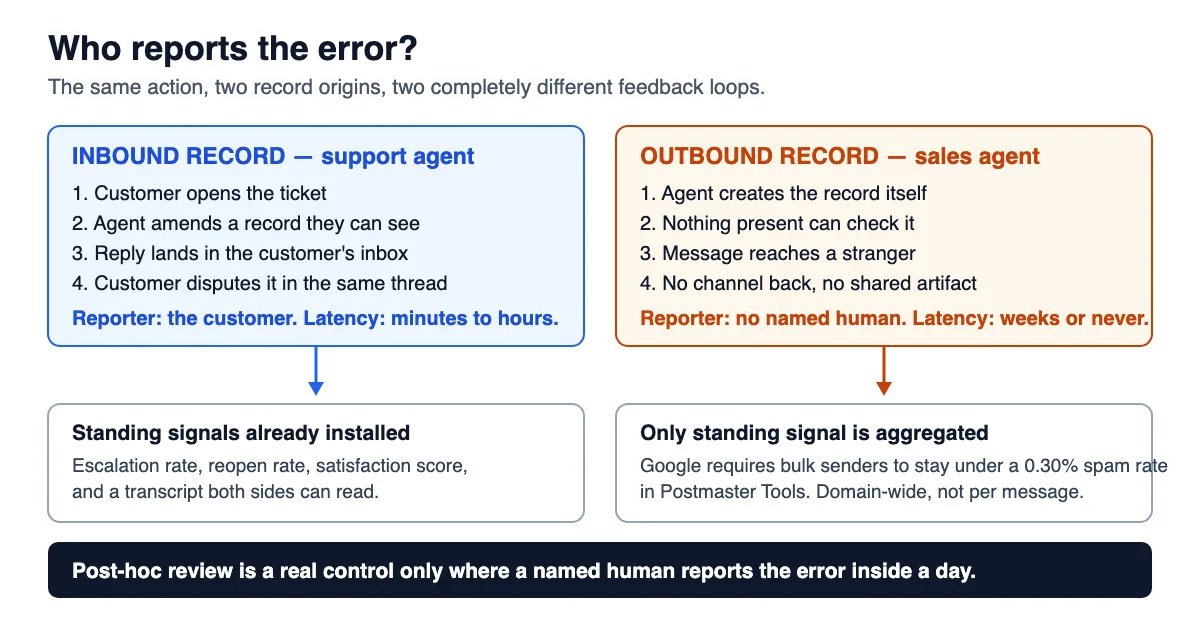
The short answer: For the actions a customer can see, support agents act where the counterparty is already in the room and will tell you within hours that you got it wrong, so post-hoc review is a real control; sales agents act where the only feedback channel is an aggregated spam-complaint rate you never see attributed to a message, so the approval has to happen before the send.
Last updated: July 31, 2026.
Who opened the record, and why it decides the controls
An AI support agent works on a record its subject created. Someone wrote in, opened a ticket, started a chat. The record exists because a person decided it should, that person is watching the thread, and every action the agent takes lands in front of them. An AI sales agent frequently works the other way: it builds the record, decides the record refers to a real human being, and then acts on that judgement by contacting them.
Everything most comparisons put in the middle of the table, from channel coverage to CRM integrations to autonomy level, sits downstream of this. Two agents can share a model, connectors and escalation logic and still need different governance, because in one case the person the agent is wrong about is available to correct it at the moment it happens, and in the other they are not.
Be precise about what an existing relationship buys you, because it is not politeness. It is three things: a live channel back to you, so the counterparty can dispute the action; a shared artifact, the ticket or thread or transcript, so both sides see the same evidence; and a clock the counterparty cares about, so they answer quickly. Outbound contact has none of the three at the moment the action fires.
We should be honest about the sloppy edge here: not all sales agent work is outbound and not all support work is inbound. A sales agent that answers an inbound demo request is operating on an inbound record and behaves, from a control standpoint, much more like a support agent. A support team running a proactive outage notification to ten thousand accounts is manufacturing outbound contact and inherits the sales-side problem. The class is set by the action, not by the department that owns the tool. That is the single most useful correction to the way this comparison is normally drawn.
This piece is a governance comparison, not a product roundup. We have not deployed a sales agent or a support agent ourselves for this article, so nothing below is written as a first-hand deployment log. What we have done is fetch the primary vendor documentation and the published research that exists, put the two agent classes through the same set of questions, and record the places where the evidence runs out. Where we make a call, we say it is our call.
At a glance: the two agent classes side by side
The table below compresses the comparison to the dimensions that change what you build. Two of the rows carry published vendor facts, checked on 31 July 2026; the rest are our classification, applied consistently to both sides.
| Dimension | AI support agent | AI sales agent |
|---|---|---|
| Who created the record it acts on | The counterparty, by contacting you | The agent or its enrichment source |
| Counterparty's consent state at the moment of action | Initiated contact, expects a reply | Did not ask, may not know the record exists |
| Who reports an error | The customer, in-thread | Usually nobody |
| Typical detection latency | Minutes to hours | Weeks, or never |
| Standing error signal | Escalation rate, reopen rate, CSAT | Aggregated spam-complaint rate at the mailbox provider |
| Shared evidence of the action | Ticket or chat transcript both sides can read | Sender-side log only |
| What a rollback reaches | The record, and often the conversation | The record only; the message has left |
| Where approval has to sit | After the act, for most actions | Before the act, for anything that leaves the building |
| Common billing unit | Resolved outcome ($0.99 per outcome at Fin) | Volume of records or messages (credits at Apollo) |
| Public benchmark coverage | Partial: τ-bench emulates rule-following support tasks | None we could find for cold outbound accuracy |
| Best for | Deflecting repeat questions, drafting replies, routing | Research, list building, drafting, internal enrichment |
| Worst for | Anything the customer cannot see you doing | Anything that contacts a stranger unreviewed |
Two rows in that table deserve a warning label. "Usually nobody" is our reading of the structural situation, not a measured rate. The point is that no channel exists for the report, not that we have counted the reports that did not happen. And "none we could find" is a statement about our search, not a proof of absence.
AI support agents, fully specified
An AI support agent resolves or advances an inbound request: it reads a ticket or chat, retrieves an answer, replies, updates fields on an existing record, and hands off to a human when it cannot proceed. What defines it for governance purposes is not the channel list. It is that the subject of every action is a person who initiated contact and is waiting for the outcome.
Best for. High-volume repeat questions with a documented answer; first-response drafting where a human sends; triage and routing; field updates on a record the customer already knows exists; after-hours coverage where the alternative is silence.
What it actually writes. Replies in a thread the customer can read. Ticket fields — status, priority, tags, assignee. Occasionally a customer-facing record change such as an address correction or a subscription downgrade, which is where it starts to look less like support and more like a money-moving action. We drew that ladder in detail in our earlier analysis of customer service automation as a read-say-do ladder, and it holds here.
Who detects an error, and how. The customer, first, because the wrong answer arrives in their inbox with your name on it. Then the human agent who picks up the escalation. Then the metrics: escalation rate, reopen rate, and satisfaction scoring on the resolved conversation. None of these are perfect. All of them exist.
How long detection takes. Bounded by the customer's own reply latency, which for an open support conversation is usually short. A wrong answer to a live chat is contested in the same session.
Approval geometry. Post-hoc review is a defensible control for most support actions, because the error surfaces on its own. That is what makes support the easier place to start. It stops being true the moment the action stops being visible to the customer — a silent field change, a quiet account merge, an internal note that will be read as fact by the next person.
Pros. Errors are self-reporting. The audit artifact is a conversation both parties hold. Vendors sell it on a defined success event. There is at least some public research on agent reliability in support-shaped tasks. Rollback often reaches both the record and the relationship, because you can simply say sorry in the same thread.
Cons. The visible-to-the-customer property is exactly what makes a bad answer embarrassing in public. Deflection metrics can improve while resolution gets worse — we have argued that at length in deflection is not resolution. And the class quietly escalates: an agent that starts by answering questions and ends by issuing refunds has changed category without changing its name.
Real published pricing. Fin, the support agent sold by Intercom, publishes $0.99 per outcome with a 50-outcome monthly minimum, and from $0.99 per outcome plus $29 per helpdesk seat per month when paired with the Intercom helpdesk, on its own pricing page (checked 31 July 2026). Zendesk describes its billing unit on its pricing page as an automated resolution, defining it so that "you pay only for customer requests that were successfully resolved by the AI agent, without any escalation to a human agent," alongside a Support Team plan at $19 per agent per month billed yearly.
Bottom line. Start here if you are starting anywhere. Not because support is low-stakes, which it is not, but because the feedback loop that tells you the agent is wrong is already installed and already staffed.
AI sales agents, fully specified
An AI sales agent researches accounts, builds and enriches contact records, drafts and often sends outreach, follows up on a schedule, books meetings, and logs its own activity to the CRM. The governance-relevant fact is that for a meaningful share of that work, the person at the other end has not asked for anything and does not know a file about them exists.
Best for. Account research and briefing; list building; drafting sequences a human sends; internal enrichment where the output stays inside your walls; call and meeting summarisation; keeping the CRM current on deals a human is already running.
What it actually writes. New contact and account records. Enriched fields on those records. Outbound messages. Activity logs and next-step fields that a forecast will later read as fact. Two of those categories cross the boundary of your own systems, and one of them creates the subject of the record rather than describing them.
Who detects an error, and how. This is the hard part, and it is the reason for this article. If the agent emails the wrong person, the wrong person is not your customer, owes you nothing, and has no reason to write back. If the agent invents a job title, the record simply carries a wrong job title until somebody happens to look. The one structural signal that does exist is aggregated and arrives at the wrong desk: mailbox providers measure the rate at which recipients mark your mail as spam. Google's own sender guidelines set 0.30% as the line senders above 5,000 messages a day must stay under, and separately recommend keeping the rate lower still: "keep spam rates reported in Postmaster Tools below 0.10% and avoid ever reaching a spam rate of 0.30% or higher". That is a real feedback channel. It is also a percentage across a domain's whole mail stream, visible to whoever runs deliverability, attributable to no individual message and to no individual mistake.
How long detection takes. Long enough that the discovery usually arrives as a second-order symptom: a reply-rate decline, a deliverability incident, a duplicate record surfacing at renewal, or a customer asking why they got prospected by a company they already buy from.
Approval geometry. For anything that leaves the building, the approval has to happen before the send, because there is no downstream reader who will catch it. This is the mirror image of the support case, and it is why "add a human review step" means two structurally different things in the two teams.
Pros. The research, drafting and internal-enrichment half of the job is genuinely well suited to an agent, and all of it can be governed with post-hoc review because it stays inside your systems. The economics are attractive precisely because volume is cheap. Sales tooling has mature per-field permissions in most CRMs.
Cons. The failure mode is silent by construction. Volume amplifies a single wrong assumption across thousands of records before anything surfaces. A message cannot be recalled once it is delivered. And the enrichment layer will confidently return something for an input that deserves nothing at all. That is exactly what the Hacker News tester found when a bogus address still returned a success flag with a name derived from the mailbox string.
Real published pricing. The billing units are volume-shaped. Apollo's pricing page describes credit-based consumption, with trial plans including "50 credits, 5 mobile credits" and a fair-use ceiling on its Unlimited plan expressed as "10,000 credits per account per month for non-paying accounts" or, for paying accounts, "the lesser of $Paid / $0.025 or 1 Million credits per account per year" (checked 31 July 2026). Salesforce publishes Agentforce consumption at $2 USD per conversation, with Flex Credits sold in blocks of 100,000, on its Agentforce pricing page — the same headline unit whether the agent faces a customer or a prospect.
Bottom line. Deploy the research and drafting half now. Treat the send as a separate grant with its own approval, its own owner and its own audit, because nothing else in the system is going to check it.
The Complaint Channel Test
Before an AI agent is allowed to take any action unattended, answer four questions about that action in writing. We call this the Complaint Channel Test. It is four questions per action, which is why it scales to a list of twenty without becoming a project. It replaces the usual "how autonomous should this agent be" conversation with something you can actually settle.
Question one: if this action is wrong, who is the first human being who will notice? Name the role, not the system. "The customer" is a valid answer. "Monitoring" is not, unless you can name the alert.
Question two: how do they find out? They see it in a channel they already read, or they receive a report they already open, or somebody runs a query nobody has scheduled. Only the first two count.
Question three: how long does that take? Give a number in hours, days or weeks. If the honest answer is "at the next audit", write "never" and move on.
Question four: what does undoing it actually reach? The record, the message, the downstream system that already consumed it, or the recipient's memory. Be specific, because these come apart quickly.
The scoring rule is short. If question one has a named human and question three is under a day, post-hoc review is a real control and the action can run unattended with monitoring. If question one is empty, or question three exceeds a week, the approval has to move in front of the action. Anything in between gets a sampling regime with a stated sample rate and a named reviewer.
Applied to a support reply, the answers come out easily: the customer, in the thread, within hours, and undo reaches both the record and the conversation. Applied to a cold outbound email, three of the four answers are uncomfortable. That is the finding. The test is not clever; it is just the question nobody asks in the deployment meeting, and both classes of agent fail or pass on it for structural reasons rather than on how good the model is.
We built this test because the usual alternatives measure the wrong thing. Autonomy levels describe how much the agent decides. Risk tiers describe how bad the outcome could be. Neither tells you whether you will find out. An action can be low-autonomy, low-severity and completely undetected, and those are the ones that accumulate.
It is worth saying where this sits next to our own earlier work, since two of our published tests are adjacent. The countersignature test asks who inside your company signs the agent's output; the delegation ceiling scores a workflow on undo, notice, reach and proof. The Complaint Channel Test asks a narrower question than either: not who signs and not how bad it is, but whether the person the action was about is in a position to say it was wrong. That is the question the sales-versus-support split turns on.
The First-Record Grant: creating a person is not editing one
Most permission models treat record creation as a mild form of record editing. It is not. Editing a record changes a description of someone your organisation already has a relationship with. Creating a contact record asserts that a person exists, that this is their name and address, and that they belong in your systems, and it does so without their participation. That assertion is the thing that later gets acted on.
We would separate four grants that a single CRM write permission can cover on its own, and require a different approver for each:
| Grant | What the agent may do | Who the subject is | Default approver |
|---|---|---|---|
| G0 Read | Retrieve and summarise existing records | Someone you already know | Agent owner |
| G1 Amend | Change fields on an existing record | Someone you already know | Agent owner, with field-level scoping |
| G2 Create | Create a new record about a person | Someone who has not contacted you | Data owner, batch-reviewed |
| G3 Contact | Send a message to the subject of a G2 record | A stranger | Named human, before the send |
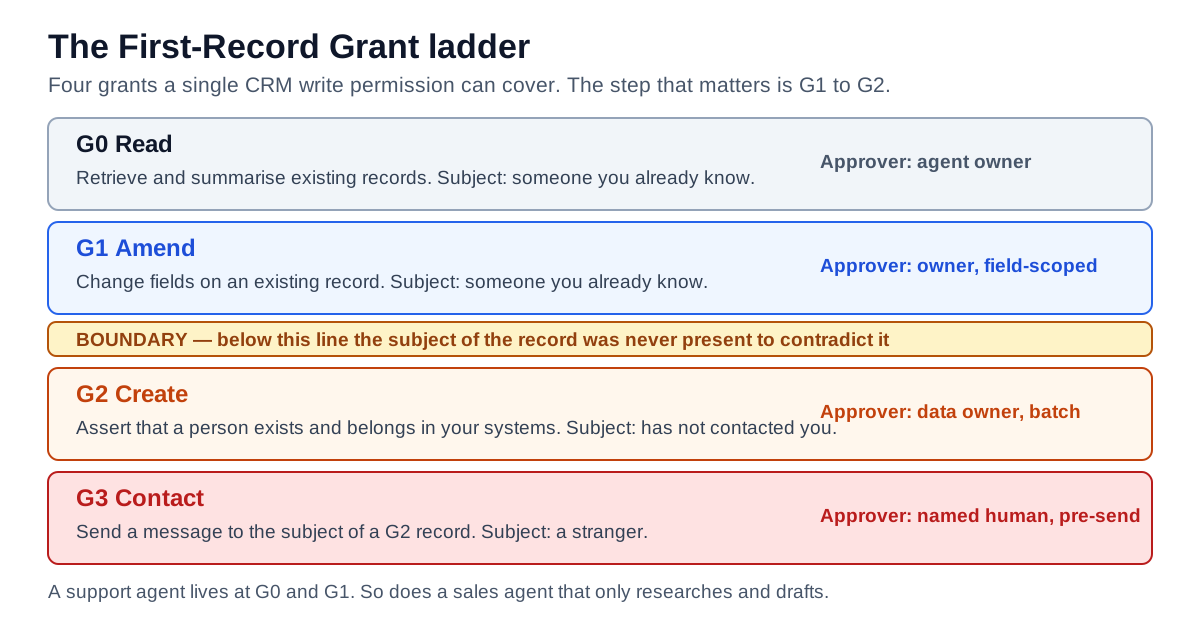
The step that matters is G1 to G2, and a permission model that only distinguishes read from write will not see it at all. A support agent lives almost entirely at G0 and G1. A sales agent that only does research and drafting also lives at G0 and G1. That is why the honest version of "sales agents are riskier" is not about sales at all. It is about G2 and G3.
Two properties make the G2 grant worth its own approval. First, a G2 record is unfalsifiable at the moment of creation: nothing in the pipeline can check it against the person it claims to describe, because that person is not present. Second, the record does not stay put. It flows into segmentation, into scoring, into forecast rollups, into whatever the next system reads. The Hacker News tester's bogus lookup returning "success": true is a small, clear demonstration of the first property; the second is what turns one bad record into a reporting problem.
The practical version of this is unglamorous. Give the creation grant a batch review with a sample rate, an owner who signs the batch, and a field that records which source asserted the record. Then treat the contact grant as a genuinely different thing, held by a named person, with the message content reviewed before it goes. Our earlier work on non-human identity — owner, scope and expiry covers the mechanics of attaching those grants to the agent rather than to a borrowed human account, which is the other half of making this stick.
Detection latency: hours on one side, never on the other
Detection latency is the elapsed time between an agent doing something wrong and a human who can act on it finding out. It is the most decision-relevant number in this comparison and it is easy to leave out of the deployment plan entirely. The support side inherits a short latency for free. The sales side has to build one.
| Action | First reporter | Route | Realistic latency |
|---|---|---|---|
| Support reply with a wrong answer | The customer | Replies in the same thread | Minutes to hours |
| Support agent misroutes a ticket | The receiving human agent | Sees a ticket that is not theirs | Hours |
| Support agent sets a wrong field silently | Nobody in-thread | Surfaces at the next human read | Days to weeks |
| Sales agent enriches a wrong job title | Nobody | Surfaces if a human reads the record | Weeks or never |
| Sales agent creates a duplicate contact | Nobody | Surfaces at dedupe or at renewal | Weeks |
| Sales agent emails an existing customer as a prospect | The customer, if they care enough | Complains to their account manager | Days, and only sometimes |
| Sales agent emails the wrong person entirely | Nobody | Aggregated spam-rate movement only | Never, individually |
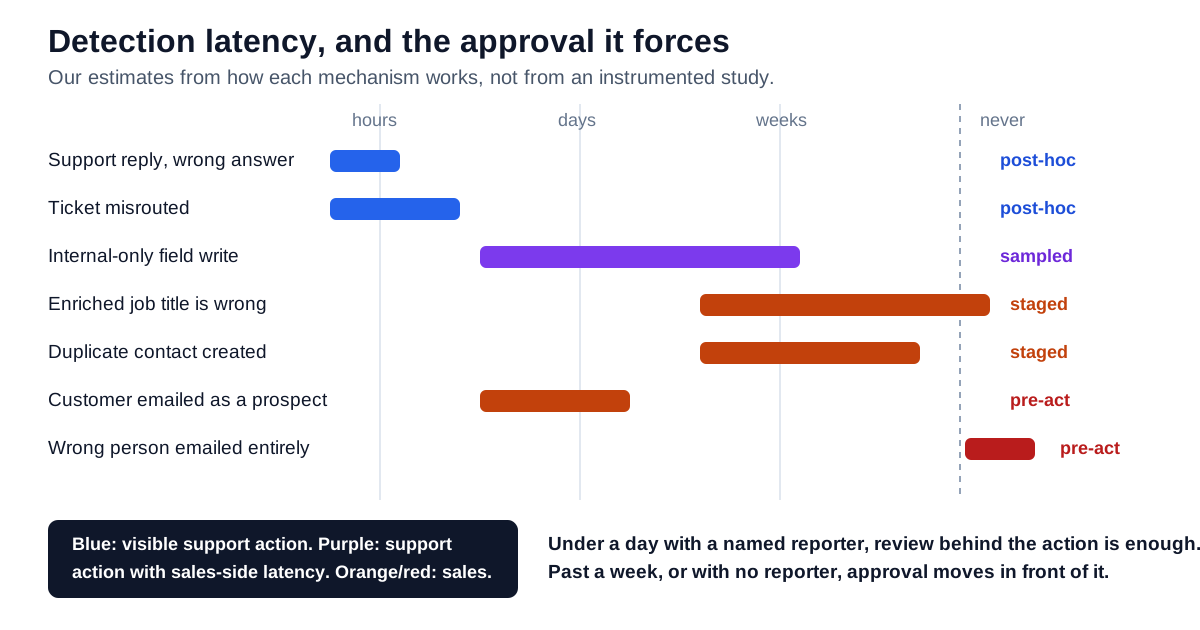
Read the third row carefully, because it breaks the tidy story. A silent field write inside a support tool has sales-side latency. The customer cannot see it, so the built-in reporter does not fire. This is why we keep saying the class attaches to the action: "support agents are safer" is only true for the visible actions, which is most of them but not all.
The aggregated signal on the outbound side deserves one more paragraph, because teams routinely mistake it for a safety net. Google's guidance to bulk senders is explicit that the spam rate is measured in Postmaster Tools, with 0.30% the level to stay under and 0.10% the level it recommends. That is a domain-level health metric. Crossing it tells you that enough recipients were unhappy enough to press a button, which is useful and which arrives far too late and far too coarse to identify a bad segment, a bad assumption, or a hallucinated job title. It is a smoke alarm for the building, not for the room.
The same guidance is worth reading for what it demands, and it demands different things at different volumes. Of every sender, regardless of volume, it requires authentication via SPF or DKIM, valid forward and reverse DNS records, and TLS for transmission. Of senders above 5,000 messages a day it requires one thing more: marketing and subscribed messages must support one-click unsubscribe with a visible unsubscribe link. Those are platform requirements, not legal advice, and they are the closest thing outbound has to a standing control. Whether any given campaign also triggers a legal obligation depends on jurisdiction, list provenance and message content, and that question belongs with your counsel rather than with an article. We have deliberately kept this comparison off statutory ground; our piece on the four binding sentences in AI-assisted selling covers the commitment side of outbound in more depth.
Approval geometry: before the act or after it
Approval geometry is the shape of the control: whether a human stands in front of the action or behind it. Most vendor documentation offers one dial labelled autonomy, which implies the two are points on a line. They are not. They are different controls that fail in different ways, and the Complaint Channel Test tells you which one the action can support.
Post-hoc review works when three conditions hold: someone will see the action, they will see it soon, and undoing it restores the world. Support replies usually satisfy all three. Internal enrichment satisfies them too, but only if you actually schedule the review. Its advantage is that it costs no throughput. The agent runs at full speed and humans sample.
Pre-act approval is the control you are forced into when the action leaves your systems or the subject cannot report it. Its cost is real: it caps volume at human reading speed, and it is the reason "AI SDR" products push so hard toward autonomous sending. Its benefit is that it is the only thing standing between a wrong assumption and a stranger's inbox.
There is a third geometry that gets forgotten and is often the right answer for sales: staged. The agent produces the artifact, whether a record, a message or a sequence, into a holding area, and a human releases the batch. This preserves most of the throughput benefit while keeping a human in front of the boundary crossing. It works badly for support, where latency is the product, and well for outbound, where a two-hour delay costs nothing.
| Geometry | Human position | Costs you | Right for |
|---|---|---|---|
| Post-hoc review | Behind the action | Sampling time | Visible actions with a fast reporter |
| Sampled review | Behind, on a fraction | Sampling time, plus tail risk | High-volume internal writes |
| Staged release | In front of a batch | Batch latency | Record creation, outbound sequences |
| Pre-act approval | In front of each action | Throughput | Contacting a stranger, money movement |
One warning about approval modes as vendors ship them: a global "require approval" toggle usually approves the agent's turn, not the specific boundary crossing you care about, so a human ends up approving a research summary and a send in the same click. If you can only approve at the turn level, the control you have is coarser than the one you designed. Ask the vendor which specific action types can be gated independently, and ask to see the record of what was approved.
Getting the record right is the part that survives a personnel change. Our earlier analysis of audit trails that prove agent actions argues that the audit has to capture what was refused as well as what ran; in this comparison, that matters most on the sales side, where a refusal is the only evidence that the gate ever did anything.
What the vendors bill for, and what that reveals
Look at how the two categories are priced and the asymmetry shows up in the invoice. Support agents are increasingly sold on a defined success event that the customer implicitly confirms. Sales agents are sold on volume of inputs. We found no vendor billing per "the prospect was glad to hear from you", and no such event is observable at the moment of the send. The absence of that billing unit is a fact about the domain, not about vendor imagination.
| Product | Published unit | Published price | What the unit implies |
|---|---|---|---|
| Fin (Intercom) | Outcome | $0.99 per outcome, 50/month minimum | A resolvable event exists and can be counted |
| Fin with Intercom helpdesk | Outcome plus seat | From $0.99 per outcome + $29 per helpdesk seat per month | Humans remain in the loop and are priced |
| Zendesk AI agents | Automated resolution | Zendesk states they are "included in every Suite and Support plan", billed per resolution | Escalation to a human is the negative signal |
| Zendesk Support Team | Seat | $19 per agent per month, paid yearly | Baseline human capacity |
| Salesforce Agentforce | Conversation | $2 USD per conversation | Volume of exchanges, regardless of outcome |
| Salesforce Agentforce | Flex Credits | Sold in blocks of 100,000 credits | Consumption, decoupled from result |
| Apollo | Credit | Trials include 50 credits; Unlimited plans capped by fair use | Inputs consumed, not outcomes produced |
All figures above are transcribed from the vendors' own pricing pages and were checked on 31 July 2026. Prices change; re-check before you quote them internally.
The Zendesk definition is the one to sit with. Billing only for requests "successfully resolved by the AI agent, without any escalation to a human agent" makes escalation the billing-relevant negative event. That is a vendor incentive to minimise escalation, which is a governance problem in its own right — a point we have made about resolution definitions in chatbot pricing and who defines a resolution. It also demonstrates the underlying claim. The support domain has an observable, countable, contested-by-the-customer success event. Somebody can build a business on it.
On the sales side, look at what the unit measures: a conversation, a credit, a lookup. Apollo's fair-use language even prices credits implicitly at $0.025 in the ceiling formula for paying Unlimited accounts. None of these units say anything about whether the record was right or the recipient was the right person. You are billed identically for a perfect message to the perfect contact and for a fabricated title sent to a stranger. If the vendor's meter cannot tell those apart, your monitoring will not get it for free either.
Two caveats. Outcome pricing is not automatically better for the buyer: it can cost more at high resolution volumes, and the outcome definition is the vendor's. And the sales-side vendors are not being lazy. They are pricing the only thing measurable at the moment of the action, which is precisely the point.
What the benchmark evidence covers, and what it leaves out
Public research on agent reliability skews toward support-shaped tasks, and even there the numbers are sobering. τ-bench, by Shunyu Yao, Noah Shinn, Pedram Razavi and Karthik Narasimhan, emulates dynamic conversations between a user and an agent working under domain-specific rules — which is customer support, structurally, and the one domain named in the results is retail. Their published abstract reports that state-of-the-art function-calling agents such as gpt-4o "succeed on <50% of the tasks, and are quite inconsistent (pass^8 <25% in retail)."
Two things follow, and they cut in different directions.
The first is a caution for the support side. A benchmark in which a leading model solves fewer than half the tasks, and repeats a success across eight trials less than a quarter of the time in retail, is not an argument for unattended resolution of anything consequential. The pass^k metric the authors introduce is measuring exactly what a governance reviewer cares about: not whether the agent can do it, but whether it does it every time. Benchmark conditions are not your conditions, model capability moves, and a well-scoped agent on your top twenty contact reasons may do considerably better. But the direction of the evidence is that consistency, not capability, is the binding constraint.
The second is an observation about the sales side. We looked for an equivalent public benchmark for cold outbound: accuracy of enrichment, correctness of an inferred title, rate of contacting the wrong human. We did not find one. We are not claiming none exists; we are recording that our search did not surface one, and that if you know of a credible one, it changes this section. The asymmetry is itself informative. Benchmarks get built where there is ground truth to score against, and the support domain supplies ground truth because a resolution either held or the customer came back.
For framework language rather than measurement, the NIST AI Risk Management Framework, released on 26 January 2023 and explicitly "intended for voluntary use", is the vocabulary most enterprise reviewers will already recognise for mapping, measuring and managing this kind of risk. It will not tell you which agent to deploy first. It will give you a shared set of words for the argument you are about to have with your security team.
Recognisable-source note. Two sources a reader might reasonably expect here did not survive verification. Salesforce's help documentation on merging duplicate records is rendered client-side and returned no readable text to a static fetch, so we have not asserted anything about what a CRM merge can or cannot undo. Hacker News item pages returned 403 to direct fetching, so the comment quoted at the top of this article was retrieved and verified through Hacker News's own Algolia search API and is linked to its canonical item permalink.
Ten agent actions, classified
Here is the framework applied. Every row runs the same four Complaint Channel questions, and the verdict column is our recommendation rather than a sourced claim. Disagree with a row by disagreeing with its detection latency. That is the argument worth having.
| # | Action | First reporter | Latency | Grant | Our verdict |
|---|---|---|---|---|---|
| 1 | Summarise an inbound ticket for a human | Human agent reading it | Minutes | G0 | Unattended |
| 2 | Answer a documented how-to question in chat | Customer | Minutes | G1 | Unattended, sampled |
| 3 | Tag and route a ticket | Receiving agent | Hours | G1 | Unattended, monitored |
| 4 | Change a customer-visible order or subscription | Customer | Hours | G1 | Pre-act approval |
| 5 | Set an internal-only field on a support record | Nobody in-thread | Weeks | G1 | Sampled review, scheduled |
| 6 | Research an account and write a briefing | Nobody | Never | G0 | Unattended |
| 7 | Draft an outbound sequence for a human to send | The sending human | Immediate | G1 | Unattended |
| 8 | Create a new contact record from enrichment | Nobody | Weeks or never | G2 | Staged release, batch-signed |
| 9 | Send a first-touch email to that new contact | Nobody | Never | G3 | Pre-act approval |
| 10 | Log an activity or next step that a forecast reads | The forecast reader, eventually | Weeks | G1 | Sampled review |
Rows 6 and 7 are the ones that cut against the department label. A sales agent doing research and drafting is, on this framework, safer than a support agent silently editing an internal field, because the drafting output is read by a human before anything happens and the field edit is read by nobody. The department label points the wrong way; the action points the right way.
Row 10 is where the two classes converge on a shared problem. An activity log that a forecast consumes is a claim about the world that a downstream system will treat as fact, and the reader who could contest it is far away in time. We have written about that particular hazard in the second-reader test for pipeline writes.
Which AI agent to deploy first
If you are choosing where to spend the first quarter of agent effort, the decision comes down to which failure your organisation can currently see. Here is the tree, with a branch for staying put.
Choose an AI support agent first if your contact volume is dominated by repeat questions with documented answers, you already measure escalation and reopen rates, and a human queue exists to absorb what the agent cannot do. You are borrowing a detection channel that is already staffed, which is the cheapest governance you will ever get.
Choose an AI sales agent first — the research and drafting half — if your reps spend more time assembling context than talking to people, and you can commit to a human sending every message for the first quarter. This is a real, defensible deployment. It is also the version most vendors will try to talk you out of, because autonomous sending is the demo.
Choose neither yet if you cannot answer question one of the Complaint Channel Test for your top five candidate actions. Not knowing who would notice is a governance gap, not an AI problem, and deploying an agent into it converts a slow problem into a fast one.
Stick with your current stack if the work you want automated is already sitting behind a workflow tool with approval steps and an audit log. Adding an agent buys flexibility you may not need and costs you determinism you currently have. Our piece on human-in-the-loop automation and when approval is really control sets out when the extra layer earns its keep.
Deploy both simultaneously only if the two are governed by different owners with different grants. The failure we would expect from a simultaneous rollout is not technical. It is that one owner ends up holding both, applies the support-side control model to sales actions because it worked, and discovers months later that post-hoc review never fired because there was no reporter.
A note on sequencing that is easy to miss: the support deployment teaches your organisation how to read agent logs, run sampling, and argue about escalation thresholds. Those muscles transfer. Starting on the side where mistakes announce themselves is how you learn to catch the ones that do not.
Can one AI agent handle sales and support?
Technically, frequently yes. Governance-wise, one agent identity should not hold both the G1 amend grant on customer records and the G3 contact grant on strangers, because the combination lets a single wrong inference travel from your customer base into cold outreach with no human in between. That is the whole answer, and it is worth expanding because it is the question buyers actually arrive with.
The shared-platform version is fine and increasingly normal. One vendor, one model, one connector registry, one audit stream. Salesforce prices customer-facing and employee-facing Agentforce agents from the same consumption menu, and there is nothing wrong with that. The problem is not shared infrastructure. It is a shared principal: one agent identity carrying the union of both permission sets.
Three concrete failures follow from the union, and none of them require the model to misbehave:
The customer becomes a prospect. An agent that can read support records and initiate outbound will, sooner or later, treat an existing customer's contact as a cold lead. The customer notices. The account manager finds out from the customer.
The prospect gets support authority. The reverse is worse and rarer: a manufactured contact record inherits treatment reserved for verified customers, because the record does not carry its own provenance. This is the argument for a source field on every G2 record.
The audit becomes unreadable. When one identity does both, "the agent did it" stops distinguishing between an amendment to an existing relationship and the creation of a new one. You lose the ability to answer the only question that matters after an incident: which grant was exercised?
The practical arrangement we would recommend is two agent identities on one platform, with separate owners, separate grants, separate approval geometry and a shared audit stream that records which identity acted. That costs almost nothing to set up and preserves the ability to revoke half of it on a bad day. It is the same logic we applied to handoff permission contracts in multi-agent systems: the identity boundary is where the accountability lives.
What goes wrong with AI agents in the first quarter
Six failures we would expect, drawn from the structure of the problem rather than from a deployment we ran. Each one is a consequence of the asymmetry this article is about.
The review that nobody scheduled. Post-hoc review is chosen for internal writes because it is cheap, and then it is never actually calendared. The control exists on the design document and nowhere else. Fix it by naming the reviewer and the day, and by treating a missed review as an incident rather than a slip.
Approval fatigue on the wrong actions. Teams gate everything at first, humans click through hundreds of low-consequence approvals, attention collapses, and the one approval that mattered gets the same reflexive click. Gate the boundary crossings; sample the rest. An approval queue that is always approved is a log, not a control.
Silent success. Enrichment and lookup layers tend to return something rather than nothing, and a "success": true on a garbage input is worse than an error because it flows onward. Insist on a confidence field and a null path, and treat a source that never returns null as a source that never says "I don't know".
Volume before verification. The economics of outbound push toward scale immediately, and scale is what turns a single wrong assumption into thousands of wrong records. Cap the first campaign at a number a human could read in an afternoon, and read it.
Class drift. The support agent that started by answering questions is now issuing credits; the sales agent that started by drafting is now sending. Nothing was approved, because nothing looked like a new decision. Re-run the Complaint Channel Test on a schedule, not just at launch.
Ownership by absence. The person who configured the agent leaves, and the agent keeps running with their credentials and nobody's attention. It is the failure behind our earlier piece on the AI employee's personnel file, and it is why the owner, scope and expiry fields belong on the agent itself rather than in somebody's memory.
There is a seventh that is less a failure than a misreading. Teams look at their support metrics improving and conclude the sales agent must be doing equally well, because it is the same technology on the same platform. The support metrics improved partly because the customer is in the room, and that particular property is the one thing that does not transfer. The operational habits do; the free detection channel does not.
Where LeapForce fits
Everything above is a question about grants: who holds them, what they cover, when they expire, and what record exists afterwards. That is the layer LeapForce builds. Access and identity treats non-human identities as first-class, so a sales agent and a support agent can be two owned principals with different scopes and their own expiry rather than two configurations sharing one person's credentials. The Connectors page describes scopes that go below the app to the action, from search and read through draft, write, send and export, each grantable separately, and sensitive actions published as approval-gated, which is what makes a G3 send a separately approvable thing rather than part of a bundle. The Observability and audit page describes a trail that records what was refused, not only what ran, which is the only way a pre-act gate can prove it was ever load-bearing. LeapForce is in active development and per-capability build status is disclosed on request, so check the status of anything you intend to depend on. Our gateway rollout sequence is deliberately staged the same way this article argues you should deploy: observe first, enforce second, optimize third — you cannot set a sensible gate on an action class until you have watched it for a while.
What LeapForce does not do is tell you whether the contact record is about a real person. No governance layer can verify a claim about someone who is not present; that remains a data-quality and sourcing problem you own.
Where this analysis is still uncertain
Several parts of this comparison rest on structure rather than measurement, and you should read them accordingly.
We have not run either deployment. This is an analysis of published vendor documentation, published research, and the mechanics of the two situations. It is not a field report, and no number in it comes from a LeapForce deployment.
"Nobody reports it" is a claim about channels, not a measured rate. We are asserting that no structural reporting channel exists for most outbound errors. We are not asserting that outbound errors are never discovered. Plenty are, through account managers, deliverability incidents and luck.
The benchmark gap may be our search, not the field. We found τ-bench for support-shaped tasks and no equivalent for outbound accuracy. A benchmark we did not find would weaken the section, not the argument, since the argument is about ground truth being available on one side.
Detection latencies in our tables are estimates. They are drawn from how the mechanisms work, not from an instrumented study. Your numbers will differ, and measuring your own is a better use of an afternoon than trusting ours.
Pricing moves. Every price here was read from the vendor's own page on 31 July 2026 and is quoted with its unit, because the unit outlives the number.
Legal questions are out of scope by choice. Whether a particular outbound programme creates obligations under consent, marketing or data-protection law depends on jurisdiction, list provenance and content. We have kept this article on operational ground deliberately; take the legal question to counsel with your actual campaign in front of you.
The framework may be too coarse for regulated selling. Financial services, healthcare and employment contexts carry additional duties on both sides of this comparison that a four-question test does not capture.
Frequently asked questions
An AI support agent acts on a record the customer created by contacting you, inside a conversation the customer is watching, so errors are reported back within hours. An AI sales agent frequently creates the first record about someone who never asked and then acts on it, so the subject has no channel to correct it. Channels, integrations and autonomy settings follow from that difference rather than defining it.
No, and the distinction is about write access rather than conversational quality. A chatbot retrieves and replies; an agent takes actions in systems of record — updating tickets, changing fields, triggering workflows. The governance question changes accordingly: for a chatbot you review what it said, for an agent you also review what it changed. Vendors now bill on outcomes precisely because the agent is expected to close the loop, not just answer.
In most cases the customer contests it in the same thread, a human picks up the escalation, and the record shows both the wrong answer and the correction. That is the strongest property of the support class. It stops holding for actions the customer cannot see. A silent internal field change has the same invisibility problem as outbound, and needs a scheduled review rather than a reliance on the customer noticing.
Deploy support first if you already measure escalation and reopen rates and have a human queue, because you are borrowing a detection channel that already exists. Deploy the research-and-drafting half of a sales agent first if context assembly is your bottleneck and you can commit to a human sending every message for a quarter. Deploy neither if you cannot name who would notice an error for your top five candidate actions.
They are usually priced on different units, which makes direct comparison misleading. Fin publishes $0.99 per outcome with a 50-outcome monthly minimum, or from $0.99 per outcome plus $29 per helpdesk seat per month alongside the Intercom helpdesk, and Zendesk bills per automated resolution, meaning requests resolved without escalation to a human. Sales-side tools bill for inputs: Apollo sells credits, and Salesforce publishes Agentforce at $2 USD per conversation with Flex Credits sold in 100,000-credit blocks. Prices checked 31 July 2026.
Technically yes, and sharing a platform is fine. Sharing an identity is not. One agent principal holding both the amend grant on customer records and the contact grant on strangers lets a single wrong inference travel from your customer base into cold outreach with no human in between, and it makes the audit trail unable to answer which grant was exercised. Run two identities with separate owners on one platform.
It should hold its own non-human identity with a named human owner, an explicit scope and an expiry date, rather than borrowing a rep's mailbox credentials. Borrowed credentials make the audit trail attribute the agent's actions to a person, break one-step offboarding when that person leaves, and remove the ability to revoke the agent's sending grant without disabling the human's own email.
You have to build the measurement, because unlike support there is no built-in reporter. Practical instruments: a sampled human read of newly created records against their source, a source-provenance field on every enriched record, duplicate-rate monitoring, and deliverability telemetry. Google requires bulk senders to keep the Postmaster Tools spam rate under 0.30% and recommends staying below 0.10%, but that signal is domain-wide and cannot attribute a problem to a message.
For most visible actions, no — post-hoc review plus sampling is a real control because the customer reports errors quickly. Gates earn their cost on two categories: actions that move money or change entitlements, and actions the customer cannot see, such as internal-only field writes. The test is not how risky the action feels; it is whether somebody will tell you it was wrong, and how soon.
Four things per action type: who notices an error, how they find out, how long that takes, and what an undo actually reaches. Then the grant level the action needs, the named owner of the agent identity, the approval geometry, and the review schedule with a named reviewer. If any of those is blank at launch, it will still be blank at the incident review.
Ready to Govern Your AI?
Talk to LeapForce — one controlled layer for every AI tool, connector, model, and agent.
Comments